Contaminants guide
The Best Water Filters for Nitrates
AquaTru Classic is the best-documented catalog choice because its certified nitrate claim uses a 27 mg/L nitrate-N challenge. Waterdrop G3P800 and APEC ROES-50 need a stricter finished-water verification plan.
The market trap is assuming every reverse-osmosis badge proves nitrate reduction. NSF/ANSI 58 requires TDS reduction, while nitrate and nitrite claims are optional. Carbon pitchers, sediment filters, UV lamps, and ordinary water softeners do not gain a nitrate claim from their stage count or micron rating.
Who should pause product shopping
Stop using water above 10 mg/L nitrate as nitrogen for infant formula or food. EPA says an exceedance calls for a safe alternate drinking-water supply, with bottled water as the fastest option. Contact the local health department, repeat the laboratory sample, and inspect the well before treating a single faucet. A filter purchase does not repair a flooded cap, failed casing, nearby septic leak, or runoff path.
Four rules decide the shortlist
Nitrate has no useful taste, color, or odor warning. Apply these checks before comparing price or convenience.
Match the reporting unit
Confirm whether the laboratory reports nitrate as nitrogen or as the full nitrate ion before comparing any number.
Demand an exact nitrate record
A system can meet NSF/ANSI 58 for required TDS reduction without the optional nitrate claim.
Use the weakest supported reduction
Plan from the published minimum, not an average or an unqualified up-to figure.
Sample the treated faucet
Pressure, temperature, hardness, membrane age, and source concentration can all change the finished result.
What matters when choosing nitrate filters
Use a lab result and the exact nitrate-reduction claim to narrow your options. Check the system’s water limits, output, drain needs and replacement cost.
Ward and colleagues reported a 2018 to 2019 Iowa private-well study in Science of the Total Environment. The team measured tap water for 47 farmers, and 15 had water at or above 10 mg/L nitrate-N. That small regional sample does not estimate national risk, but it shows why a local water result can materially change total nitrate intake. The research came from federal and academic investigators, not a filter maker.
One unit mistake can reverse the decision
| Lab wording | Federal comparison point | What 10 mg/L means |
|---|---|---|
| Nitrate as nitrogen, NO3-N | 10 mg/L | At the EPA maximum contaminant level |
| Nitrate ion, NO3 | About 44.3 mg/L | 10 mg/L nitrate ion is only about 2.26 mg/L as nitrogen |
| Nitrite as nitrogen, NO2-N | 1 mg/L | A separate, lower federal limit |
The Texas Water Development Board derives the 4.427 conversion from molecular weight. Multiply nitrate-N by 4.427 to estimate nitrate ion, or divide nitrate ion by 4.427 to estimate nitrate-N. Never compare two unlabeled values.
Three options with different evidence strength
Affiliate disclosure: We may earn from qualifying purchases through retailer links. The comparison method and its limits show why these three options do not receive equal confidence. Price ranges allow for normal Amazon offer changes.
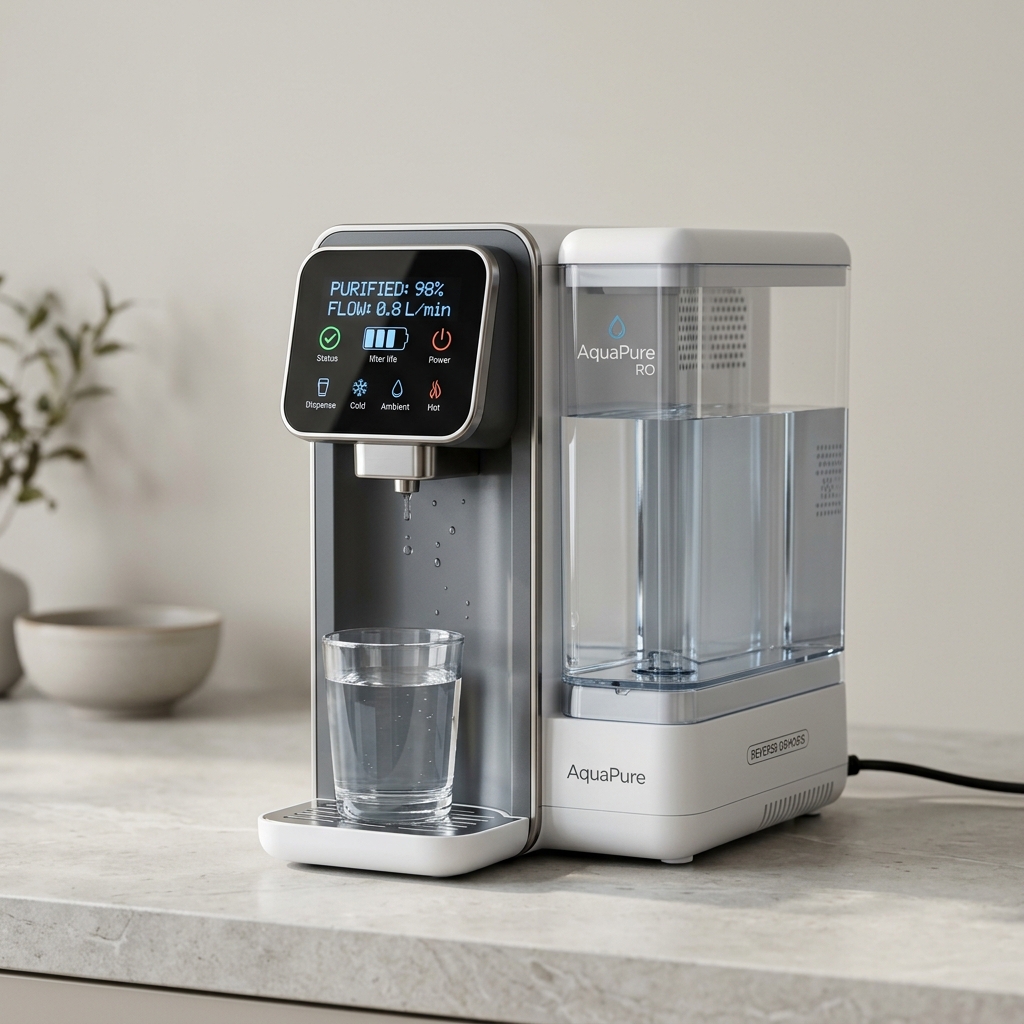
For the strongest model-level nitrate record
AquaTru Classic Alkaline Countertop RO
$400 to $550 price range
AquaTru Classic is the first choice when the exact nitrate record matters more than faucet speed. Its performance sheet reports 70% minimum and 87.2% average nitrate reduction from a 27 mg/L nitrate-as-nitrogen challenge.
- Treatment
- Countertop reverse osmosis with no feed or drain plumbing
- Nitrate evidence
- IAPMO-certified NSF/ANSI 58 nitrate and nitrate-plus-nitrite claims
- Service basis
- Prefilter and VOC filter at 600 gallons; RO membrane at 1,200 gallons
- Setup
- 120-volt outlet, manual tank filling, and regular concentrate disposal
Finished-water math. Use the 70% minimum for planning. A 12 mg/L nitrate-N source would estimate to 3.6 mg/L after treatment, while 30 mg/L would estimate to 9 mg/L. The result still needs a finished-water lab test.
Sale-stopping flaw. It works in batches and occupies counter space. AquaTru advises against feed water above 10 grains per gallon, about 171 mg/L hardness, unless it is softened first.
The evidence level and limits come from the AquaTru Classic Alkaline Countertop RO technical record.
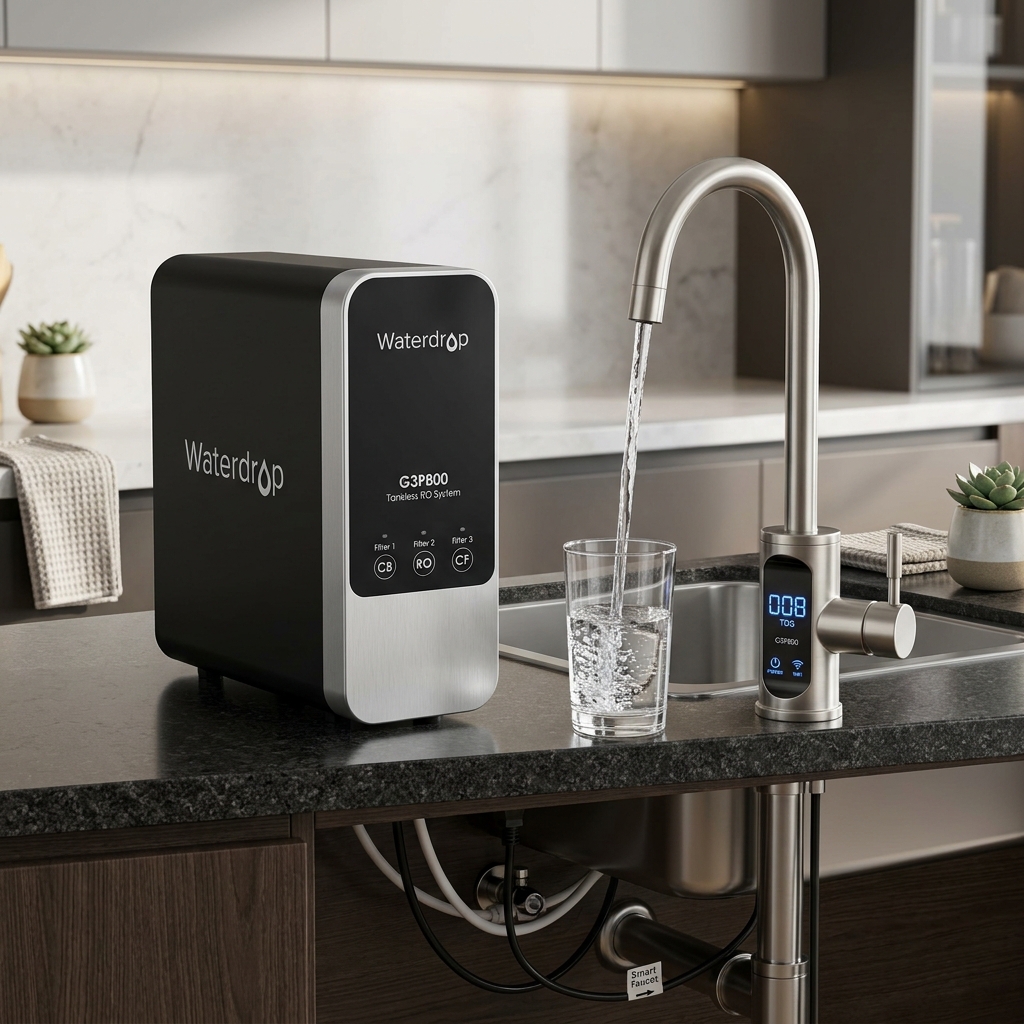
For fast draws with a verification plan
Waterdrop G3P800 Tankless Reverse Osmosis
$600 to $750 price range
Choose the G3P800 only when fast repeated draws justify the larger budget and you will test the finished water. Waterdrop lists 800 GPD production and a 3:1 pure-to-drain ratio.
- Treatment
- Powered tankless reverse osmosis with a smart faucet
- Nitrate evidence
- Model sheet reports 98% nitrate reduction from a 1.654 mg/L nitrate-N challenge
- Service basis
- CF at 6 months or 550 gallons; CB at 12 months or 1,100 gallons; RO at 24 months or 2,900 gallons
- Setup
- Cold-water feed, drain saddle, dedicated faucet, and power outlet
Finished-water math. The published nitrate challenge started below EPA's 10 mg/L nitrate-N limit. That result shows rejection under the stated test, but it cannot establish the finished concentration for a well that starts above the limit.
Sale-stopping flaw. Its smart faucet reports TDS and filter life, not nitrate. The low-concentration nitrate test is weaker purchase evidence than AquaTru's 27 mg/L nitrate-N challenge.
The evidence level and limits come from the Waterdrop G3P800 Tankless Reverse Osmosis technical record.
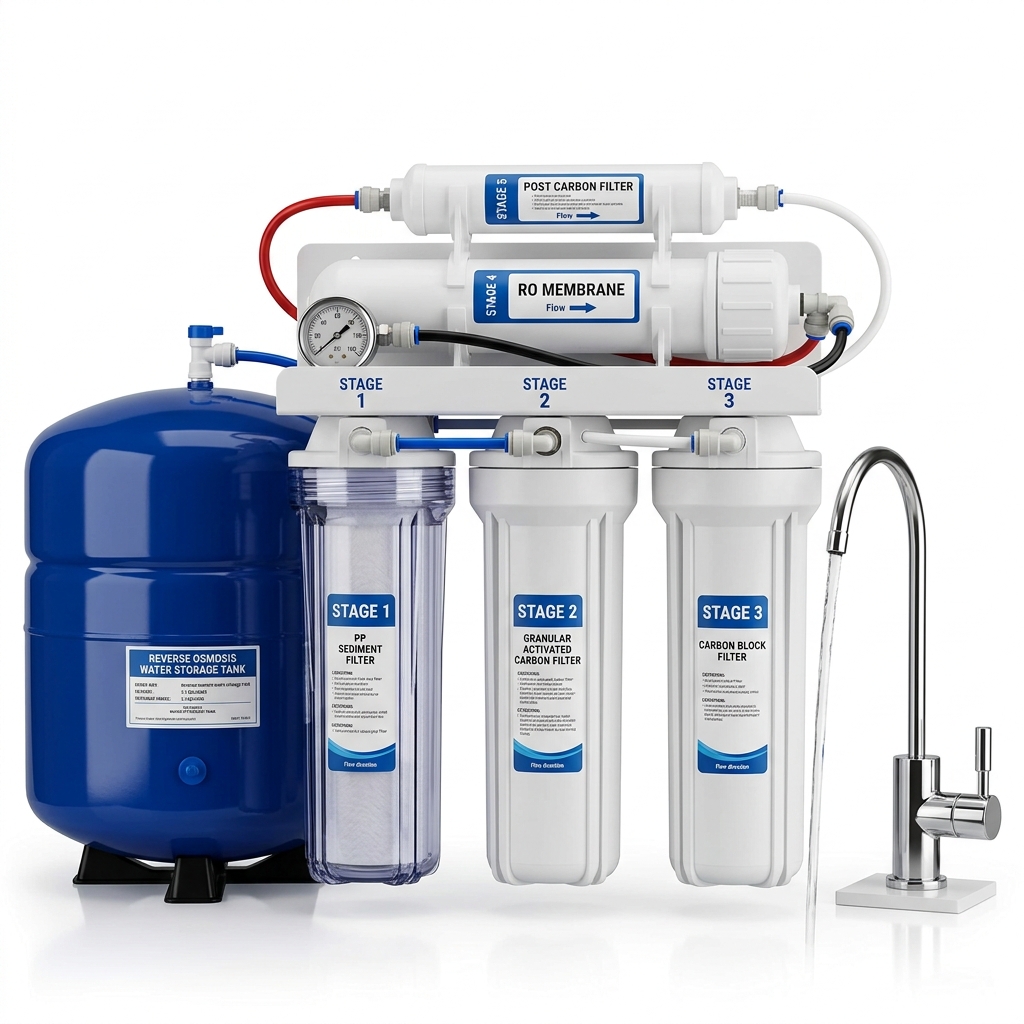
For a lower purchase band with lab follow-up
APEC Essence ROES-50
$180 to $250 price range
The ROES-50 is the budget option for a household willing to prove performance after installation. It uses a 50 GPD membrane rating at 60 psi and a four-gallon nominal storage tank.
- Treatment
- Non-electric tank-style reverse osmosis
- Nitrate evidence
- Manufacturer names nitrate; its WQA certification statement names TDS reduction
- Service basis
- Follow the current ROES-50 manual and replace the membrane when rejection declines
- Setup
- Cold-water feed, drain saddle, storage tank, and dedicated faucet
Finished-water math. APEC also lists 30 GPD at 50 psi and 77 degrees F. That pressure example shows why a membrane rating cannot stand in for a nitrate result at your sink.
Sale-stopping flaw. The current product page names nitrate but gives no model-specific nitrate percentage or challenge concentration. Its certification section says the system was tested for TDS reduction.
The evidence level and limits come from the APEC Essence ROES-50 technical record.
Source level changes the margin
AquaTru publishes a 70% minimum nitrate reduction. Treat that as a planning floor, not a guarantee. Multiply the source result by 0.30 to estimate the remaining concentration, then require a laboratory result from the treated faucet.
| Source nitrate-N | Assumed reduction | Estimated finished nitrate-N |
|---|---|---|
| 12 mg/L | 70% | 3.6 mg/L |
| 20 mg/L | 70% | 6.0 mg/L |
| 30 mg/L | 70% | 9.0 mg/L |
| 35 mg/L | 70% | 10.5 mg/L |
The table exposes the threshold most roundups hide. Even a documented 70% reduction would leave a 35 mg/L nitrate-N source above the federal limit. High source levels need professional treatment design or a different safe supply, not optimistic percentage math.
Pick by household constraint
| Constraint | Best next move | Reason |
|---|---|---|
| Infant formula and a result above 10 mg/L nitrate-N | Alternate safe water now | Treatment selection comes after exposure stops |
| No plumbing changes | AquaTru Classic | Strongest exact model record and countertop setup |
| Fast repeated draws | Waterdrop G3P800 plus lab test | High nominal output, but a weaker nitrate challenge |
| Lower installed price | APEC ROES-50 plus lab test | Lower band, tank storage, and no outlet |
| Whole-house nitrate treatment | Water-treatment professional | Nitrate-selective resin needs sizing, regeneration, and breakthrough control |
Why reverse osmosis removes nitrate
Nitrate is a small dissolved anion, not a particle. Reverse osmosis applies pressure across a selective membrane. Some water crosses as permeate, while nitrate and other dissolved ions are concentrated in the drain stream. Carbon stages protect the membrane from chlorine and improve taste, but the RO membrane performs the nitrate separation.
NSF lists nitrate and nitrite reduction as optional claims under NSF/ANSI 58. Required TDS reduction does not grant every optional claim. The system, cartridge, and performance sheet must match.
What else works
Distillation can provide nitrate-reduced drinking water without an RO membrane, although it uses electricity and works slowly. Nitrate-selective anion exchange can treat larger flows by swapping chloride for nitrate. Sulfate competes for resin sites, and exhausted resin can release captured nitrate, so whole-house units need source-water sizing, regeneration control, and scheduled sampling.
Fix the source when possible. EPA advises annual private-well tests for nitrate, coliform bacteria, TDS, and pH, plus immediate testing after flooding, well repairs, or major land changes. A well professional can inspect the cap, casing, grade, and separation from septic or animal-waste sources.
The water filter matchmaker connects source water and installation limits to a treatment type. Renters can compare reversible countertop and pitcher options. A well report that also names arsenic, bacteria, or hardness requires separate treatment decisions because nitrate reduction does not prove those claims.
What does not solve nitrate
Brita 10-Cup with Elite, Aquasana AQ-MF-1, and Waterdrop 17UB-UF are useful named losers for this job. Their current catalog records support other contaminant claims, but none supplies the exact nitrate record needed here. A lead or PFAS claim cannot be stretched to cover nitrate.
Boiling is worse than doing nothing because evaporation can concentrate nitrate. UV light treats microbes, not dissolved ions. A standard cation-exchange softener targets hardness, while nitrate treatment uses a different anion resin. A TDS meter cannot identify nitrate. More stages, lower micron numbers, and an alkaline cartridge do not answer the nitrate question.
EPA says water above 10 mg/L nitrate needs a safe alternate drinking supply. That instruction comes before shopping, especially when the water will feed an infant.
Limits that change the verdict
Cold water and low pressure reduce RO production. Hardness can scale the membrane. A spent or damaged membrane can lower rejection without changing taste. Short draws after idle periods may differ from steady operation. Feed concentration can also exceed the range that a product sheet tested. Sample from the treated faucet after installation and again on the schedule set by your health department or treatment professional.
A whole-house choice has a different failure mode. Nitrate-selective resin can break through, spent brine carries nitrate, and sulfate changes capacity. Professional commissioning should define the sampling point, acceptable endpoint, regeneration trigger, and safe response if nitrate rises.
Nitrate filter questions
What type of water filter removes nitrate?
Reverse osmosis, nitrate-selective anion exchange, and distillation can remove nitrate. For a kitchen system, require an exact model nitrate or nitrate-plus-nitrite record and confirm the finished water with a certified laboratory.
Do carbon pitcher filters remove nitrate?
Ordinary activated-carbon pitchers should not be relied on for nitrate. Carbon is useful for chlorine taste and some organic chemicals, but dissolved nitrate needs a different treatment mechanism and a model-specific claim.
Does boiling water remove nitrate?
No. Boiling removes water as vapor while nitrate remains, so the nitrate concentration can rise. Use an alternate safe source when public-health guidance says the water is unsafe.
Is 10 mg/L nitrate the same as 10 mg/L nitrate-N?
No. EPA's 10 mg/L limit is stated as nitrogen. It equals about 44.3 mg/L when a laboratory reports the full nitrate ion. Confirm the reporting basis before comparing a result with a limit or product sheet.
Can a TDS meter prove nitrate removal?
No. A TDS meter estimates the combined conductive dissolved load. It cannot identify nitrate, distinguish nitrate from other ions, or show that finished water is below a health limit.
Should nitrate treatment cover the whole house?
Point-of-use treatment is often the practical choice for drinking, cooking, ice, and infant formula. Whole-house nitrate treatment needs professional sizing, source-water analysis, regeneration or concentrate handling, and a sampling plan.