Contaminants guide
The Best Water Filters for PFAS
Choose Waterdrop G3P800 for a high-use under-sink system, AquaTru Classic when plumbing changes are off the table, or Aquasana AQ-MF-1 when certified PFOA and PFOS reduction without RO fits your report.
The market trap is a broad NSF logo with no PFAS claim beside the exact model. NSF/ANSI 42 taste certification, a small micron number, and a low TDS reading say nothing about PFOA or PFOS reduction.
Who should skip these filters
Skip product shopping until you know whether PFAS is in your water. Ask your utility for its current results or use an EPA-listed state certification program to find a drinking-water laboratory. Private-well owners also need microbial, nitrate, arsenic, and local contaminant testing before selecting treatment.
Four rules decide the shortlist
Match the exact claim
The model record must name PFOA, PFOS, or Total PFAS reduction under NSF/ANSI 53 or 58.
Treat swallowed water first
A point-of-use unit gives its media and replacement budget to drinking, ice, and cooking water.
Respect the rated endpoint
Replace each stage at the gallon or time limit, whichever arrives first.
Test when the number matters
Certification proves a test reduction. A finished-water lab result tells you what reaches your glass.
What matters when choosing PFAS filters
The shortlist starts with model-specific certification and performance records, then weighs treatment physics, capacity, flow, installation, reject water, and replacement workload. EPA senior science advisor Thomas F. Speth, PhD, PE, has worked in water-treatment research at EPA since 1986. His explanation of media choice, bed depth, flow, water chemistry, and PFAS chain length sets our weighting for carbon systems. A generic carbon label never substitutes for a named claim.
EPA identifies activated carbon, ion exchange, and reverse osmosis as practical home PFAS treatments. Its guidance also states that current certifications do not show that a filter reaches the newer federal limits. PFOA and PFOS remain at 4.0 parts per trillion each, while the 2026 compliance extension is still a proposal.
A Duke University field study in Environmental Science & Technology Letters sampled 73 North Carolina homes. The under-sink dual-stage and RO units showed near-complete removal across the PFAS measured, while ordinary activated-carbon formats varied sharply. The authors declared no competing financial interest.
The certification endpoint gap
| Number | What it means | What you should do |
|---|---|---|
| 4 ppt | Current federal MCL for PFOA and for PFOS | Use your utility or lab result as the starting target |
| 20 ppt | Maximum treated-water concentration on the AquaTru PFOA and PFOS certification test | Do not read certification as proof of 4 ppt at your tap |
| Your result | Finished-water concentration under your chemistry and replacement schedule | Lab-test after installation when exposure is confirmed |
The 4 ppt limit comes from the current EPA PFOA and PFOS rule page. The certification test endpoint comes from the AquaTru performance sheet linked with its recommendation below.
Three evidence-backed picks
Affiliate disclosure: We may earn from qualifying purchases through retailer links. The comparison method explains how products qualify. Price ranges account for normal Amazon offer changes.
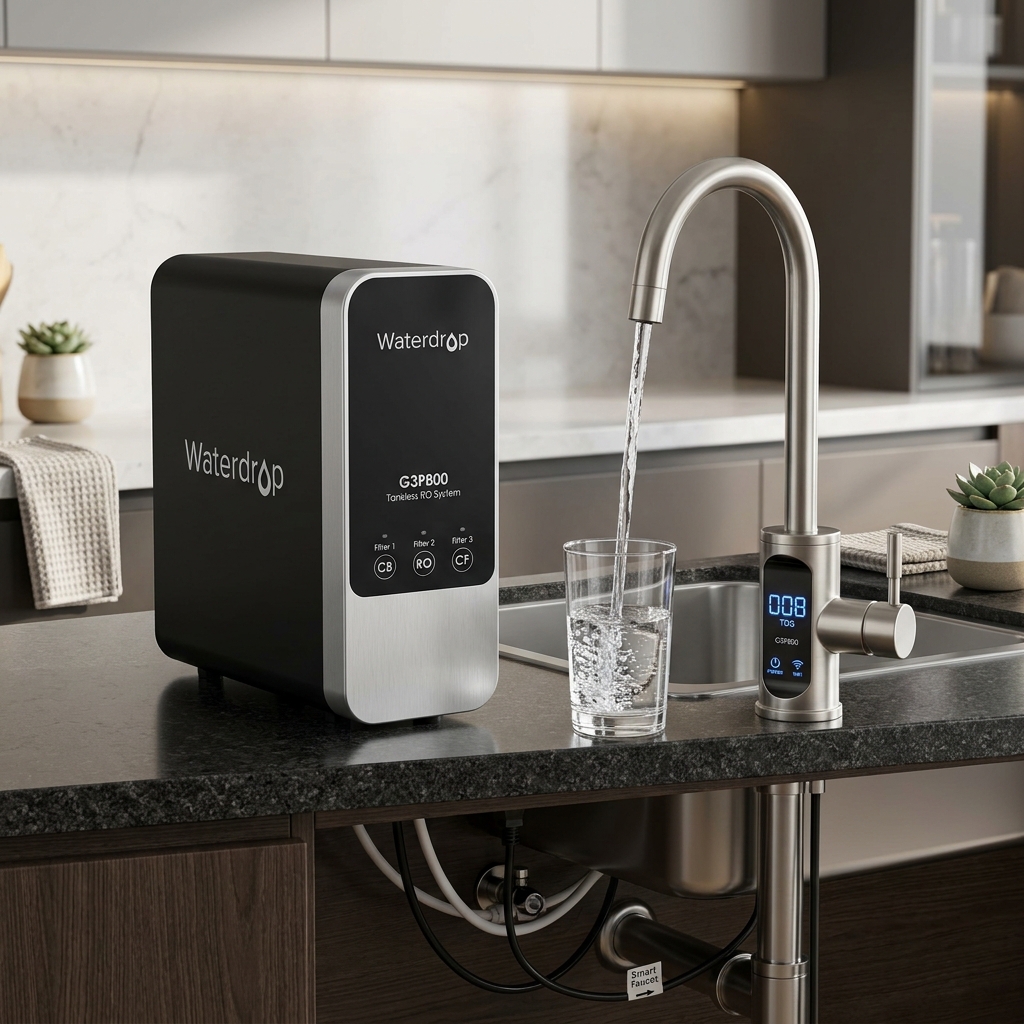
For a high-use kitchen
Waterdrop G3P800
$700 to $900 price range
Choose it when several people need PFAS-treated drinking and cooking water without waiting on a storage tank. Its 3-to-1 pure-to-drain ratio means one gallon goes to drain for each three gallons dispensed under rated conditions.
- Treatment
- Tankless reverse osmosis
- PFAS evidence
- IAPMO certified to NSF/ANSI 53 and 58 for the claims in its performance sheet
- Rated capacity
- 550-gallon CF, 1,100-gallon CB, and 2,900-gallon RO limits
- Rated service
- 800 gallons per day production rating
Capacity math. At 3 gallons per day, the 550-gallon first stage reaches its rated limit in about 183 days. The stated six-month change interval arrives at nearly the same time.
Sale-stopping flaw. It needs power, a drain connection, a new faucet hole, and enough cabinet depth for an 18.11 by 5.67 by 17.73 inch body. A TDS display does not measure PFAS.
The model numbers and limits come from the Waterdrop G3P800 technical record.
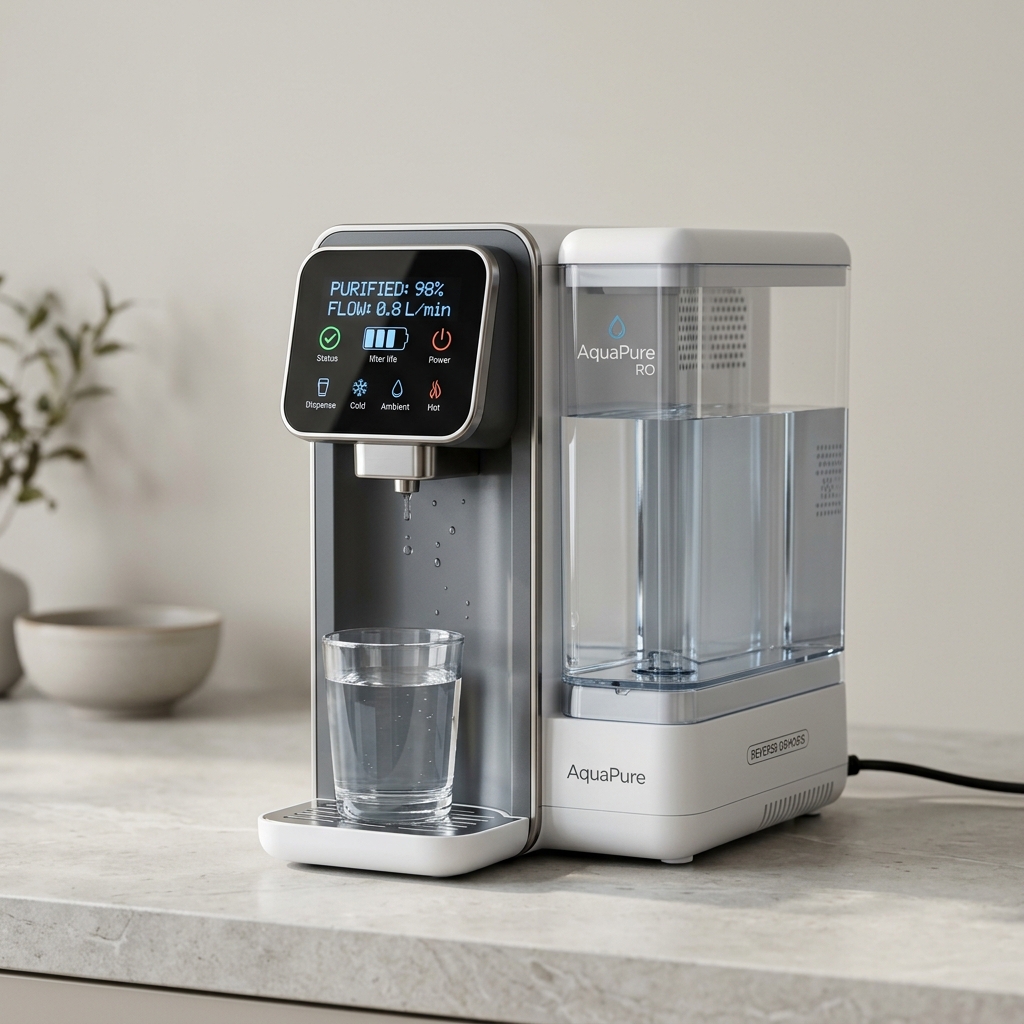
For a no-plumbing kitchen
AquaTru Classic
$400 to $500 price range
Choose it when you rent, cannot drill a faucet hole, or want RO without opening a water line. Its performance sheet lists 97.5% minimum PFOA and PFOS reduction and an 80% recovery rating.
- Treatment
- Countertop reverse osmosis
- PFAS evidence
- IAPMO certified to NSF/ANSI 53 and 58 with a PFOA and PFOS claim
- Rated capacity
- 600-gallon prefilter and VOC stages, 1,200-gallon RO membrane
- Rated service
- 0.06 gallons per minute rated flow
Capacity math. At 3 gallons per day, each 600-gallon stage reaches its rated limit in about 200 days. The 1,200-gallon membrane reaches its limit in about 400 days.
Sale-stopping flaw. It occupies counter space, needs an outlet, and runs batch by batch. The maker says water above 10 grains per gallon hardness can scale the membrane rapidly unless softened first.
The model numbers and limits come from the AquaTru Classic technical record.
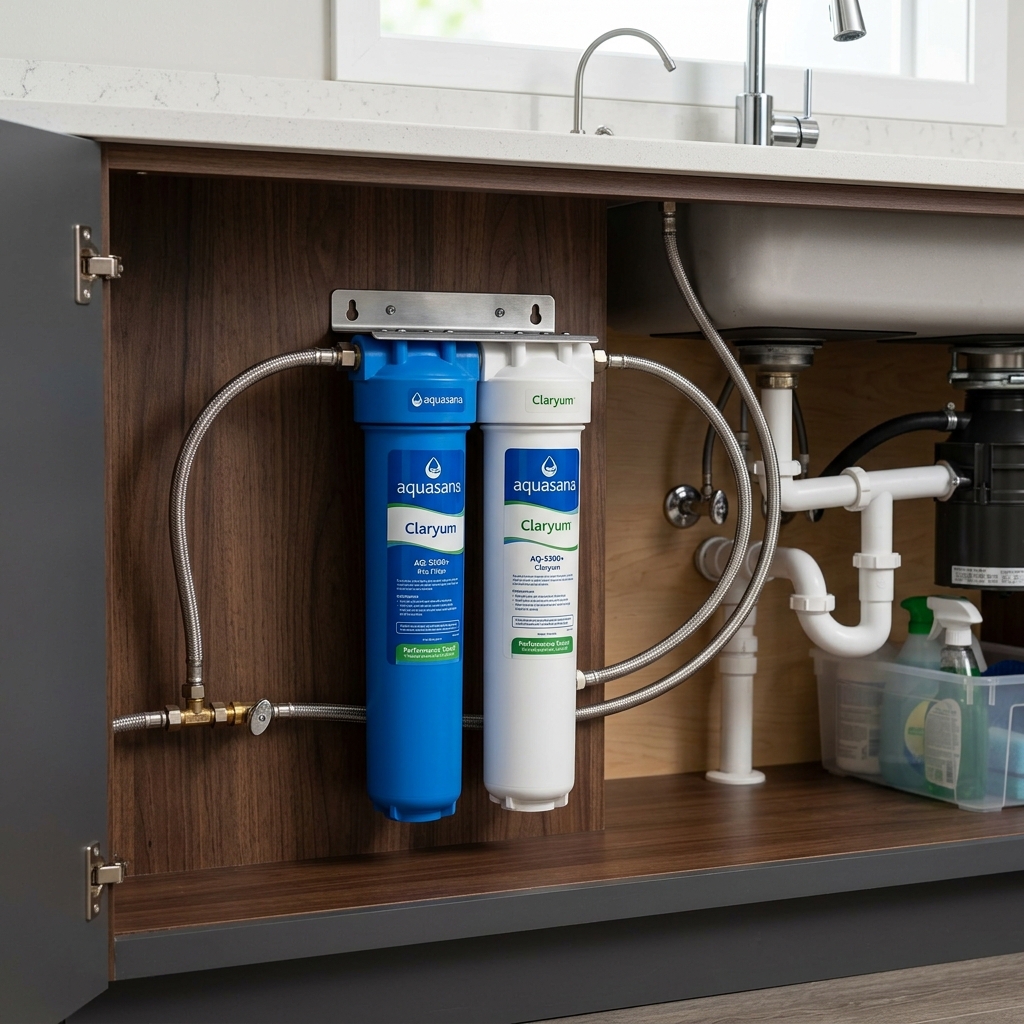
For full faucet flow without RO
Aquasana Claryum Direct Connect AQ-MF-1
$100 to $200 price range
Choose it when you want normal cold-faucet flow and no RO reject water. Its performance sheet reports 95.8% PFOA and PFOS reduction through the full rated capacity.
- Treatment
- Carbon and ion-exchange direct connect
- PFAS evidence
- IAPMO certified to NSF/ANSI 53 with a PFOA and PFOS claim
- Rated capacity
- 784 gallons or six months
- Rated service
- 1.5 gallons per minute rated flow
Capacity math. At 3 gallons per day, 784 gallons equals about 261 days. The six-month time limit arrives first, so plan on two cartridge changes per year.
Sale-stopping flaw. It treats municipally disinfected water only and does not make a claim for every PFAS compound. The long cartridge hangs 20 inches below the connection and may not fit a crowded cabinet.
The model numbers and limits come from the Aquasana Claryum Direct Connect AQ-MF-1 technical record.
Pick by constraint
| Constraint | Best fit | Reason |
|---|---|---|
| No plumbing changes | AquaTru Classic | Countertop batch RO needs only power and refilling |
| High daily volume | Waterdrop G3P800 | Tankless 800 GPD production rating |
| No reject water | Aquasana AQ-MF-1 | Adsorptive media treats the existing cold-faucet stream |
| Confirmed short-chain PFAS concern | Test after RO | EPA reports high-pressure membranes work across a wider PFAS range |
Why the filter media matters
Activated carbon adsorbs PFAS onto a porous surface. Contact time and unused capacity matter, and shorter-chain PFAS tend to break through sooner than PFOA and PFOS. Ion-exchange resin attracts negatively charged PFAS to positively charged sites. Reverse osmosis separates dissolved compounds with pressure and a membrane, but sends a concentrated reject stream to the drain.
EPA reports that high-pressure membranes are typically more than 90% effective across a wide PFAS range. Its treatment research also explains why carbon performance depends on PFAS chain length. Product certification still outranks a media claim because the complete cartridge, housing, flow, and rated life are tested together.
What else reduces exposure
Use your utility result before buying hardware. If the result is below detection, a PFAS filter may add cost without solving a measured problem. If the result is elevated, ask what source or treatment changes are planned and use treated water for anything you swallow. We earn nothing from utility records or certified laboratory testing.
The water filter matchmaker connects your water source and household constraints to a treatment type. Renters can also compare reversible and countertop options in our water filter guide for rental homes.
What does not remove PFAS
Brita Original OB03 is a 40-gallon taste-and-odor cartridge with no model-specific PFAS claim. Water softeners exchange hardness ions and do not serve as PFAS filters. Sediment cartridges capture particles, while PFAS in water are dissolved. UV systems inactivate microbes and do not remove dissolved chemicals. Boiling can concentrate PFAS as water evaporates.
A TDS meter also cannot validate a PFAS filter. It responds to conductive dissolved solids at a much larger concentration scale. Only a PFAS laboratory analysis can measure the finished-water result that matters here.
Limits that change the verdict
PFOA and PFOS claims do not cover every compound in the PFAS family. Influent chemistry, competing organic matter, flow, and cartridge age can change adsorption. RO recovery changes with pressure and temperature. A whole-home system may make sense near a heavily contaminated private well, but sizing it from one sample and an online flow estimate is poor practice. Start with a certified lab result and a qualified local treatment professional.
PFAS filter questions
Does boiling water remove PFAS?
No. Boiling removes water as vapor and can leave PFAS behind in a smaller volume. Use a filter with a model-specific PFAS reduction claim.
Does a TDS meter detect PFAS?
No. A TDS meter estimates dissolved ionic material at parts-per-million scale. PFAS are measured with specialized laboratory methods at parts-per-trillion levels.
Is NSF 53 enough for PFAS?
Only when the exact model listing or performance sheet names PFOA, PFOS, or Total PFAS reduction. NSF/ANSI 53 also covers unrelated health-effect claims, so the standard number alone is not enough.
Should PFAS water be filtered for cooking?
Yes. Use treated water for drinks, ice, food preparation, and cooking when your report shows PFAS. Point-of-use treatment focuses capacity on water you are likely to swallow.