Buying guide
The Best Iron Filters for Well Water
The iSpring WGB32BM is the catalog pick when a laboratory report shows iron at or below 3 ppm and manganese at or below 1 ppm. Higher iron, iron bacteria, tannins, or a weak backwash supply need a professionally sized treatment train instead.
Choose the WGB32BM only inside its published water limits. Choose oxidation plus backwashing media when the iron load, sulfur, or water chemistry exceeds a cartridge system. Treat the well itself when sticky red or brown slime points to iron bacteria. Orange staining alone cannot choose among those paths.
The first trap is a product called an iron filter with no influent limit. The second is treating every rusty stain as the same substance. EPA lists 0.3 mg/L for iron and 0.05 mg/L for manganese as secondary standards. These federal values address taste, color, staining, and other aesthetic effects rather than defining a universal filter design.
Who should skip the catalog pick
Skip the WGB32BM if iron exceeds 3 ppm, manganese exceeds 1 ppm, the water carries sticky slime, a sulfur result lacks a quantified treatment claim, or the well has not been tested for bacteria. Also skip it when the household needs hardness removal. An iron cartridge is not a softener or a disinfectant.
A private well with a positive coliform or E. coli result needs health-department guidance and an alternate safe source until corrective work and follow-up testing are complete. The well-water treatment guide maps bacteria, hardness, iron, nitrate, and arsenic to separate jobs.
Five results decide the treatment path
Clear water that rusts after standing suggests dissolved ferrous iron. Water that leaves the faucet red or yellow already contains oxidized ferric particles. A lab result still sets the concentration.
Black or dark-gray staining can point to manganese. Test it separately because a product's iron limit cannot be reused as its manganese limit.
Oxidation and media performance change with water chemistry. Minnesota's iron guidance explains that organic iron and tannins can slow or prevent oxidation, which can make a simple aeration claim unreliable.
Hardness can add a softener stage. A rotten-egg odor needs a hydrogen-sulfide result and a system with a stated sulfur limit, not a guess from smell.
A cartridge system needs acceptable pressure at household peak flow. A backwashing tank also needs the well pump to deliver the media's cleaning rate. An undersized pump can turn good media into a channelled, clogged bed.
Three paths cover the real iron problem
The table separates a shippable product from the two situations where a checkout button would be the wrong answer. The same four fields apply to each path.
| Path | Measured fit | Mechanism | Service burden | Hard limit |
|---|---|---|---|---|
| iSpring WGB32BM | Iron at or below 3 ppm and manganese at or below 1 ppm | Sediment, carbon, then catalytic iron and manganese media | Three heavy cartridges, shutoff work, pressure checks, finished-water tests | No complete-system iron certification stated; no bacteria or hardness treatment |
| SpringWell WS | Tested water within the maker’s limits, including up to 7 ppm iron, 8 ppm hydrogen sulfide, or 1 ppm manganese | Air-injection oxidation followed by a backwashing media bed | Power, drain flow, control-head care, automatic backwash, and finished-water tests | No bacteria, hardness, nitrate, arsenic, or PFAS treatment; SpringWell reviews the water test before release |
| Oxidation plus backwashing media | Higher iron, mixed iron, or chemistry that needs a designed oxidation step | Convert dissolved iron to particles, capture them, then flush the media bed | Power or chemical feed may be needed, plus a drain and adequate backwash flow | Media, oxidant, pH, contact time, and pump flow must be sized together |
| Well cleaning and disinfection | Iron-bacteria slime, recurring clogging, or a fouled well and pump | Remove deposits and control the biological growth before polishing residual iron | Licensed well work, possible repeat treatment, and bacterial retesting | A filter alone does not rehabilitate an infected or fouled well |
What to check before choosing
Use a water test to check the iron level and form before buying. Compare the treatment limits, pump and drain needs, cartridge changes and upkeep for your home.
The underlying treatment map comes from a UGA Extension review published in July 2026. It distinguishes ferrous iron, ferric iron, and iron bacteria, then pairs them with oxidation, filtration, or disinfection. The guide also warns that softeners may only work up to 5 ppm of combined iron and manganese, which is a category limit rather than permission to apply that number to any softener.
Two picks for two measured iron ranges
Affiliate disclosure: We may earn from qualifying retailer purchases. The comparison method and evidence limits explain how the products were assessed. Price bands are planning ranges, not live offers.
For a tested well inside the cartridge limits
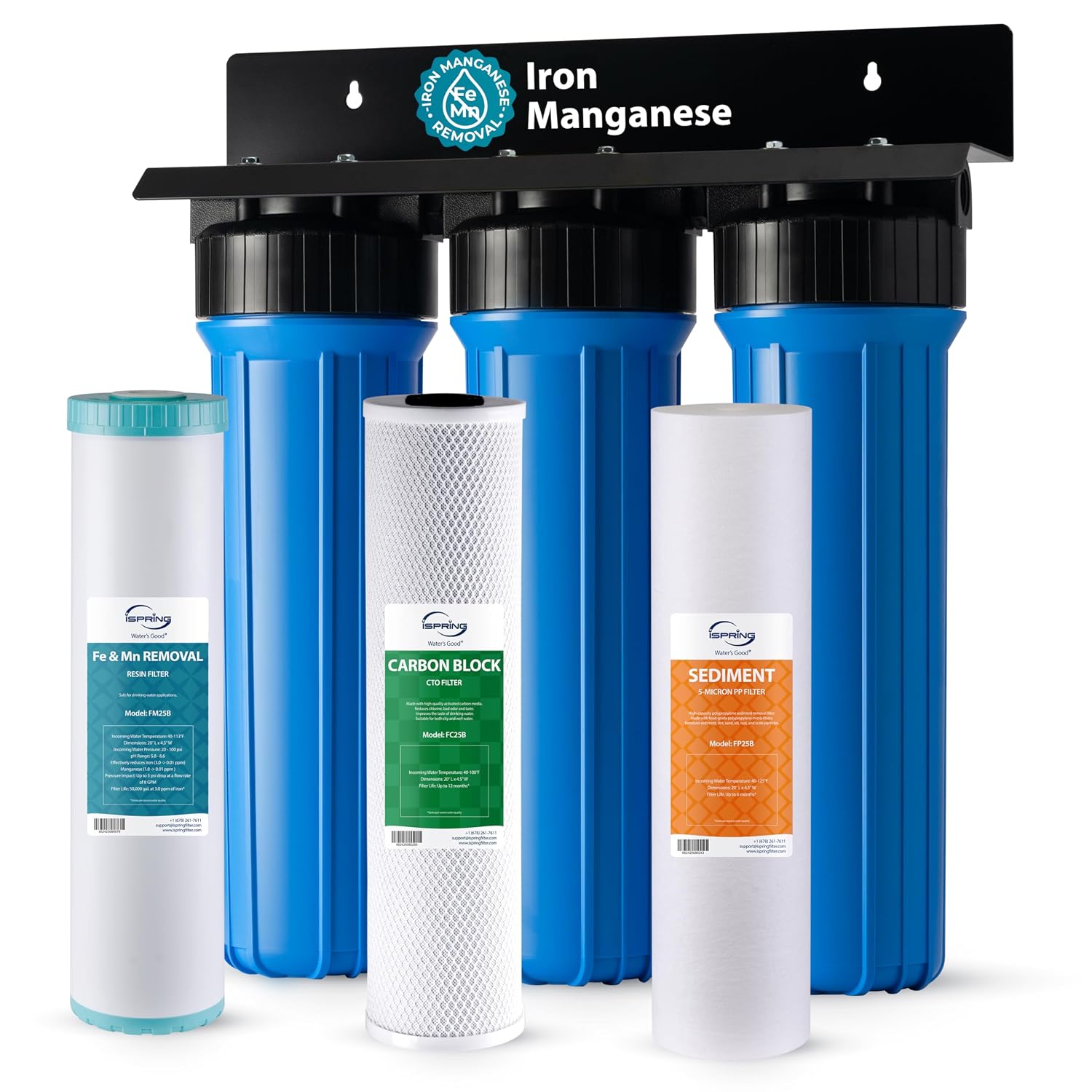
iSpring WGB32BM
$450 to $650 typical Amazon range
- Published limit
- Up to 3 ppm iron and 1 ppm manganese
- Rated work
- 15 GPM peak; iron cartridge rated for 50,000 gallons at 3 ppm
- Plumbing
- One-inch NPT, 25 to 80 psi, indoor installation protected from freezing
- Service
- Three 20 by 4.5-inch cartridges; listed replacement cycle of 6 to 12 months
Why it fits. The three stages keep separate jobs separate. The first cartridge catches sediment, the second handles chlorine taste and odor, and the FM25B stage targets iron and manganese. No drain or electrical outlet is needed for normal filtration, which avoids the backwash constraints of a media tank.
Sale-stopping flaw. The manufacturer publishes concentration, flow, pressure, capacity, and service limits for the WGB32BM, but it does not present the complete system as third-party certified for iron or manganese reduction. The 15 GPM figure is a peak rating, not a published clean-filter pressure-loss curve.
Capacity math. A four-person home using an assumed 60 gallons per person daily sends 240 gallons through the unit. Dividing the 50,000-gallon iron-cartridge rating by 240 gives about 208 days, or just under seven months, at the maker's 3 ppm rating. Heavy sediment or higher daily use can shorten that interval.
Ownership work. The assembled unit weighs 55 pounds before water fills the housings. Leave enough floor clearance to lower each 20-inch cartridge, add shutoffs and a bypass, and give the bracket structural support. A low initial pressure reading and a loaded-filter reading make service decisions more useful than a calendar alone.
Premium backwashing pick for tested iron and sulfur
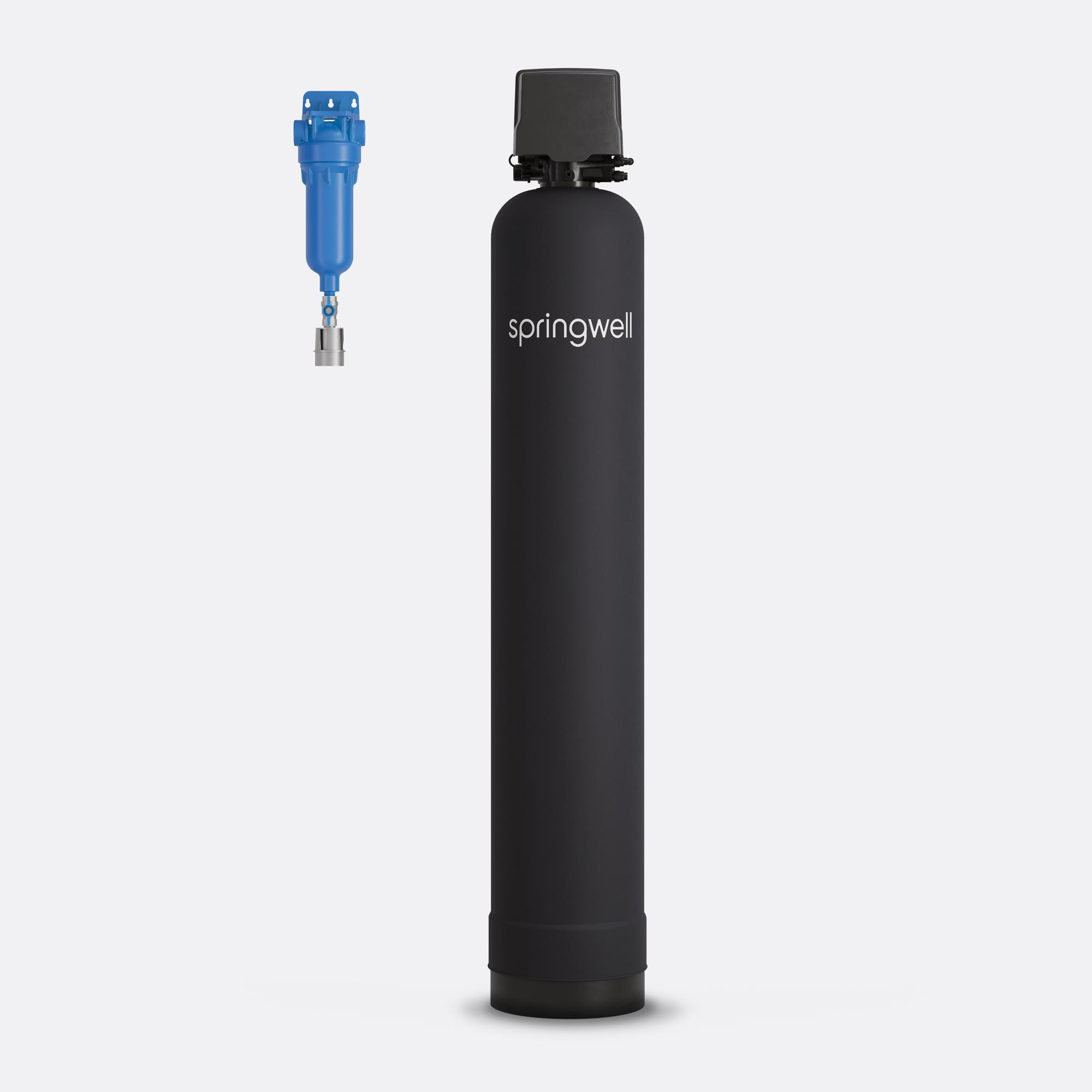
SpringWell WS Whole House Well Water Filter
$2,000 to $3,000 typical planning range
- Published limits
- Up to 7 ppm iron, 8 ppm hydrogen sulfide, and 1 ppm manganese
- Current sizes
- The current size guide lists 9, 12, and 20 GPM options
- Feed water
- 25–80 psi and pH 6.5–10, plus an approved complete water test
- Service
- Automatic air-injection cycle and nightly backwash through a suitable drain
Why it fits. The WS earns a place when iron exceeds the iSpring cartridge limit or sulfur odor also needs treatment. It oxidizes dissolved iron, manganese, and hydrogen sulfide inside the tank, captures the particles, and flushes the media instead of storing the full load in disposable cartridges.
Sale-stopping flaw. The limits are manufacturer claims, not a finished-system certification record shown here. The unit also needs power, enough well-pump output for backwash, a code-compliant drain, and water that fits every chemistry limit. A positive bacteria result still needs source repair and disinfection.
Before checkout. SpringWell requires a complete water test before releasing the WS order. Use that review to confirm iron form, manganese, sulfur, pH, hardness, tannins, bacteria, and the selected system’s backwash demand.
Higher iron needs a backwashing design
Do not stack disposable cartridges when iron exceeds the WGB32BM limit. SpringWell WS is now the catalog option for a compatible air-injection and backwashing job, but it is not the only valid design. A treatment professional can compare aeration, air injection, chlorine or peroxide oxidation, and catalytic or greensand-type media against the exact iron form, manganese, sulfur, pH, alkalinity, and organic color. Ask for a written influent limit for every target.
A backwashing tank earns its place by flushing captured rust out of the media bed instead of storing the entire load in a disposable cartridge. That advantage creates a new requirement. The well pump must sustain the maker's backwash rate while the drain and septic plan accept the discharge. UGA's 2026 mechanical-filtration guidance names inadequate backwash flow and poor backwash timing as failure causes and recommends raw and treated-water testing after installation and annually.
Get two quotes built from the same lab report. Each should name the valve, tank diameter, media volume, service flow, backwash flow, drain requirement, oxidant or air step, pH window, iron and manganese limits, sulfur limit, annual work, and finished-water target. A quote that says only “removes iron” has not defined the job.
Iron bacteria change the first purchase
Sticky red, brown, gray, or black slime can indicate iron bacteria. A rainbow-like sheen, recurring pump or screen clogging, and musty or swampy odor add evidence, but a laboratory or well professional should confirm the cause. Ordinary iron media can foul while the colony remains in the well and plumbing.
Minnesota's health department advises physical cleaning first in heavily affected wells, followed by professional chemical treatment where needed. It also warns that iron bacteria can create conditions where other organisms grow, so coliform and nitrate testing belongs in the plan. We earn nothing from well cleaning, disinfection, or accredited-laboratory testing.
Flow and iron load matter more than bedroom count
Suppose two showers draw 2 GPM each while a 2.2 GPM kitchen faucet and a 2 GPM appliance run. The assumed peak is 8.2 GPM. That sits below the WGB32BM's 15 GPM peak label, but the comparison is incomplete without inlet pressure and pressure loss across clean and loaded cartridges.
Iron load adds another dimension. The same 50,000-gallon cartridge sees twice as much iron mass per day when the household doubles its water use. A vacation home and a six-person home can share the same lab result yet need different service dates. Log the meter reading, inlet and outlet pressure, raw iron, and finished iron at each cartridge change.
What does not solve the measured problem
iSpring WGB32B. The base model uses sediment and carbon cartridges, not the FM25B iron and manganese stage. The WGB32B review and specifications separate the base municipal-water model from the BM variant. A nearly identical blue housing does not make the cartridges interchangeable in purpose.
DuraWater 48K with Fleck 5600SXT. The catalog bundle is a standard-resin softener for hardness, and its exact product record does not publish an iron-removal limit. The Fleck-based softener review covers the bundle identity and installation limits. Do not borrow a generic “softeners remove iron” number and apply it to this exact ASIN.
Pitcher and faucet filters. Small point-of-use devices may catch iron particles, but that can become the failure mode. A 2025 field study in ACS ES&T Water found that high iron and manganese clogged faucet filters before half of their rated capacity in one community. That evidence does not rank whole-house iron systems. It does show why a kitchen cartridge is a poor substitute for source-wide treatment.
A TDS meter. Total dissolved solids combine conductive ions into one reading. The WGB32BM can reduce iron without producing a dramatic TDS change. Use iron and manganese tests to judge this job.
The non-commissioned purchase comes first
Buy an accredited-laboratory panel before equipment. Include total iron, dissolved iron when the lab offers it, manganese, pH, hardness, alkalinity, turbidity, tannins or organic color when suspected, coliform bacteria, nitrate, and local geologic risks. Sample before treatment. Ask the lab or extension office whether a separate wellhead sample is needed.
Retest after installation from a sample point after treatment but before any unrelated plumbing source can change the result. A successful iron result does not prove bacterial safety, and clear water does not prove the manganese target was met. The whole-house comparison keeps carbon, softening, and UV claims in their own lanes when the panel finds more than iron.
Certification language needs a model number
A component described as tested to an NSF standard is not the same as a complete system certified for an iron-reduction claim. WQA explains that product certification combines testing, manufacturing review, retesting, and continuing facility inspections. Search a certifier's live listing for the exact model and exact claim before treating a badge as performance evidence.
Iron-filter questions
What type of filter removes iron from well water?
The answer depends on the iron form and concentration. Ferric particles may respond to mechanical filtration, dissolved ferrous iron usually needs oxidation before filtration, and iron bacteria call for well cleaning and disinfection before a filter is sized. A laboratory result for iron, manganese, pH, hardness, and bacteria should come first.
Is iron in well water dangerous to drink?
Iron in household well water is usually an aesthetic and plumbing problem, but rusty color does not prove the water is otherwise safe. Test for coliform bacteria, nitrate, manganese, arsenic, and local risks. Manganese has separate health guidance and should not be treated as merely an iron stain.
Can a sediment filter remove dissolved iron?
No. A sediment cartridge catches particles that are already solid. Clear-water ferrous iron is dissolved and usually needs oxidation to turn it into a filterable particle. A cartridge can serve as a later polishing stage after that conversion.
How often do iSpring WGB32BM filters need replacement?
iSpring lists a 6-to-12-month replacement cycle for the three-stage set, with the iron cartridge rated for 50,000 gallons at 3 ppm iron. Actual service can be shorter when sediment, iron load, water use, or pressure loss is higher. Test the finished water instead of relying only on the calendar.
Will an iron filter remove a rotten-egg smell?
Do not assume it will. A rotten-egg odor can come from hydrogen sulfide, sulfur bacteria, a water heater, or another source. The WGB32BM page does not publish a quantified hydrogen-sulfide capacity, so a sulfur result needs treatment with a stated limit for that job.
Match the system to your actual well result
The finder separates iron and manganese from hardness, bacteria, sulfur odor, flow needs, and installation limits.