Buying guide
The Best Shower Filters for Chlorine
Choose an NSF-listed Weddell Duo when a verified free-chlorine claim matters most; choose Jolie for an integrated showerhead, or AquaBliss SF100 for an inexpensive inline trial.
A shower filter can target free chlorine, but it should not be bought as a cure for hard water. The calcium and magnesium behind scale and poor lather need a different treatment. Nor does a free-chlorine claim automatically cover chloramine, the disinfectant used by some utilities.
Start with your utility's disinfectant information and a local hardness result. NSF/ANSI 177 covers aesthetic free available chlorine reduction, while EPA describes cation exchange as the method that removes hardness ions. Those are different jobs.
Who should skip a shower filter
If your goal is fewer mineral spots or less scale, use the measured hardness result to consider a properly sized softener. If you have a microbiological advisory, follow the utility or health department; these are not pathogen-removal devices. If treated shower water meets your goal already, keeping the existing showerhead avoids cartridge spending.
What counted in our selection
We favored an exact model claim, a stated service limit, standard fitting information, and a clear account of what the cartridge cannot treat. A claim printed on a package is weaker than a current certifier listing. We also separated a new showerhead from an inline filter that lets you keep your current spray pattern.
| Option | Best reason to choose it | Evidence boundary | Service planning |
|---|---|---|---|
| Weddell Duo WD-100 | Certified free-chlorine claim | NSF/ANSI 177 does not certify hardness or chloramine removal | Maker says 8,000 gallons; check current replacement guidance |
| Jolie | Integrated head and published lab percentage | Maker-reported lab result, not a current 177 listing here | 90 days |
| AquaBliss SF100 | Keep your existing head at lower initial cost | No verified model percentage established here | Three to six months |
Weddell's product page states 8,000 gallons; the current NSF listing shows 10,000 gallons at 2.0 GPM. Use the maker's shorter replacement figure until the two records agree. Neither number predicts lifetime in every home's water.
What to check before choosing
Compare the exact chlorine claim, shower fittings, flow and cartridge cost. A 2023 study by Elizabeth Dach, Ngai Yin Yip and colleagues in Environmental Engineering Science found that many claims made for five online shower filters failed their water-chemistry checks. Those five results cannot be assigned to the models here, but they make model-level proof especially valuable.
Two catalog options with different tradeoffs
Affiliate disclosure: We may earn from qualifying purchases through retailer links. The comparison method and evidence limits explain the selections. Price bands are planning ranges, not live offers.
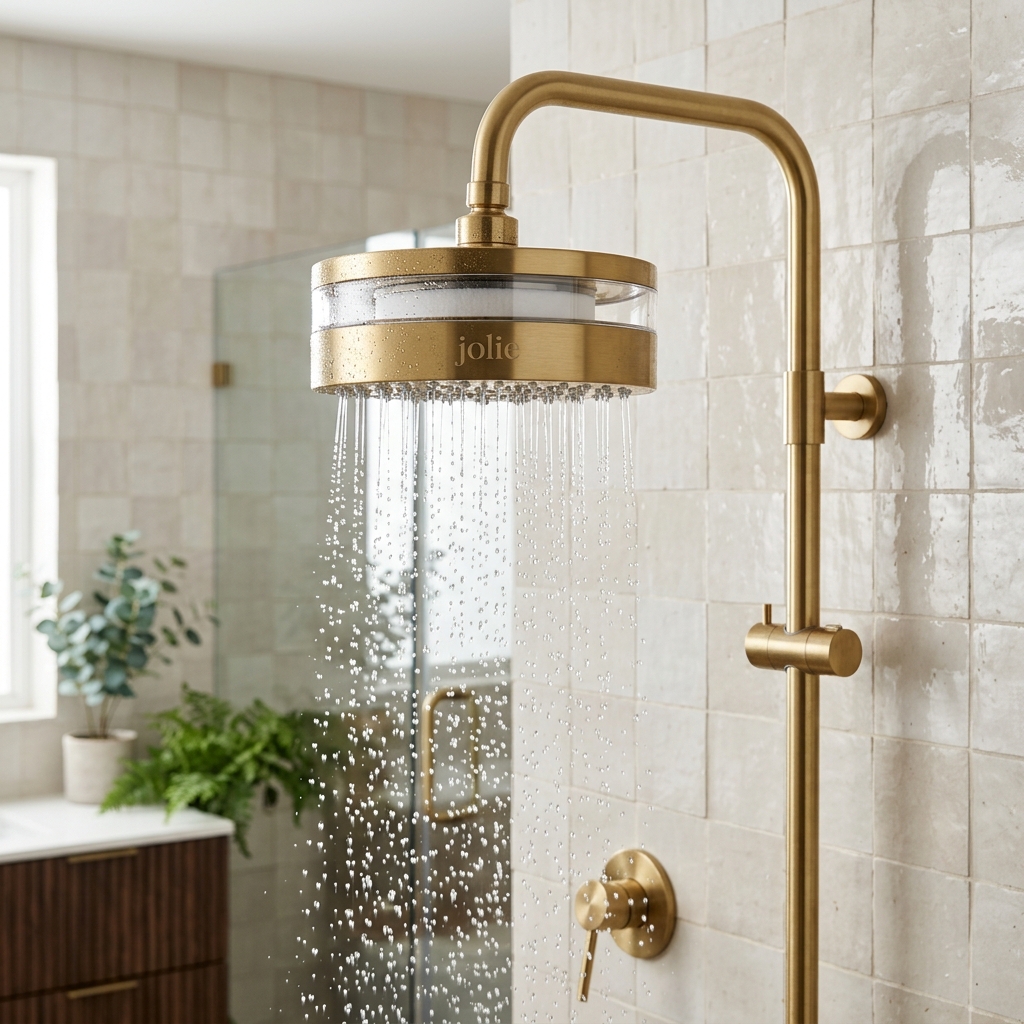
For a finished showerhead with published chlorine data
Jolie Filtered Showerhead
$130 to $170 typical range
Choose Jolie if you want one finished fixture and are comfortable relying on the maker-published laboratory claim. The 90-day schedule is easy to plan, and the filter media are KDF-55 and calcium sulfite.
- Chlorine evidence
- Jolie reports more than 84% free-chlorine reduction across cartridge life in third-party laboratory testing; this is not an NSF/ANSI 177 certification listing.
- Replacement
- Replace its proprietary cartridge every 90 days.
- Installation
- Replaces the showerhead; standard shower-arm connection. The head and filter are one unit.
- Water source
- Treated municipal water; confirm the disinfectant first
Sale-stopping flaw. The fixed replacement schedule means four cartridges a year even in a one-person home. The published percentage does not establish chloramine reduction or hardness removal.
The Jolie Filtered Showerhead source record explains the cartridge and maintenance claim.
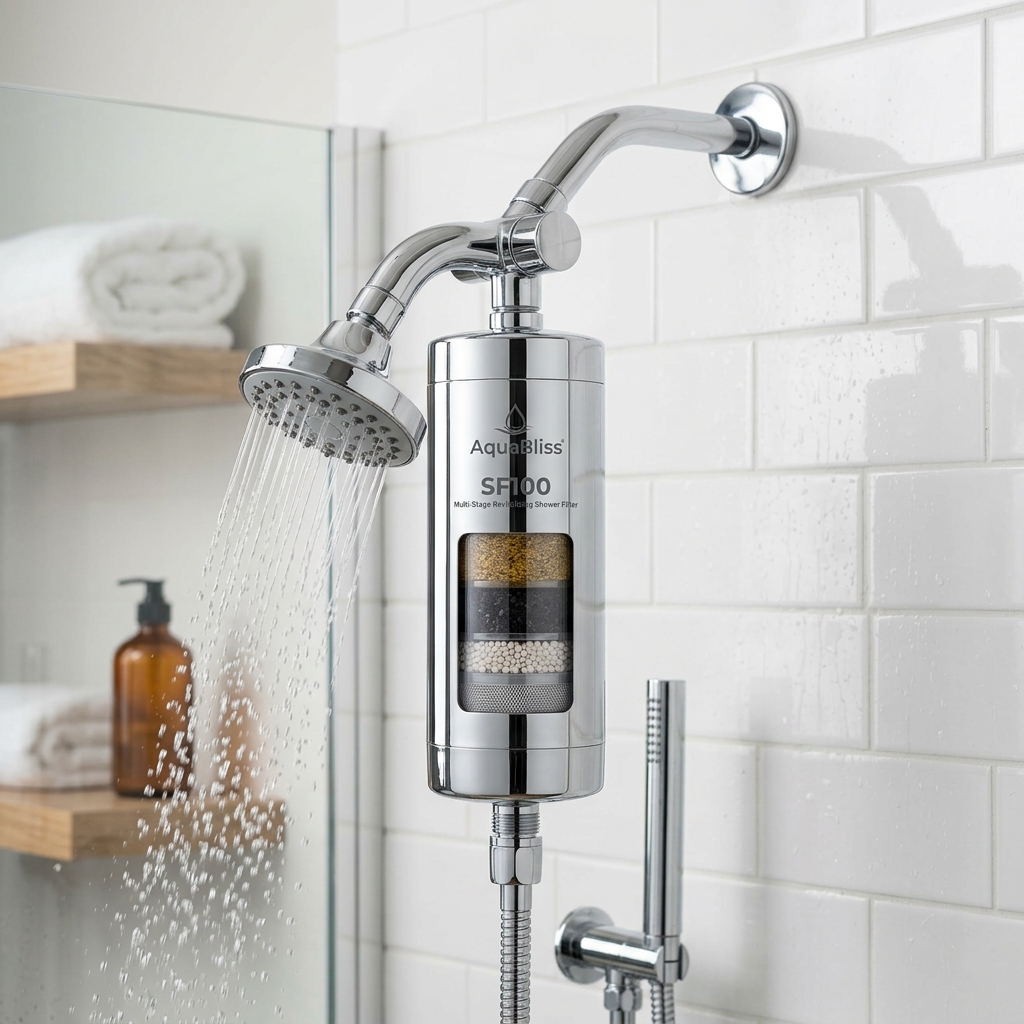
For a lower-cost inline trial
AquaBliss SF100 Shower Filter
$30 to $50 typical range
Try this if keeping your showerhead and minimizing the initial spend matter more than a verified percentage claim. The removable inline body can suit a rental with a standard fitting.
- Chlorine evidence
- Manufacturer states chlorine and sediment reduction; no current NSF/ANSI 177 certification or quantified model test is established here.
- Replacement
- Replace the SFC100 cartridge every three to six months, sooner with high sediment or chlorine.
- Installation
- Fits a standard half-inch shower connection between the arm and an existing showerhead.
- Water source
- Treated municipal water; confirm the disinfectant first
Sale-stopping flaw. The evidence is weaker than a certified free-chlorine claim. Its added vitamin C and mineral language should not be read as proof of skin benefit or water softening.
The AquaBliss SF100 Shower Filter source record explains the cartridge and maintenance claim.
The certified option we do not earn from
The Weddell Duo WD-100 with WD-100F cartridge is the clearest pick when verified free-chlorine reduction is the decisive condition. Its current NSF record specifies that claim at 2.0 GPM. The maker describes a tool-free inline installation that retains your showerhead, but its wider body needs clearance below the shower arm. We do not have an affiliate shopping link for it. The key limitation remains: its 177 listing says nothing about hardness, chloramine or microbial safety.
Count gallons before trusting the calendar
A pair of ten-minute showers at 2.0 GPM uses about 40 gallons a day. Over 90 days, that is about 3,600 gallons. Four such showers reach about 7,200 gallons. This is simple flow arithmetic, not a measured use study. The WaterSense showerhead specification caps labeled models at 2.0 GPM; your installed head can differ. Check its rated flow or time a measured bucket fill before using the calculation.
Jolie's 90-day cartridge rule applies regardless of a household's gallon estimate. AquaBliss gives a three-to-six-month range that depends on water quality, leaving less certainty about treated volume. Weddell's shorter maker capacity of 8,000 gallons would equal about 200 days at 40 gallons daily, but replace sooner if its instructions require it or performance changes. These figures help budget cartridges; they cannot verify contaminant removal at home.
Claims that should stop a purchase
AquaBliss SF100 sold as a hardness fix
Its listed media are calcium sulfite, redox media and activated carbon. That is not evidence that it removes dissolved hardness ions. USGS defines hardness by calcium and magnesium; test that measurement before paying for a supposed softening shower cartridge.
Jolie chlorine data sold as chloramine proof
The published percentage concerns chlorine. A utility using chloramine changes the question. EPA says chloraminated municipal water meeting standards is generally safe to shower in; its chloramine guidance offers no reason to infer that a free-chlorine result is a chloramine result.
Questions about shower filters
Will a shower filter soften hard water?
These cartridge shower filters do not establish removal of dissolved calcium and magnesium. If scale and poor soap lather are the problem, obtain a local hardness result and assess an ion-exchange softener sized for the home.
Does NSF/ANSI 177 mean a filter removes chloramine?
No. The standard addresses aesthetic free available chlorine reduction. Ask the manufacturer for a model-specific chloramine performance report if your utility uses chloramine.
Can I use a shower filter during a boil-water advisory?
Follow your utility or health department instructions. The models in this guide are not microbiological purifiers and do not make unsafe water safe to shower in when an advisory restricts bathing.
How do I estimate cartridge use for my household?
Multiply shower minutes by showerhead flow in gallons per minute and by showers per day. At two gallons per minute, two ten-minute showers use about 40 gallons daily, or about 3,600 gallons in 90 days. A calendar replacement limit can arrive before a gallon limit.
Match the treatment to the measured problem
For a utility using chloramine, the chloramine guide compares exact drinking-water claims. If scale is the issue, measure hardness before selecting a softener; a full review and specifications for the Fleck-based softener explain a whole-home option.