Contaminants guide
The Best Water Filters for Chloramine
Aquasana AQ-MF-1 is the strongest one-tap catalog pick, AquaTru Classic is the better no-plumbing option, and Clearly Filtered is the portable fallback when installation is impossible.
The market trap is treating a chlorine claim as a chloramine claim. Both can sit under NSF/ANSI 42, but the claims are separate and vary by product. A Standard 42 logo without the word chloramine does not settle the question.
CDC says utilities use low disinfectant levels to keep killing germs as water travels through pipes. It also says levels up to 4 mg/L are considered safe. Start with your utility report, not a health scare or a filter-media slogan.
Who should skip a consumer chloramine filter
Skip this purchase if your public water meets its disinfectant requirements and you have no taste, odor, or added-barrier goal. Stop shopping and follow the responsible agency if an advisory is active. Home dialysis and aquarium water also need purpose-specific treatment, not an ordinary drinking-water cartridge.
Four checks decide what belongs under your sink
The right product depends on the disinfectant, the water you want to cover, and the exact claim. Make these checks before comparing prices.
Confirm chloramine
Use the annual water quality report or ask the utility. Some systems switch between free chlorine and chloramine during the year.
Name the coverage
One-tap treatment covers drinking and cooking. Whole-home treatment is a different project with higher flow and much more media.
Find the exact claim
Match the system and replacement element to a chloramine line in a certifier listing or performance sheet. Chlorine alone does not count.
Respect rated service
Compare gallon capacity, time limit, and flow. Carbon reaction time and water chemistry matter more than a generic media name.
What matters when choosing chloramine filters
Check that your supplier uses chloramine, then look for that exact filter claim. Compare filling speed, cartridge life and replacement cost for the amount of water you use.
Fairey, Gerald Speitel, and Lynn Katz compared five granular activated carbons in two waters in the Journal of the American Water Works Association. Their fixed-bed study found that monochloramine destruction changed with carbon type and pH. It tested treatment mechanics, not these consumer products, but it explains why the word carbon is not a performance guarantee.
The certification line matters more than the badge
NSF describes chlorine and chloramine as separate claims available under NSF/ANSI 42. Product certification covers the claims actually listed, not every contaminant in the standard.
| Document wording | What it supports | What remains unknown |
|---|---|---|
| Certified for chloramine reduction | The exact listed system met the chloramine test conditions through rated service | Performance outside the listed flow, capacity, cartridge, or water conditions |
| Certified to NSF/ANSI 42 | Only the specific Standard 42 claims named for the system | Chloramine reduction when the listing names chlorine, taste, odor, or particulates only |
| Independent chloramine test | Performance under the stated challenge, endpoint, method, and sample | Ongoing certification, factory audit, or performance in your water unless separately documented |
| Catalytic carbon media | A plausible treatment mechanism that can improve chloramine reaction | The finished system result at its advertised household flow and service life |
Three catalog choices with different workloads
Affiliate disclosure: We may earn from qualifying purchases through retailer links. The comparison method and its limits show why exact certification receives more weight than an unverified media claim. Price ranges allow for normal Amazon offer changes.
For fast filtered water from the kitchen faucet
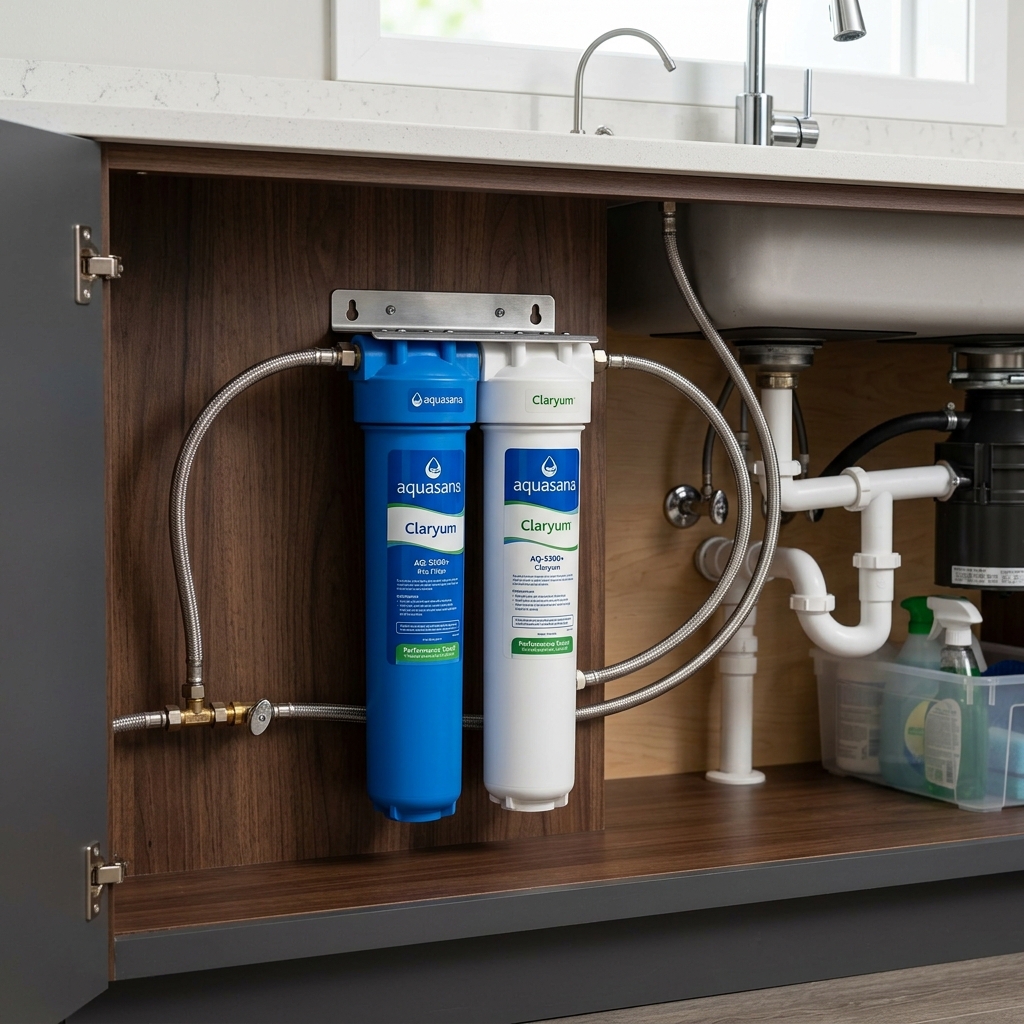
Aquasana Claryum Direct Connect AQ-MF-1
$110 to $180 price range
The AQ-MF-1 is the strongest catalog fit when you want chloramine reduction at the main kitchen faucet without the refill routine of a pitcher. Its chloramine claim is tied to the exact system, and its 1.5 GPM rated flow is much higher than gravity-fed service.
- Treatment
- Direct-connect carbon-based filtration
- Chloramine evidence
- IAPMO-certified NSF/ANSI 42 chloramine claim with 96.06% overall reduction
- Service basis
- 784 gallons or 6 months, whichever comes first
- Setup
- 1.5 GPM rated flow, cold-water line, existing faucet, no drain or power
Capacity example. At 2 gallons per day for drinking and cooking, 784 gallons equals about 392 days. The 6-month limit arrives first, so budget for two replacements per year.
Sale-stopping flaw. Every cold-water pour through that faucet consumes cartridge life, even when you only need filtered water for a glass or cooking pot. The unit also leaves showers and other taps untreated.
The claim boundary comes from the Aquasana Claryum Direct Connect AQ-MF-1 performance record.
For a renter who wants no-plumbing reverse osmosis
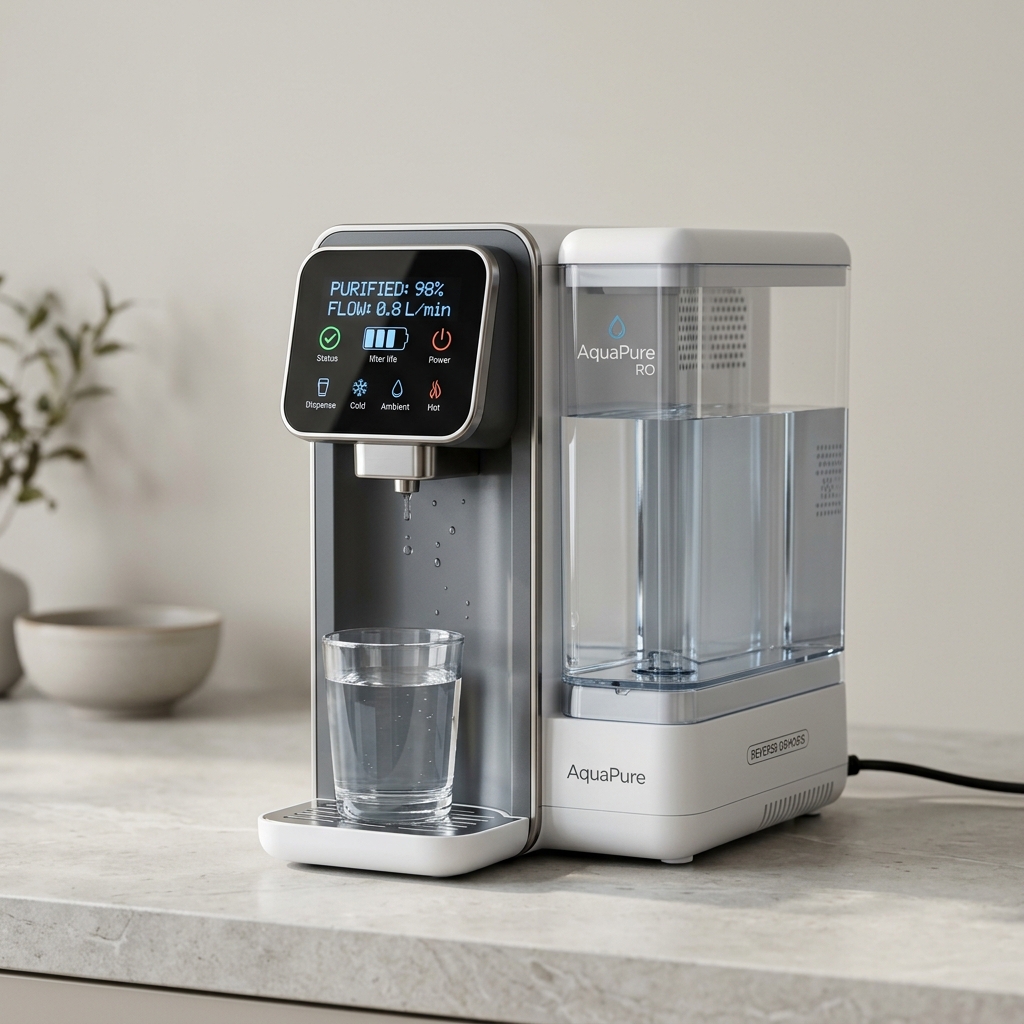
AquaTru Classic Alkaline Countertop RO
$400 to $550 price range
AquaTru Classic is the better catalog choice when plumbing changes are off limits or chloramine is only one of several dissolved-water concerns. Its performance sheet states a 3.0 mg/L chloramine challenge and 96% average reduction. That result implies about 0.12 mg/L under the test conditions, but it is not a promise for every tap.
- Treatment
- Countertop reverse osmosis with carbon prefiltration and a carbon finishing stage
- Chloramine evidence
- IAPMO-certified NSF/ANSI 42 result averaging 96% reduction from a 3.0 mg/L chloramine challenge
- Service basis
- Pre/carbon at 600 gallons or 6 months; VOC/mineral at 600 gallons or 12 months; RO at 1,200 gallons or 24 months
- Setup
- 120-volt outlet, manual feed tank, counter space, and concentrate disposal
Capacity example. At 2 gallons per day, the 600-gallon prefilter limit equals about 300 days. The 6-month time limit still controls, while the RO membrane reaches its 1,200-gallon rating in about 600 days under the same use.
Sale-stopping flaw. You must fill the source tank and discard concentrate. That daily handling makes this a poor fit for a busy household that wants filtered water on demand.
The claim boundary comes from the AquaTru Classic Alkaline Countertop RO performance record.
For portable drinking water when installation is impossible
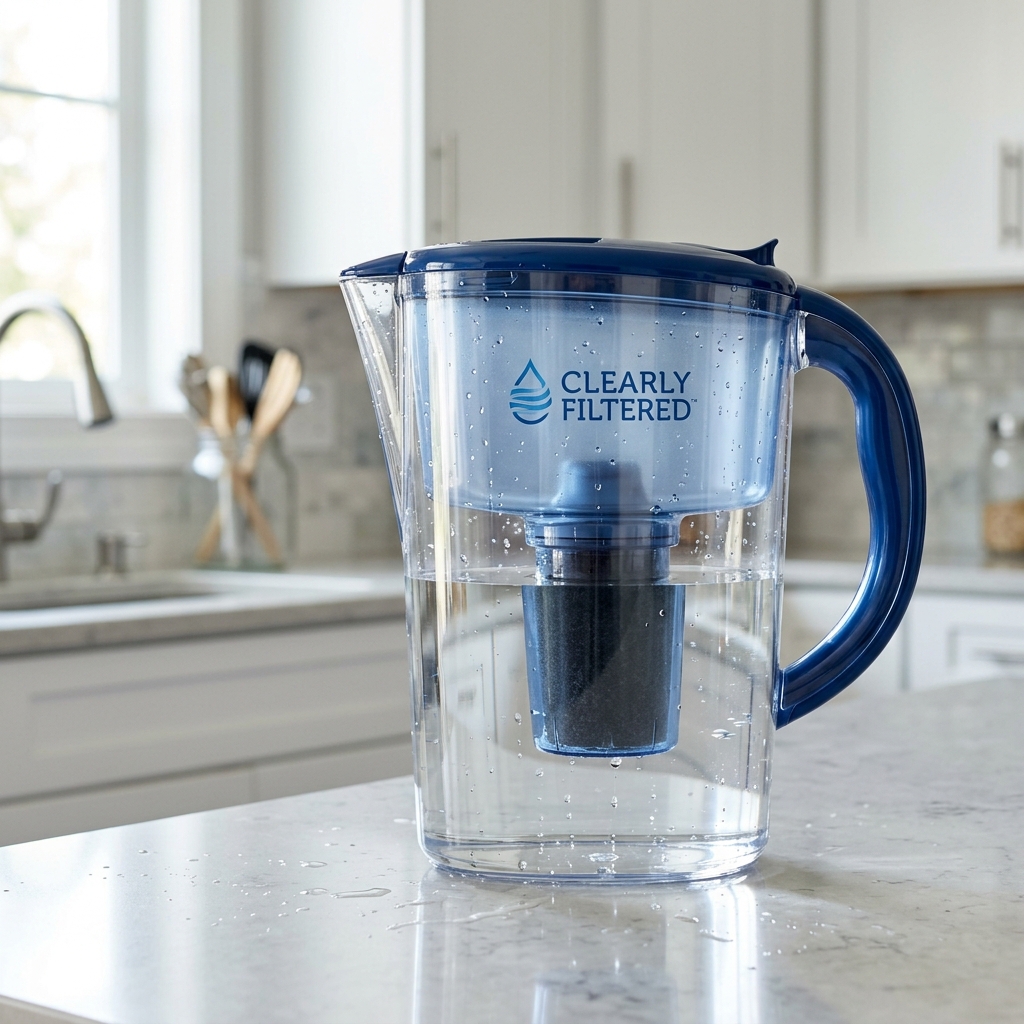
Clearly Filtered P-V3 10-Cup Water Pitcher
$90 to $120 price range
The P-V3 is the portable fallback when neither a cold-line connection nor a powered countertop unit will work. Its published laboratory table gives both the challenge and filtered chloramine concentrations, which makes the claim more useful than an unbounded marketing percentage.
- Treatment
- Gravity-fed adsorption media in a portable pitcher
- Chloramine evidence
- Independent laboratory result of more than 99.68% reduction from 3.1 mg/L to below 0.01 mg/L, separate from its NSF 42 and 372 certification
- Service basis
- 100 gallons or 6 months, whichever comes first
- Setup
- No installation; fill by hand and wait for gravity filtration
Capacity example. At 2 gallons per day, 100 gallons lasts about 50 days. That pace means roughly seven cartridges a year, so its low setup burden comes with the highest refill workload here.
Sale-stopping flaw. The chloramine result is a manufacturer-published independent lab test, not a certified chloramine claim. Gravity service is also the slowest option, and heavily contaminated water may shorten filter life.
The claim boundary comes from the Clearly Filtered P-V3 10-Cup Water Pitcher performance record.
Your daily volume changes the real cost
The gallon rating does not always set the replacement date. Time limits control the two certified systems at a 2-gallon daily assumption, while the 100-gallon pitcher reaches its volume limit first.
| Product | First controlling limit at 2 gallons daily | Planning refill range | Daily burden |
|---|---|---|---|
| Aquasana AQ-MF-1 | 6 months, before 784 gallons | About $70 to $110 yearly | None beyond normal faucet use |
| AquaTru Classic | 6 months, before 600 gallons for the pre/carbon filter | About $80 to $140 yearly | Fill the tank and discard concentrate |
| Clearly Filtered P-V3 | About 50 days at the 100-gallon rating | About $120 to $160 yearly | Refill and wait for each batch |
Carbon needs reaction time
Chloramine reduction is a reaction at the carbon surface, and movement through the particle pores can limit the overall rate. Faster water means less contact. Carbon formulation, particle structure, pH, source-water chemistry, and cartridge condition can all change the result.
That mechanism explains two useful buying rules. A micron number does not describe dissolved chloramine treatment, and a whole-house flow claim is not a chloramine claim. Large service tanks can create more contact time, but the exact design still needs performance evidence and a replacement or monitoring plan.
What else can work
Your utility report is the first non-affiliate tool. EPA's Consumer Confidence Report search identifies local annual water reports, and the report should name the disinfectant and its measured range. A utility phone call can clarify seasonal switches.
A professionally sized catalytic-carbon tank can cover showers and every tap when whole-home removal is the actual goal. Ask for the design flow, media volume, empty-bed contact time, chloramine challenge, and a sampling plan. A tank size or million-gallon slogan without those inputs is not a design.
What does not prove chloramine reduction
These catalog products can be useful for other jobs, but their current exact-model records do not earn a chloramine recommendation.
Brita Elite OB06 has a chlorine claim, not a chloramine claim
Brita's current Elite performance sheet reports 97.4% chlorine reduction from a 2.0 ppm challenge, but it does not list chloramine. The Brita Elite full review and specifications cover the lead, PFAS, and chlorine jobs the model can document.
The base iSpring WGB32B is not the chloramine variant
The catalog model uses two carbon blocks and has a 15 GPM peak-flow claim, but no finished-system chloramine test is documented in its current record. iSpring sells separately named chloramine configurations, which does not transfer their claims to the base unit. The base WGB32B review and model limits explain the distinction.
Jolie and AquaBliss shower filters do not have an exact chloramine record
A free-chlorine result cannot be carried across to chloramine. Neither catalog shower model has a chloramine-specific certification or finished-system performance sheet in the current record, so neither belongs in a chloramine roundup.
A TDS meter cannot measure chloramine
Total dissolved solids is an electrical-conductivity estimate. Chloramine can change without a meaningful TDS change, so a zero or low TDS reading does not verify disinfectant removal.
Special uses need separate treatment
Fish, reptiles, and amphibians should not live in chloraminated water. CDC says these animals absorb water directly into their bloodstream and advises a pet-store product that removes the disinfectant. Water left to sit can lose chlorine after a few days, but not chloramine.
Dialysis water is a medical-system requirement. Use the home machine instructions or manufacturer guidance. A consumer cartridge selected for taste and household drinking water cannot stand in for that treatment train.
Questions about chloramine water filters
What type of water filter removes chloramine?
Choose an exact system with a chloramine-specific performance claim. Carbon-based filters and reverse-osmosis systems can reduce chloramine, but media type alone does not prove performance. Match the exact model, rated flow, capacity, and replacement element to the chloramine claim.
Does NSF/ANSI 42 certification mean a filter removes chloramine?
No. NSF/ANSI 42 includes several optional aesthetic claims, including chlorine and chloramine. A certified product only proves the claims named in its listing or performance sheet, so look for the word chloramine beside the exact model.
Will letting tap water sit remove chloramine?
No. CDC says chlorine can dissipate after water sits for a few days, but chloramine does not. Aquarium water needs a treatment product labeled for chloramine, and drinking water needs a filter with an exact chloramine claim if you choose to reduce it.
Is chloramine in tap water unsafe to drink?
EPA and CDC say chloramine levels up to 4 mg/L are allowed and considered safe in public drinking water. A household filter is usually a taste, preference, or added-barrier purchase, not a substitute for utility disinfection or an answer to an active water advisory.
Can I use a chloramine water filter for home dialysis?
Do not rely on a consumer drinking-water filter for dialysis water. CDC says home dialysis users should follow the machine instructions or contact the manufacturer about water treatment because dialysis requires removal of chemical disinfectants.
How often should a chloramine filter be replaced?
Use whichever comes first, the model-specific gallon rating or time limit. Flow, source concentration, pH, competing compounds, and cartridge condition can change real performance, so health-critical applications need a separate monitoring plan.
Match the claim to the utility report
The filter finder can narrow the format after you confirm chloramine and decide between one-tap and whole-home coverage. Renters can compare reversible filter setups for rental kitchens. If the report also lists lead or disinfection byproducts, use the separate lead filter evidence comparison and VOC and trihalomethane claim guide.