Contaminant buying guide
The Best Water Filters for Copper
Choose the $200 to $480 Aquasana SmartFlow RO when you own the home and want a certified under-sink copper claim with broad treatment. Choose the $400 to $550 AquaTru Classic when you need the same type of certified claim without plumbing changes. A $25 to $45 Brita pitcher fitted with the 40-gallon Original OB03 cartridge is the lower-cost certified option, but its service workload is much higher.
A filter can lower copper at the glass, but it cannot repair the corrosion that put copper there. EPA regulates copper through a treatment technique with a 1.3 mg/L action level. The rule responds when more than 10 percent of sampled customer taps exceed that level, so the number is not a guarantee that every individual tap is below it.
The sales trap is a product wearing an NSF/ANSI 53 or 58 badge without copper on its exact claim list. NSF says certified copper filters are challenged at 3 mg/L and must reduce the result to 1.3 mg/L or less. The standard number alone covers many possible claims.
Who should skip a filter purchase
Skip the purchase until a laboratory result confirms the problem. Blue-green stains and a metallic taste can justify testing, but neither gives you a concentration. Ask for a copper result from the drinking tap and tell the laboratory whether you want to measure first-draw exposure, flushed water, or both.
Skip a drinking-water filter as the only response when a private well or spring feeds visibly corroding copper plumbing. The water chemistry can keep damaging pipes behind walls. A neutralizing treatment may be part of the repair, but pH, alkalinity, hardness, and metal results should set the design.
People with Wilson disease or another condition affecting copper metabolism should follow their clinician's advice and use finished-water laboratory results. A consumer filter comparison is not a medical exposure plan.
Four rules make the decision
Copper often enters after utility treatment through pipes and fittings. The copper contaminant profile separates source water from corrosion leaching.
Look for Copper in the performance table beside the exact model and replacement cartridge. NSF/ANSI 372 only addresses lead content in materials. It is not a contaminant-reduction claim.
Point-of-use treatment keeps copper pipe downstream from the filter to a minimum. Shower treatment has little value because ingestion, not skin contact or inhalation, drives the household exposure concern.
A filter protects drinking and cooking water while the utility, plumber, or water-treatment professional investigates corrosion. It should not become permission to ignore pinhole leaks or unstable water chemistry.
Three options fit three different homes
The comparison keeps the same decision fields across each option. The two shopping price bands are Amazon planning ranges, not live quotes. The Brita option is included without a shopping link because the cartridge code and listed pitcher combination matter more than a changing bundle page.
| Option | Copper evidence | Rated service | Installation | Sale-stopping limit |
|---|---|---|---|---|
| Aquasana SmartFlow RO | WQA-certified NSF/ANSI 58, 98% overall reduction | 365 gallons; multiple replacement stages | Under-sink tank, drain, dedicated faucet | Cabinet space, reject water, and plumbing work |
| AquaTru Classic | IAPMO-certified NSF/ANSI 58, 90.6% minimum and 95.2% average | 600-gallon pre and VOC filters; 1,200-gallon RO membrane | Countertop power and manual tanks, no plumbing | Large counter footprint and 10 gpg hardness limit |
| Brita Original OB03 | WQA-certified NSF/ANSI 53, 89% at pH 6.5 and 73% at pH 8.5 | 40 gallons or about two months | Compatible listed pitcher, no plumbing | Ten to 20 service days at two to four gallons daily |
What to check before choosing
Check the plumbing and water-test results before choosing a filter. Compare the exact copper claim, where the filter goes and how often it needs replacing.
A five-utility Environmental Monitoring and Assessment study found that water age and chemistry could raise or lower copper release depending on the site. Copper and lead did not reliably peak under the same conditions. That result supports contaminant-specific sampling and rejects the idea that one utility number describes every kitchen tap.
The installed pick for broad treatment
Affiliate disclosure: We may earn from qualifying purchases through retailer links. The comparison method and evidence limits explain how the products were assessed. Where a product has more than one retailer, you can choose where to check the current offer.
For a homeowner who wants daily convenience

Aquasana SmartFlow RO AQ-SFRO2-BN
$200 to $480 typical Amazon range
- Copper evidence
- WQA-certified NSF/ANSI 58 claim
- Published result
- 98% overall reduction; 1.3 mg/L requirement
- Rated capacity
- 365 gallons
- Operating range
- 40 to 100 psi; 40 to 100°F cold water
Why it fits. The SmartFlow performance sheet lists 98% overall copper reduction and a passing result under NSF/ANSI 58. The same exact system also carries claims for lead, both chromium forms, nitrate and nitrite, fluoride, arsenic, PFAS, TDS, and selected emerging compounds. That breadth makes the plumbing work worthwhile when the laboratory report names more than copper.
Sale-stopping flaw. It needs a storage tank, cabinet room, a drain saddle, and a dedicated faucet. Its 42.8% recovery rating means part of the feed becomes reject water. A renter or a kitchen with no safe installation path should not force this format.
Capacity math. Two gallons a day reaches 365 gallons in about 183 days. Four gallons a day reaches it in about 91 days. The replacement stages do not all share one interval, so service the exact cartridge set on its own schedule.
The no-plumbing pick for a rental
For a renter or a kitchen without a drain connection
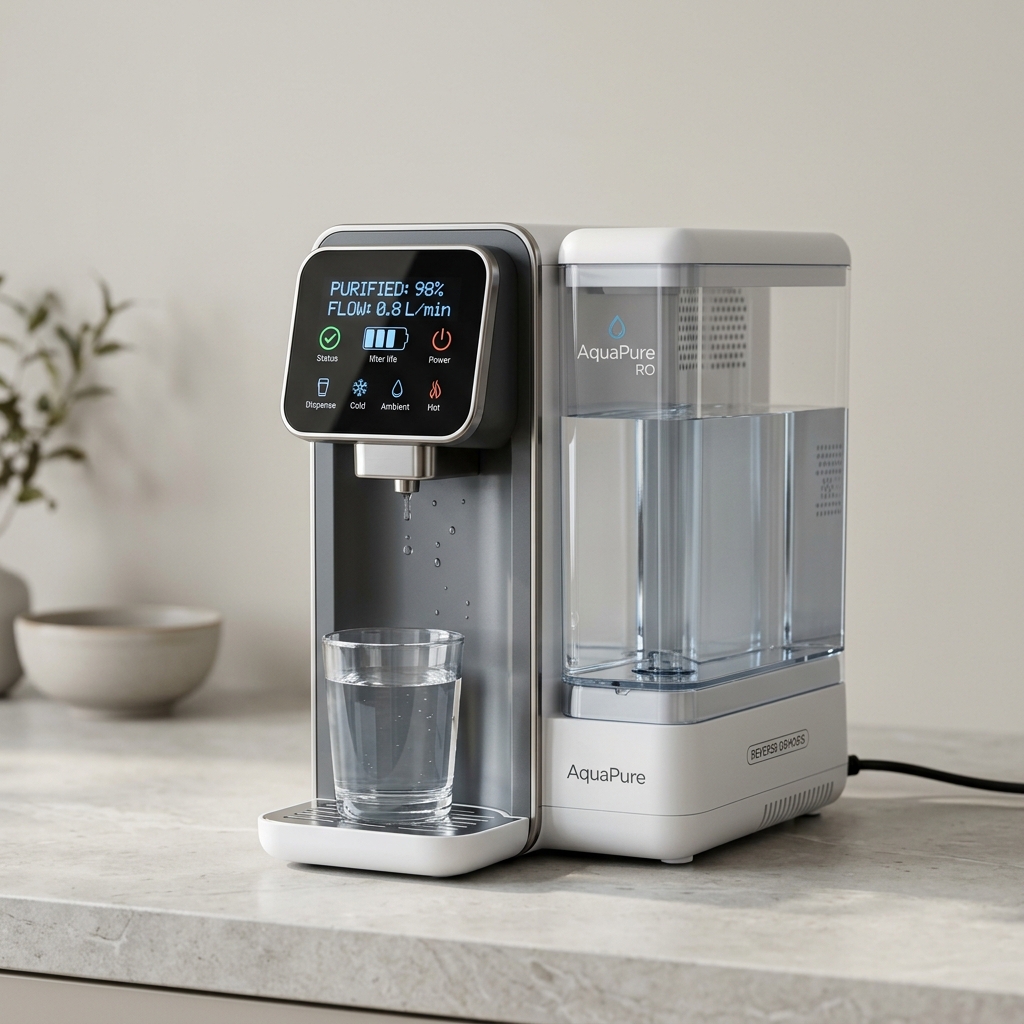
AquaTru Classic Alkaline Countertop RO
$400 to $550 typical Amazon range
- Copper evidence
- IAPMO-certified NSF/ANSI 58 claim
- Published result
- 90.6% minimum and 95.2% average reduction
- Rated service
- 600-gallon pre and VOC filters; 1,200-gallon membrane
- Source-water limit
- 10 gpg hardness unless softened first
Why it fits. The AquaTru performance sheet reports a 3 mg/L copper challenge, 90.6% minimum reduction, and 95.2% average reduction. It keeps the treatment at the point of use without altering the cold-water line, which suits a lease or a temporary corrosion response.
Sale-stopping flaw. The purifier needs power, clear counter space, manual feed-tank filling, and concentrate disposal. The maker warns against use above 10 grains per gallon hardness unless the water is softened first. That limit can disqualify the unit in a hard private-well home before price matters.
Service math. At two gallons a day, 600 gallons is about 300 days and 1,200 gallons is about 600 days. At four gallons a day, those figures fall to about 150 and 300 days. Water quality can shorten the intervals.
The countertop filter comparison covers tank handling, reject water, cleaning, and counter clearance for this format.
The uncommissioned budget option
For a small household that can manage frequent cartridges
Brita listed pitcher with Original OB03 filter
$25 to $45 typical Amazon range for a compatible pitcher bundle
- Copper evidence
- WQA-certified NSF/ANSI 53 claim
- Published result
- 89% at pH 6.5; 73% at pH 8.5
- Rated service
- 40 gallons or about two months
- Daily limit
- Maker says no more than two gallons daily for maximum efficiency
Why it fits. The Brita Original OB03 performance sheet lists certified copper reduction at both pH 6.5 and pH 8.5. It gives a household a low-commitment bridge while plumbing or water chemistry is investigated.
Sale-stopping flaw. The 40-gallon rating is tiny beside either RO pick. Two gallons a day reaches it in 20 days, and four gallons a day reaches it in 10 days while exceeding the maker's maximum-efficiency use guidance. A family filtering pasta water, coffee, ice, and drinking water can turn the cheap device into an expensive routine.
Match the OB03 cartridge to one of the system model numbers on the performance sheet. A Brita shell does not make every cartridge claim interchangeable.
The filter reduces exposure but not corrosion
Health Canada's copper technical review favors point-of-use treatment because copper can enter from household plumbing after water reaches the property. It also calls residential devices an interim measure rather than a permanent solution. That distinction matters more than the difference between two certified percentages.
Copper pipe release changes with pH, alkalinity, oxidants, stagnation, pipe age, and the scale already on the pipe wall. A private-water home may need a calcite contactor or chemical feed to raise pH and stabilize alkalinity. A public-water customer should involve the utility because corrosion-control changes can affect lead and other water-quality priorities.
Point-of-use treatment covers the water you swallow or cook with. It does not protect copper plumbing from pinhole leaks. It also does not need to cover showers because skin and inhalation are not meaningful copper exposure routes in the government review.
A paired sample tells you where to act
A single sample can confirm a concentration, but two properly planned samples can be more useful for diagnosis. Penn State Extension describes a first-draw copper sample after water has stood in the pipes for at least 12 hours. Follow the laboratory's containers, preservation, timing, and flush instructions instead of improvising the protocol.
| Pattern | Likely interpretation | Next action |
|---|---|---|
| First draw high, flushed sample lower | Household plumbing contact is a strong suspect | Use point-of-use protection and investigate fixtures, piping, and water chemistry |
| Both samples high | Source water or broader distribution conditions may contribute | Contact the utility or a private-water professional and expand the sampling plan |
| Both samples below the reporting concern | A filter may not solve a measured copper problem because one was not found | Keep the report and investigate other causes of taste or staining |
What does not prove copper reduction
Brita Elite. The current Elite claim list does not include copper. The cheaper Original cartridge has the relevant claim, which is why a familiar brand name cannot replace the cartridge code. The Brita Elite review documents what its 120-gallon cartridge is actually built to address.
Aquasana AQ-MF-1. Its exact performance sheet carries valuable lead, PFAS, VOC, chloramine, and emerging-compound claims, but it does not list copper. The AQ-MF-1 specifications show why broad NSF/ANSI 53 certification must be read claim by claim.
A TDS meter. Conductivity can show that dissolved ions changed, but it cannot identify copper or prove the finished concentration. Use a laboratory result for the named metal.
A generic carbon or sediment cartridge. Copper reduction needs the exact certified claim. Particle capture does not establish removal of dissolved copper, and chlorine taste certification does not fill the gap.
Copper filter questions
What type of water filter removes copper?
Choose an exact model certified for copper reduction under NSF/ANSI 53 or NSF/ANSI 58. Adsorption media that combine carbon with ion exchange, reverse osmosis, and distillation can qualify, but the technology name or a broad standards badge does not prove that a particular model carries the copper claim.
Does reverse osmosis remove copper from drinking water?
A reverse osmosis system can reduce copper when the exact model is certified for that claim. NSF/ANSI 58 copper testing uses a 3 mg/L challenge and a 1.3 mg/L maximum product-water concentration. Check the performance sheet rather than assuming every RO system has been tested for copper.
Do Brita filters remove copper?
The Brita Original OB03 and Brita Plus OB08 performance sheets list certified copper reduction, but the Brita Elite sheet does not. The pitcher shell and cartridge code both matter, so do not transfer a claim from one Brita filter to another.
How should water be tested for copper from plumbing?
Ask an accredited laboratory for instructions and explain that plumbing corrosion is the concern. A first-draw sample after water has stood in the pipes can capture a higher-exposure condition. A paired flushed sample can help distinguish household plumbing from source water, but the laboratory should set the exact sampling protocol.
Will a whole-house carbon filter fix copper pipe corrosion?
No. Ordinary whole-house carbon does not correct corrosive water, and copper can enter the water after a point-of-entry filter as it passes through household plumbing. A qualified water-treatment professional should design pH and alkalinity correction for a private supply. A utility must manage system-level corrosion control on public water.
Match the filter to the copper result and the plumbing plan
The finder compares copper with lead, hardness, installation limits, rental constraints, capacity, and the rest of your water report.