Buying guide
The Best Countertop Water Filters
Choose the AquaTru Classic for exact, model-level contaminant certification. Choose the Waterdrop A1 only when hot and chilled dispensing matters enough to accept a weaker certification record for reduction claims.
The trap in this category is treating “reverse osmosis,” “seven stages,” or a TDS display as proof that an exact appliance reduces your target contaminant through its full service life. Those features describe a mechanism or interface. They do not replace a model-specific certification and performance sheet.
CDC advises testing your water and matching treatment to the germ or chemical you need to address. If the tap already meets your goals, a countertop appliance may add expense, cleaning, and lost counter space without solving a health problem.
Who should skip both picks
Skip these reservoir-fed appliances during a boil-water or do-not-drink advisory unless the issuing authority specifically approves the treatment. Skip them for an untested private well, for whole-home protection, or when lifting a 17- to 38.5-pound unit and carrying water tanks is impractical. A simple certified pitcher or faucet filter can also be the better choice when the only goal is chlorine taste or one named contaminant that it covers.
Five rules separate useful evidence from appliance marketing
Choose RO only when its exact claims fit a measured concern or a clearly defined taste goal.
NSF/ANSI 58 covers RO systems, but each certified model still has a specific list of reduction claims.
Reservoir-fed units trade plumbing for lifting, filling, draining, and washing.
Include lid access, tank removal, the drip tray, the cord, and clearance below cabinets.
The concentrate remains in a tank. You must empty it instead of topping off the reservoir and sending concentrated water through another cycle.
The decision table
| Model | Best reason to buy | Reduction evidence | Daily tradeoff |
|---|---|---|---|
| AquaTru Classic | Certified claims for the exact model family | IAPMO certification plus a contaminant performance sheet | Manual fills, concentrate disposal, and weekly tank washing |
| Waterdrop A1 | 41°F to 203°F dispensing | NSF/ANSI 372 plus a separate third-party laboratory report | Large powered appliance, tank work, and hot-water safety |
What to check before choosing
Choose a countertop filter by the water concerns it covers, the space it needs and the tanks you will handle each day. Include replacement filters, power and leftover-water disposal in your decision.
NSF distinguishes material, aesthetic, health-effect, RO, and emerging-contaminant standards and warns that a standard mark does not mean a device reduces every contaminant. A household field study by Jerome Nriagu and colleagues in Scientific Reports found that point-of-use devices can become traps and reservoirs for deposits that support microbial growth. The study did not test either pick here. It supports the cleaning and replacement burden, not a comparison of these two models.
Two picks with different evidence ceilings
Affiliate disclosure: We may earn from qualifying purchases through retailer links. The comparison method and evidence limits explain how the options were assessed. Price bands are planning ranges, not live offers.
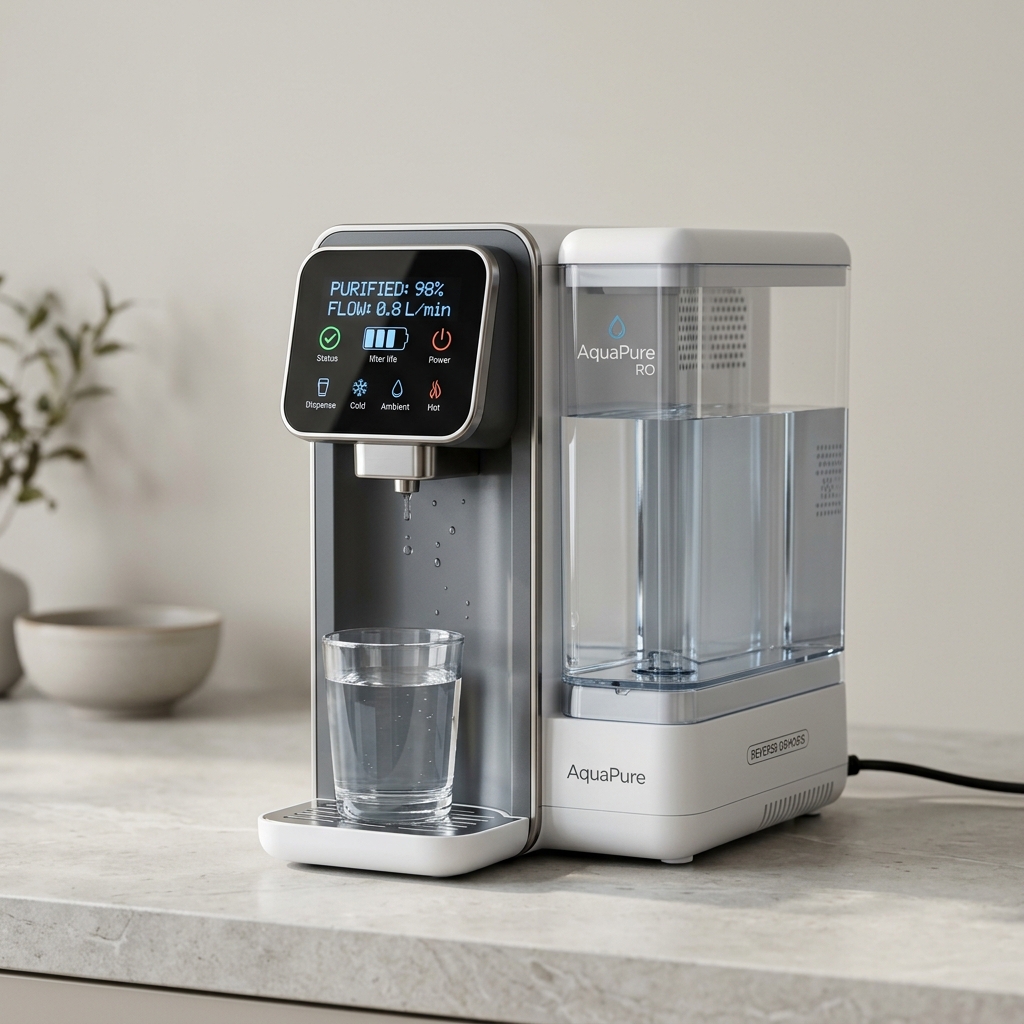
For the strongest model-level contaminant evidence
AquaTru Classic Alkaline Countertop RO
$400 to $550 typical range
Choose the AquaTru Classic when certified reduction claims matter more than temperature control. Its exact performance sheet covers the Classic model family and names individual contaminants rather than asking you to infer performance from the letters RO.
- Evidence
- IAPMO certified to NSF/ANSI 42, 53, 58, 401, and P473 for the claims in its performance sheet
- Output and reject water
- 0.75-gallon clean-water tank; maker reports 75% efficiency
- Service schedule
- Pre-filter at 6 months or 600 gallons; VOC filter at 1 year or 600 gallons; RO filter at 2 years or 1,200 gallons
- Counter envelope
- 12 by 14 by 14 inches; about 17 pounds
Sale-stopping flaw. The 0.75-gallon clean tank creates refill work for a busy household. You also need to empty the concentrated water after every cycle, wash both tanks weekly, and descale when hardness slows production. AquaTru says source water should stay below 10 grains per gallon hardness.
The AquaTru Classic specifications and certification link define the published configuration and limits.
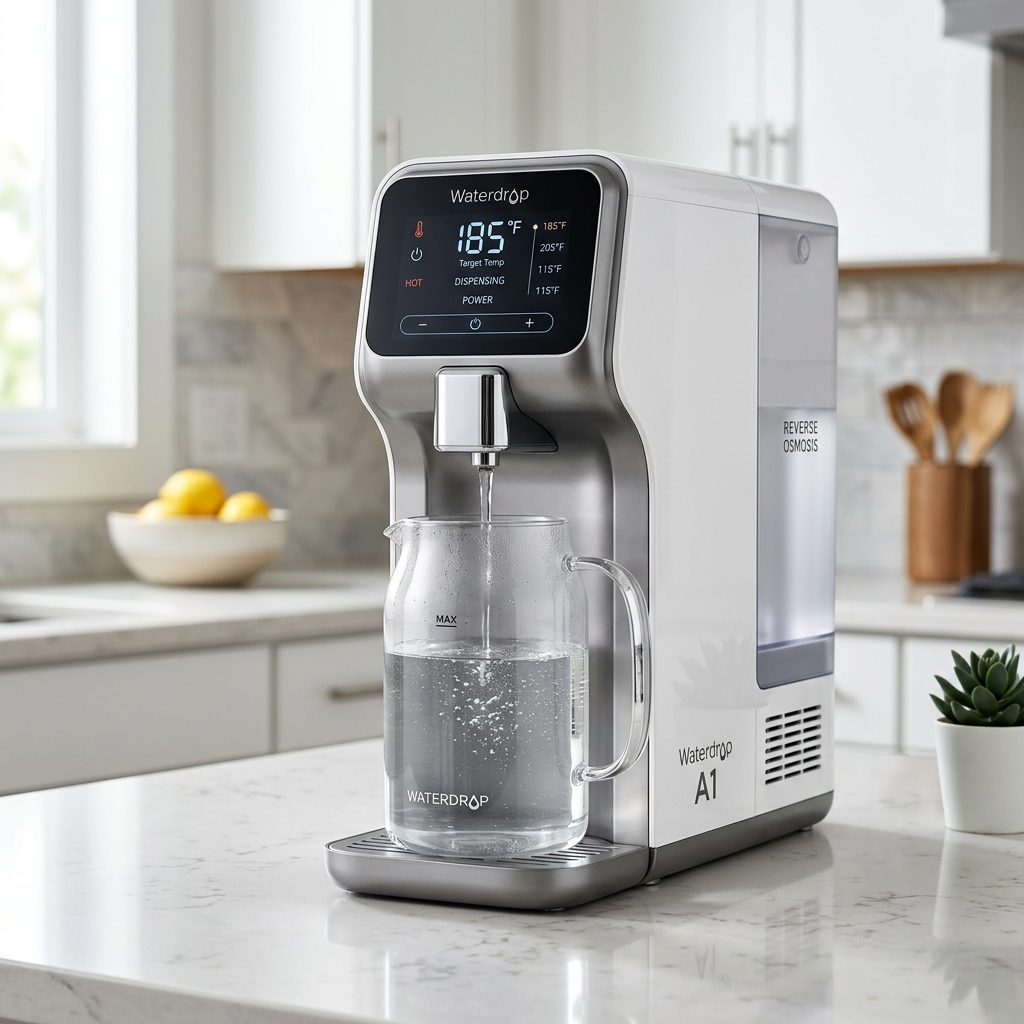
For hot and chilled water from one appliance
Waterdrop A1 Countertop Hot and Cold RO
$550 to $700 typical range
Choose the A1 when 41°F chilled water and water up to 203°F can replace a kettle and refrigerator pitcher. It provides preset temperature and volume controls, a child lock for hot dispensing, and no plumbing connection.
- Evidence
- NSF/ANSI 372 certified for lead content; contaminant reductions are in a separate third-party laboratory report
- Output and reject water
- 100 GPD maker rating; 2:1 pure-to-drain ratio
- Service schedule
- CF cartridge at 6 months or 550 gallons; RO cartridge at 12 months or 1,100 gallons
- Counter envelope
- 18.3 by 7.8 by 17.1 inches; 38.5 pounds
Sale-stopping flaw. NSF/ANSI 372 addresses lead content in product materials. It does not certify the A1 contaminant-reduction list. The separate report is useful, but it is not equivalent to a certifier listing that audits the exact claims through rated service life. The unit is also tall and heavy for a portable appliance.
The Waterdrop A1 specifications and laboratory report define the published configuration and limits.
Refill and reject-water math changes the winner
Assume your household drinks and cooks with exactly two gallons of treated water a day. AquaTru's 75% efficiency claim implies about 2.67 gallons of feed water and 0.67 gallon of concentrate each day, or about 244 gallons of concentrate a year. Its 0.75-gallon clean tank requires at least three batches to make two gallons available, so practical whole-cycle totals can be higher.
Waterdrop's 2:1 pure-to-drain claim turns the same two treated gallons into about one gallon of concentrate each day, or 365 gallons a year. That is a difference of roughly 121 gallons under the stated assumption. Neither number is a measured result in your kitchen. Feed-water chemistry, scale, cartridge condition, and the appliance's control cycle can change actual recovery. EPA defines RO reject water and explains why exact-system efficiency matters.
Counter space includes service space
AquaTru lists a 12-by-14-inch base, about 168 square inches. The A1's narrow 7.8-by-17.1-inch base uses about 133 square inches, but the 17.1-inch height and 38.5-pound dry weight can be the harder limit. Measure the outlet location and the clearance needed to remove each tank. Do not plan to slide a full appliance from under a cabinet every day.
Hot dispensing adds a child-safety decision. The A1 includes a child lock, but its 203°F maximum is near boiling. Put the unit where the control panel and cup platform cannot be reached or bumped by a child. AquaTru dispenses ambient-temperature water and has no heated-water hazard.
Maintenance is part of water quality
AquaTru tells owners to empty the concentrate after every cycle, wash the tanks weekly, and descale as needed. Its published cartridge ceilings split across 600- and 1,200-gallon stages. At two treated gallons a day, 600 gallons arrives in about 300 days, so the gallon limit can beat the one-year calendar limit on the VOC cartridge. The six-month pre-filter interval still arrives first.
Waterdrop rates the A1 CF cartridge at six months or 550 gallons and the RO cartridge at 12 months or 1,100 gallons. At the same two-gallon daily assumption, the calendar limits arrive before the gallon limits. Both manufacturers warn that source water and use can shorten service. A TDS display cannot prove that every named contaminant remains below a health target, so use the cartridge schedule and finished-water testing when the stakes justify it.
The purchase we recommend without earning a commission
Buy a certified laboratory test before a countertop appliance if you use a private well, have a building-plumbing concern, or need to verify a health contaminant. Use the utility's current consumer confidence report as the starting point for public water, then test at the tap when the problem could enter after the main. We earn nothing from the laboratory. The result can also show that a certified pitcher with no reject water or an under-sink system with less daily tank handling is the better fit.
Three claims that should stop the sale
A feature can be real and still fail the job. These are the exact boundaries that rule out a purchase.
Waterdrop A1 sold as NSF-certified contaminant reduction
The current A1 page lists NSF/ANSI 372 and separately links a third-party contaminant report. Standard 372 addresses lead content in materials. It does not certify the displayed reduction list. The full A1 review and specifications preserve that boundary.
AquaTru Classic used through a boil-water notice
The Classic performance sheet lists NSF/ANSI 42, 53, 58, 401, and P473 claims. It does not list NSF P231 or NSF/ANSI 55 microbiological treatment. Follow the issuing authority instead of extending chemical-reduction evidence to pathogens. The full AquaTru Classic review and specifications cover the certified claims.
An alkaline stage sold as a health treatment
A remineralization cartridge can change taste and add listed minerals after RO. It does not turn alkalinity into a treatment claim for an unrelated health condition. Buy the exact reduction performance you need, then choose the post-filter by taste preference.
Questions about countertop water filters
Do countertop reverse osmosis filters need plumbing?
Reservoir-fed models such as the AquaTru Classic and Waterdrop A1 do not. You fill a feed tank, plug in the appliance, and empty the concentrated water. Faucet-diverter countertop systems are a different format and do connect to a compatible faucet.
Does an NSF/ANSI 372 mark prove contaminant removal?
No. NSF/ANSI 372 addresses lead content in drinking-water system components. Look for the exact model and named reduction claim under a performance standard such as NSF/ANSI 53, 58, or 401.
Can a countertop RO system make well water microbiologically safe?
Do not assume so. Use a certified laboratory to test the well, then follow a treatment plan that addresses the detected organisms and the complete exposure pathway. Neither pick should replace a boil-water or do-not-drink instruction.
How much reject water does countertop RO produce?
It depends on the exact unit. At two gallons of treated water per day, a 75% recovery claim implies about 0.67 gallon of concentrate per day. A 2:1 pure-to-drain claim implies one gallon. Real results vary with feed water and maintenance.
Match the appliance to the water result
The renter filter guide compares other reversible formats. For a named contaminant, use the Guides hub to check exact-model evidence before choosing a countertop feature set.