Buying guide
The Best Water Filters for Microplastics
Start with how you want to use it: a pitcher for a lower-cost start, filtered water from your kitchen tap, or countertop reverse osmosis with no plumbing changes. Here is how to choose—and what each option costs to keep using.
PureWater Filter Finder Research · Updated · 10 min read
We may earn from qualifying purchases. Price ranges are budgets, not live offers. Choose the right model before comparing deals.
Which filter fits your home?
You do not need the most expensive filter to reduce microplastics. These three picks have a named result for a tested range of tiny plastic particles. The best fit depends on your space, budget and how often you want to refill or change filters.
Lower-cost start
Brita Elite pitcher
Good if you want no installation and do not mind filling a pitcher. Buy the Elite filter, not Standard.
See why it fits ↓Less daily refilling
Aquasana AQ-MF-1
Good if you can connect a filter under the sink and want water from the faucet you already use.
See why it fits ↓RO without plumbing
AquaTru Classic Alkaline
Good if you want reverse osmosis on the counter and can refill tanks, empty leftover water and plug it in.
See why it fits ↓Check your water first. Read your supplier’s water report or test your well. Follow any water advisory before shopping. A microplastics filter is not a substitute for fixing a known water-safety problem.
Compare the daily routine—not just the test percentage
| Your choice | Setup | Daily work | Main reason to skip |
|---|---|---|---|
| Brita Elite | No plumbing or power | Fill the pitcher and wait for water to pass through | Frequent refills would frustrate you |
| Aquasana AQ-MF-1 | Connect to the cold-water line; uses your faucet | No hand-filled tank | You cannot change plumbing, or need fluoride/nitrate reduction |
| AquaTru Classic Alkaline | Counter space and a power outlet | Fill, run a batch and empty the leftover water | Little counter space, no outlet, or no patience for tanks |
Our choice for fewer chores: AQ-MF-1, if the installation and replacement budget work for you. Our lower-cost starting point: Brita Elite. Pay more for AquaTru when its no-plumbing RO setup solves another need—not just to chase a larger number on a box.
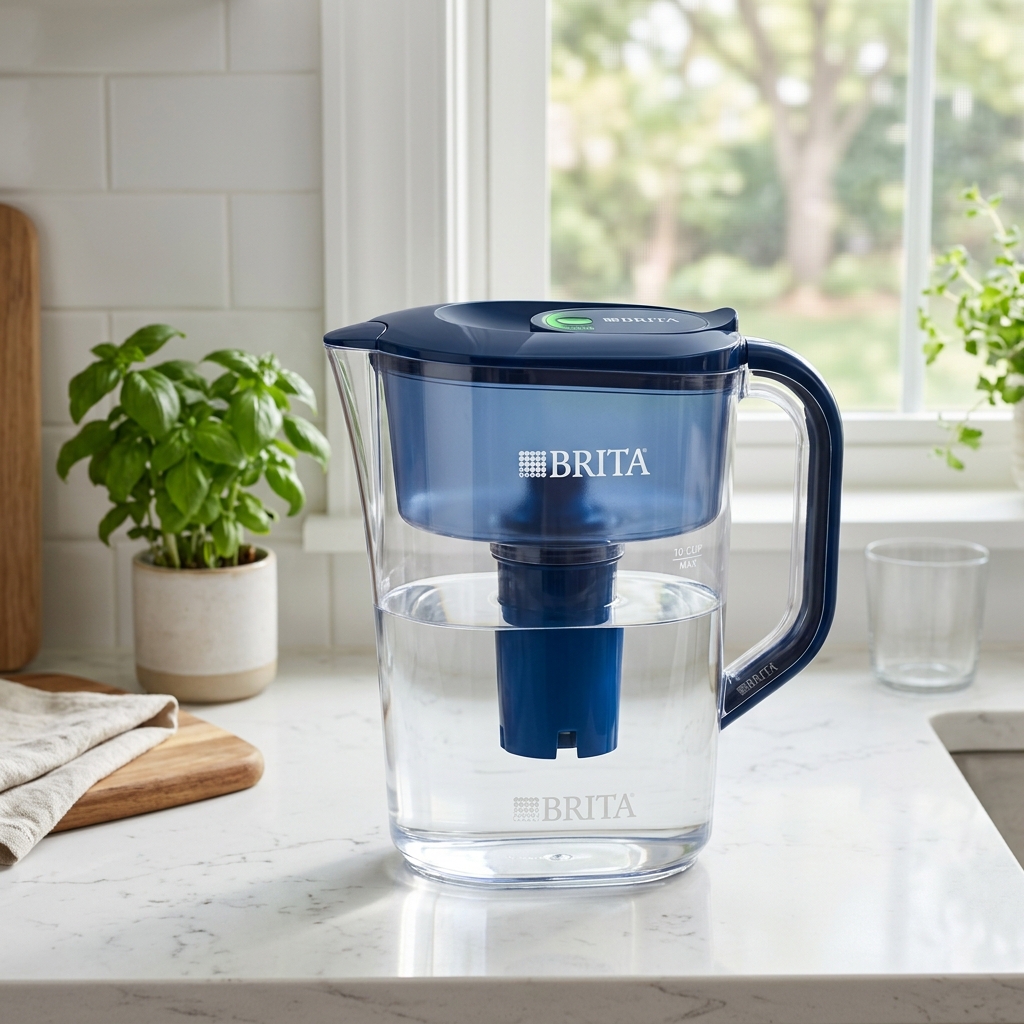
Brita 10-Cup Pitcher with Elite Filter
Typically $35–$60 · equipment only
Choose it if: you want a lower upfront cost, have no room for a machine, or cannot change the plumbing. The linked 10-cup kit includes an Elite filter.
What supports this pick: Brita’s Elite OB06 performance sheet reports 99.6% microplastics reduction for particles from 0.5 to 1 micron in the listed pitcher systems. The cartridge and pitcher model both matter.
Skip it if: you fill lots of bottles or cook with large amounts of filtered water. Hand filling can become a chore. This is not the choice for reducing fluoride or nitrate.
Before ordering: check that the kit includes the blue Elite cartridge. A similar-looking pitcher with a Standard filter is a different purchase.
Our buyer-fit assessment
Best starting point for everyday value
Good for: A household that wants better tap-water taste, a long rated cartridge life and no plumbing.
The tradeoff: It keeps many dissolved minerals. Buy the blue Elite cartridge, not an Original cartridge with a different claim sheet.
Before you buy: Confirm the pitcher model appears on the Elite sheet, especially if lead reduction is your reason to buy.
See our six buying checks and sources
Editorial judgments for Cold treated-city-water taste improvement; 1 gallon/day for one year; health claims checked separately by exact pitcher model. These are not lab scores or customer ratings. A missing fact stays unscored; we do not fill it in with a guess.
- Treatment evidence Strong point
- Model-specific sheet lists certified chlorine, lead and Class I particle claims. Check which claims cover the selected pitcher; no blanket all-PFAS promise.Source
- Water and size fit Meets the brief
- Cold potable water; manually filled batches. Not a treatment for an unsafe well or boil-water notice.SourceCompare document
- Setup Meets the brief
- No plumbing or power. Hand-wash, seat the filter and discard startup batches as directed.Source
- Upkeep Strong point
- 120 gallons or about six months, sooner if needed. One gallon daily reaches 120 gallons in about four months.Source
- Long-term cost Strong point
- At 365 gallons/year, a $35–$60 starter kit plus three $15–$25 replacements gives an $80–$135 first-year budget before tax/shipping. The starter is counted once. Not a live offer.SourceCompare document
- Warranty and returns Needs confirmation
- Check the written warranty shipped with the exact pitcher and the retailer return terms; FAQ and linked warranty versions should be reconciled before an overall score.Source
Checked . Assessment applies to 10-cup compatible pitcher + blue Elite OB06 cartridge.

Aquasana Claryum Direct Connect AQ-MF-1
Typically $110–$180 · equipment only
Choose it if: you want filtered cold water from your existing kitchen faucet, without filling tanks. It needs no power outlet or drain connection.
What supports this pick: the AQ-MF-1 performance sheet lists IAPMO certification, a 99.4% microplastics result for particles from 0.5 to under 1 micron, and a rated flow of 1.5 gallons per minute.
Skip it if: you need RO-style reduction of fluoride, nitrate or dissolved minerals. It filters one cold-water line, not every tap. All cold water used at that faucet also uses up filter capacity.
Before ordering: check the cold-water fittings and mounting space. The installation manual calls for three inches below the cartridge for changes. “No extra faucet” does not mean “no plumbing work.” Renters should get permission.
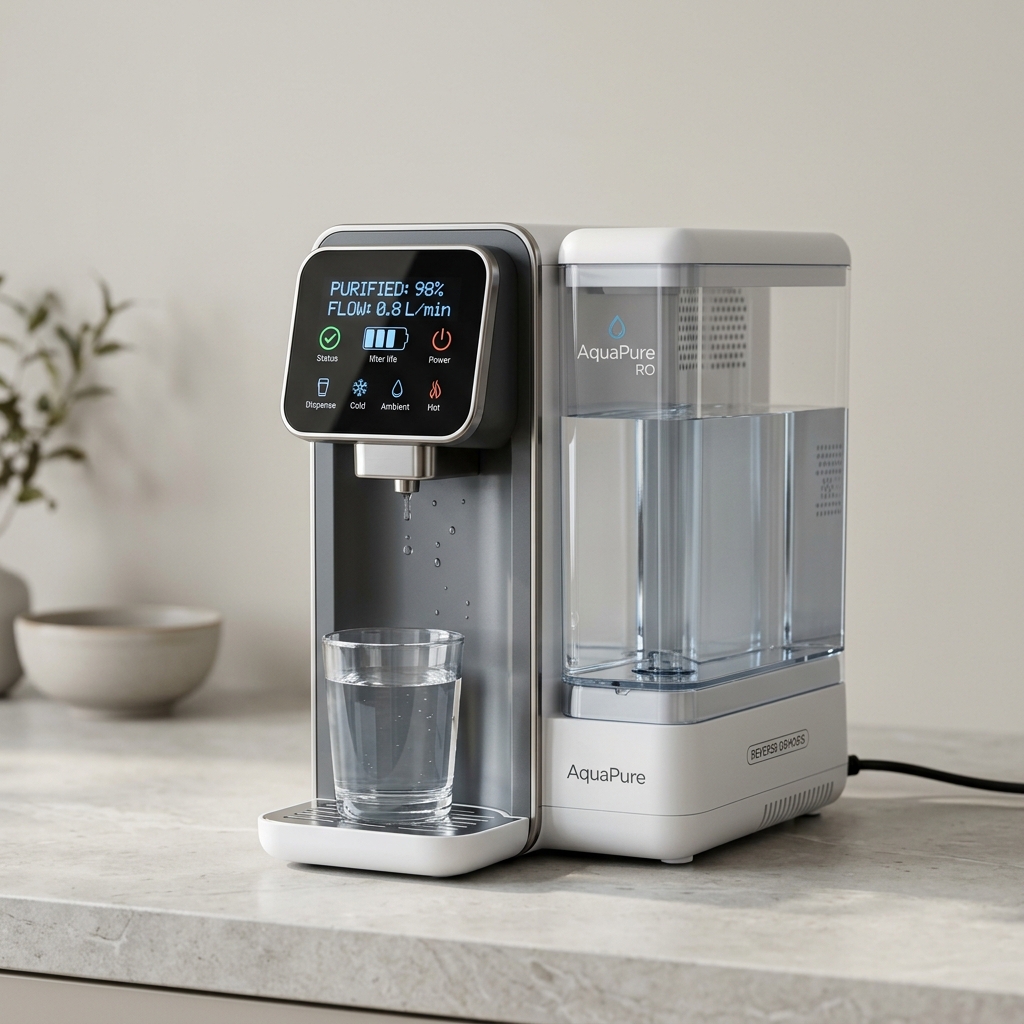
AquaTru Classic Alkaline Countertop RO
Typically $400–$550 · equipment only
Choose it if: you want reverse osmosis but cannot change plumbing. RO means water passes through a membrane that also reduces dissolved substances named in the system’s test sheet.
What supports this pick: the Classic performance sheet reports 96.48% microplastics reduction for particles from 0.5 to under 1 micron and lists IAPMO certification. It also names the Mineral Boost replacement filter used by the alkaline version linked here.
Skip it if: lifting tanks, running batches or emptying leftover water would put you off using it. The maker lists a 12-inch-wide, 14-inch-deep, 14-inch-high unit that needs power. Leave room to lift out the tanks.
Before ordering: check water hardness. The performance sheet advises against use above 10 grains per gallon unless the water is softened first. The alkaline finishing filter adds minerals for taste; do not pay extra for it expecting better microplastics removal.
What will replacement filters cost?
Budget for the filters you will use, not only the first kit. The examples below assume about one gallon a day for drinking and cooking. Prices are planning ranges checked against maker parts pages, not live offers. Installation, tax, shipping, water and power are extra.
Brita Elite
At a 120-gallon rating, one gallon a day uses four cartridges in the first year, including the one supplied. That means three additional filters.
At a planning range of $15–$25 per cartridge, allow $45–$75 for those three replacements. Count cartridges already included in a bundle.
Aquasana AQ-MF-1
Use the 784-gallon or six-month limit, whichever comes first. At one gallon daily, time arrives first.
Budget roughly $150–$200 per year for two cartridges at $75–$100 each. The included cartridge covers the first cycle; the exact first-year bill depends on when you buy replacements.
AquaTru Classic Alkaline
The pre/carbon filter lasts six months or 600 gallons; the alkaline VOC filter, 12 months or 600 gallons; the RO filter, 24 months or 1,200 gallons. Use the earlier limit.
Allow roughly $120–$170 a year averaged over time, including a share of the RO replacement. You will not buy every part each year.
If you use more: at two gallons a day, Brita’s 120-gallon rating lasts about 60 days. Plan seven cartridges from new across a full year, or six additional filters if one comes with the pitcher. Aquasana’s six-month limit still comes before 784 gallons at that use. Heavy faucet use beyond drinking and cooking can change that.
Five checks before you spend money
- Name the job. Is it drinking and cooking, another measured water problem, or every tap? Do not buy a whole-house system for a one-tap job without a reason.
- Check the exact model. Find “microplastics” in its performance sheet, not only a general NSF badge. NSF explains how to verify certification.
- Measure the space. Include room for cartridge changes, lifting tanks and opening lids—not just the unit’s footprint.
- Price the next filters. Check the right cartridge, pack count and both time and gallon limits. An inexpensive kit can cost more to keep using.
- Choose a routine you will keep. A pitcher that stays empty or an overdue cartridge is not a useful purchase.
What the test results tell you
Microplastics are small bits of plastic. The three results above cover a much narrower size range: roughly 0.5 to 1 micron. That is far smaller than a grain of sand. None of these results proves that every smaller particle is removed.
The reported reductions—99.6% for Brita, 99.4% for Aquasana and 96.48% for AquaTru—come from each product’s linked sheet. They are not a head-to-head test. Do not choose by the decimal alone: setup, replacement cost and daily use may matter more to your decision.
We chose these options by the named microplastics evidence, the home setup they suit, the work they need and the cost of keeping them running. We do not rank a product higher because it has more filter stages or a more expensive price tag.
What about health? Finding particles is not the same as proving that a filter will improve your health. The FDA describes major gaps in the evidence. Buy for a clear water goal, not a promise of zero plastic exposure.
What about other brands? A pore-size label, a zero TDS reading or a whole-house carbon claim does not replace an exact microplastics result. That is why we have not added extra products just to make a longer list.
For more help, use the pitcher-only microplastics decision and cartridge-cost examples, choose a rental setup by permission, space, and daily work, or decide when reverse osmosis earns its added cost for microplastics. Households buying cases can compare bottled-water spending with a safe filtered-tap plan. Homeowners considering an equipment-room system can compare whole-house flow and cost with drinking-water treatment. If your report lists another concern, check that exact claim too.
Bottled-water context: NIH’s summary of a three-brand study explains why a result from one study should not be treated as a count for every bottle.
Questions you may ask next
Do I need reverse osmosis just for microplastics?
No. Brita Elite and Aquasana AQ-MF-1 have named microplastics reduction results without reverse osmosis. Consider reverse osmosis when your water report points to other concerns that the exact system also covers, or you want fewer dissolved minerals.
Does any Brita filter remove microplastics?
No brand-wide claim applies. The result here belongs to the blue Elite OB06 filter used with the compatible pitcher systems listed in its performance sheet. Do not assume a Standard filter has the same claim.
Will these filters remove all nanoplastics?
These results do not prove that. The sheets cover a stated particle-size range, around 0.5 to 1 micron. A micron is a tiny unit of length. Smaller particles fall outside that tested range, even when an ad uses the word nanoplastics.
Can a zero TDS reading prove there are no microplastics?
No. A TDS meter estimates dissolved salts and minerals from an electrical reading. It does not count plastic particles. Choose from the exact filter performance sheet, not the number on a meter.
Is a whole-house filter worth buying just for this?
Start with where you want filtered water. A pitcher or kitchen filter may meet a drinking-and-cooking goal at lower setup cost. A whole-house system needs its own microplastics evidence at the flow your home uses. A sediment-filter label or softener is not enough proof.
Can I use these filters on untreated well water?
Do not assume so. Test the well first and deal with any germs or other measured problems. A microplastics claim does not make a filter a full well-water treatment system. Follow the exact model’s water-quality limits.
How often will I buy replacement filters?
It depends on both use and time. Aquasana AQ-MF-1 uses a 784-gallon or six-month limit. AquaTru has separate limits for its three cartridges. Brita Elite is rated for 120 gallons, described as about six months for an average family. At one gallon a day, it reaches 120 gallons in about four months.
Is bottled water always the better choice?
No. Researchers have found plastic particles in bottled water too. Counts vary with the study and what sizes it can measure. Use local water-safety advice and your water report to decide whether treated tap water and a suitable filter fit your needs.
Which one should I buy if I rent?
Choose Brita Elite for a lower-cost start, or AquaTru Classic if you want countertop reverse osmosis and have space and power. Both avoid plumbing changes. Aquasana AQ-MF-1 connects to the cold-water line and needs mounting, so check your lease and get permission first.
Still deciding? Start with your home and water.
The finder narrows the choices by water source, space, budget and the problem you want to fix.