Buying guide
Bottled Water or Filtered Tap Water for Microplastics?
Switch to filtered tap when your tap is safe, the exact filter has the claim you need, and the routine costs less than your own bottle habit. Keep bottled water for an advisory or unsafe supply when local guidance calls for it.
PureWater Filter Finder Research · Updated · 19 min read
We may earn from qualifying purchases. Price ranges are budgets, not live offers. Choose the right model before comparing deals.
Check tap safety before you compare plastic
Filtered tap is usually the better daily plan for a bottled-water buyer with safe public water. It avoids buying a new single-use container for every drink, and several exact filters publish microplastics results. Bottled water is not a proven plastic-free choice.
The warning comes first. Do not switch because of one plastic-particle headline if your tap has a boil-water or do-not-drink notice. A microplastics filter does not turn unsafe water into safe water. It also does not treat every chemical or germ.
EPA says each community water system must send an annual Consumer Confidence Report. The report lists the source, regulated contaminants found, violations, and actions taken. It is the starting point for public water, even though it does not give you a routine microplastics count.
Decide whether filtered tap fits your home
- Water source
Use the utility report for public water. Test a private well. Follow an active notice before choosing any filter.
- Measured problem
Match lead, PFAS, nitrate, fluoride, germs, or another concern to the same exact model. A microplastics row proves only its stated job.
- Household demand
Count the water used for drinking, bottles, coffee, ice, and cooking. That daily total controls refills and cartridge life.
- Installation limits
Choose a pitcher for no installation, a countertop unit for no plumbing, or an under-sink filter only when the connection and cabinet fit.
- Upkeep and budget
Use your bottle receipts, the equipment range, the right replacement part, and the earlier of the time or gallon limit.
- Desired outcome
Aim for safe water and a routine you will keep. No option here proves zero plastic exposure or a health benefit.
EPA notes that private wells are not regulated under the Safe Drinking Water Act. Well owners need to check safety before treating a narrower concern. A bottle can be a short-term safe-water source, but it should not hide an untested well or a treatment failure.
What bottled-water studies can and cannot tell you
A 2024 PNAS study used stimulated Raman scattering microscopy on three unnamed bottled-water brands. It estimated an average of about 240,000 identified plastic particles per liter across those samples, with large variation. It did not test tap water or any home filter. The number cannot be assigned to your brand, bottle size, or lot.
A newer Science of the Total Environment study compared four treated-water plants with six bottled-water brands. It detected particles from 300 nanometers to 42.3 microns and found higher particle concentrations in the bottled samples, especially among smaller particles. That is a useful direct comparison, but it covers one set of plants and brands. It does not prove that every tap beats every bottle.
John J. Lenhart, PhD, joined Ohio State in 2003 and studies microplastics in natural and engineered water systems. He was the senior author of the newer comparison. The paper reports NOAA Ohio Sea Grant support and no brand funding. Its method is stronger evidence than a bottle label, but it still did not test the three household filters below.
Evidence limit This comparison does not publish a numerical product score. The studies used different particle methods, and the product sheets use their own challenge water. A percentage from a filter sheet and a count from bottled water are not a head-to-head test.
Choose the lightest filter that fits the water
NSF tells buyers to start with the local water report and check the claims for the exact product. A general NSF/ANSI 401 mark does not mean every model has the optional microplastics claim.
| Decision | Brita Elite | Aquasana AQ-MF-1 | AquaTru Classic |
|---|---|---|---|
| Best fit | Lowest setup cost and no installation | Fast faucet use without hand filling | No-plumbing RO for another measured need |
| Microplastics result | 99.6% | 99.4% | 96.48% |
| Stated particle band | 0.5 to 1 micron | 0.5 to under 1 micron | 0.5 to under 1 micron |
| Equipment range | Typically $35 to $60 | Typically $110 to $180 | Typically $400 to $550 |
| Main work | Fill and wait | Install, check for leaks, and replace on time | Fill, run, empty, and wash tanks |
| Sale stopper | Refills will not keep up with daily use | Plumbing, cabinet, or leak risk does not fit | No second reason for RO or no counter space |
The three percentages are not rankings. Each model has a different setup and test record. Choose on water fit, daily volume, installation, and the work you can keep doing.
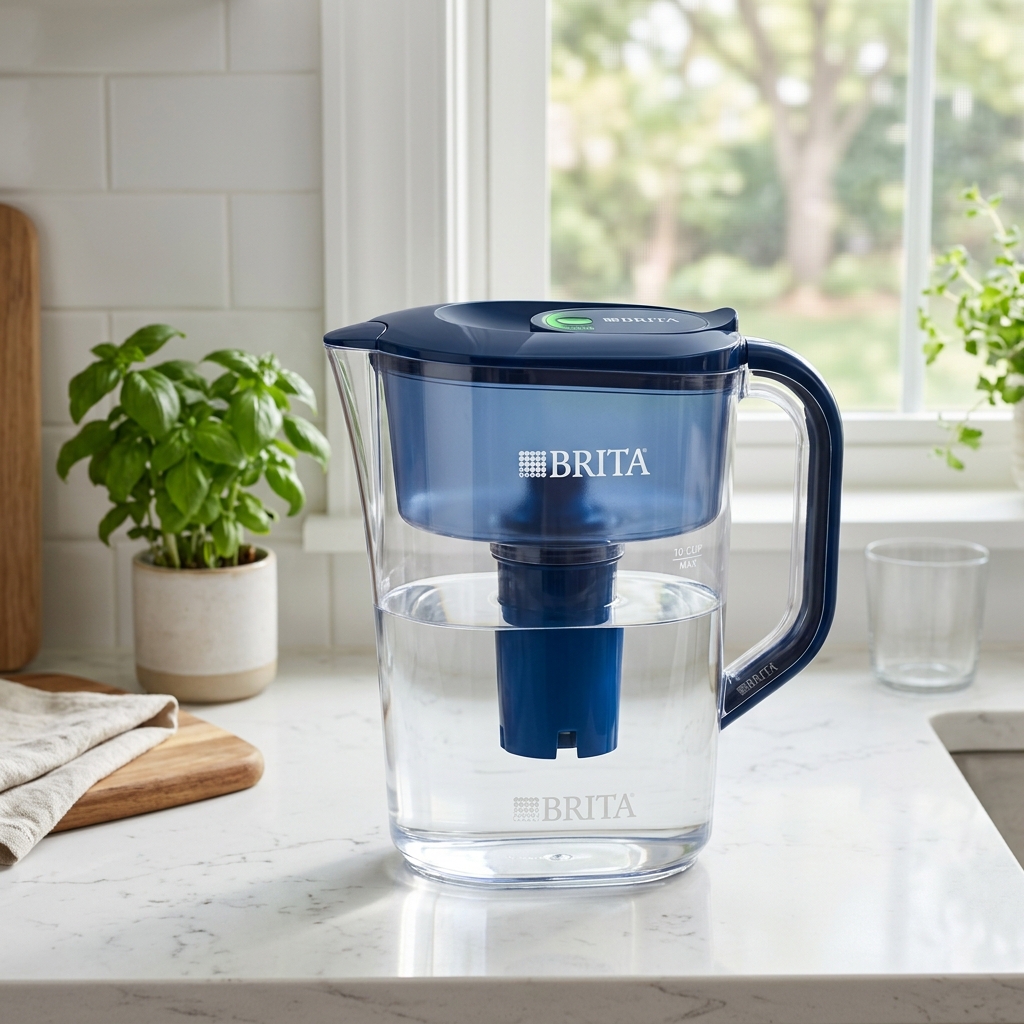
Brita 10-Cup Pitcher with Elite Filter
Typically $35–$60 · equipment only
Choose it if your public tap is safe, you want the lowest-cost start, and one or two gallons of daily filtering will not make the pitcher routine fail.
What supports the choice The Brita Elite OB06 sheet reports 99.6% reduction for microplastics from 0.5 to 1 micron in the listed pitcher systems. It sets a 120-gallon limit, about six months for an average family, and no more than two gallons processed daily.
What costs the sale One gallon daily reaches 120 gallons in about four months. That means four cartridges from new across a 365-day year. Heavy cooking or several bottle fills can turn the lower purchase price into too much waiting.
Before ordering Confirm the kit has the blue Elite OB06 cartridge and a system named in the sheet. Brita Standard OB03 does not inherit this result.

Aquasana Claryum Direct Connect AQ-MF-1
Typically $110–$180 · equipment only
Choose it if you own the home or can make the cold-line connection, want water from the existing faucet, and need faster daily service than a pitcher gives.
What supports the choice The AQ-MF-1 sheet reports 99.4% microplastics reduction for 0.5 to under 1 micron particles. It names replacement AQ-MF-1-R, a 784-gallon capacity, 1.5 GPM flow, and IAPMO certification for the listed claims.
What costs the sale Every cold gallon from that faucet uses capacity. The unit does not reduce fluoride, nitrate, or dissolved minerals like RO. A loose fitting can damage the cabinet.
Before ordering The manual calls for a cold-water adapter, mounting, a 15-minute flush, and leak checks. It sets replacement at 784 gallons or about six months. Measure the fitting and service space first.
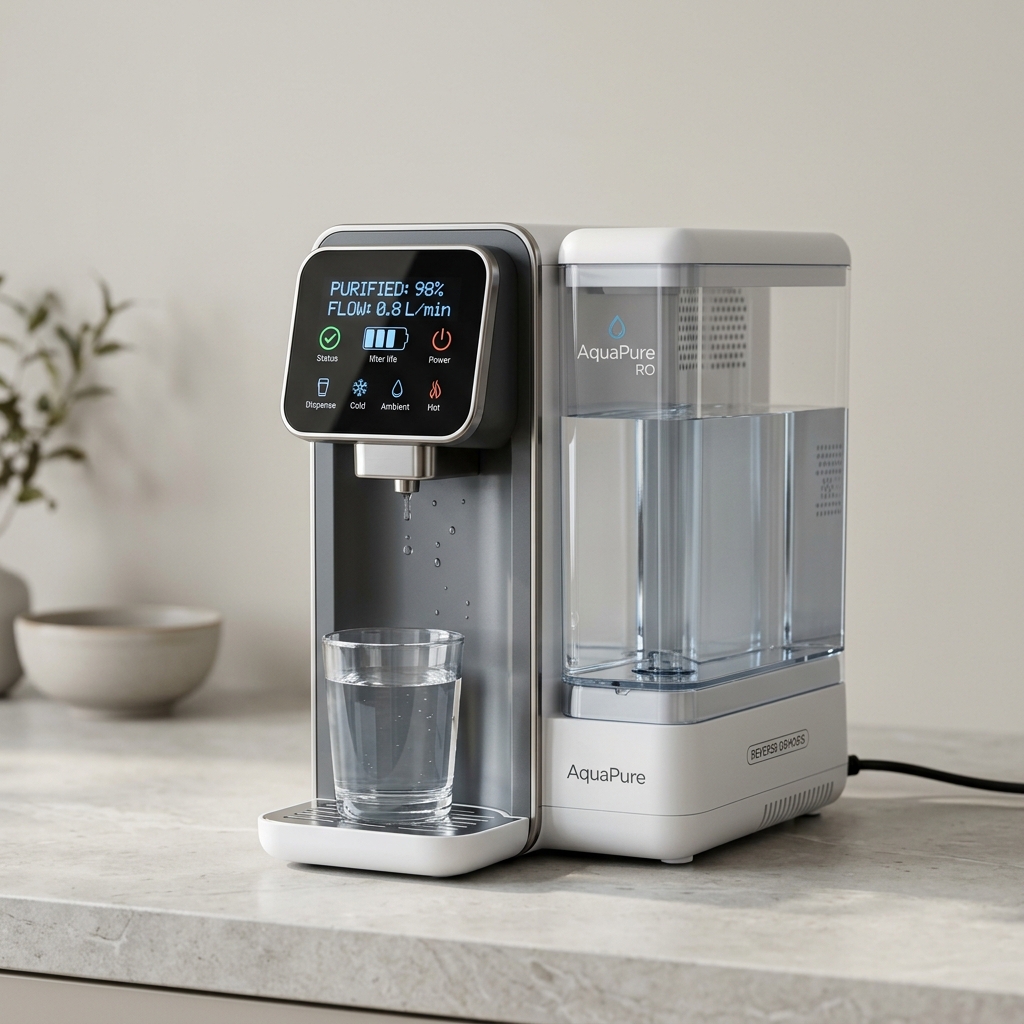
AquaTru Classic Alkaline Countertop RO
Typically $400–$550 · equipment only
Choose it if another contaminant on its exact sheet makes RO useful, plumbing changes are off the table, and tank handling fits your kitchen.
What supports the choice The AquaTru Classic sheet reports 96.48% reduction for microplastics from 0.5 to under 1 micron. It also lists broader dissolved-contaminant results, 600-gallon limits for the prefilter and finishing filter, and a 1,200-gallon membrane limit.
What costs the sale Microplastics alone do not justify a large RO machine. Each batch needs feed water, power, and concentrate disposal. The performance sheet advises against water above 10 grains per gallon unless it is softened first.
Before ordering The maker lists a 12 by 14 by 14 inch body, a 0.75-gallon clean-water tank, and 120-volt power. Leave room to lift the tanks and open the lid, not only the footprint.
Use your receipts instead of a savings promise
Add four weeks of bottle purchases, including delivery fees and deposits. Multiply that total by 13. This gives a planning year without pretending that every household buys the same brand, pack, or amount.
| Step | Worked example | Replace with your number |
|---|---|---|
| Bottle spend | Two $7.50 cases weekly equals $15 each week | Use the checkout total from your receipts |
| One-year bottle plan | $15 times 52 equals $780 | Four-week total times 13 |
| Water volume | Two 24-packs of 16.9-ounce bottles equal about 6.3 gallons weekly | Count every person, plus cooking and ice |
| Filter comparison | About 330 bottled gallons yearly is close to a one-gallon-daily filter plan | Compare the same water volume and first-year costs |
The example supports a filter budget, not a universal savings claim. Brita starts lower but asks for four cartridges from new at one gallon daily. AQ-MF-1 has a higher setup range and a six-month replacement clock. AquaTru costs more and earns that cost only when its wider RO record solves another need.
Do not call any option plastic-free. These filters use plastic parts, and the bottled-water studies did not test their output. The complete-system sheets show reduction across a narrow particle band. Keep the housing clean, use the exact replacement, and change it on time.
Keep bottled water for the right short-term job
Bottled water remains useful when the utility, health department, or emergency notice tells you to use it. It can also bridge the time while a private well is tested or a known treatment problem is fixed. Follow the named source, container, storage, and expiration instructions in that notice.
Routine bottled water is a weak fix for taste alone when safe tap water and an exact filter fit the home. A bottle-brand change also does not prove a lower plastic count. The three-brand PNAS study kept brands unnamed, and the six-brand comparison found variation rather than one number for the market.
Claims and shortcuts that do not settle the choice
- “Purified” on a bottle does not provide a microplastics count or promise no plastic from treatment, filling, the cap, or the container.
- A filter stage count does not prove a microplastics claim. Find the exact model, replacement element, particle band, and result.
- A membrane pore size leaves out the complete housing, seals, bypass, filter age, and particles introduced after treatment.
- A TDS meter responds to dissolved ions. It cannot identify or count plastic particles.
- A 99% number without a size band cannot be compared with these 0.5-to-1-micron results.
Stop the switch when the safety or routine fails
- Active advisory Use the water source and treatment method named by local officials. A normal household filter may not be enough.
- Unknown private well Test before shopping. Microplastics can be a smaller concern than germs, nitrate, arsenic, or another measured hazard.
- Wrong exact model Match Brita Elite OB06, Aquasana AQ-MF-1-R, or the correct AquaTru Classic cartridge set. Similar parts do not inherit the claim.
- Unworkable daily volume Count real drinking, cooking, coffee, and ice use. An empty pitcher or overdue filter does not meet the goal.
- Cost that does not close Compare the first year and later years. Keep bottled water for travel or emergencies if that fits, without treating every drink as an emergency.
The main microplastics filter comparison matches formats to exact particle evidence. A low-cost switch can start with the pitcher cartridge and refill decision. Buyers with another dissolved-water goal can use the RO microplastics cost and installation test, while renters can choose a lease-safe setup by permission and daily work.
FDA says current evidence does not show that detected microplastic and nanoplastic levels in water pose a human-health risk. Reduce a source you would rather avoid, but do not let fear replace the safety checks that decide whether tap water is fit to drink.
Questions you may ask next
Is filtered tap water always safer than bottled water?
No. Start with the safety of your tap water, not the container. Follow any boil-water or do-not-drink notice. Test a private well. A filter is a good switch only when the exact model addresses the measured problem and your water falls within its limits.
Can I use 240,000 particles per liter as the count for my bottled water?
No. That average came from samples of three unnamed brands measured with one new method. Brand, lot, particle size, sampling, and test method can change the result. It is evidence that bottled water is not plastic-free, not a label for every bottle.
How do I compare my bottled-water cost with a filter?
Add four weeks of bottle receipts and multiply by 13 for a yearly estimate. Then add the filter equipment, the correct replacement cartridges, and any installation cost for the same year. Keep delivery fees and bottle deposits in your bottle total.
Which option avoids plumbing changes?
Brita Elite needs no plumbing or power. AquaTru Classic also avoids plumbing, but it needs counter space, a 120-volt outlet, feed-tank filling, and concentrate disposal. Aquasana AQ-MF-1 changes the cold-water connection.
Does a filter make tap water plastic-free?
No filter here supports that claim. Their performance sheets cover particles from about 0.5 to 1 micron under laboratory conditions. Smaller particles, particles outside the test, and particles added after treatment are not covered by those results.
What should stop me from switching away from bottled water?
Stop if your tap is under an advisory, your private well is untested, the exact filter does not address another measured hazard, the model is not compatible with your water or home, or the refill and replacement routine will not be kept.
Still deciding? Start with your home and water.
The finder narrows the choices by water source, space, budget and the problem you want to fix.