Buying guide
The Best Under-Sink Water Filters
Start with the Aquasana AQ-MF-1 for treated municipal water; choose APEC ROES-50 when a documented dissolved-contaminant goal calls for RO, or Waterdrop G3P800 when tank space is scarce.
An under-sink location does not tell you what a filter removes. A carbon cartridge and an RO membrane can fit the same cabinet yet solve different problems. Buying RO for ordinary chlorine taste adds a drain, faucet and maintenance; buying carbon for confirmed nitrate leaves the core problem untreated.
EPA's treatment guide says to start with the utility water report or certified laboratory result, then choose a technology and exact contaminant claim. Public-water customers can request a consumer confidence report; private-well owners should use a state-certified lab.
Who should skip these under-sink systems
Skip an added system if your treated tap meets your goals and the filter would only add chores. An active boil-water or do-not-drink advisory takes priority over shopping. A private well with possible microbial contamination needs testing and a treatment plan for the whole exposure pathway; none of these ordinary drinking-water systems should be treated as a stand-alone purifier for unsafe water. Renters who cannot alter plumbing may prefer the reversible and countertop options in our renter guide.
Decide the treatment before the cabinet layout
Name your target
Use a utility report, certified lab result or specific taste problem. A broad “removes 99%” claim is not a treatment goal.
Match the exact claim
NSF/ANSI 42 covers aesthetic effects, 53 health-effect claims, 58 RO systems, and 401 selected emerging substances. Each system earns only its listed reductions.
Map the sink
Check a cold-water shutoff, faucet opening, drain access, cabinet height and depth, and an outlet if the unit needs power. Leave room to service cartridges.
Plan the routine
Price the earliest gallon or calendar replacement limit. Check pressure and source-water limits before treating a gallon-per-day rating as faucet flow.
The NSF standards guide makes the crucial distinction: a standard number is not a promise to reduce every contaminant covered by that standard.
What matters when choosing under-sink filters
Compare the exact filter claims, cabinet space, faucet connections and replacement cost. Check whether the system needs a drain or power outlet and choose a setup you can maintain.
A Water Research field study by Chen and colleagues examined nine point-of-use RO units treating arsenic and co-occurring contaminants; it underscores why source water and finished-water results matter. Those units were not the models in this guide.
Three picks for three different sinks
Affiliate disclosure: We may earn from qualifying purchases. Price ranges are planning budgets, not live offers.
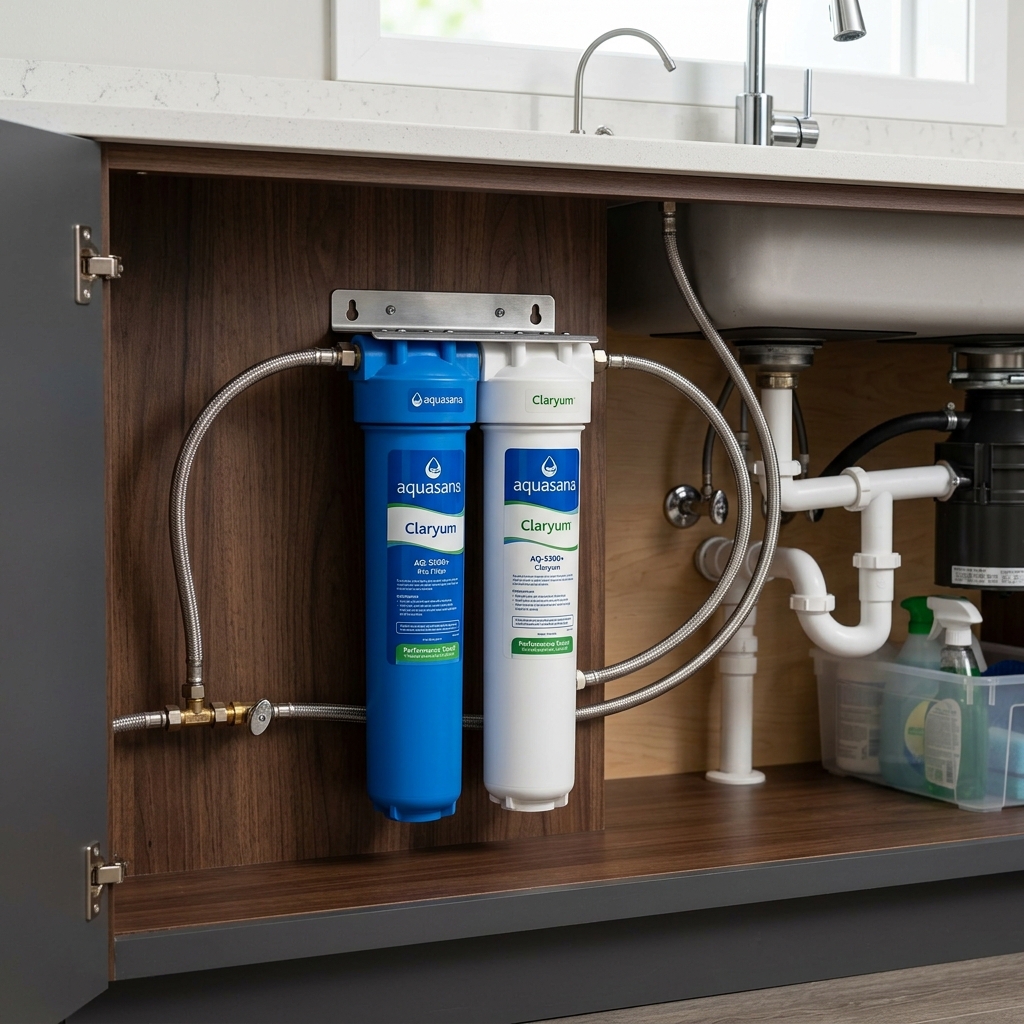
For treated municipal water and a shared kitchen faucet
Aquasana Claryum Direct Connect AQ-MF-1
$110 to $180 typical range
The best starting point for most municipal-water kitchens. It uses the faucet you already have and has exact-system claims for chlorine, chloramine, lead, PFAS and other listed substances. It does not remove dissolved salts, fluoride or nitrate like reverse osmosis.
- Treatment
- Direct-connect carbon-based filtration
- Evidence boundary
- IAPMO-certified NSF/ANSI 42, 53 and 401 claims on the AQ-MF-1 sheet
- Replacement
- 784 gallons or 6 months; 1.5 GPM rated flow
- Installation
- Cold-water line and existing faucet; no drain, outlet or separate tap
Sale-stopping flaw. All cold-water use at that faucet spends cartridge life. The 20-inch height can also be harder to place than the slim width suggests.
Check the Aquasana Claryum Direct Connect AQ-MF-1 manufacturer record for model and service details.
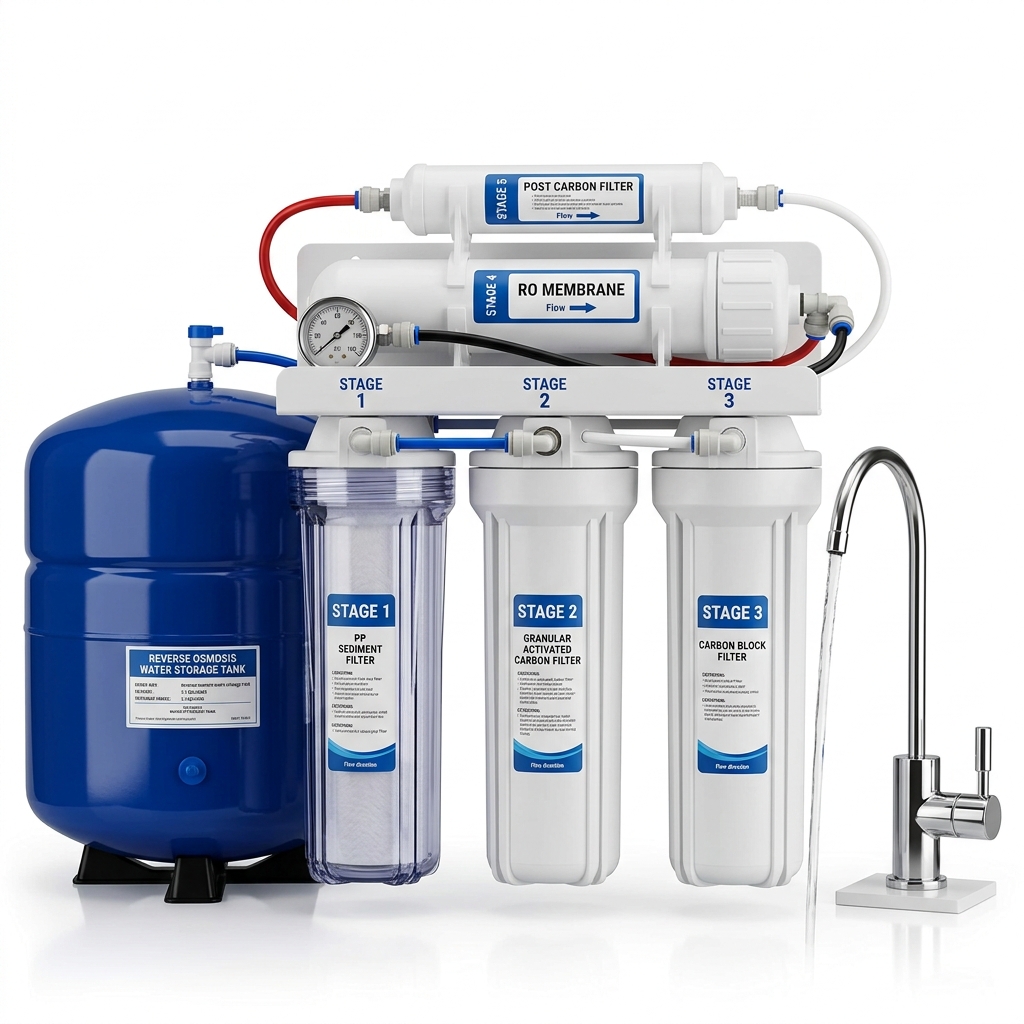
For a lower-cost RO setup with room for a tank
APEC Essence ROES-50
$180 to $250 typical range
This is the value RO option when dissolved contaminants call for a membrane and the cabinet can hold a separate tank. APEC rates production at 50 gallons per day at 60 psi and 77°F, but only 30 gallons per day at 50 psi under the same temperature condition.
- Treatment
- Five-stage, tank-style reverse osmosis
- Evidence boundary
- WQA-certified NSF/ANSI 58 system; verify the desired contaminant on the model sheet
- Replacement
- Prefilters every 6 to 12 months; membrane and postfilter every 2 to 4 years
- Installation
- Dedicated faucet, feed connection, drain saddle and four-gallon nominal tank; no outlet
Sale-stopping flaw. The tank consumes about an 11-by-11-inch cabinet footprint, and lower pressure slows production. A drain connection and separate faucet are required.
Check the APEC Essence ROES-50 manufacturer record for model and service details.
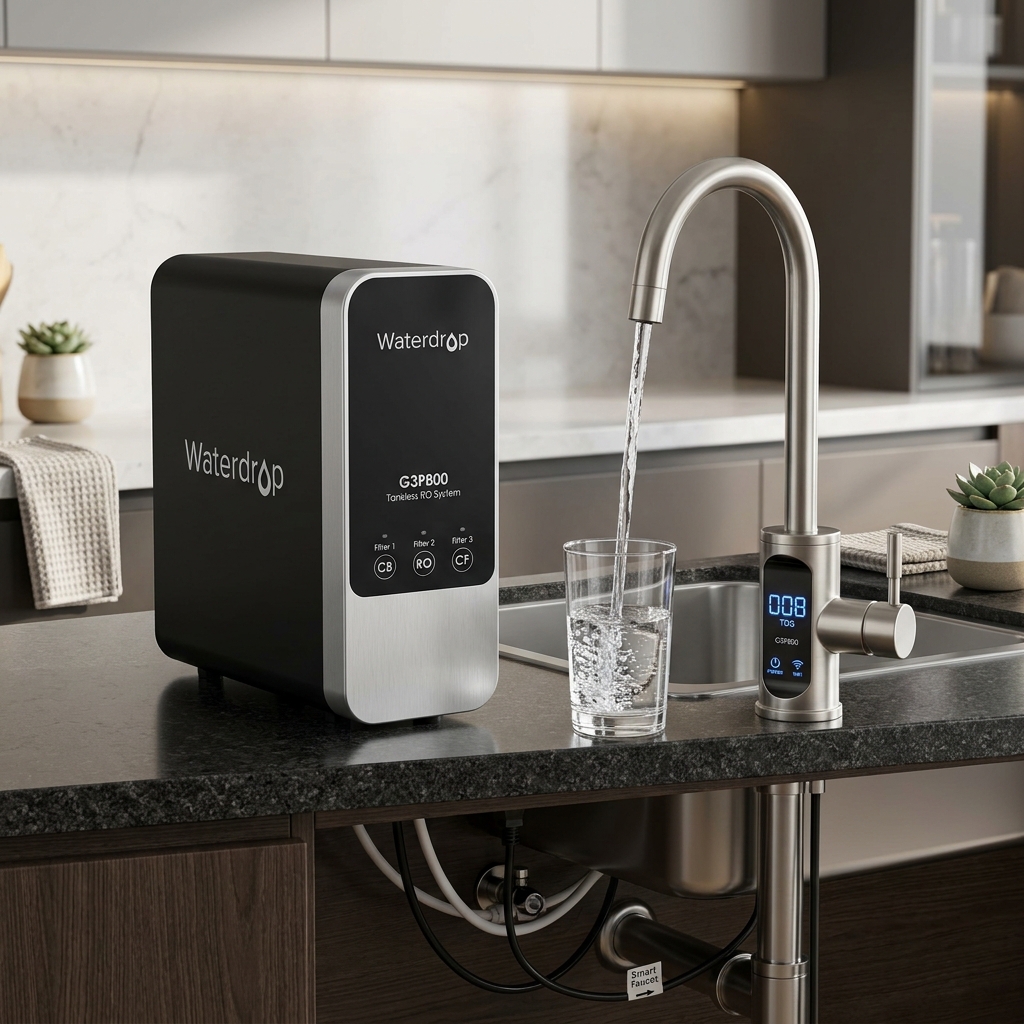
For a narrow cabinet with power and a higher budget
Waterdrop G3P800
$600 to $900 typical range
The 5.67-inch width preserves cabinet floor space and the maker rates the unit at 800 gallons per day with a 3:1 treated-to-drain ratio. Those are system ratings, not a guarantee of identical flow or recovery in every home.
- Treatment
- Powered, tankless reverse osmosis
- Evidence boundary
- IAPMO-certified NSF/ANSI 42, 53, 58 and 372; exact claims depend on its data sheet
- Replacement
- CF about 6 months, CB about 12 months, RO about 24 months
- Installation
- Dedicated smart faucet, drain connection and outlet; 18.11 by 5.67 by 17.73 inches
Sale-stopping flaw. The upfront band is much higher than a tank RO, and it depends on power plus model-specific replacement cartridges. Its faucet TDS display cannot verify an individual contaminant.
Check the Waterdrop G3P800 manufacturer record for model and service details.
Cabinet fit can reverse the price ranking
The Aquasana cartridge is about 20 inches tall, so a shallow shelf or disposal line can force it to lie horizontally. APEC lists a 15.5-by-5.25-by-17-inch assembly plus an 11-by-11-by-15-inch nominal tank. Waterdrop's 5.67-inch width is narrow, but its 18.11-inch depth and 17.73-inch height still need clearance. These published dimensions exclude comfortable space for tubing bends and filter changes; measure those separately.
At two gallons of drinking and cooking water daily, the AQ-MF-1's 784-gallon rating represents about 392 days. Its six-month calendar limit arrives first. The APEC replacement schedule calls for prefilters every 6 to 12 months and the membrane and postfilter every 2 to 4 years, depending on water and use. APEC's 50-gallon-per-day label is a production rate under specified pressure and temperature, not a 50-gallon storage tank or faucet flow. Waterdrop's 800-gallon-per-day figure is also a production rating. None should be multiplied into a promise about your tap.
Water use deserves its own line in the budget
Direct-connect carbon produces no RO concentrate. APEC's tank RO does, and its actual drain volume depends on pressure, temperature, tank back pressure and water chemistry. Waterdrop advertises a 3:1 pure-to-drain ratio, which would mean roughly one gallon to the drain for three treated gallons under its rating conditions. Do not compare that marketing ratio directly with a household measurement.
EPA says a typical point-of-use RO system can send five or more gallons down the drain per treated gallon and its WaterSense label requires no more than 2.3. Check the EPA WaterSense product search for a verified label on the exact model; a favorable maker ratio alone is not that certification. If carbon meets your exact target, avoiding an unnecessary RO drain is a practical, commission-free choice.
Two shortcuts that do not survive the model sheet
A cheaper 17UB-UF is not a drop-in replacement for RO
The Waterdrop 17UB-UF review and specifications describe a 0.01-micron ultrafiltration model, but its catalog certification is limited to NSF/ANSI 42 and 372. It does not address dissolved nitrate or fluoride. A membrane pore-size slogan cannot substitute for a finished-system contaminant claim.
The iSpring CU-A4 lacks a current finished-system certification in our record
The iSpring CU-A4 review and specifications show a useful no-drain format, but no current exact-system NSF contaminant-reduction certification is claimed. That limits its role when a verified health-contaminant result drives the purchase.
Questions about under-sink filters
Is an under-sink carbon filter as effective as reverse osmosis?
For an exact listed contaminant, compare the model-specific certified claim rather than the technology name. Carbon filters can address many taste and health-effect targets but generally do not reduce dissolved salts, nitrate or fluoride like an RO membrane. RO creates a drain stream and requires more plumbing.
Can I connect an under-sink filter to my regular faucet?
Some direct-connect systems, including the Aquasana AQ-MF-1, use the existing cold-water faucet. The two RO systems in this guide require a separate drinking-water faucet and a drain connection. Check your countertop or sink for a suitable faucet opening before buying.
Does a tankless RO system need electricity?
The Waterdrop G3P800 does. Its pump and electronic faucet require an outlet. The unpowered APEC ROES-50 uses a storage tank and needs suitable feed pressure instead.
Does an RO faucet TDS reading prove the water is safe?
No. TDS estimates dissolved ionic material through conductivity. It does not identify lead, PFAS, microbes or a specific chemical. Use a certified model claim and, when a health contaminant is known or suspected, appropriate laboratory testing.
How do I know whether an under-sink system fits?
Measure height, depth and width with the cabinet door shut, then include tubing bends, shutoff valves and room to change filters. APEC also needs floor space for its separate tank. A faucet opening, drain route and outlet can be more decisive than the filter dimensions.
Choose the contaminant before the hardware
For a specific concern, compare our lead filter evidence, PFAS model claims, and nitrate treatment limits. Then match the installation to your cabinet and maintenance routine.