Contaminant buying guide
The Best Water Filters for Bacteria
Use bottled or properly boiled water for an active advisory. For a private well with a recurring bacteria risk, repair the source first, then choose a professionally sized point-of-entry disinfection system. The VIQUA VH200 is our catalog fit only when its uncertified base-model status, dose curve, flow limit, and water-quality limits match that plan.
The safest first purchase is often no device at all. A positive E. coli result, a flood, or a utility notice calls for an alternate safe supply while you follow the issuing authority. CDC says to boil filtered tap water during a boil-water advisory, with a full rolling boil for one minute or three minutes above 6,500 feet.
The dangerous claim in this category is that any fine filter makes microbiologically unsafe water safe. A cyst claim does not prove bacteria or virus reduction. A carbon pitcher can improve taste yet carry an explicit warning against microbiologically unsafe water. Start with the organism, source, and exposure route, then require the exact claim.
Who should skip a home treatment purchase
Skip checkout and use the emergency instructions if your utility issued a boil, do-not-drink, or do-not-use advisory. Those notices are not interchangeable. A full boil does not remove fuel, toxic chemicals, or radioactive material.
A private-well owner should also pause if the only evidence is odor, cloudiness, or a home test strip. The coliform and E. coli explainer separates an indicator result from a pathogen diagnosis. Collect a sterile sample through a certified laboratory and ask the local health department how many follow-up samples are required.
Four rules decide whether a bacteria system fits
Bacteria, viruses, protozoan cysts, and harmless heterotrophic organisms are separate claims. NSF distinguishes Class A and Class B UV systems, intermittent-contamination filters under NSF/ANSI 244, and purifiers under P231.
A UV chamber delivers less dose as water moves faster. Compare the household’s simultaneous fixture demand with the flow published at the dose you intend to use, not the largest flow number on a sales page.
Sediment, iron, manganese, tannins, hardness scale, and low UV transmittance can block light or foul the sleeve. Pretreatment is part of the disinfection design, not an optional accessory.
UV leaves no disinfectant residual. Contaminated downstream plumbing, a dead leg, dirty storage, or service work can put bacteria back into treated water.
Three responses cover the real bacteria problem
This decision table keeps emergency response, a catalog product, and the stricter certified-system path separate. The same five fields apply to each option.
| Path | Best fit | Mechanism | Service work | Sale-stopping limit |
|---|---|---|---|---|
| Bottled or properly boiled water | Active boil-water advisory or unresolved positive well result | Heat inactivates bacteria, viruses, and parasites | Boil, cool, and store in sanitized covered containers | Does not remove toxic chemicals and does not repair the source |
| VIQUA VH200 | Professionally planned whole-home UV on clear water within model limits | A high-output UV lamp inactivates organisms as water passes the chamber | Annual lamp, sleeve cleaning, alarm checks, pretreatment, and water tests | Base VH200 is not presented as NSF/ANSI 55 certified and has no UV sensor |
| Exact-model NSF/ANSI 55 Class A system | A professional plan that requires certified treatment for microbiologically unsafe water | Validated UV reduction under the Class A model listing and labeled conditions | Model-specific lamp, sleeve, sensor, flow control, pretreatment, and verification | No current catalog pick; certification never removes source-repair work |
What to check before choosing
Start with the water-test result and any local safety advice. Compare the exact treatment model, the water conditions it needs and the checks required to keep it working.
A 2025 Environmental Science & Technology systematic review of 396 household-water-treatment studies found wide variation within and across technology types. Its practical conclusion is the one that matters here: microbiological performance loses meaning when a device is not used consistently, correctly, and sustainably.
The catalog pick for a professionally planned UV barrier
Affiliate disclosure: We may earn from qualifying purchases through retailer links. The comparison method and evidence limits explain how the product was assessed. The price band is a planning range, not a live offer.
For clear private-well water after source repair
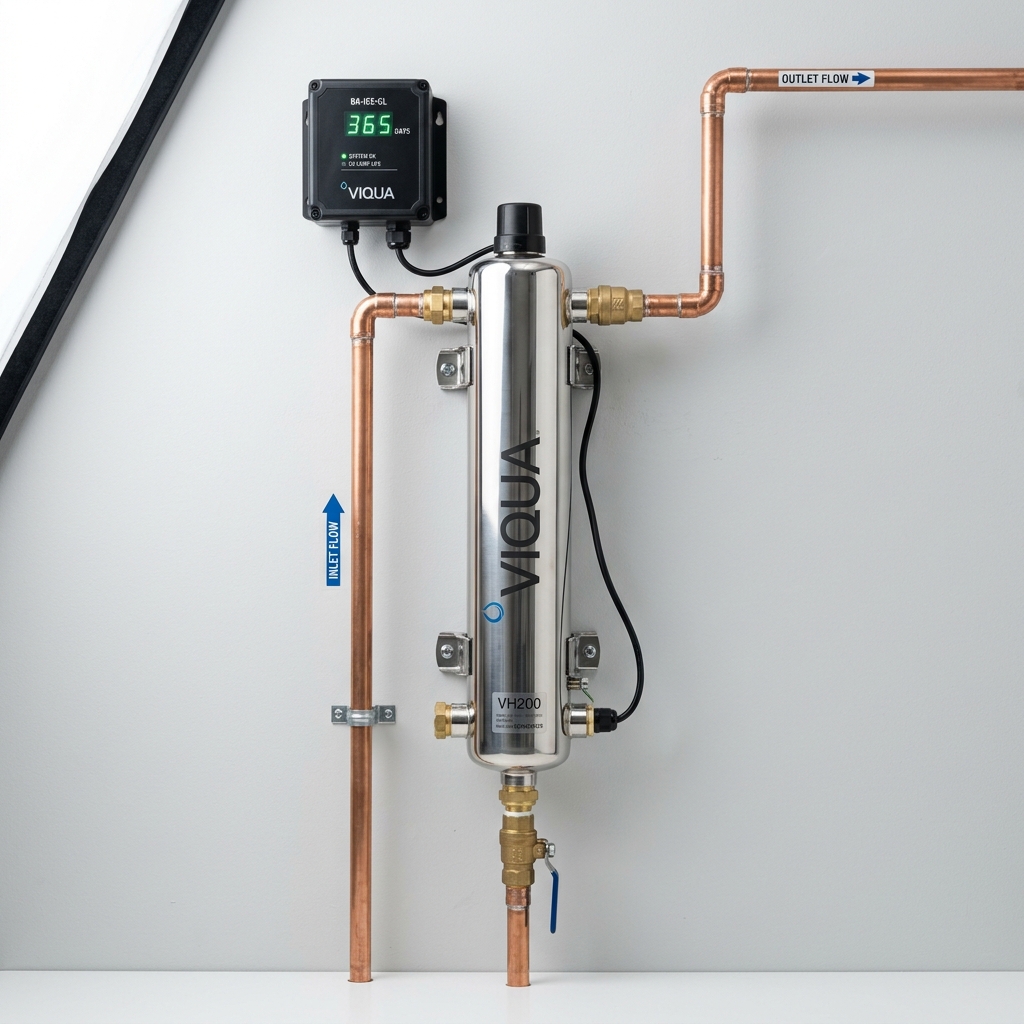
VIQUA VH200
$650 to $900 typical Amazon range
- Dose-linked flow
- 9 GPM at 30 mJ/cm²; 7 GPM at 40 mJ/cm², each at 95% UVT
- Water limits
- Turbidity under 1 NTU; iron under 0.3 mg/L; hardness under 7 gpg; UVT over 75%
- Utilities
- 35 W, 100 to 240 V, grounded GFCI-protected receptacle
- Service
- 9,000-hour lamp, sleeve inspection and cleaning, controller alarm checks
Why it fits. VIQUA publishes a model-specific dose curve and names E. coli and fecal coliform among the microorganisms the VH200 inactivates. The chamber treats the entire home without adding a chemical residual. The controller counts lamp life and alarms on lamp failure.
Sale-stopping flaw. The base VH200 is not the VH200-V and is not presented as NSF/ANSI 55 certified. It also has no UV-intensity sensor or included automatic shutoff. Buyers who need certified treatment for unsafe source water should specify a currently listed Class A model instead of borrowing a claim from a related VIQUA model.
Peak-flow math. Assume two 2 GPM showers, a 2.2 GPM kitchen faucet, and a 2 GPM appliance run together. The 8.2 GPM demand fits below the 9 GPM line at 30 mJ/cm² but exceeds the 7 GPM line at 40 mJ/cm². A nine-gallon marketing label cannot decide which dose the household receives.
Ownership work. The current VIQUA manual calls for lamp replacement after 9,000 hours and lists pretreatment thresholds. It also requires downstream plumbing disinfection after installation and after an outage or service interruption. A timer reset cannot substitute for a finished-water test.
Certification changes the model choice
Class A and Class B are not a better-and-best ladder. NSF describes Class A for contaminated water and Class B for reducing non-disease-causing bacteria in already disinfected drinking water. The currently certified NSF listing identifies the VIQUA VH200-V at 7.8 GPM as Class B. That listing does not certify the base VH200 or turn the V model into Class A.
Ask the installer to write the complete model number, certification class, certified flow, flow restrictor, alarm response, UV sensor, automatic shutoff, pretreatment, and sample points on the proposal. Search the certifier’s current directory yourself. A family name on a brochure is not an exact-model listing.
Water quality can cut delivered dose
UV only works when light reaches the organism. The VH200 specification sheet ties its 9 and 7 GPM flow figures to 95% UV transmittance. The owner’s manual sets broader installation thresholds, but the published dose curve still assumes clearer water than the minimum 75% UVT value.
A 2021 field and laboratory study in the Journal of Water Process Engineering found that humic acid lowered UVT from 88.7% to 73.3% and reduced MS2 virus inactivation by 1 to 2 log units in the studied system. That result does not rate the VH200. It shows why color and UVT belong in a UV design instead of relying on a visual clarity check.
The iron-filter guide explains why dissolved iron, particles, and iron bacteria need different corrective work. Do not place UV behind untreated iron, manganese, or sediment and expect the lamp chamber to compensate.
UV does not protect dirty downstream plumbing
Whole-home UV inactivates organisms only while water passes the lit chamber. It does not leave chlorine behind. A Water Research field study of household UV and safe storage found E. coli in 5.0% of system-effluent samples, 21.1% of storage-container samples, and 26.0% of drinking-glass samples. The device differed from the VH200, but the failure mode applies broadly: treated water can be contaminated again.
A new installation needs a plan to disinfect pressure tanks and plumbing after the UV chamber. A power failure, lamp service, bypass opening, or contaminated fixture can trigger the same work. Put an untreated sample tap before treatment and a treated sample tap after UV but before avoidable storage or complex plumbing.
What does not solve a bacteria result
Brita Elite. Brita’s own Elite filter instructions say not to use it on microbiologically unsafe water without adequate disinfection. Its chlorine, lead, and microplastics claims do not become an E. coli claim. A silver-containing filter medium supports filter hygiene but does not make the pitcher a purifier.
AquaTru Classic. The countertop RO has valuable chemical and cyst-reduction claims, but AquaTru says not to use it with microbiologically unsafe water. The AquaTru Classic review covers its intended countertop RO job; it is not our response to an unresolved positive well result.
iSpring WGB32B. Sediment and carbon stages can protect later equipment and improve taste, but the exact base model has no bacteria-inactivation stage. The WGB32B specifications make its cartridge role clear. Pretreatment becomes useful when a UV design calls for it; alone, it does not close a coliform case.
VH200-V used as a Class A substitute. The V suffix adds a certified Class B claim at its listed flow. It does not certify the system as Class A for microbiologically unsafe water. Model suffixes carry the safety boundary.
The non-commissioned work comes first
EPA advises annual private-well testing for total coliform bacteria, nitrate, total dissolved solids, and pH through a certified laboratory. Test again after flooding, well or plumbing work, a change in taste or appearance, or unexplained gastrointestinal illness when the health department advises it.
A positive result starts an investigation, not a shopping list. Inspect the cap, casing, grading, drainage, nearby septic system, and recent flood or repair history with qualified local help. The well-water guide maps bacteria, nitrate, arsenic, iron, hardness, and sulfur to separate treatment jobs. We earn nothing from laboratory testing, source repair, bottled water, or a Class A system outside the catalog.
Bacteria filter questions
What water filter removes E. coli and coliform bacteria?
A device needs a bacteria-specific claim, not only a chlorine, cyst, or fine-particle claim. CDC lists an absolute pore size of 0.3 micron or smaller, ultrafiltration, nanofiltration, and reverse osmosis as physical removal approaches for bacteria. Whole-home UV can inactivate bacteria when dose, peak flow, water clarity, maintenance, and the exact model are suitable.
Can I use a home filter during a boil water advisory?
Follow the advisory. CDC says to use bottled water or bring tap water to a rolling boil for one minute, or three minutes above 6,500 feet, even when the water has passed through a home filter or pitcher. A chemical or do-not-use advisory needs different instructions from local officials.
Does ultraviolet treatment remove bacteria from water?
UV inactivates microorganisms rather than physically removing them. Performance depends on delivered dose, actual peak flow, UV transmittance, turbidity, lamp age, sleeve condition, and the organism. UV does not remove nitrate, arsenic, PFAS, hardness, iron, sediment, or other dissolved chemicals.
How often does a VIQUA VH200 lamp need replacement?
VIQUA lists 9,000 hours of continuous operation, about one year, for lamp replacement. The quartz sleeve also needs inspection and cleaning because mineral film reduces the UV light reaching the water. The controller alarm does not measure bacteria in the finished water.
Should I shock-chlorinate a well that tests positive for coliform?
Contact the local health department or a licensed well professional before treating the well. Shock disinfection can address an event, but a recurring positive result can indicate a casing, cap, drainage, septic, or source problem. Use alternate safe water until corrective work and follow-up samples meet the authority’s instructions.
Match the treatment train to the laboratory result
The finder separates bacteria treatment from sediment, iron, hardness, nitrate, arsenic, and whole-home flow requirements.