Contaminants guide
The Best Water Filters for VOCs
Aquasana AQ-MF-1 is the strongest catalog pick for one-tap drinking water, AquaTru Classic is the better no-plumbing option, and a confirmed whole-home VOC problem needs professional point-of-entry treatment instead of a shopping shortcut.
The market trap is treating VOC as one contaminant and treating any carbon cartridge as proof. VOCs cover many chemicals with different limits and adsorption behavior. An NSF/ANSI 53 badge proves only the reduction claims named for that exact system.
A kitchen filter also solves only ingestion. The Agency for Toxic Substances and Disease Registry now uses a household water-use model for inhalation and skin exposure to volatile chemicals. A confirmed VOC result can therefore change where treatment belongs.
Who should stop shopping for now
Stop using the affected water and follow the utility, state agency, or health department advisory when VOC contamination is suspected after a fire, spill, fuel leak, or damaged well. EPA warns that boiling or hot-water use can create an inhalation risk during a VOC incident. Use the approved alternate source until the agency defines safe uses and a certified laboratory confirms the result.
Four checks decide the treatment
A gasoline smell can justify an urgent call, but no smell does not prove the water is clear. Make these checks before comparing products.
Name the chemical
Order a locally appropriate VOC panel from a state-certified drinking-water laboratory. Do not buy against the word VOC alone.
Map every exposure route
Decide whether the goal is drinking and cooking water or every indoor use, including showers, baths, laundry, and dishwashing.
Match the exact claim
Find the exact model and replacement element under the named VOC, TCE, PCE, benzene, MTBE, or other result. A standard number by itself is incomplete.
Plan for breakthrough
Carbon capacity changes with contaminant concentration, competing chemicals, contact time, and water use. Treatment needs a sampling and replacement plan.
What matters when choosing VOC filters
Match the filter to the specific chemical concern and the taps you need to treat. Compare the exact claim, flow, capacity and replacement costs.
A paper by J. B. Andelman in Science of the Total Environment used field observations and a model shower to study trichloroethylene moving from water into indoor air. The reported air concentration rose with water concentration, temperature, and drop path. The study predates these products and does not rank them, but its exposure finding remains consistent with current ATSDR practice.
A VOC claim has a defined boundary
NSF defines its VOC reduction claim through a set list of organic chemicals. It includes benzene, TCE, PCE, toluene, and total trihalomethanes. It does not include every volatile compound.
| Document wording | What it proves | What it does not prove |
|---|---|---|
| NSF/ANSI 53 VOC reduction | The exact listed system met the standard for the defined VOC surrogate group | Removal of every volatile compound or treatment beyond rated life |
| NSF/ANSI 42 | Aesthetic claims such as chlorine taste and odor when named | A health-effects VOC claim |
| NSF/ANSI 58 | Reverse-osmosis system requirements and the optional claims actually listed | Automatic removal of an unlisted VOC |
| Independent lab result | Performance under the stated challenge, method, and endpoint | Third-party product certification unless the listing says so |
Three catalog choices with different jobs
Affiliate disclosure: We may earn from qualifying purchases through retailer links. The comparison method and its limits explain why laboratory data and product certification receive different weight. Price ranges allow for normal Amazon offer changes.
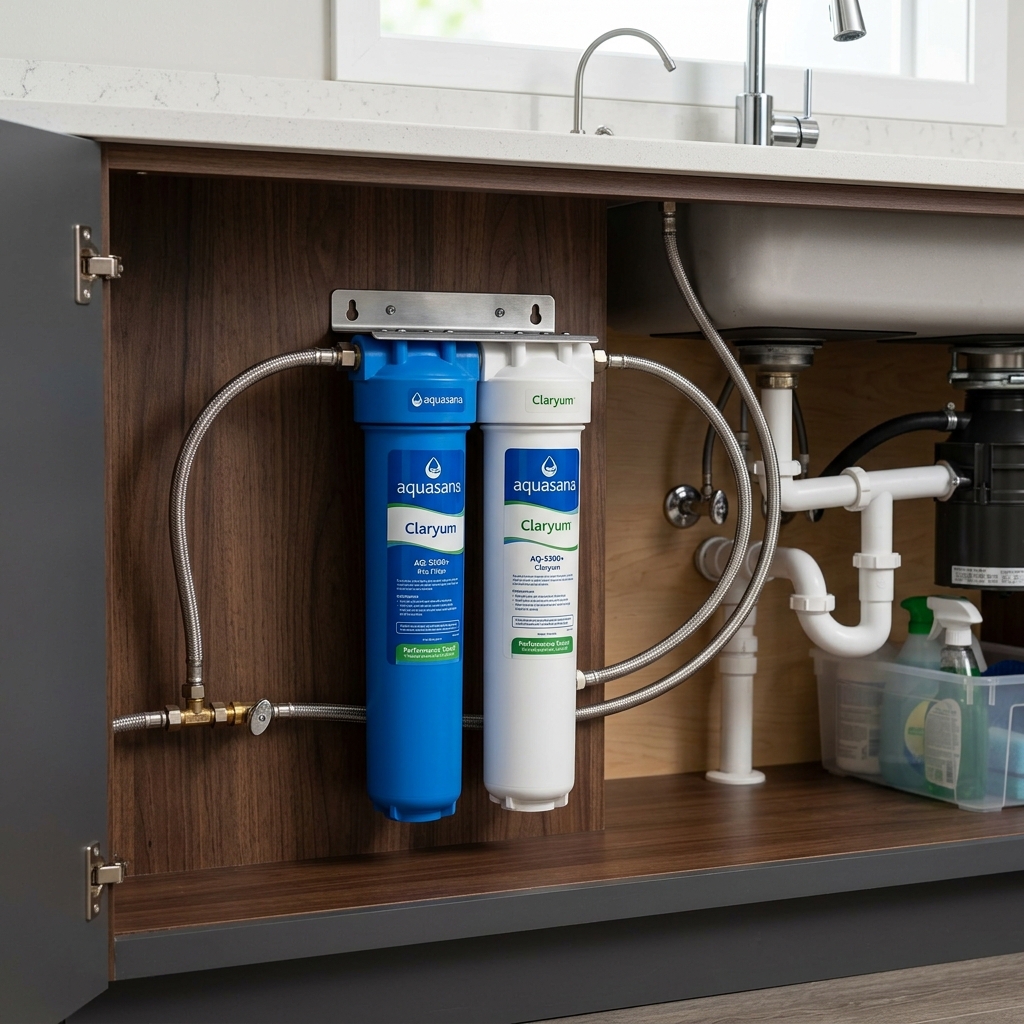
For a certified drinking-water claim at 1.5 GPM
Aquasana Claryum Direct Connect AQ-MF-1
$110 to $180 price range
The AQ-MF-1 is the strongest catalog choice for drinking and cooking water when the exact contaminant is inside the NSF VOC surrogate group. Its sheet reports 99.4% overall reduction against the VOC surrogate test and lists benzene, TCE, PCE, toluene, xylenes, and other covered compounds.
- Treatment
- Carbon-based direct-connect filtration on the cold-water line
- VOC evidence
- IAPMO-tested NSF/ANSI 53 VOC surrogate result with 99.4% overall reduction
- Service basis
- Replace at 784 gallons or 6 months, whichever comes first
- Setup
- Existing kitchen faucet, 3/8-inch cold-water connection, no drain or power
Capacity example. At 2 gallons per day for drinking and cooking, 784 gallons would last about 392 days. The 6-month limit arrives first, so plan on two cartridges per year even if the gallon total is lower.
Sale-stopping flaw. It treats only the cold water routed through one faucet. It does not control vapor released from showers, baths, laundry, or other untreated taps.
The evidence level and limits come from the Aquasana Claryum Direct Connect AQ-MF-1 technical record.
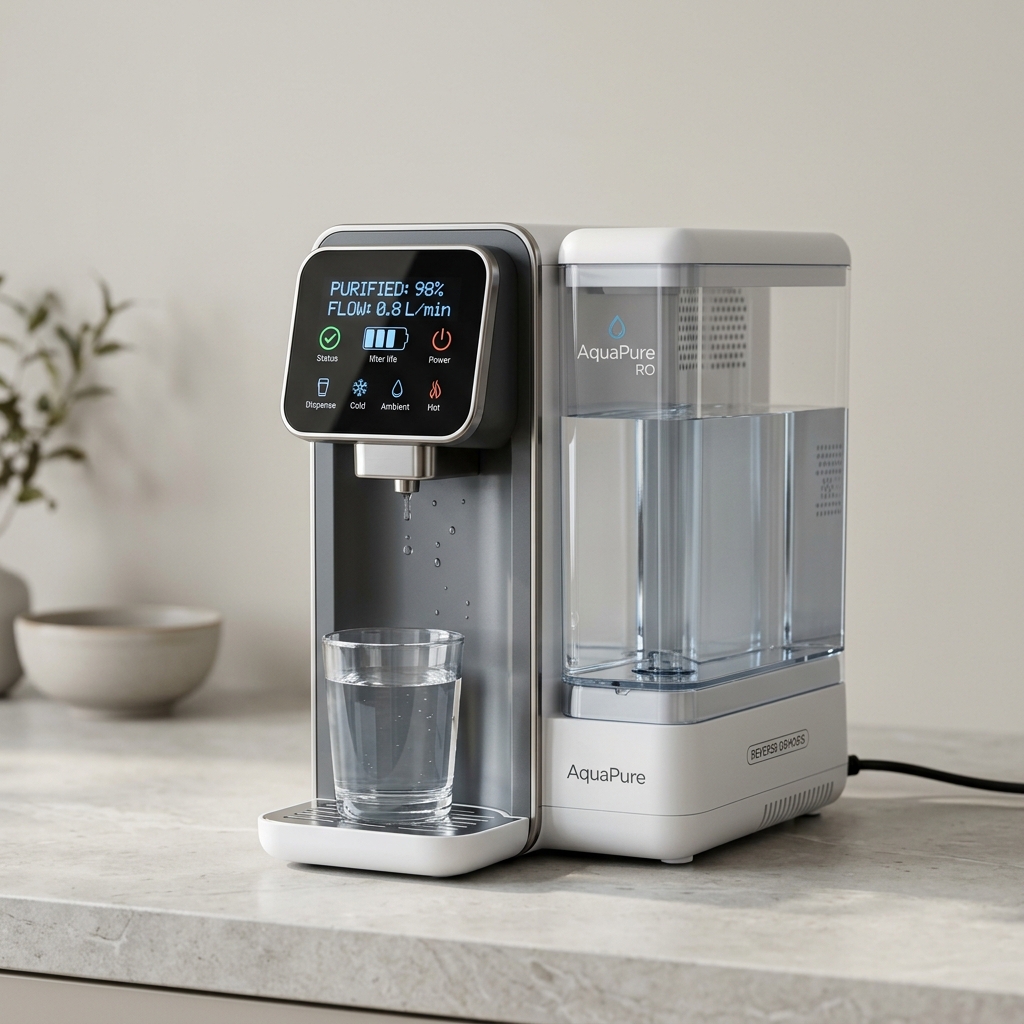
For a renter who cannot alter plumbing
AquaTru Classic Alkaline Countertop RO
$400 to $550 price range
AquaTru Classic is the best no-plumbing catalog choice for drinking and cooking water. Its certified organic-chemical table lists greater than 99% minimum reduction for benzene, TCE, PCE, toluene, and total xylenes, while the trihalomethane group has a 95% minimum.
- Treatment
- Countertop reverse osmosis followed by a VOC carbon stage
- VOC evidence
- IAPMO-certified NSF/ANSI 53 organic-chemical list with 95% to more than 99% minimum reduction
- Service basis
- Pre/carbon at 600 gallons or 6 months; VOC at 600 gallons or 12 months; RO at 1,200 gallons or 24 months
- Setup
- 120-volt outlet, manual tank filling, counter space, and concentrate disposal
Capacity example. At 2 gallons per day, the 600-gallon VOC cartridge rating equals about 300 days. Heavy cooking use can reach the gallon limit before the 12-month time limit.
Sale-stopping flaw. Manual refilling and concentrate disposal add daily work. It remains a point-of-use device, so its certified performance says nothing about vapor exposure elsewhere in the home.
The evidence level and limits come from the AquaTru Classic Alkaline Countertop RO technical record.
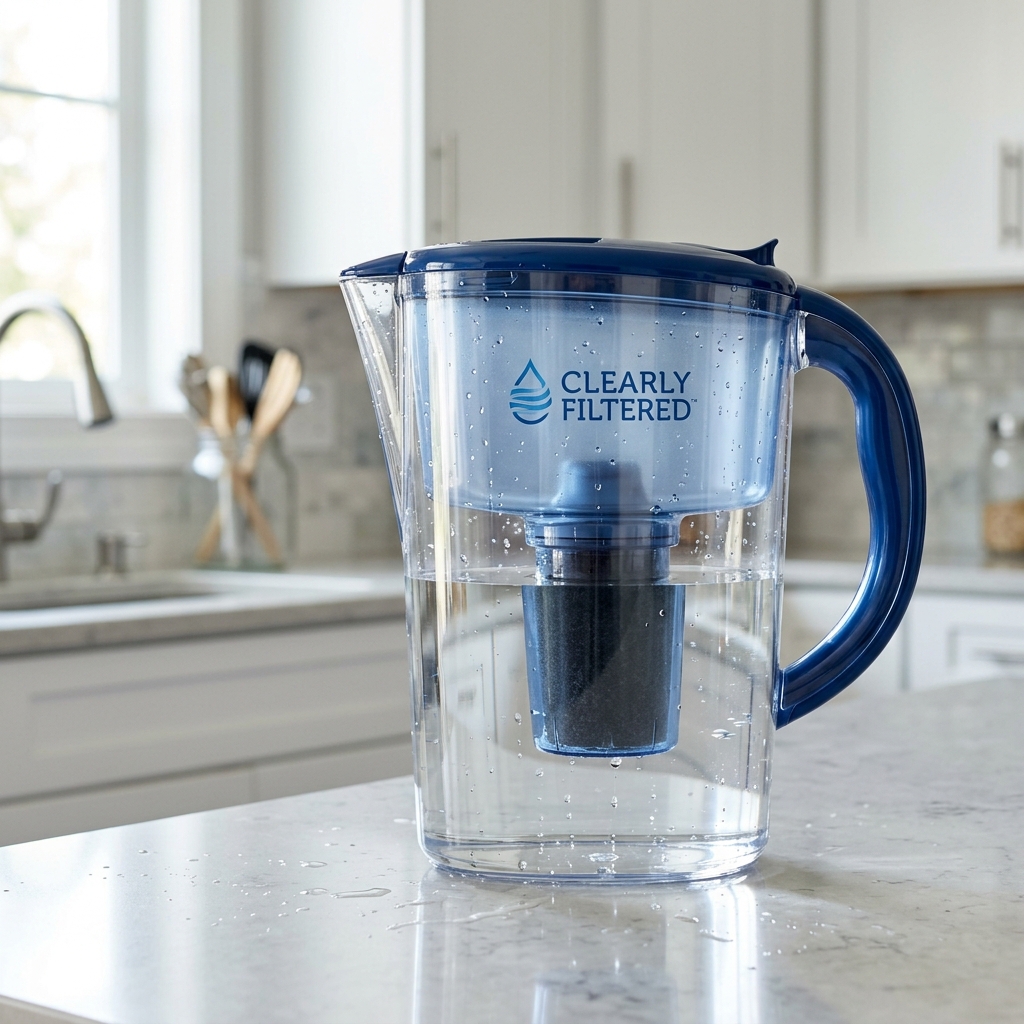
For portable drinking water with a wider lab panel
Clearly Filtered P-V3 10-Cup Water Pitcher
$90 to $120 price range
The P-V3 is a conditional portable option when the exact compound appears in its November 2025 laboratory table. The maker posts challenge and filtered concentrations for benzene, TCE, PCE, vinyl chloride, and many other compounds.
- Treatment
- Gravity-fed adsorption media in a portable pitcher
- VOC evidence
- Independent IAPMO New Jersey laboratory results, separate from the product's NSF 42 and 372 certification
- Service basis
- Replace at the 100-gallon maker rating and sooner if the treatment plan requires it
- Setup
- No installation; designed for municipally treated cold water
Capacity example. At 2 gallons per day, a 100-gallon filter lasts about 50 days, or roughly seven cartridges per year. Lower daily use stretches that interval, but not the rated gallon capacity.
Sale-stopping flaw. The broad VOC results are controlled-lab maximum removals, not NSF-certified VOC claims. Connecticut public-health guidance also says pour-through units are not recommended for organic-chemical contamination.
The evidence level and limits come from the Clearly Filtered P-V3 10-Cup Water Pitcher technical record.
Coverage decides point of use or whole house
| Water result or notice | Best next move | Reason |
|---|---|---|
| No VOC detected, taste and odor only | Treat the nuisance named in the report | A health-contaminant purchase is not justified by odor alone |
| Regulated compound in a utility report, below its limit | Certified point-of-use filter if you want an added drinking-water barrier | The goal is drinking and cooking water, not remediation |
| Confirmed VOC in a private well | Health department plus professional point-of-entry design | Indoor water use may create inhalation and skin exposure |
| Wildfire, spill, or active advisory | Follow the advisory and use approved alternate water | A consumer filter is not an emergency clearance test |
| Vinyl chloride detected | Professional aeration or agency-directed treatment | Vinyl chloride falls outside the standard VOC surrogate group |
Connecticut public-health guidance recommends whole-house GAC for most VOC contamination and explains that carbon eventually reaches breakthrough. Two tanks in series, sampling taps, a water meter, and laboratory monitoring can make breakthrough visible before untreated water reaches the house.
Carbon works until its sites fill
EPA describes granular activated carbon as a porous adsorption medium. Organic molecules collect on its internal surfaces. More contact time can improve capture, while competing organic matter consumes capacity that might otherwise hold the target VOC.
A calendar reminder cannot measure that chemistry. The correct service plan starts with the maker's limit, adds the actual household flow and source concentration, and uses before-and-after laboratory samples when a health contaminant is present. Odor is too compound-specific and too subjective to serve as the safety alarm.
What else can work
Packed-tower aeration can move volatile chemicals from water into a controlled exhaust stream. It is a treatment-system job because the off-gas must leave the occupied space. A new well, a public-water connection, or delivered water may be safer or cheaper when the contamination source persists.
A state-certified laboratory is the first non-affiliate purchase. EPA maintains state drinking-water laboratory contacts, and CDC advises well owners to ask local health officials which fuel-related and industrial VOCs belong in the local panel.
What does not solve a confirmed VOC problem
A useful treatment claim must match the chemical, the location, and the service plan. These catalog products miss at least one of those gates.
The base iSpring WGB32B is not a certified VOC treatment plan
It has whole-house flow and carbon blocks, but the current catalog record has no finished-system NSF/ANSI 53 VOC certification. Its broad 100,000-gallon maker rating is not a breakthrough limit for your detected compound. A professional may use a different carbon design after testing, but the base retail model does not close the evidence gap.
Waterdrop 17UB-UF and iSpring CU-A4 do not earn a VOC pick from pore size
A 0.01-micron ultrafiltration membrane targets particles, not dissolved volatile molecules. Carbon in a multi-stage unit can adsorb some organics, but neither catalog model has the exact VOC claim needed here.
VIQUA VH200 UV does not adsorb solvents
Ultraviolet treatment is for microbial control under the right water conditions. It does not provide a carbon bed or aeration stage for VOC removal.
Boiling is not the emergency fix
EPA advises utilities to consider do-not-drink, do-not-boil, or do-not-use notices when VOC contamination is suspected. Heat can transfer the chemical into indoor air, and boiling does not protect showers or other taps.
Questions about VOC water filters
What type of water filter removes VOCs?
Granular activated carbon is the standard treatment for many VOCs. Point-of-use carbon or reverse osmosis with carbon can protect drinking and cooking water when the exact model has the right claim. Confirmed household contamination may require a professionally designed point-of-entry carbon or aeration system because exposure can also occur during showers and other water uses.
Does reverse osmosis remove VOCs?
Some reverse-osmosis systems reduce named VOCs, often with carbon stages before or after the membrane. NSF/ANSI 58 certification alone does not prove a VOC claim. Check the exact model performance sheet for the compound found in your water.
Does boiling water remove VOCs?
Do not boil water during a suspected or confirmed VOC incident unless the responsible health agency tells you to. Heating can move volatile chemicals from water into indoor air. Follow the current do-not-drink, do-not-boil, or do-not-use advisory and use an approved alternate water source.
Can a water filter remove vinyl chloride?
Vinyl chloride needs its own treatment decision. It is not part of the NSF VOC surrogate list, and older EPA guidance identifies packed-tower aeration rather than granular activated carbon as the best available treatment for it. Use a certified laboratory result and professional design.
How do I test drinking water for VOCs?
Ask your state drinking-water program or health department for a certified laboratory and a locally appropriate VOC panel. Follow the laboratory bottle, preservation, and sampling instructions exactly because volatile compounds can escape during collection.
How often should a VOC filter be replaced?
Use the exact model capacity and time limit, then shorten the interval when source concentration, competing organics, sediment, or laboratory monitoring shows earlier breakthrough. A change in taste or odor is not a safe exhaustion indicator for health-related VOC treatment.
Match treatment to the laboratory result
The filter finder can narrow the format after you know the contaminant and whether the goal is one tap or the whole home. Readers with a rental can also compare the renter-safe filtration tradeoffs. VOCs found alongside PFAS or lead need separate exact claims, covered in our PFAS filter comparison and lead filter comparison.