Contaminant buying guide
The Best Water Filters for Chromium-6
Choose the $200 to $480 Aquasana SmartFlow RO for an installed system with a certified 98% chromium-6 result. Choose the $400 to $550 AquaTru Classic when you cannot alter plumbing. The $35 to $60 Culligan ZeroWater 10-Cup pitcher is the lower-cost certified option, but its 15-gallon chromium test capacity makes it a high-service choice.
Chromium has a measurement problem before it has a shopping problem. EPA regulates total chromium at 100 parts per billion, a result that combines chromium forms. California separately limits hexavalent chromium, or chromium-6, to 10 ppb.
The sales trap is a filter advertised as NSF/ANSI 53 or 58 certified without chromium-6 on the exact claim list. The claim is optional. A second trap hides in the test endpoint: certification can pass at 100 ppb finished water, ten times California's current limit. The badge is a useful starting point, not proof that your tap will finish below a chosen target.
Who should skip a filter purchase
Skip the purchase when the only number came from a TDS meter, a color strip, or a database estimate. Ask your utility whether its report shows total chromium or chromium-6. Private-well owners should use a laboratory that can identify the requested form.
Skip a consumer device as the sole response to a public-water violation notice. Follow the utility and health-department instructions while the water system brings the source or treatment process into compliance. Bottled water or another approved supply can be the safer bridge.
Skip the three picks below for microbiologically unsafe water. Their chromium claims do not turn an untreated well into a safe drinking-water source.
Four rules make the decision
Total chromium and chromium-6 are different laboratory results. Match the filter claim to the result you are trying to lower.
NSF lists hexavalent chromium reduction as an optional NSF/ANSI 58 claim. TDS certification or the standard number by itself is not enough.
Multiply the source result by one minus the published reduction fraction. Treat the answer as a planning estimate, then verify the installed system with a finished-water sample.
Chromium performance is tied to the tested cartridge or membrane life. A cheap pitcher can cost more per month than its purchase price suggests when source-water TDS is high.
The certification gap changes the ranking
WQA states that the NSF/ANSI 53 and 58 chromium-6 procedures use a 300 ppb challenge and allow no more than 100 ppb in treated water. California's 10 ppb limit took effect in 2024, and systems with at least 10,000 service connections reached their compliance date on October 1, 2026.
| Number | What it covers | What it does not prove |
|---|---|---|
| 100 ppb federal MCL | Total chromium in public water | A separate chromium-6 result |
| 100 ppb certification ceiling | A pass in the standard chromium-6 reduction test | Finished water below California's limit |
| 10 ppb California MCL | Hexavalent chromium in covered public systems | Your home's result after a consumer filter |
| Exact model percentage | Performance under the published test conditions | The concentration at your tap after installation |
What to check before choosing
Start with your water-test result and the exact chromium claim. Compare water limits, installation, replacement filters and the need to check the treated water.
A Journal of Chemistry membrane study reported reverse-osmosis chromium-6 retention from 85% to 99.9% as solution composition and operating conditions changed. The study used model water and industrial effluent, not these household products. Its useful lesson is the range: a membrane name cannot replace model-specific data and a finished-water test.
Three options fit three service levels
The comparison uses the same fields for all three picks. Price bands are Amazon planning ranges, not live quotes. Reduction percentages come from the cited model records and should not be compared without their test conditions.
| Option | Chromium-6 evidence | Rated service | Installation | Sale-stopping limit |
|---|---|---|---|---|
| Aquasana SmartFlow RO | WQA-certified NSF/ANSI 58, 98% overall result | Carbon stages 250 gallons or six months; membrane 12 months | Under-sink tank, drain, dedicated faucet | Cabinet space, reject water, and plumbing work |
| AquaTru Classic | IAPMO-certified NSF/ANSI 58, 94.3% minimum and 97.2% average | 600-gallon pre and VOC filters; 1,200-gallon membrane | Countertop power and manual tanks | Counter space and 10 gpg hardness limit |
| Culligan ZeroWater 10-Cup | IAPMO-certified NSF/ANSI 53 chromium claim; maker reports 99% chromium-6 | Chromium result after 15 gallons in maker test | No plumbing; manual filling | Short, source-water-sensitive cartridge life |
The installed pick for broad treatment
Affiliate disclosure: We may earn from qualifying purchases through retailer links. The comparison method and evidence limits explain how the products were assessed. Where a product has more than one retailer, you can choose where to check the current offer.
For a homeowner who wants low daily effort

Aquasana SmartFlow RO AQ-SFRO2-BN
$200 to $480 typical Amazon range
- Chromium-6 evidence
- WQA-certified NSF/ANSI 58 claim
- Published result
- 98% overall reduction
- Faucet flow
- 0.7 GPM maker rating
- Operating range
- 40 to 80 psi; 40 to 100°F
Why it fits. The SmartFlow performance sheet lists 98% overall hexavalent chromium reduction. A 20 ppb source result multiplied by the remaining 2% gives a 0.4 ppb planning estimate. The same exact system has a trivalent chromium claim, which helps when a report lists total chromium without speciation.
Sale-stopping flaw. It needs a storage tank, cabinet room, a drain saddle, and a dedicated faucet. The current product page says the carbon stages last 250 gallons or up to six months, and the membrane lasts 12 months. A household filtering four gallons a day reaches 250 gallons in about 63 days, so the gallon limit can arrive long before the calendar limit.
What the percentage cannot promise. The 98% result came from standard laboratory conditions. Feed concentration and real operating conditions still matter. Test the finished water if the purchase responds to a measured chromium-6 result.
The no-plumbing pick for a rental
For a renter who wants RO without a drain connection
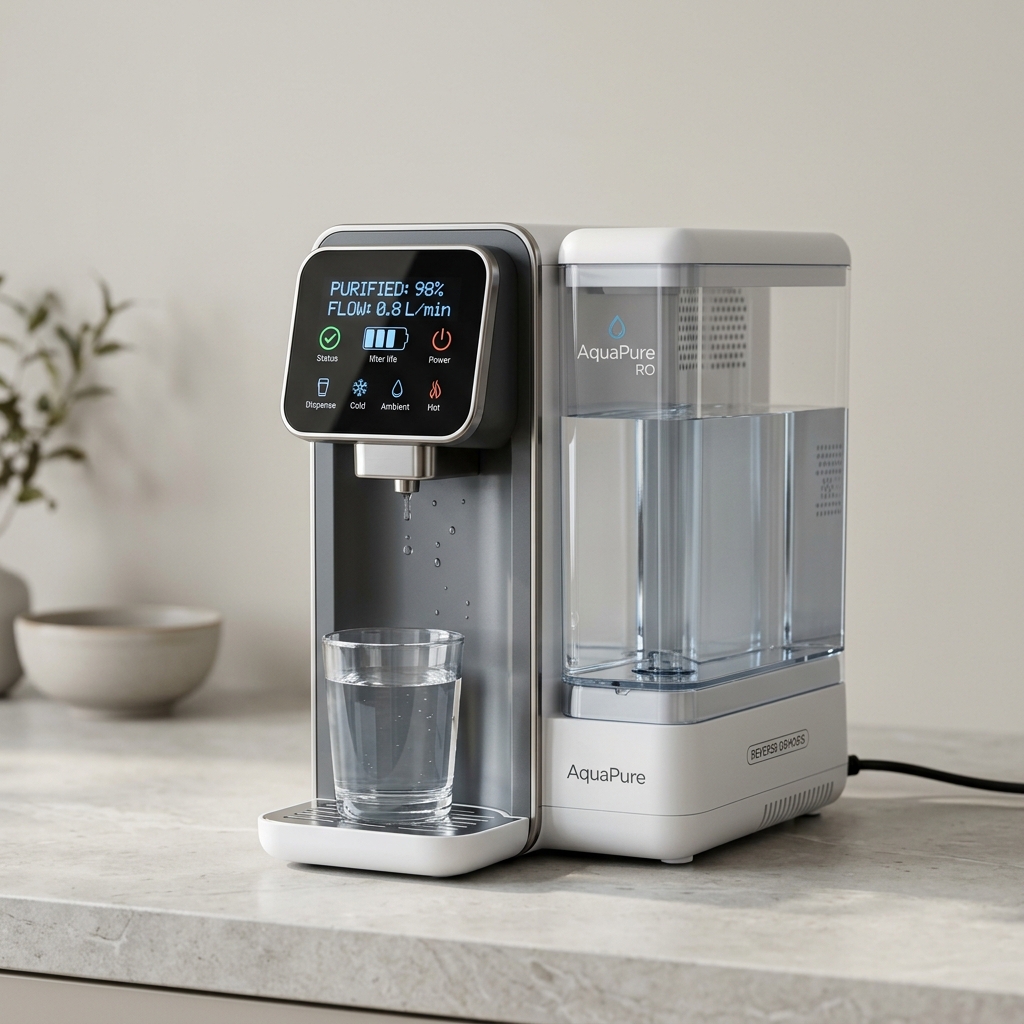
AquaTru Classic Alkaline Countertop RO
$400 to $550 typical Amazon range
- Chromium-6 evidence
- IAPMO-certified NSF/ANSI 58 claim
- Published result
- 94.3% minimum and 97.2% average reduction
- Rated service
- 600-gallon pre and VOC filters; 1,200-gallon membrane
- Source-water limit
- 10 gpg hardness unless softened first
Why it fits. The AquaTru sheet reports a 300 ppb challenge, 94.3% minimum reduction, and 97.2% average reduction. Those figures imply about 17.1 ppb at the minimum and 8.4 ppb at the average under the test challenge. The split shows why a certified pass does not automatically prove a result below California's 10 ppb limit.
Sale-stopping flaw. The unit needs power, a 12 by 14-inch counter footprint, tank filling, and concentrate disposal. The maker warns against source water above 10 grains per gallon hardness unless it is softened first.
Service math. Two gallons a day reaches 600 gallons in about 300 days and 1,200 gallons in about 600 days. Four gallons a day cuts those figures to about 150 and 300 days. The published calendar limits can arrive first.
The countertop filter comparison covers tank handling, cleaning, reject water, and clearance for this format.
The budget pick for light demand
For a small household that can manage frequent filters
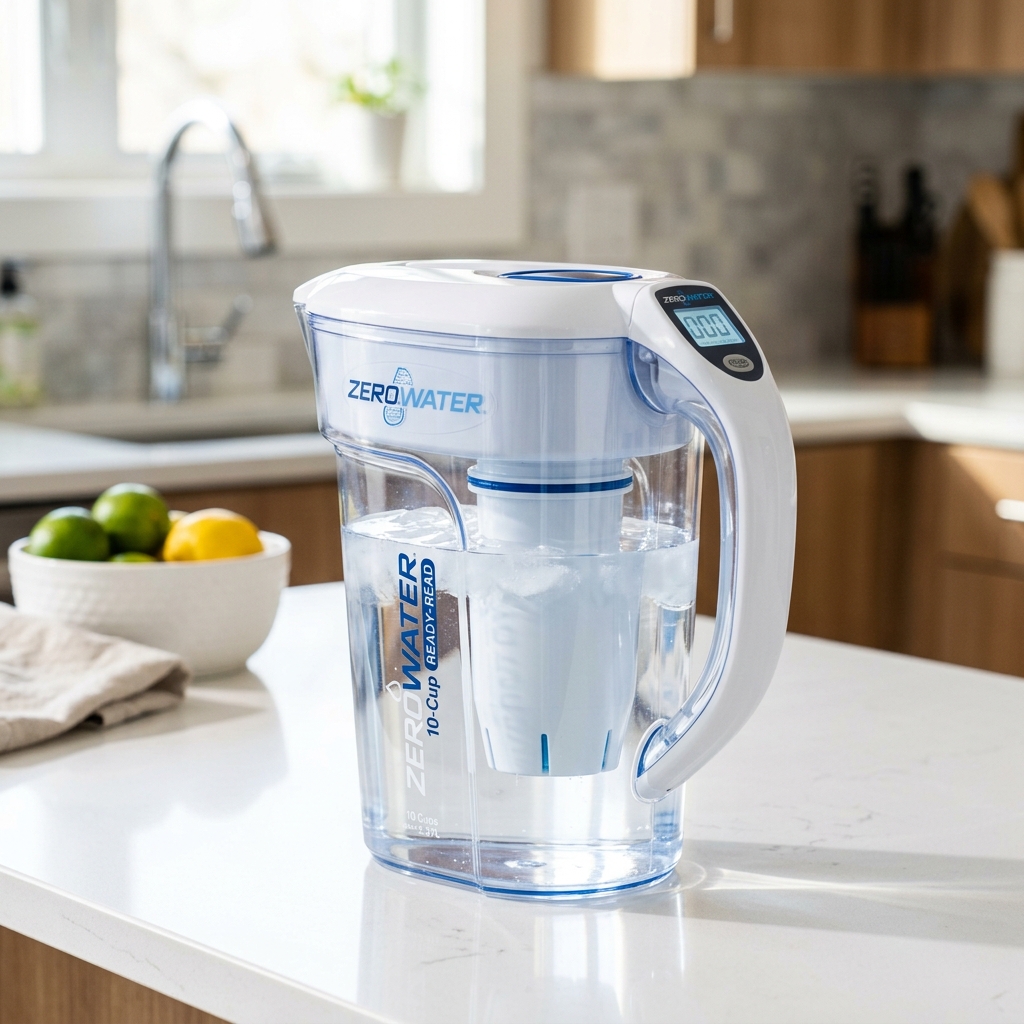
Culligan ZeroWater 10-Cup ZP-010
$35 to $60 typical Amazon range
- Chromium evidence
- IAPMO-certified NSF/ANSI 53 claim
- Published result
- Maker reports 99% chromium-6 after 15 gallons
- Monitoring aid
- Included conductivity-based TDS meter
- Installation
- None; manual pitcher filling
Why it fits. The maker's current comparison reports 99% chromium-6 reduction after 15 gallons. The current ZP-010 page also identifies IAPMO certification under NSF/ANSI 53 for chromium. This is the simplest exact catalog model for a low initial budget.
Sale-stopping flaw. Fifteen gallons lasts about 7.5 days at two gallons daily or less than four days at four gallons daily. Actual useful life varies with dissolved solids. The included meter can flag ion-exchange exhaustion, but it cannot identify chromium-6 or replace a laboratory result.
Ownership math. One 15-gallon cartridge every 7.5 days is about four cartridges per month at two gallons daily. The pitcher makes the most sense for one person's drinking water, a short bridge, or low-TDS source water.
A percentage needs a source number
Reduction arithmetic is useful for screening, not certification. Multiply the measured source level by the fraction that remains. A 97.2% average reduction leaves 2.8%. A 20 ppb source estimate becomes 0.56 ppb, while a 300 ppb source becomes 8.4 ppb.
Do not reverse the calculation and claim a guaranteed result. Test water chemistry, membrane condition, and service age differ from your kitchen. California's current rule sets a 10 ppb MCL and a 0.1 ppb reporting limit. A laboratory must use an appropriate chromium-6 method to compare your water with either number.
What else works
A state-accredited laboratory test is the first uncommissioned purchase. It can stop an unnecessary filter sale, distinguish total chromium from chromium-6, and give you the source number needed for meaningful reduction math.
WQA identifies reverse osmosis, distillation, and anion-exchange resin as household treatment paths for hexavalent chromium. A distiller can suit low-volume use when electrical demand, heat, noise, and cleaning are acceptable. A professionally designed anion-exchange system can serve larger flows, but competing sulfate, resin capacity, regeneration, and waste handling must be part of the design.
The reverse osmosis format guide compares pressure, cabinet space, faucet flow, and reject-water demands before you commit to a plumbed system.
What does not prove chromium-6 reduction
A generic NSF/ANSI 42, 53, or 58 badge. Each standard contains different required and optional claims. Find Chromium (Hexavalent) beside the exact system and replacement module.
Brita Elite. Its exact performance sheet lists useful lead, PFAS, VOC, and emerging-compound claims, but not chromium-6. The Brita Elite review shows why a long-life cartridge still has to name the target contaminant.
A plain carbon block. Carbon can be part of a certified multi-media device, but carbon taste-and-odor performance does not establish removal of a dissolved chromium oxyanion. The Aquasana AQ-MF-1 review documents valuable claims that do not include chromium-6.
A sediment, ultrafiltration, or UV device. Particle filters do not establish removal of dissolved chromium-6, and UV changes microorganisms rather than dissolved metals.
A TDS reading of zero. The meter responds to total conductivity, not one named ion. Use it for the ZeroWater cartridge's service cue, then use a laboratory for chromium-6.
Chromium-6 filter questions
What type of water filter removes chromium-6?
Choose an exact model certified for hexavalent chromium reduction under NSF/ANSI 53 or NSF/ANSI 58. Reverse osmosis and anion-exchange media can reduce chromium-6, but the technology name or a broad standards badge does not prove that a particular model carries the claim.
Does reverse osmosis remove chromium-6?
Some reverse osmosis systems are certified for hexavalent chromium reduction under NSF/ANSI 58. The claim is optional, so check the exact model performance sheet. Source concentration, water chemistry, membrane condition, pressure, and recovery can affect the finished result.
Does a Brita filter remove chromium-6?
Do not assume so from the brand or pitcher shell. The current Brita Elite performance sheet does not list hexavalent chromium. Match the exact filter cartridge and system model to a certifier record that names the contaminant.
Is chromium-6 the same as total chromium on a water report?
No. Total chromium combines chromium forms in one result, while a chromium-6 analysis measures the hexavalent form. The federal drinking-water limit is 100 ppb for total chromium. California separately regulates chromium-6 at 10 ppb.
Can a TDS meter detect chromium-6?
No. A TDS meter estimates the combined concentration of dissolved ions from electrical conductivity. It cannot identify chromium-6 or show that a filter reached a health-based target. Use a laboratory method that names hexavalent chromium.
Match the device to the chromium form and target
The finder compares chromium concerns with installation limits, household demand, rental constraints, source-water chemistry, and the rest of your water report.