Buying guide
The Best Reverse Osmosis Systems
Buy the Waterdrop G3P800 for fast certified tankless RO, the APEC ROES-50 for a lower-cost non-electric system, or the AquaTru Classic when plumbing changes are off limits.
The main hazard is buying the letters RO instead of the exact reduction claim. A membrane can reduce a broad range of dissolved substances, yet certification, source-water limits, pressure, maintenance, and downstream sanitation determine whether a complete system fits your water problem.
EPA warns that RO is water-intensive and may be unnecessary when a no-waste filter addresses the same concern. Current WaterSense criteria require certified point-of-use RO systems to send no more than 2.3 gallons to drain for each treated gallon. Start with a current water report or tap test, then match the exact model claim.
Who should skip all three picks
Skip RO when a certified carbon filter covers your only target and the extra water use has no benefit. Skip these systems during a boil-water or do-not-drink notice unless the issuing authority approves the exact treatment. A private well with bacteria, high iron, manganese, sulfide, turbidity, or hardness needs laboratory testing and a complete treatment plan before a kitchen RO unit.
Five checks come before a product name
A performance sheet must list the target. NSF/ANSI 58 alone is not a universal claim.
Count the tank, outlet, drain, faucet hole, tubing bends, and room needed to change cartridges.
Convert every claim to drain gallons per treated gallon before comparing ratios and efficiency percentages.
GPD describes production over time. A tank or pump determines how quickly a glass fills.
The first prefilter can arrive in six months even when the membrane lasts two years. Missed service can erase the value of a cheap purchase.
The format decision table
| Model | Best fit | How water arrives | Installation burden | Main limit |
|---|---|---|---|---|
| Waterdrop G3P800 | Busy owned kitchen | Powered direct flow | Feed, drain, faucet, outlet | High purchase cost and proprietary cartridges |
| APEC ROES-50 | Value-focused homeowner | Pressure tank | Feed, drain, faucet, large tank | Pressure-sensitive refill and cabinet volume |
| AquaTru Classic | Renter or no-drill kitchen | Manual countertop batches | Outlet and counter only | Tank handling and counter clearance |
What to check before choosing
Choose the system that covers your water concerns and fits your kitchen. Compare space, water pressure, power and drain needs, filling speed and replacement costs.
A 2026 household study by Manikandan Sudalaimuthu and colleagues in the Journal of Exposure Science & Environmental Epidemiology found that post-RO samples in Chennai could still contain E. coli. The study did not test these models and should not be generalized to disinfected U.S. municipal water. It does show why storage, cleaning, maintenance, and finished-water testing cannot be replaced by the word reverse osmosis.
Three picks for three different kitchens
Affiliate disclosure: We may earn from qualifying purchases through retailer links. The comparison method and evidence limits explain how the products were assessed. Price bands are planning ranges, not live offers.
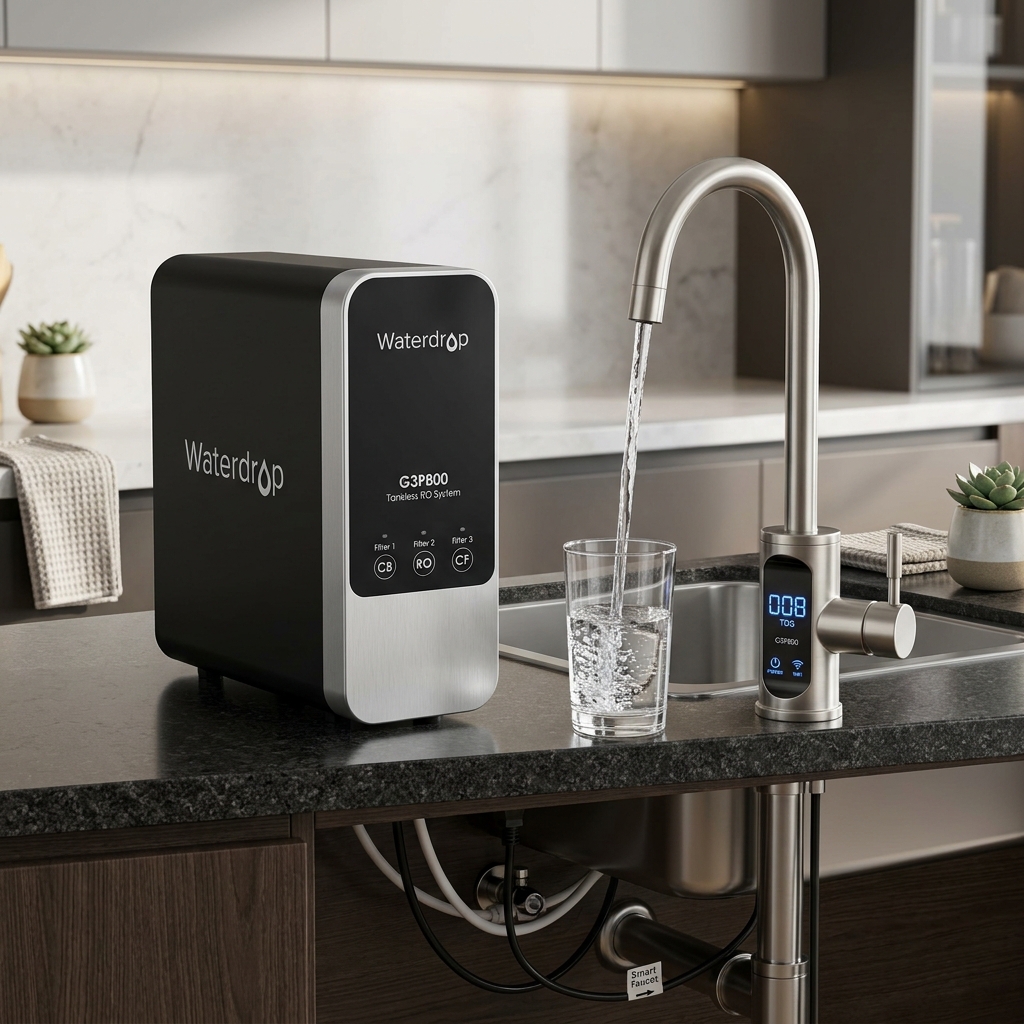
For fast flow and a narrow cabinet footprint
Waterdrop G3P800 Tankless Reverse Osmosis
$600 to $800 typical range
Choose the G3P800 when a busy kitchen needs water on demand and the cabinet has an outlet. The 5.67-inch width is easier to place beside a disposal than a pressure tank, while the smart faucet reports TDS and cartridge status.
- Evidence
- IAPMO certification to NSF/ANSI 42, 53, 58, and 372 for the claims specified in its performance data
- Delivery
- 800 GPD maker rating; six ounces in five seconds under stated conditions
- Water use
- 3:1 pure-to-drain maker rating, equal to one drain gallon per three treated gallons
- Service schedule
- CF at 6 months or 550 gallons; CB at 12 months or 1,100 gallons; RO at 24 months or 2,200 gallons
- Installation
- 18.11 by 5.67 by 17.73 inches; power, cold-water connection, drain saddle, and dedicated faucet required
Sale-stopping flaw. The pump needs power, the installation requires a drain connection, and the base configuration does not remineralize. Its TDS display tracks dissolved solids. It cannot prove that each certified contaminant remains below a health target.
The Waterdrop G3P800 specifications, performance sheet, and service schedule define the published configuration and limits.
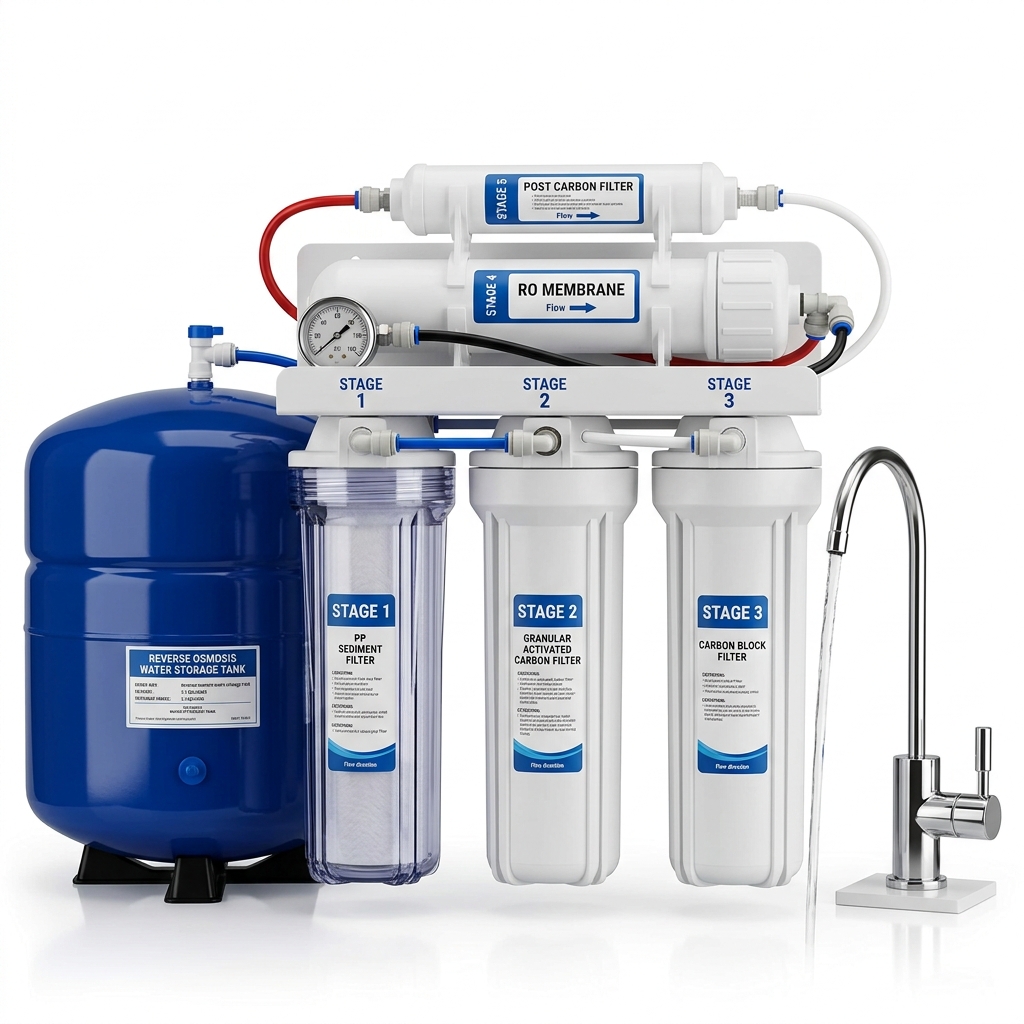
For value and non-electric operation
APEC Essence ROES-50
$180 to $260 typical range
Choose the ROES-50 when purchase cost, standard cartridge housings, and operation without an outlet matter more than instant flow. The tank stores slowly produced water so the faucet can supply short bursts without a powered pump.
- Evidence
- WQA Gold Seal certification under NSF/ANSI 58; the maker describes TDS testing and publishes model-specific reduction data
- Delivery
- 50 GPD at 60 psi; 30 GPD at 50 psi and 77°F; nominal four-gallon storage tank
- Water use
- No model-specific efficiency rating found on the current product page; pressure, temperature, and tank backpressure affect real output
- Service schedule
- Three prefilters at 6 to 12 months; RO membrane and carbon post-filter at 2 to 4 years
- Installation
- Filter assembly is 15.5 by 5.25 by 17 inches; separate 11 by 11 by 15-inch tank; 40 to 85 psi feed range
Sale-stopping flaw. The tank consumes far more cabinet volume than the slim filter assembly suggests. Production falls from 50 to 30 GPD between the maker stated 60- and 50-psi conditions, so low pressure and cold water can lengthen refill time.
The APEC ROES-50 dimensions, pressure range, production ratings, and certification summary define the published configuration and limits.
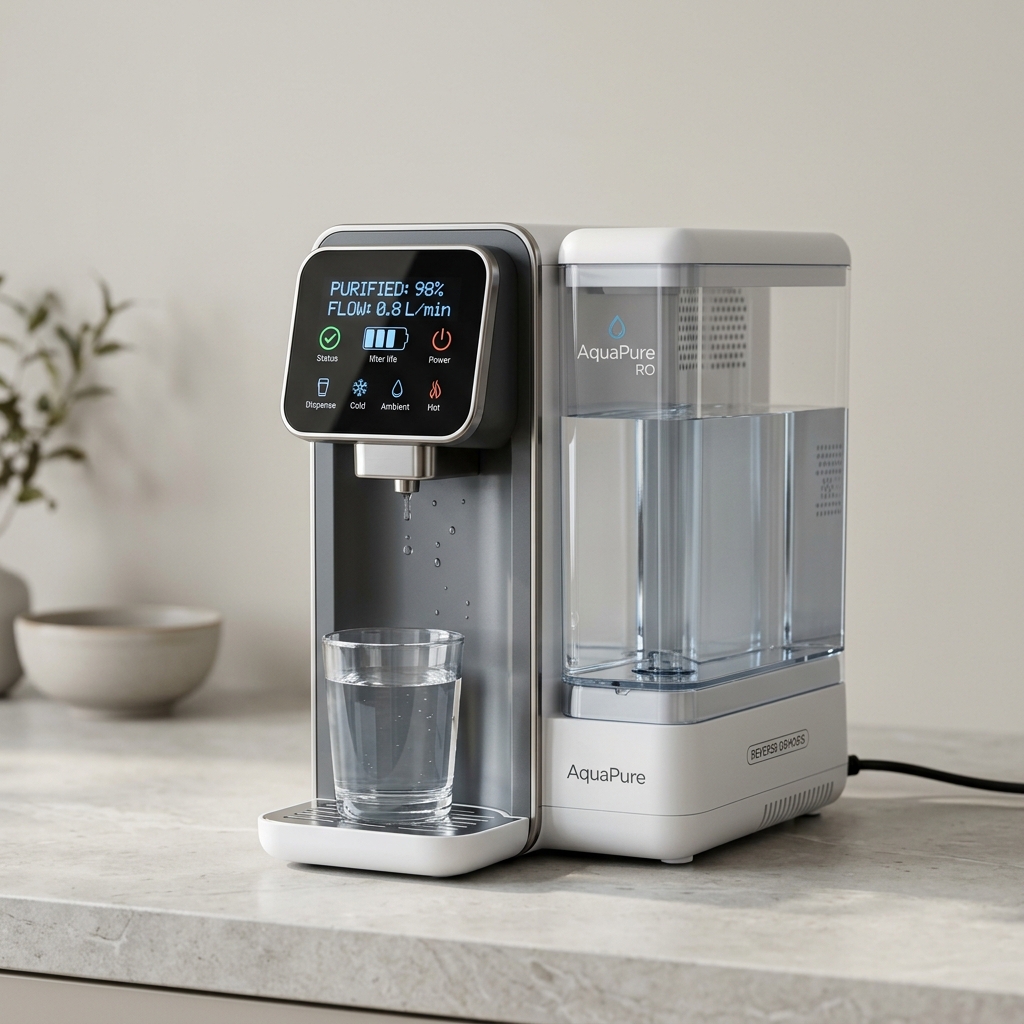
For renters and kitchens without plumbing access
AquaTru Classic Alkaline Countertop RO
$400 to $550 typical range
Choose the AquaTru Classic when drilling a faucet hole or attaching a drain saddle is not allowed. Its exact-model performance sheet has the broadest published contaminant list of these picks, and the alkaline configuration restores calcium and magnesium for taste.
- Evidence
- IAPMO certified to NSF/ANSI 42, 53, 58, 401, P473, and 372 for the exact Classic model family
- Delivery
- 54 GPD performance-sheet rating; 0.75-gallon clean-water tank
- Water use
- 75% efficiency and 80% recovery in the performance sheet; concentrate remains in the removable feed tank
- Service schedule
- Pre/carbon at 6 months or 600 gallons; VOC at 12 months or 600 gallons; RO at 24 months or 1,200 gallons
- Installation
- 12 by 14 by 14 inches; 120-volt outlet, manual filling, tank washing, and concentrate disposal required
Sale-stopping flaw. No plumbing means repeated carrying, filling, emptying, and washing. The 0.75-gallon clean tank can require several cycles for cooking and drinking. AquaTru also limits source hardness to 10 grains per gallon unless pretreatment or regular descaling is used.
The AquaTru Classic performance data and operating limits define the published configuration and limits.
A pumped option when feed pressure is low
iSpring RCC7P-AK
Consider the RCC7P-AK when a pressure reading makes an unpowered tank system a poor fit. It adds a booster pump and a mineral stage. Plan roughly $300 to $450, plus space for the tank, an outlet, a drain, and a drinking-water faucet.
Check before buying: ask iSpring to confirm the pumped model’s minimum feed pressure and its own performance record. A pump supports membrane pressure; it cannot fix every supply problem. The base RCC7AK’s certification does not automatically cover RCC7P-AK.
The RCC7P-AK product record describes the pump and compatible filter sets.
GPD does not tell you how fast a glass fills
A 50 GPD membrane rating equals about 2.08 gallons per hour only at the stated test condition. APEC lists 50 GPD at 60 psi but 30 GPD at 50 psi and 77°F, equal to 1.25 gallons per hour before tank backpressure and other losses. The four-gallon tank exists because the membrane does not deliver a sink faucet's normal flow on demand.
Waterdrop uses a powered pump and rates the G3P800 at 800 GPD, about 33 gallons per hour as a production figure. The more useful kitchen claim is six ounces in five seconds, roughly 0.56 gallon per minute. AquaTru rates its batch appliance at 54 GPD but stores only 0.75 gallon of finished water. Daily carrying and batch count matter more than the headline production ceiling for that format.
Normalize reject water before comparing claims
Assume a household uses exactly three treated gallons each day. Waterdrop's 3:1 pure-to-drain claim implies one drain gallon daily, or 365 gallons yearly. AquaTru's 75% efficiency also means three treated gallons from four incoming gallons under its test definition, which implies the same one-gallon difference. AquaTru keeps that concentrate in the feed tank for manual disposal, while Waterdrop sends it through a drain saddle.
APEC does not publish an exact ROES-50 efficiency rating on the current product page, so a fair annual calculation is not possible from the page alone. EPA estimates that a WaterSense-labeled replacement can save more than 3,100 gallons per year against a typical point-of-use RO system, but none of these three picks should be called WaterSense labeled unless the exact model appears in the current EPA product registry.
Pressure and hardness can reverse the ranking
The ROES-50 operates across a listed 40 to 85 psi feed range, yet its production rating already falls 40% when the stated condition moves from 60 to 50 psi. Measure static pressure, then consider pressure while another fixture runs. A low reading can turn the value pick into a slow-refill system or require a pump that changes its cost and power advantage.
Scale creates a different limit. AquaTru lists a maximum hardness of 10 grains per gallon and says high hardness can slow production and shorten membrane life. A kitchen RO system treats a small drinking-water stream. It does not protect a water heater or shower from scale. Homes that need scale control should compare the whole-house softening and scale-management options separately.
Service work exposes the real ownership cost
At three treated gallons daily, Waterdrop's 550-gallon CF limit arrives after about 183 days, almost exactly its six-month limit. Its 1,100-gallon CB limit arrives after about 367 days, while the 2,200-gallon membrane limit arrives after about 733 days. The calendar and gallon ceilings align closely under this assumption.
AquaTru's 600-gallon stages reach their gallon limit after 200 days, so the six-month prefilter interval arrives first and the 600-gallon VOC limit arrives before one year. The APEC ROES-50 service table uses time ranges instead of gallon ceilings: prefilters every 6 to 12 months, then the membrane and post-filter every 2 to 4 years. Source-water quality and use can shorten every schedule.
The purchase we recommend without earning a commission
Pay for a certified tap-water laboratory test before buying RO for a private well, a plumbing-specific concern, or a contaminant that is not clear in the utility report. We earn nothing from that test. Its concentration, chemical form, and supporting chemistry can determine whether RO is suitable, needs pretreatment, or should be replaced by another method. The result may also show that a certified pitcher is sufficient without drain water.
Four claims should stop the sale
These claims ignore a model boundary, a measurement limit, or the daily work that keeps treatment reliable.
Any RO system removes everything
No consumer treatment unit has an unlimited claim. Read the exact performance sheet, challenge concentration, finished-water endpoint, capacity, and source-water restrictions. The arsenic guide shows why chemical form changes an RO claim.
A TDS reading proves contaminant safety
A falling TDS value can indicate broad membrane rejection. It cannot identify one regulated contaminant or prove microbial safety. Use a relevant analytical method when a health decision depends on the result.
APEC ROES-50 makes 50 gallons at every home
The 50 GPD figure is tied to 60 psi. The same official page lists 30 GPD at 50 psi and 77°F. The full ROES-50 review and specifications preserve the condition behind the headline.
Remineralization improves contaminant reduction
A mineral post-filter can change taste after treatment. It does not strengthen the RO membrane's certified reduction claims. Choose it after the exact contaminant evidence, pressure, and service plan are settled.
Questions about reverse osmosis systems
Is a tankless reverse osmosis system always better than a tank system?
No. Tankless systems save cabinet space and can deliver faster continuous flow, but they need power and usually cost more. A tank system stores water without electricity and can be easier to repair with standard parts, but pressure and temperature affect refill time.
Does NSF/ANSI 58 mean every contaminant is reduced?
No. NSF/ANSI 58 is the standard for reverse osmosis drinking-water systems, but each certified model has a specific claim list. Check the exact model and named contaminant in the certifier listing or performance data sheet.
How much water does reverse osmosis send to the drain?
It depends on the exact model and conditions. A 3:1 pure-to-drain rating means one gallon goes to drain for every three treated gallons. A 75% efficiency rating also means three of four incoming gallons become available as treated water under the defined test conditions.
Can a TDS meter prove that reverse osmosis water is safe?
No. TDS is a bulk measure of dissolved material. It does not identify lead, PFAS, nitrate, arsenic form, microorganisms, or the many other substances that may matter. Use the exact reduction claim and appropriate laboratory testing.
Should reverse osmosis water be remineralized?
Remineralization is a taste preference unless a clinician has given you different advice. It does not improve the upstream contaminant-reduction evidence. The Waterdrop and APEC picks can accept optional post-treatment, while the listed AquaTru configuration includes a mineral-boost VOC filter.
Match the RO format to your kitchen
The under-sink guide compares RO with a no-drain carbon option, while the countertop guide covers batch work and temperature features.