Contaminants guide
The Best Water Filters for Fluoride
Choose AquaTru Classic when you cannot alter plumbing, iSpring RCC7AK for a lower-cost installed system, or Waterdrop G3P800 when fast tankless flow earns the larger budget.
The market trap is treating “NSF 58” as a universal fluoride promise. NSF/ANSI 58 requires a TDS reduction claim, but fluoride reduction is optional. The exact system record must name fluoride. A carbon filter, micron rating, or low TDS screen does not fill that gap.
Who should skip product shopping
Check your concentration first. Your utility is the best source for municipal-water fluoride, while a private well needs laboratory analysis. CDC says 0.7 mg/L supports cavity prevention, so speak with a dentist or pediatrician before removing fluoride solely for general wellness. Follow your health department when a result exceeds 4.0 mg/L or a public notice gives different instructions.
Four rules decide the shortlist
Fluoride is a dissolved target, so the label and the water conditions matter more than stage count. Apply these checks before comparing convenience or price.
Find fluoride by name
Match the exact model and replacement cartridge to a fluoride claim, not just an RO or materials standard.
Start with a measured source level
A percentage without your starting concentration cannot tell you the expected finished-water level.
Respect feed-water limits
Pressure, hardness, temperature, and cartridge age can move real performance away from a laboratory result.
Plan for reject water
Every RO design separates a treated stream from a concentrate stream, although the ratio differs by model.
What matters when choosing fluoride filters
Look for a fluoride claim for the exact model. Then compare space, filling speed, water use and replacement costs—not just the number of filter stages.
U.S. Geological Survey scientists reported their national well analysis in Science of the Total Environment. The USGS summary covers 16,441 public-supply and domestic wells and found that high fluoride was uncommon but geographically uneven. That is why a private-well owner needs a local result, not a national average. The work was government research, not filter-company testing.
Three fluoride numbers answer different questions
| Number | What it describes | How to use it |
|---|---|---|
| 0.7 mg/L | U.S. Public Health Service recommendation for cavity prevention | Discuss intentional removal with your dental provider |
| 2.0 mg/L | EPA secondary standard tied to dental fluorosis notice | Provide another drinking-water source for children 8 and younger under CDC guidance |
| 4.0 mg/L | Current federal maximum contaminant level | Contact the public health department and follow its treatment steps |
CDC explains the three household decision points and where to find a water result. EPA retained the 4.0 mg/L maximum after its 2024 review and accelerated a new toxicity assessment in 2026, so the federal health review is active rather than settled for the next cycle.
Three picks with fluoride records
Affiliate disclosure: We may earn from qualifying purchases through retailer links. The comparison method and its limits explain how products qualify. Price ranges allow for normal Amazon offer changes.
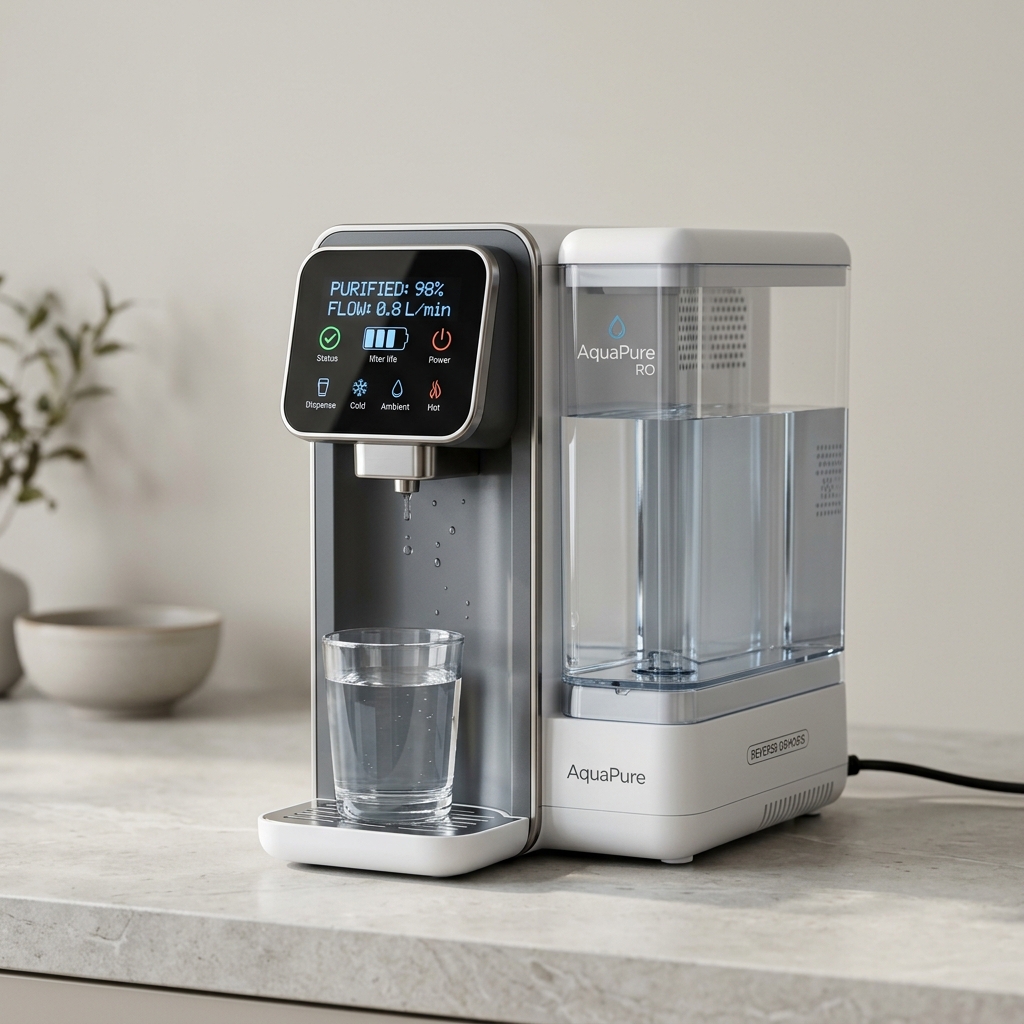
For renters and no-plumbing kitchens
AquaTru Classic Alkaline Countertop RO
$400 to $550 price range
Choose AquaTru Classic when drilling and drain plumbing are off the table. Its current performance sheet reports 91.8% minimum and 93.5% average fluoride reduction from an 8 mg/L laboratory challenge.
- Treatment
- Countertop reverse osmosis with carbon stages
- Fluoride evidence
- IAPMO-certified NSF/ANSI 58 fluoride claim for the Classic family
- Rated service
- Prefilter at 6 months or 600 gallons; RO membrane at 24 months or 1,200 gallons
- Setup
- 120-volt outlet, manual tank filling, no plumbing connection
Capacity math. At one gallon per day, the six-month clock arrives before the 600-gallon prefilter limit. At three gallons per day, 600 gallons lasts about 200 days, so the same calendar limit still arrives first.
Sale-stopping flaw. It occupies counter space, works in batches, and leaves concentrate in the feed tank for you to discard. Feed water above 10 grains per gallon, about 171 mg/L as hardness, needs softening first under AquaTru's use guidelines.
The model identity and limits come from the AquaTru Classic Alkaline Countertop RO technical record.

For value-focused under-sink installation
iSpring RCC7AK 6-Stage Alkaline RO
$200 to $300 price range
Choose the RCC7AK when cabinet room matters less than a lower purchase band and no-power operation. The maker's current NSF claim lists 97.4% fluoride reduction, and the mineral stage sits after the RO membrane.
- Treatment
- Tank-style reverse osmosis with post-RO remineralization
- Fluoride evidence
- NSF/ANSI 58 fluoride claim for the RCC7AK system
- Rated service
- Prefilters and postfilters at 6 to 12 months; RO membrane at 2 to 3 years
- Setup
- Cold-water feed, drain saddle, storage tank, dedicated faucet, no outlet
Capacity math. The 75-gallon-per-day rating describes membrane production under test conditions, not faucet delivery. The 3.2-gallon storage tank supplies the first draw, then flow slows if you empty it before the membrane refills it.
Sale-stopping flaw. The tank and six stages take more cabinet space than a tankless unit. Feed pressure and temperature control real production, and the drain stream continues whenever the membrane makes water.
The model identity and limits come from the iSpring RCC7AK 6-Stage Alkaline RO technical record.
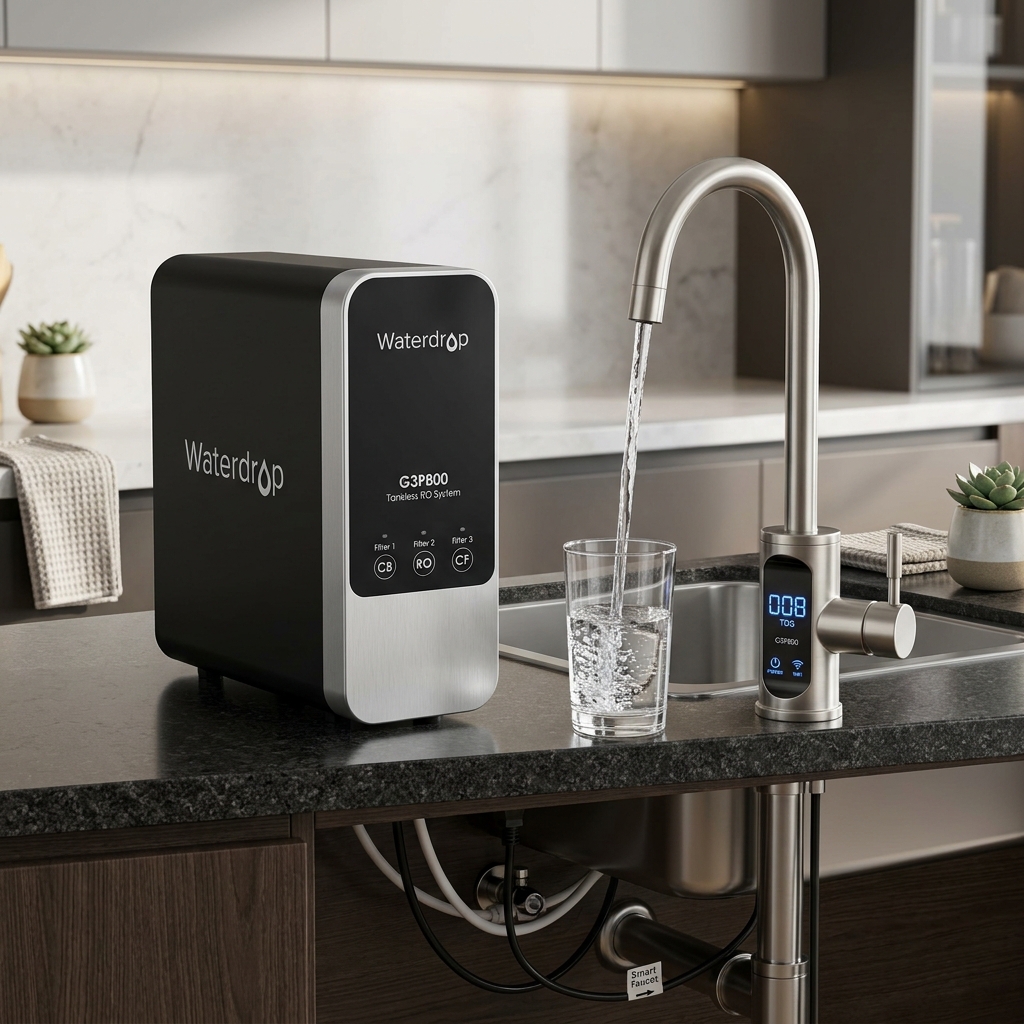
For high-demand kitchens with cabinet power
Waterdrop G3P800 Tankless Reverse Osmosis
$600 to $750 price range
Choose the G3P800 when several people fill bottles and cookware throughout the day. Its 800 GPD rating and 3:1 pure-to-drain specification favor fast service and lower reject volume than many conventional RO designs.
- Treatment
- Powered tankless reverse osmosis with separate prefilters
- Fluoride evidence
- IAPMO-certified NSF/ANSI 58 system with fluoride named in the model record
- Rated service
- CF at 6 months or 550 gallons; CB at 12 months or 1,100 gallons; RO at 24 months or 2,900 gallons
- Setup
- Cold-water feed, drain saddle, dedicated faucet, and power outlet
Capacity math. At three treated gallons per day, the CF cartridge reaches about 183 days, almost exactly its six-month calendar limit. At one gallon per day, the six-month limit still controls even though the gallon count is much lower.
Sale-stopping flaw. The system needs power and cannot use your normal faucet. Its display reports TDS and filter life, not fluoride concentration, so a reassuring screen is not a finished-water fluoride result.
The model identity and limits come from the Waterdrop G3P800 Tankless Reverse Osmosis technical record.
Turn a percentage into a finished-water estimate
Multiply the source concentration by the fraction left after treatment. AquaTru's certified minimum reduction leaves 8.2%, so the estimate is source fluoride × 0.082. This is planning math, not a substitute for a finished-water laboratory sample.
| Source concentration | Assumed reduction | Estimated finished water |
|---|---|---|
| 0.7 mg/L | 91.8% | About 0.057 mg/L |
| 2.0 mg/L | 91.8% | About 0.164 mg/L |
| 4.0 mg/L | 91.8% | About 0.328 mg/L |
The 91.8% figure is AquaTru's minimum result from an 8 mg/L challenge under controlled conditions. It does not promise the same percentage with an old membrane, hard feed water, low pressure, or a different model.
Pick by household constraint
| Constraint | Best fit | Reason |
|---|---|---|
| No plumbing changes | AquaTru Classic | Countertop batch RO with a model-level fluoride claim |
| Lower installed price band | iSpring RCC7AK | Tank RO, no outlet, and post-RO mineral stage |
| Fast repeated draws | Waterdrop G3P800 | Powered 800 GPD tankless design |
| Private well above 4.0 mg/L | Health department plan | Treatment selection follows a full laboratory panel and local guidance |
Why RO separates fluoride from water
Fluoride is a dissolved ion, so ordinary sediment screening does not catch it. Reverse osmosis applies pressure across a selective membrane. Water permeates the membrane while a concentrate stream carries away much of the dissolved load. Carbon stages protect the membrane from chlorine and improve taste, but the RO membrane does the main fluoride work.
NSF lists fluoride as an optional contaminant claim under NSF/ANSI 58. That detail matters because a system can meet the standard for required TDS reduction without carrying every optional contaminant claim.
What else works
Distilled or deionized bottled water can provide a short bridge when a health department advises another drinking-water source. CDC says those labels usually indicate no or only trace fluoride unless fluoride was added. A specialty activated-alumina system can also adsorb fluoride, but media volume, pH, flow, and exhaustion control performance. Demand an exact model record and a service endpoint rather than assuming the media name is enough.
The water filter matchmaker connects your source water and installation limits to a treatment type. Renters can compare other reversible options in the rental-home filter guide. A report that also names PFOA or PFOS needs the separate PFAS certification comparison, since fluoride and PFAS claims are not interchangeable.
What does not solve fluoride at the tap
Aquasana Claryum Direct Connect AQ-MF-1 is a useful named loser for this job. Its performance sheet says all reduced contaminants are listed and gives fluoride zero rows. The filter has valid claims for lead, PFOA and PFOS, chlorine, and other substances, but those do not extend to fluoride.
Boiling does not remove a dissolved fluoride ion. UV treats microbes, not dissolved salts. A softener exchanges hardness ions and is not a fluoride claim. A TDS meter can show that an RO membrane is changing the total ion load, but it cannot tell which part of that reading came from fluoride.
Households already comparing dissolved-contaminant treatment can use the lead filter guide's model-level certification checks. The same discipline applies here, even though the claim sits under a different part of the standard.
Limits that change the verdict
Laboratory claims use controlled pressure, temperature, water chemistry, and replacement schedules. Hard water can scale a membrane. Cold water slows production. Low feed pressure can reduce both output and rejection. A missed filter change removes the basis for relying on the rated result. Test the finished water when a health notice, a child's exposure, or a private-well result makes the exact concentration important.
Fluoride filter questions
What type of water filter removes fluoride?
Reverse osmosis is the most widely certified household option. A specialty adsorptive or ion-exchange filter may also reduce fluoride, but only when the exact model has a fluoride performance claim for its rated water conditions and service life.
Do Brita filters remove fluoride?
Do not assume they do. Brita Elite has certified claims for contaminants such as lead and specified PFOA and PFOS, but its current performance sheet does not list fluoride. Match the exact cartridge to a fluoride claim before buying.
Does boiling water remove fluoride?
No. Boiling removes water as vapor and leaves dissolved fluoride behind, so it can increase the fluoride concentration slightly.
Can a TDS meter measure fluoride?
No. A TDS meter estimates the combined concentration of conductive dissolved ions. It cannot identify fluoride or prove that fluoride is below a chosen target.
Does remineralization add fluoride back after reverse osmosis?
The mineral stages on the AquaTru Alkaline and iSpring RCC7AK add mineral media after RO treatment, but their model documents do not describe that stage as adding fluoride. Use a laboratory test when you need a measured finished-water concentration.