Buying guide
The Best Water Softeners for Hard Water
Want truly soft water? Start with a salt-based softener. Want less scale without adding salt? A conditioner may fit—but the minerals stay. Here is how to choose without buying the wrong kind of system.
PureWater Filter Finder Research · Updated · 12 min read
We may earn from qualifying purchases. Price ranges are budgets, not live offers. Choose the right model before comparing deals.
Choose the result you want
- Less scale, easier lather and truly soft water: compare SpringWell SS with a correctly specified salt-based system from your installer.
- Lower equipment price: the DuraWater/Fleck bundle is an option to investigate, not a verified winner without its current bundle sheet.
- No salt bags or drain, and scale control is enough: consider FutureSoft only if your full water test fits its limits.
- Only want different drinking water: compare reverse osmosis. Do not pay to soften every tap for a one-tap goal.
White spots and soap trouble can point to hard water, but a test tells you how hard it is. USGS calls water over 180 mg/L as calcium carbonate very hard. Hardness is mainly calcium and magnesium. A normal carbon or sediment filter does not remove it.
Two softener options—and one different job
Our checks put water fit ahead of price or brand. We compare the true softeners for hardness removal. FutureSoft gets a separate scale-control assessment; it cannot win a soft-water contest while leaving the hardness behind.
| Choice | Removes hardness? | Salt / drain / power | What to confirm |
|---|---|---|---|
| SpringWell SS | Yes, ion exchange | All three needed | Working capacity at the quoted salt dose |
| DuraWater/Fleck 48K | Softener format; confirm current bundle | All three needed | Exact system sheet and service flow |
| FutureSoft | No; scale conditioning only | None for treatment | Full feed-water chemistry |
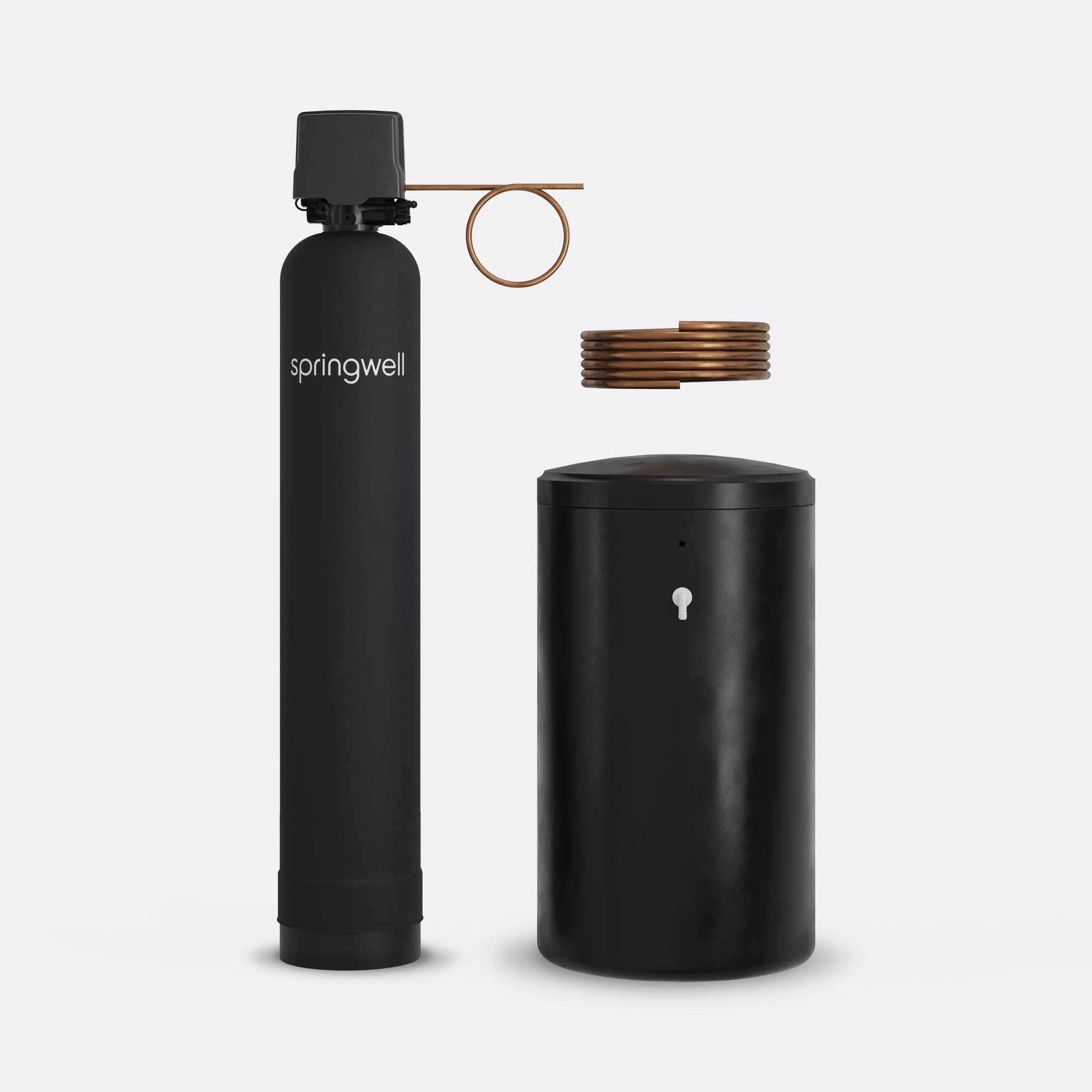
SpringWell Salt-Based Water Softener
Typically $1,500–$2,500 · equipment only
This is the clearer starting point in our catalog for a buyer who wants a published choice of sizes. It uses salt and resin to remove hardness. You need room for the treatment tank and salt tank, plus a drain and power.
SpringWell lists SS1, SS4 and SS+ at 11, 13 and 20 GPM, with nominal capacities of 32K, 48K and 80K grains. Those labels are not the usable capacity at every salt setting. Ask the seller to size it from your water test and use.
Our buyer-fit assessment
Better published sizing choices
Good for: A homeowner who wants truly soft water and can supply salt, power and a legal drain.
The tradeoff: Salt and rinse-water costs depend on programming. A bathroom count alone cannot size the softener.
Before you buy: Request working capacity at the chosen salt dose, salt per cycle, water per cycle, and a fitted quote.
See our six buying checks and sources
Editorial judgments for Whole-home hardness removal; tested feed water; 6 GPM peak example; four users at 60 gallons/day and 10 grains/gallon; five years. These are not lab scores or customer ratings. A missing fact stays unscored; we do not fill it in with a guess.
- Treatment evidence Meets the brief
- Maker describes hardness removal by ion exchange. No exact-system efficiency certification is used to award a higher grade.Source
- Water and size fit Meets the brief
- SS1/SS4/SS+ list 11/13/20 GPM and 32K/48K/80K nominal grains. Actual working capacity depends on salt dose and reserve.Source
- Setup Meets the brief
- Requires main-line plumbing, two tanks, drain, overflow planning and power. Confirm fittings with the installer.Source
- Upkeep Meets the brief
- Metered regeneration plus salt refills and brine-tank checks. Automatic controls do not remove the need for upkeep.Source
- Long-term cost Needs confirmation
- No verified model-and-setting-specific salt/water use for a five-year total. Ask for it rather than assuming a cheap monthly running cost.Source
- Warranty and returns Tradeoff
- General returns require unused/uninstalled condition; fees and shipping apply. Installed-system remedies are limited by the detailed policy.Source
Checked . Assessment applies to SS1 baseline; SS4 and SS+ separately sized.
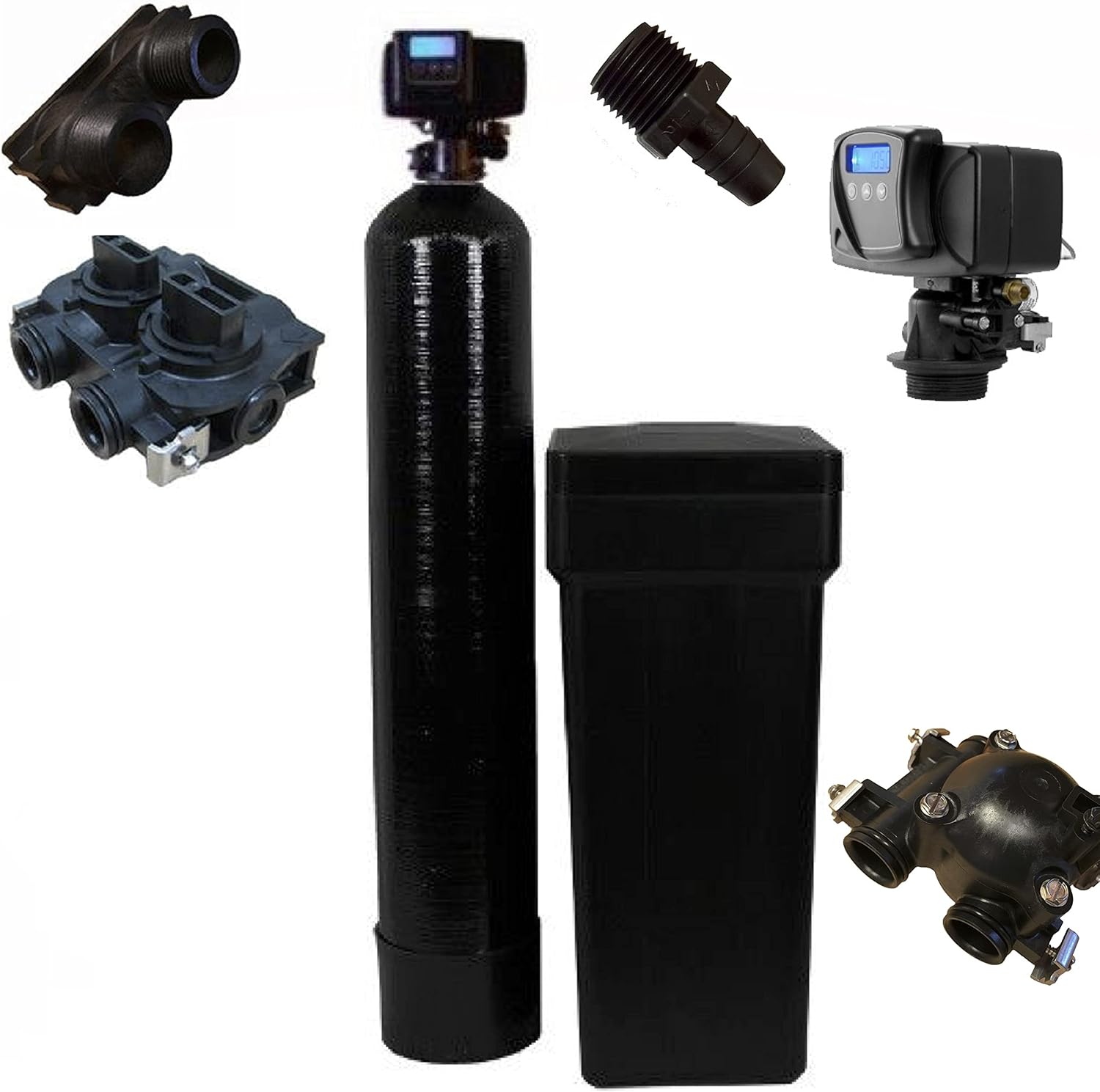
DuraWater 48,000-Grain Softener with Fleck 5600SXT Valve
Typically $750–$1,000 · equipment only
This lower-price bundle may appeal if you have an installer who can check its parts and settings. “Fleck 5600SXT” is the valve name. It does not tell you the performance of every tank and resin package sold with that valve.
The exact bundle's linked maker page did not open during our latest check. Get a current sheet for the complete DuraWater 48K system before ordering. We are not awarding it a complete score from a valve rating or a 48,000-grain sales label.
Our buyer-fit assessment
Lower-price option to confirm first
Good for: A buyer with an installer who can confirm the complete bundle and program it correctly.
The tradeoff: Fleck names the control valve, not a complete-system performance rating. The linked DuraWater specification page could not be re-opened during this check.
Before you buy: Get the current bundle sheet, service flow, resin, working capacity, salt dose and warranty before ordering.
See our six buying checks and sources
Editorial judgments for Whole-home hardness removal; same household assumptions as SS1; exact seller configuration still needs confirmation. These are not lab scores or customer ratings. A missing fact stays unscored; we do not fill it in with a guess.
- Treatment evidence Needs confirmation
- A valve brand or 48K label does not verify the current assembled bundle.Source
- Water and size fit Needs confirmation
- Finished-bundle flow and working capacity need a current seller sheet.Source
- Setup Needs confirmation
- Confirm tank sizes, plumbing connections, power and drain with the exact bundle supplier.Source
- Upkeep Needs confirmation
- Confirm resin and compatible replacement parts rather than relying on the controller name.Source
- Long-term cost Needs confirmation
- A five-year total needs the actual fitted price and programmed salt/water use.Source
- Warranty and returns Needs confirmation
- The assembled system, resin and control may have different warranty terms. Obtain the current seller policy.Source
Current exact-bundle documentation could not be reverified. Do not rank valve specifications as complete-system performance.
Checked . Assessment applies to DuraWater 48K bundle, ASIN B00MYEV6VC; not every Fleck system.
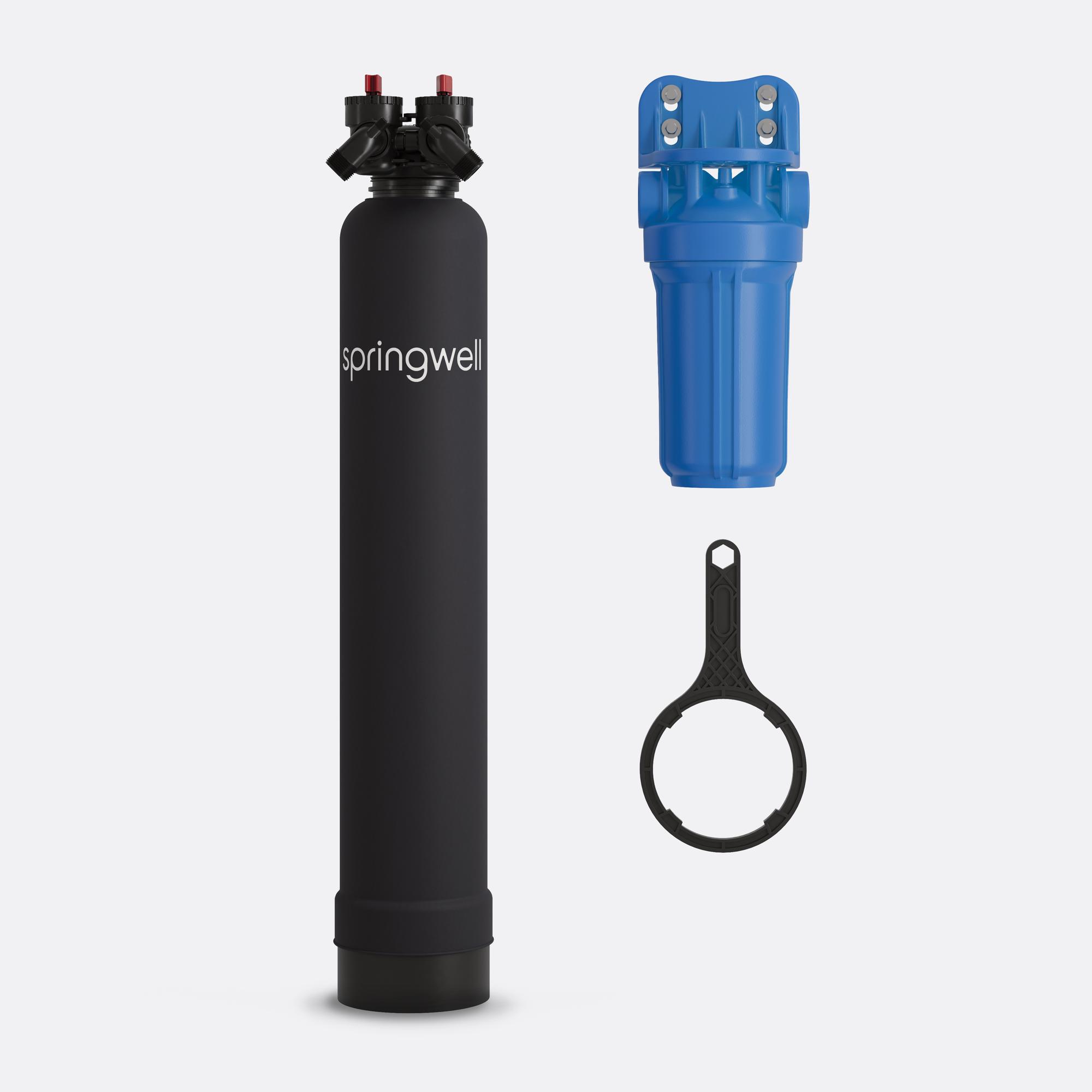
SpringWell FutureSoft Salt-Free Water Conditioner
Typically $1,200–$2,200 · equipment only
FutureSoft is the easier-care route when avoiding salt matters more than having soft water. It conditions minerals to help reduce scale. The minerals remain, so do not expect a lower hardness test or spot-free drying.
Current specs list 12/15/20 GPM by size, pH 7–9.5, and a 75-grain-per-gallon hardness ceiling. The listed limits also exclude iron, manganese, copper, oil and hydrogen sulfide. A full test matters more than the bathroom-size label.
Our buyer-fit assessment
Salt-free alternative for scale only
Good for: A homeowner who wants less scale without salt handling and accepts that minerals and some spots remain.
The tradeoff: Not a true softener. Current specs require pH 7–9.5, hardness no more than 75 grains/gallon, and no iron, manganese, copper, oil or hydrogen sulfide.
Before you buy: Send the full water test to the supplier. If you want a lower hardness reading, choose salt-based softening instead.
See our six buying checks and sources
Editorial judgments for Salt-free scale control, NOT hardness removal; tested feed within every limit; 6 GPM peak example; five years. These are not lab scores or customer ratings. A missing fact stays unscored; we do not fill it in with a guess.
- Treatment evidence Meets the brief
- Maker documents scale conditioning, not mineral removal. Its up-to-95% scale claim is not treated as a household test result.Source
- Water and size fit Meets the brief
- FS1/FS4/FS+ list 12/15/20 GPM. Current hardness ceiling is 75 grains/gallon, not the older 81 figure.Source
- Setup Meets the brief
- Main-line tank and prefilter installation; no treatment drain or electrical supply.Source
- Upkeep Strong point
- No salt filling or regeneration. Prefilter service and feed-water limits still apply.Source
- Long-term cost Needs confirmation
- No salt or regeneration cost, but a five-year total still needs installation, prefilters and current media-service terms.Source
- Warranty and returns Tradeoff
- The detailed return conditions apply, not an unrestricted six-month installed trial.Source
Checked . Assessment applies to FS1 baseline; FS4/FS+ have different flows.
Size it in plain English
You need two numbers: how much hardness arrives each day, and how fast water runs when several taps are on.
- Daily hardness load: people × gallons per person per day × hardness in grains per gallon.
- Time between cleaning cycles: programmed working capacity ÷ daily hardness load. The cleaning cycle is called regeneration.
- Peak flow: add the fixtures likely to run at the same time. Check that against the complete system's service flow.
Example only: four people × 60 gallons × 10 grains = 2,400 grains daily. If the chosen salt setting gives 24,000 grains of working capacity, that is about 10 days before reserve adjustments. It does not mean a 48K system always gives 20 days. Iron and other water conditions can change the setup.
Ask your installer for the working capacity, salt dose and reserve in writing. If the seller only repeats “up to six bathrooms,” keep asking.
Build a five-year budget
Price the system with delivery, installation, bypass and any pretreatment. Then add the work it will need. There is no honest single running-cost figure without your water use and settings.
- Salt-based: add salt, water and sewer charges for each regeneration, electricity, and service. Ask for pounds of salt and gallons of water per cycle at the quoted working capacity.
- Salt-free: no salt or regeneration-water bill, but include prefilters, future media service and any treatment needed to meet the feed limits.
- Both: include maintenance access, testing after installation, and the cost of a service visit if you cannot do the work.
For a simple example, assume 36 cycles a year. If the written settings say 8 pounds of salt and 50 gallons per cycle, that is 288 pounds of salt and 1,800 gallons yearly. These are example inputs, not specifications for either pick. Multiply your quoted values by your local costs.
Check these before booking installation
- Test hardness. For a well, check iron, manganese, pH and local health risks too.
- Confirm local salt-discharge rules and a suitable drain. Ask about septic requirements if relevant.
- Measure space for both tanks, salt refills, shutoffs and future service.
- Ask which outdoor lines can bypass the softener, so garden water does not use its capacity.
- Check return terms before plumbing it in. SpringWell's general returns require unused, uninstalled condition; installed returns need a defect determination.
- After installation, test raw and treated hardness in the same unit. Do not use a TDS reading as proof of softening.
Need chlorine reduction as well? The whole-house filter guide covers that separate choice. To compare SpringWell's two approaches, read SS vs FutureSoft. For private-well health risks, start with EPA's well-testing guidance.
Questions you may ask next
What is the best treatment for truly soft water?
A correctly sized salt-based ion-exchange softener removes calcium and magnesium hardness. Start with a hardness test, daily water use and peak flow. A carbon filter, shower filter or salt-free conditioner does not do the same job.
Will a salt-free conditioner lower my hardness test result?
No. FutureSoft is designed to reduce scale without taking calcium and magnesium out of the water. Hardness and some spotting remain. Choose a true softener if softer-water feel, easier lather or a lower hardness result is the goal.
How do I convert hardness from ppm to grains per gallon?
For hardness reported as calcium carbonate, divide mg/L or ppm by 17.1. For example, 171 mg/L is about 10 grains per gallon. A TDS meter does not measure hardness alone.
Can a softener remove bacteria, lead or PFAS?
Do not buy these softeners as treatment for those concerns. Their job is hardness. Use testing to choose separate contaminant treatment and follow local health instructions if water is unsafe.
Do I need reverse osmosis with a softener?
Not always. A softener serves the home; reverse osmosis serves drinking water at a tap. Consider both only if your water test and drinking-water goals call for both. A softener does not generally lower total dissolved solids.
Can a renter fix hard shower water with a pitcher?
No. A pitcher treats small drinking-water batches. It cannot soften a shower or protect a water heater. Ask the property owner about a properly sized whole-home softener if those are the problems.
Is hard water itself unsafe to drink?
Hardness is usually a scale, soap and appliance issue rather than a health hazard. It does not tell you whether other contaminants are present. Test private wells and any specific health concern separately.
Still deciding? Start with your home and water.
The finder narrows the choices by water source, space, budget and the problem you want to fix.