Product comparison
SpringWell SS vs FutureSoft
Choose the SpringWell SS line, usually $1,500 to $2,500 before installation, for truly soft water. Choose FutureSoft, usually $1,200 to $2,200, only when scale control without salt or a drain matters more than lower hardness, fewer spots, or a soft-water feel.
Skip both until you know the water source, hardness, iron, manganese, copper, sulfur odor, pH, peak flow, and the result you want. Neither line is a general contaminant filter, and FutureSoft has feed-water limits strict enough to stop many private-well purchases.
Pick SS
Hardness removal, less spotting, and soft-water behavior
Pick FutureSoft
Scale control with no salt, power, or regeneration drain
Stop the sale
Untested water or an installation that cannot meet the limits
Test the source and name the result first
A hardness number is the starting point. EPA says water above 7 grains per gallon is generally hard and water above 10 grains per gallon is often a softener candidate. The same 2026 WaterSense softener guide says hardness, household water use, local rules, and water that does not need softening should shape the choice.
Water source
Use the current utility report for city water. Use a certified laboratory panel for a private well.
Measured problem
Record hardness in grains per gallon or mg/L. Add iron, manganese, copper, pH, sulfur odor, sediment, and bacteria where the source calls for them.
Household demand
Add the flow of fixtures and appliances that can run together. Bathroom count is only a shortcut.
Installation limits
Check pressure, pipe size, protected floor space, bypass access, drain capacity, power, and room to service each tank.
Upkeep and budget
Price salt, regeneration water, annual service, prefilters, installation, and the eventual media or resin work.
Desired outcome
Write down one goal: true soft water, less new scale, or contaminant treatment. Those are different jobs.
A renter, a home without safe main-line access, or a household with mild hardness and no costly scale problem should delay a whole-house purchase. The hard-water treatment guide separates removal from scale control, while the whole-house systems guide matches each treatment job to the source.
How this comparison was built
Decide whether you want hardness minerals removed or scale control without salt. Then compare water limits, drain space, upkeep and the result that matters to you.
Dvorak and Sharon Skipton state in the Nebraska Extension water-softening guide that unit selection should follow water analysis and household needs. A separate peer-reviewed Journal AWWA pipe-loop study found no systematic rise in metal leaching after ion-exchange softening across two source waters. That study did not test either SpringWell product or prove a result in every plumbing system.
Salt-free evidence is weaker. A University of Waterloo master's thesis tested template-assisted crystallization with two source waters. It found only small changes in calcium and magnesium and somewhat less scale in its simplified test, while calling for flow-through work with new and used media. The Waterloo record labels the work an unreviewed thesis, and it did not test FutureSoft. That gap matters more than a broad percentage on a sales page.
Affiliate disclosure: We may earn from qualifying purchases. Price ranges are planning budgets, not live offers.
The products solve different jobs
The name on the tank matters less than what happens to the hardness minerals. SS exchanges calcium and magnesium for sodium or potassium. FutureSoft aims to change how those minerals form scale while leaving them in the water.
| Buying factor | SpringWell SS | FutureSoft |
|---|---|---|
| Treatment job | Removes calcium and magnesium hardness | Conditions hardness to target new scale |
| Finished hardness | Should fall when sized and programmed correctly | Stays hard because minerals remain |
| Spotting and soap | Made for less spotting and easier lather | Maker warns it will not stop spotting or create the slick feel of soft water |
| Utilities | Power, regeneration drain, and overflow route | No power or regeneration drain |
| Consumables | Salt as used | Sediment prefilter service, no salt |
| Smallest model flow | SS1 at 11 GPM | FS1 at 12 GPM |
| Published chemistry range | pH 6.5 to 10 in current specs | pH 7.0 to 9.5 plus zero limits for several foulants |
| Main sale stopper | No legal drain route, power, salt plan, or verified efficiency | Water outside any feed limit or a buyer who expects true softening |
The SS line wins when soft water is the goal
The SS line earns the pick when a hardness test confirms the problem and the household wants hardness removed. It is the direct answer for persistent water spots, soap that will not lather well, and a target near zero grains per gallon at indoor fixtures.
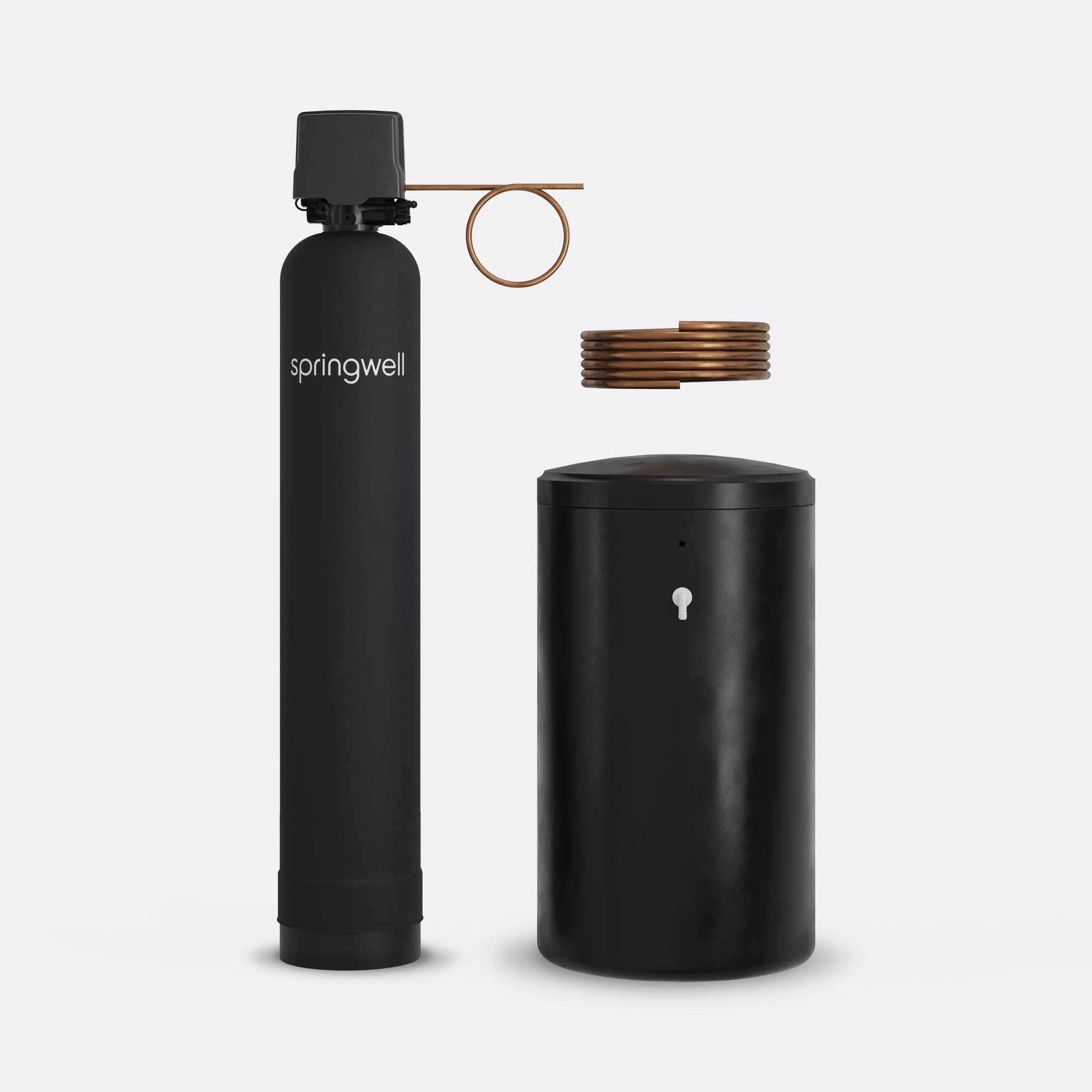
For households that want hardness removed
SpringWell Salt-Based Water Softener
$1,500 to $2,500 planning range before installation
- Models
- SS1, SS4, and SS+
- Capacity labels
- 32,000, 48,000, and 80,000 grains
- Service flow
- 11, 13, or 20 GPM
- Pressure and pH
- 25 to 80 psi and pH 6.5 to 10
- Utilities
- Power, regeneration drain, and overflow
- Routine work
- Salt refill, brine care, and annual service plan
Why it earns the recommendation. The current SpringWell SS product record describes true calcium and magnesium removal and publishes three grain capacities and flow labels. Ion exchange matches the goal of soft water instead of asking scale control to stand in for it.
What the product page does not settle. A 32,000-grain tank does not tell you salt efficiency, water used per regeneration, reserve setting, or useful capacity at the chosen salt dose. Ask for those values in writing and program the controller from a current hardness result.
Sale-stopping flaw. Skip it if local rules block brine discharge, the septic provider objects, or the house cannot provide a legal drain, overflow route, outlet, and service space. A buyer who wants zero added sodium should keep an unsoftened drinking line or discuss potassium chloride and medical needs with qualified professionals.
FutureSoft wins only when scale control is enough
FutureSoft earns a narrower recommendation. It fits a tested city-water home that wants less new scale, refuses salt and regeneration waste, and accepts that hardness readings, water feel, and some spotting may not change.
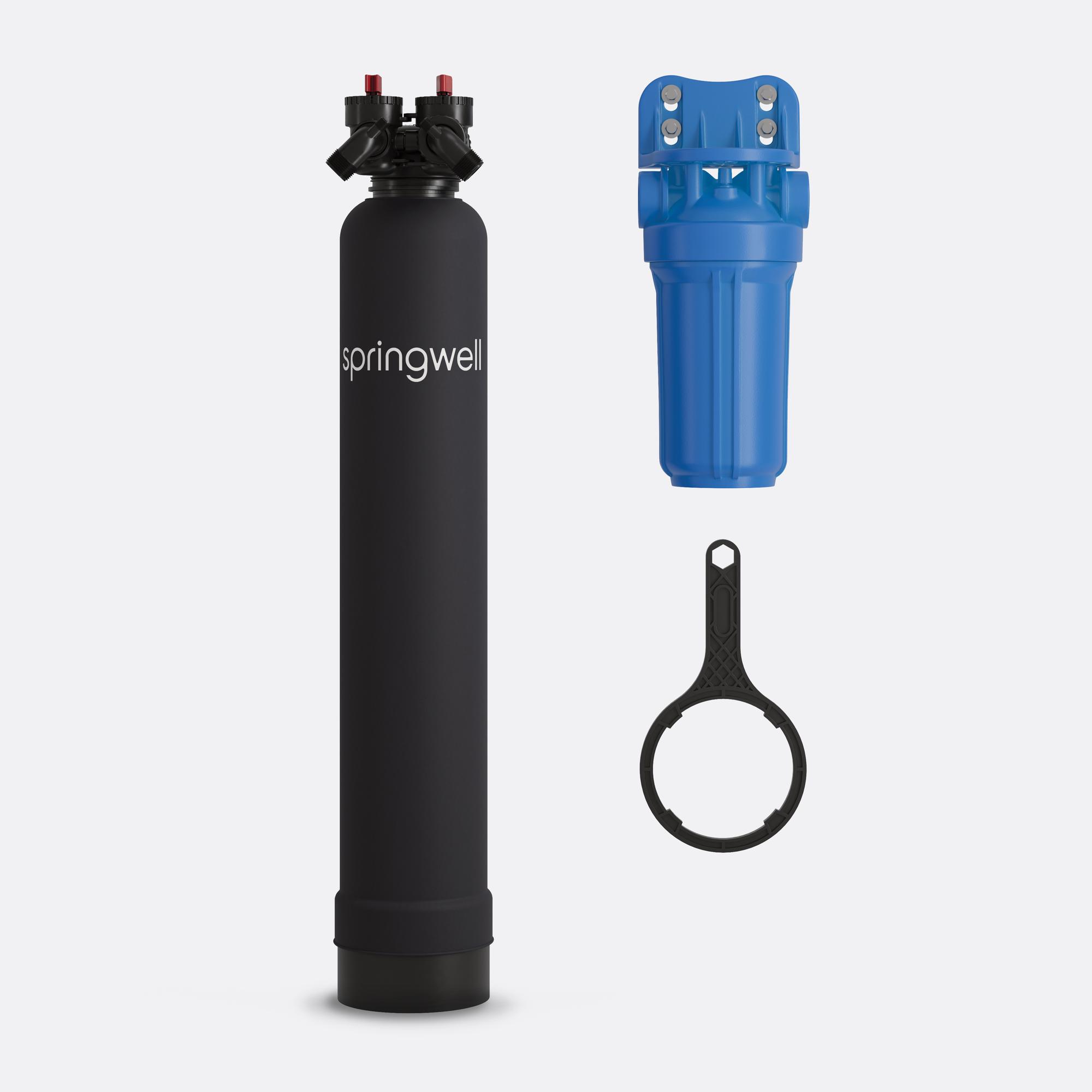
For tested water and a no-salt scale goal
SpringWell FutureSoft Water Conditioner
$1,200 to $2,200 planning range before installation
- Models
- FS1, FS4, and FS+
- Hardness label
- Up to 75 grains per gallon on the current specification page
- Service flow
- 12, 15, or 20 GPM
- Pressure and pH
- 20 to 80 psi and pH 7.0 to 9.5
- Utilities
- No power or regeneration drain
- Routine work
- Sediment prefilter checks and media planning
Why it earns a qualified recommendation. The current FutureSoft product record lists no salt, power, regeneration, or backwashing and publishes 12, 15, and 20 GPM service-flow options. That can fit a no-drain city-water installation where new scale is the only goal.
What keeps the recommendation narrow. SpringWell says up to 95% scale prevention, but the page does not link an exact model report with the challenge water, flow, temperature, endpoints, and service age. The current 75-grain hardness ceiling is an inlet limit, not proof that 75-grain water becomes soft.
Sale-stopping flaw. The published specifications list zero iron, manganese, copper, oil, and hydrogen sulfide. Any detected amount needs a written pretreatment plan or another choice. Skip FutureSoft when the buyer expects lower hardness, spot-free glass, or soft-water feel.
The decision tree has one hard fork
- 1. Do you need hardness removed? Pick SS. FutureSoft cannot produce that outcome.
- 2. Is scale control enough and salt is off the table? Keep FutureSoft on the list, but only after every feed-water limit passes.
- 3. Does the water show iron, manganese, sulfur odor, copper, oil, bacteria, or another contaminant? Buy neither yet. Treat the measured problem in the right order.
- 4. Can the house support the selected model at peak use? Match service flow, pressure, pipe size, floor space, and service clearance before ordering.
The third path is the non-commissioned recommendation. A laboratory report and a plumber's site check cost less than a mismatched whole-house system. Private-well owners can use the well-water treatment guide to build the test list, and a manganese result belongs in the manganese treatment decision before a conditioner.
The size labels need peak-flow math
SpringWell uses bathroom groups, but a house consumes water through fixtures. Add what can run at the same time, then keep a margin below the selected service-flow label. A 20 GPM label cannot fix a narrow service line or low dynamic pressure.
| Home group | SS model | FutureSoft model | Buying check |
|---|---|---|---|
| 1 to 3 bathrooms | SS1, 11 GPM | FS1, 12 GPM | Peak draw stays below the label with acceptable pressure |
| 4 to 6 bathrooms | SS4, 13 GPM | FS4, 15 GPM | Pipe and pressure support the higher demand |
| 7 or more bathrooms | SS+, 20 GPM | FS+, 20 GPM | Measured demand, not bathroom count, justifies the largest tank |
Example: two 2.0 GPM showers, one 1.5 GPM faucet, and a 2.5 GPM appliance total 8.0 GPM. The arithmetic assumes those labeled flows occur together. Replace every number with the fixtures and pressure in the house.
The manuals reveal the real installation burden
The SS installation manual requires power and shows a drain line from the electronic head plus a brine-tank overflow. Its listed backwash rates are 2 GPM for SS1, 2.4 GPM for SS4, and 4 GPM for SS+. The drain must accept that flow under local code.
The FutureSoft installation manual removes the power and regeneration-drain burden, but it calls for a two-day media soak before installation and includes a 5-micron prefilter. It also tells private-well buyers to contact SpringWell first.
SS space
Plan for the resin tank, an 18-by-33-inch brine tank, salt loading room, control-head clearance, and a dry outlet.
FutureSoft space
Plan for the tank, prefilter housing, bypass, overhead clearance, and enough room below the housing for service.
Both lines
Protect from freezing and impact. Support the plumbing. Add unions, a bypass, gauges, and a leak plan.
Quote scope
Name pipe changes, drain and overflow work, electrical work, startup, programming, testing, cleanup, and labor warranty.
The ownership cost depends on the water
No trustworthy annual salt number exists without hardness, daily indoor use, usable capacity at the salt dose, reserve, and regeneration efficiency. Use this formula before accepting an ownership estimate:
Daily hardness load = hardness in grains per gallon × softened gallons used each day
A home at 15 grains per gallon using 200 softened gallons a day loads 3,000 grains a day. A stated 32,000-grain capacity would equal about 10.7 days before reserve and real salt-dose capacity. That is planning math, not a promise about SS1.
SS adds salt, regeneration water, brine cleaning, annual inspection, and possible resin or valve work. FutureSoft avoids that cycle but still needs prefilter checks, pressure monitoring, and a budget for media at the applicable life. The maker's current page says more than five years, so do not turn that into a fixed six-, ten-, or lifetime replacement promise.
The certification gap changes the shortlist
NSF explains that NSF/ANSI 44 covers cation-exchange softeners, including hardness reduction, material safety, structure, pressure drop, and performance claims. EPA advises buyers to choose a certified model and look for a voluntary efficiency rating above 3,350 grains per pound of salt and no more than 5 gallons per 1,000 grains removed.
The current SpringWell SS product page and manual do not present an exact NSF/ANSI 44 listing or those efficiency values. FutureSoft's page does not link an exact independent scale-reduction report. Ask SpringWell for a current model and certification number, rated salt efficiency, water efficiency, pressure-loss data, and the report behind the scale claim. A buyer who requires third-party proof should stop if those records are not supplied.
These products fail outside their job
- SpringWell FutureSoft for true soft water. It leaves calcium and magnesium in the water. The hardness number should not fall to zero, and spotting can remain.
- SpringWell SS for a contaminant problem. Ion exchange softening is not proof of chlorine, PFAS, bacteria, pesticide, or sediment treatment.
- SpringWell CF for hardness. The carbon system does not remove calcium and magnesium. The SpringWell CF evidence review defines its city-water job.
- Either line on an untested well. Iron, manganese, sulfur, bacteria, sediment, and pH can demand pretreatment or a different system. The sediment and turbidity guide separates particles from source repair.
Questions buyers ask
Does SpringWell FutureSoft make water soft?
No. FutureSoft conditions hardness minerals to reduce scale behavior, but calcium and magnesium stay in the water. A hardness test should still read hard, and water spots or the feel of hard water can remain.
Which system is better for very hard water?
Choose from the result you need, not hardness alone. The SS line removes hardness and is the stronger fit when soap use, spotting, or soft-water feel matters. The current FutureSoft page lists a 75-grain-per-gallon ceiling, but it still does not remove those minerals and only fits water within every listed chemistry limit.
Can FutureSoft go on private well water?
Only after a full well test shows the water meets the maker limits or the needed pretreatment is installed. SpringWell lists zero iron, manganese, copper, oil, and hydrogen sulfide for the FutureSoft feed water and tells well owners to speak with the company before installation.
Does the SpringWell SS need a drain and electricity?
Yes. The current manual requires an electrical outlet, a regeneration drain line, and a brine-tank overflow line. The brine tank also needs room for salt and service.
Will either system remove chlorine, PFAS, bacteria, or sediment?
No model should be bought for those jobs from the softening or conditioning claims alone. Test or review the utility report, then select separate treatment with exact evidence for the contaminant. FutureSoft includes a sediment prefilter, but that does not turn it into a health-contaminant filter.
What should stop the purchase?
Stop if the water has not been tested, the desired result is unclear, peak flow has not been measured, or the installation cannot support the required power, drain, pressure, space, and service access. FutureSoft also stops at any feed-water result outside its published chemistry limits.