Contaminant buying guide
The Best Water Filters for Perchlorate
Buy the $400 to $550 AquaTru Classic when you need a no-plumbing filter for drinking and cooking water and its inlet limits fit your laboratory report. Its current performance sheet is the only catalog record that names perchlorate, a 100 microgram-per-liter challenge, a 95 percent minimum reduction, and a 6 microgram-per-liter maximum finished concentration.
Do not buy from a generic “reverse osmosis removes rocket fuel” claim. NSF/ANSI 58 covers many optional contaminant claims, and a system can carry the standard without carrying the perchlorate claim. The exact model, replacement membrane, challenge concentration, finished-water endpoint, and current certifier record all matter.
EPA proposed a 20 microgram-per-liter health goal in January 2026 and co-proposed enforceable limits of 20, 40, or 80 micrograms per liter. None is final. California's current maximum contaminant level is 6 micrograms per liter, while Massachusetts uses 2 micrograms per liter. Apply the rule and health-department advice where the water is consumed.
Who should pause before buying
Use alternate water that meets local guidance for drinking, infant formula, ice, and food preparation while a result above the applicable limit is being confirmed. Pregnant people, fetuses, infants, and people with low iodine status are the populations of greatest concern because perchlorate interferes with iodide uptake into the thyroid. A filter purchase does not replace clinical advice.
Pause when the report omits perchlorate, the result comes from a screening strip, the source exceeds the product's tested range, or hardness, iron, manganese, sulfide, TDS, turbidity, temperature, or pH falls outside the system limits. Ask an accredited laboratory to test untreated and finished water by an approved perchlorate method.
Four checks come before a product
A model earns a place only when all four checks pass. A familiar brand or a general RO certificate cannot substitute for one of them.
Request perchlorate in micrograms per liter, which is numerically the same as parts per billion in water. EPA Method 331.0 uses liquid chromatography with mass spectrometry. A TDS meter cannot identify perchlorate.
Match the model family and replacement membrane to a sheet that names perchlorate. NSF/ANSI 58 printed alone does not tell you which optional claims were certified.
Use the applicable state or federal value and ask the laboratory to report below it. California's 6 microgram-per-liter limit is not interchangeable with Massachusetts' 2 microgram-per-liter limit.
Record cartridge dates, gallons when available, feed-water changes, cleaning, and the post-install sample. Replace a failed membrane even if its calendar interval has not elapsed.
The two defensible treatment paths
Point-of-use RO treats the water people ingest. Perchlorate-selective anion exchange can cover a larger demand but creates spent resin that needs an appropriate handling plan. The choice is about service area and verified performance, not the number of stages on a sales page.
| Path | Best fit | Evidence to demand | Service work | Reason to reject it |
|---|---|---|---|---|
| AquaTru Classic countertop RO | One drinking and cooking water supply without plumbing changes | Exact perchlorate claim for the AT2000 family and AT2002 membrane | Fill and empty tanks, clean the unit, replace three cartridge types, retest | Hardness above 10 gpg, feed-water metals or sulfide above the listed limits, or insufficient daily batch capacity |
| Perchlorate-selective anion exchange | A professionally planned point-of-entry or larger-volume project | Named resin, sulfate and nitrate competition, bed volumes, flow, breakthrough target, disposal plan | Sample ports, pressure logs, scheduled laboratory checks, vessel or resin service | A generic softener or nitrate resin without written perchlorate performance and waste handling |
How we assessed the choices
Start with a water test and a matching perchlorate claim. Compare water limits, installation, upkeep and the need to test treated water.
A 2026 Environmental Research study followed 192 pregnant participants in the MARBLES cohort with repeated urine and serum samples. It assessed perchlorate, thiocyanate, nitrate, iodide, and thyroid markers. Associations were generally stronger below a urinary iodine concentration of 150 micrograms per liter, but the study evaluated a mixture and did not prove that one household water source caused a thyroid change. The authors reported no competing financial interests.
The catalog pick with an exact claim
Affiliate disclosure: We may earn from qualifying purchases. Price ranges are planning budgets, not live offers.
For a no-plumbing drinking-water station
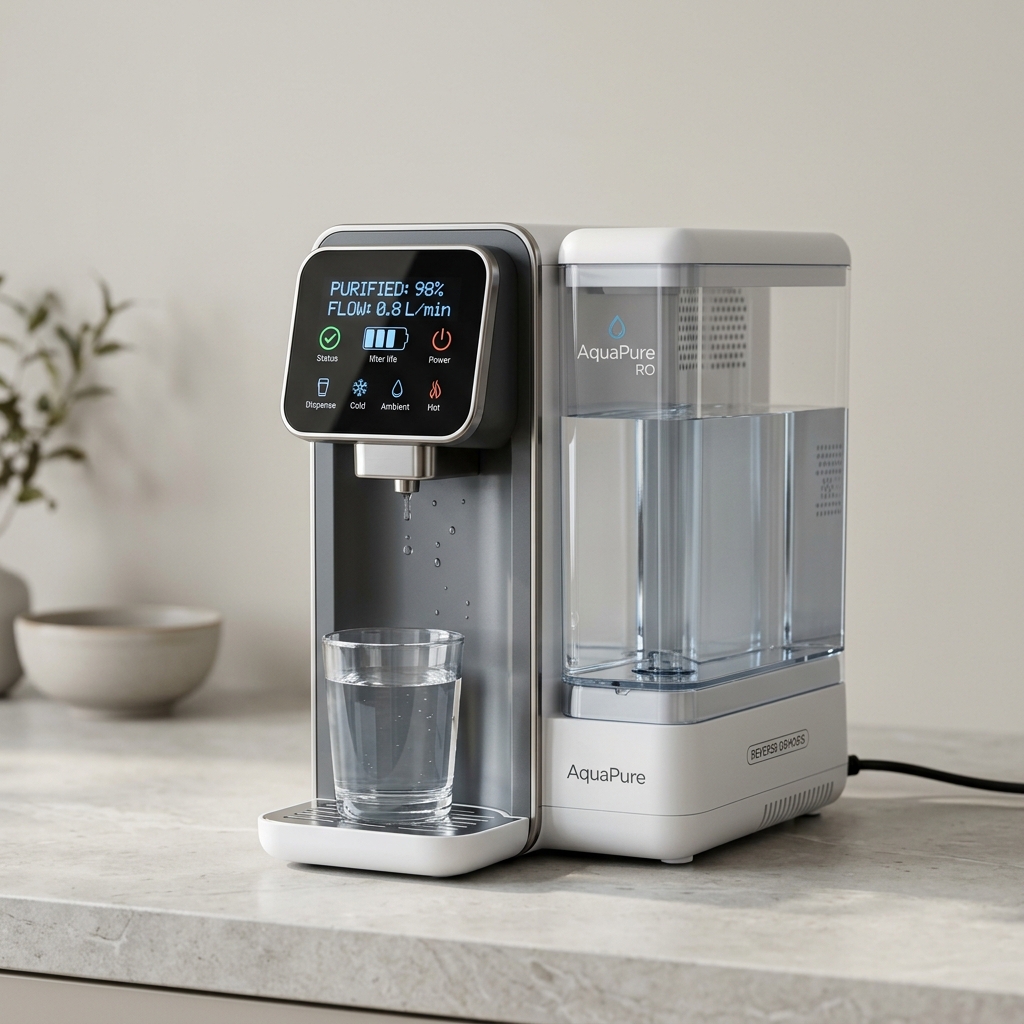
AquaTru Classic Alkaline Countertop RO
$400 to $550 typical Amazon range
- Perchlorate test
- 100 µg/L challenge, plus or minus 10 percent
- Published result
- 95.0% minimum, 98.5% average, 6 µg/L maximum permissible output
- Water use
- 80% recovery and 75% efficiency under the rating conditions
- Service
- 6-month prefilter, 12-month finishing filter, 24-month membrane limits
Why it fits. The current AquaTru Classic sheet names the AT2000 family, IAPMO certification, perchlorate, the challenge concentration, a 95 percent minimum reduction, and a 6 microgram-per-liter maximum permissible output. That is the model-level evidence missing from the other catalog RO records.
Sale-stopping flaw. This is a manual batch appliance. It needs counter space, power, refilling, concentrate disposal, tank cleaning, and a 39 to 100 degree Fahrenheit feed. AquaTru advises against feed water above 10 grains per gallon hardness unless it is softened first, and lists iron, manganese, and sulfide below 0.1 mg/L, TDS up to 1,500 mg/L, turbidity up to 5 NTU, and pH from 3 to 11.
Finished-water math. If the published 95 percent minimum held linearly at a 20 microgram-per-liter feed, the estimate would be 1 microgram per liter. At 40, the estimate would be 2. At 80, it would be 4. Those calculations illustrate margin only. Certification testing used about 100 micrograms per liter, and your installation needs a finished-water laboratory result.
Capacity workload. At an assumed two gallons of treated water per day, a 600-gallon cartridge limit equals 300 days, so the six-month prefilter interval arrives first. The 1,200-gallon membrane limit equals 600 days, also shorter than its 24-month calendar limit at that use. A four-gallon daily demand reaches the gallon limits in half those times.
Whole-home treatment needs selective resin
A standard water softener uses cation exchange to capture positively charged hardness ions. Perchlorate is an anion. Whole-home treatment needs resin selected and sized for perchlorate, with sulfate, nitrate, chloride, alkalinity, TDS, pH, flow, and the source concentration included in the design.
WQA describes reverse osmosis, distillation, and anion exchange as residential treatment methods and notes that anion resins vary widely in perchlorate selectivity. Its technical sheet reports treatment to 4 micrograms per liter or lower with suitable anion exchange, but that statement is not a promise for every resin or household vessel.
This is the non-commissioned recommendation for a home that needs more than drinking and cooking water treated. Request two written designs based on the same accredited-laboratory report. Each should name the resin, vessel size, service flow, predicted bed volumes, breakthrough target, sampling points, changeout trigger, and legal disposal route. Do not accept a proposal that calls the material “specialty resin” without identifying it.
Generic RO recommendations fail the model check
Aquasana SmartFlow AQ-SFRO2-BN is a well-documented tank RO system for other contaminants, but its current performance sheet does not list perchlorate. The Aquasana SmartFlow review shows its exact certified claims and service requirements. Those strengths do not create a missing perchlorate claim.
APEC ROES-50 also has a useful WQA-certified NSF/ANSI 58 record, a 50 GPD membrane, and widely available standard cartridges. The APEC ROES-50 review documents the exact model, pressure-sensitive production, and tank installation. Its current catalog evidence does not name a perchlorate challenge result, so it is not a perchlorate pick here.
The distinction matters because NSF describes TDS reduction as required under NSF/ANSI 58 while individual contaminant claims are optional. A general 58 logo is not a universal dissolved-contaminant guarantee. The reverse osmosis format guide compares flow, pressure, storage, and reject water after the contaminant claim is established.
Carbon, softeners, UV, and boiling miss the job
Activated carbon. Carbon can be effective for chlorine and named organic chemicals, but a chlorine, lead, VOC, or PFAS claim does not cover perchlorate. Standard carbon pitchers and direct-connect carbon systems are not picks without exact perchlorate results.
Water softeners. The hard-water guide separates cation exchange from dissolved-anion treatment. A hardness system can protect an RO membrane from scale, but it does not earn a perchlorate claim by sitting upstream.
Ultraviolet systems. UV inactivates susceptible microorganisms. It does not remove a dissolved perchlorate ion. The same limit applies to sediment and ultrafiltration membranes.
Boiling. Heat does not transfer perchlorate out with the steam. Water loss can raise the concentration left in the pot. Follow local instructions for alternate water rather than adapting boil-water advice meant for microbes.
A test result decides the next action
Public-water customers should start with the utility's current water-quality report and any perchlorate notice, then ask whether the number represents a source, entry point, distribution sample, average, or maximum. Private-well owners near aerospace, defense, munitions, fireworks, flare, or certain fertilizer sites should ask the state drinking-water program whether perchlorate belongs in the local test panel.
EPA identifies rocket propellants, munitions, fireworks, airbag initiators, matches, signal flares, some fertilizers, and improperly handled hypochlorite as sources. Location changes the reason to test, but taste, smell, color, and TDS do not reveal perchlorate.
After installation, sample the untreated feed and treated drinking tap on the same day. Keep the chain-of-custody form, method, reporting limit, units, and result. A “non-detect” is useful only when the laboratory reporting limit is below the target you need to confirm.
Perchlorate rules are still moving
EPA's January 2026 proposal is not a final federal standard. The agency must sign a final rule by May 21, 2027 under the current consent decree. A household should not wait for that date when a state standard, public notice, or private-well result already requires action.
California retains a 6 microgram-per-liter maximum contaminant level and a 1 microgram-per-liter public health goal. State data show treatment below the 4 microgram-per-liter reporting limit in more than 98 percent of samples from treated public wells, but that utility-scale record does not tell a homeowner which cartridge to buy.
Frequently asked questions
What water filter removes perchlorate?
A reverse osmosis system with an exact perchlorate reduction claim is the clearest point-of-use choice. Perchlorate-selective anion exchange can treat larger volumes when a professional sizes the resin, vessels, flow, and disposal plan. A generic RO badge, carbon filter, water softener, sediment cartridge, or UV system does not by itself prove perchlorate reduction.
Does boiling water remove perchlorate?
No. Perchlorate is a dissolved ion and does not boil away with the water. Evaporation can leave the same perchlorate mass in less water, which raises its concentration. Use alternate water that meets the applicable standard or a treatment system with a model-specific perchlorate claim.
Is perchlorate regulated in drinking water?
There is no final federal maximum contaminant level as of October 2026. EPA proposed a 20 microgram-per-liter health goal and co-proposed enforceable limits of 20, 40, or 80 micrograms per liter in January 2026, with a final rule due by May 21, 2027. California has a 6 microgram-per-liter limit, and Massachusetts has a 2 microgram-per-liter limit.
Does activated carbon remove perchlorate?
A standard activated-carbon claim does not establish perchlorate reduction. Perchlorate is a small, highly soluble anion. Look for the exact model and replacement element in a performance sheet that names perchlorate, or use a professionally designed perchlorate-selective anion-exchange system.
How often should a perchlorate filter be replaced?
Follow the exact system schedule and confirm performance with finished-water laboratory testing. AquaTru lists six months or 600 gallons for its pre-carbon cartridge, 12 months or 600 gallons for the finishing cartridge, and 24 months or 1,200 gallons for the RO membrane. Hardness, iron, manganese, turbidity, service history, and a failed finished-water result can require earlier action.