Contaminant buying guide
The Best Water Filters for Pharmaceuticals
Choose the $110 to $180 Aquasana Claryum Direct Connect AQ-MF-1 for the strongest balance of certified pharmaceutical claims, fast existing-faucet flow, and no reverse osmosis drain stream. Choose the $200 to $480 SmartFlow RO when broader dissolved-contaminant treatment matters, or the $90 to $120 Clearly Filtered P-V3 when a renter needs a portable option and accepts a weaker certification boundary.
Do not treat a headline about trace drugs as proof that your tap is unsafe. EPA released non-regulatory screening benchmarks for 374 pharmaceuticals in 2026, with separate infant and general-population values based on the lowest oral therapeutic dose. A measured compound and concentration belong beside the matching benchmark.
The sales trap is a filter described as removing “pharmaceuticals” with no drug list, model number, challenge level, or certifier scope. The pharmaceuticals contaminant profile explains why this is a family of chemicals rather than one regulated substance. No household cartridge earns a claim for every medicine or transformation product.
Who should skip a filter purchase
Skip a fear-driven purchase if you have no measured result, reuse notice, source-water concern, or other treatment goal. Start with the water utility and its source-water information. A specialty laboratory can identify selected compounds, but a TDS meter and home strip cannot.
Skip all three picks for microbiologically unsafe water or an unresolved private-well problem. Their pharmaceutical evidence does not establish disinfection. A well near a septic system needs local laboratory advice and source correction before a drinking-water device becomes the plan.
Four rules separate evidence from a broad claim
Atenolol, carbamazepine, ibuprofen, and trimethoprim behave differently. Require the exact drug on the model sheet instead of treating the word pharmaceutical as a performance result.
NSF says NSF/ANSI 401 covers up to 15 emerging compounds. A product can hold the standard for specific listed claims, and a laboratory report is not automatically product certification.
Certified capacity is a test boundary, not a promise that every home reaches the number. Divide capacity by your drinking and cooking demand, then keep the calendar limit and replacement cost in the decision.
Carbon preserves dissolved minerals and avoids reject water. RO can address fluoride, nitrate, arsenic, and total dissolved solids when the exact model carries those claims, but it needs a tank or power, a drain, and more service parts.
Three picks fit three different kitchens
The table uses the same decision fields for each model. Price bands are Amazon planning ranges rather than live prices.
| Model | Evidence boundary | Rated capacity | Installation | Sale-stopping limit |
|---|---|---|---|---|
| Aquasana AQ-MF-1 | IAPMO-certified NSF/ANSI 401 claims for all 15 listed compounds | 784 gallons at 1.5 GPM | Direct-connect cold line, existing faucet, no drain or power | Municipally treated water only; no fluoride or nitrate reduction |
| Aquasana SmartFlow RO | WQA-certified NSF/ANSI 401 claims for all 15 listed compounds | 365 gallons; 25.7 GPD production rating | Tank, dedicated faucet, drain connection, no power | More cabinet space, plumbing work, and reject water |
| Clearly Filtered P-V3 | Maker-published ISO 17025 laboratory results; NSF certification is 42 and 372, not 401 | 100 gallons | No plumbing, power, or permanent change | Shorter service workload and weaker certification boundary |
What to check before choosing
Check the named substances in each filter’s performance sheet rather than relying on a broad medicine-removal label. Compare capacity, flow and replacement costs.
A five-month Membranes pilot study of 32 trace organic contaminants found significant removal from both low-pressure RO and activated carbon, while also showing compound-specific limits. The author team included water-utility staff and a Viega Technology affiliation. It studied a semi-technical plant on Rhine bank filtrate, not these household products. We use it to explain mechanism, not to manufacture model claims.
The best fit for fast filtered water without a drain
Affiliate disclosure: We may earn from qualifying purchases through retailer links. The comparison method and evidence limits explain how the products were assessed. Where a product has more than one retailer, you can choose where to check the current offer.
For municipal water and an existing kitchen faucet
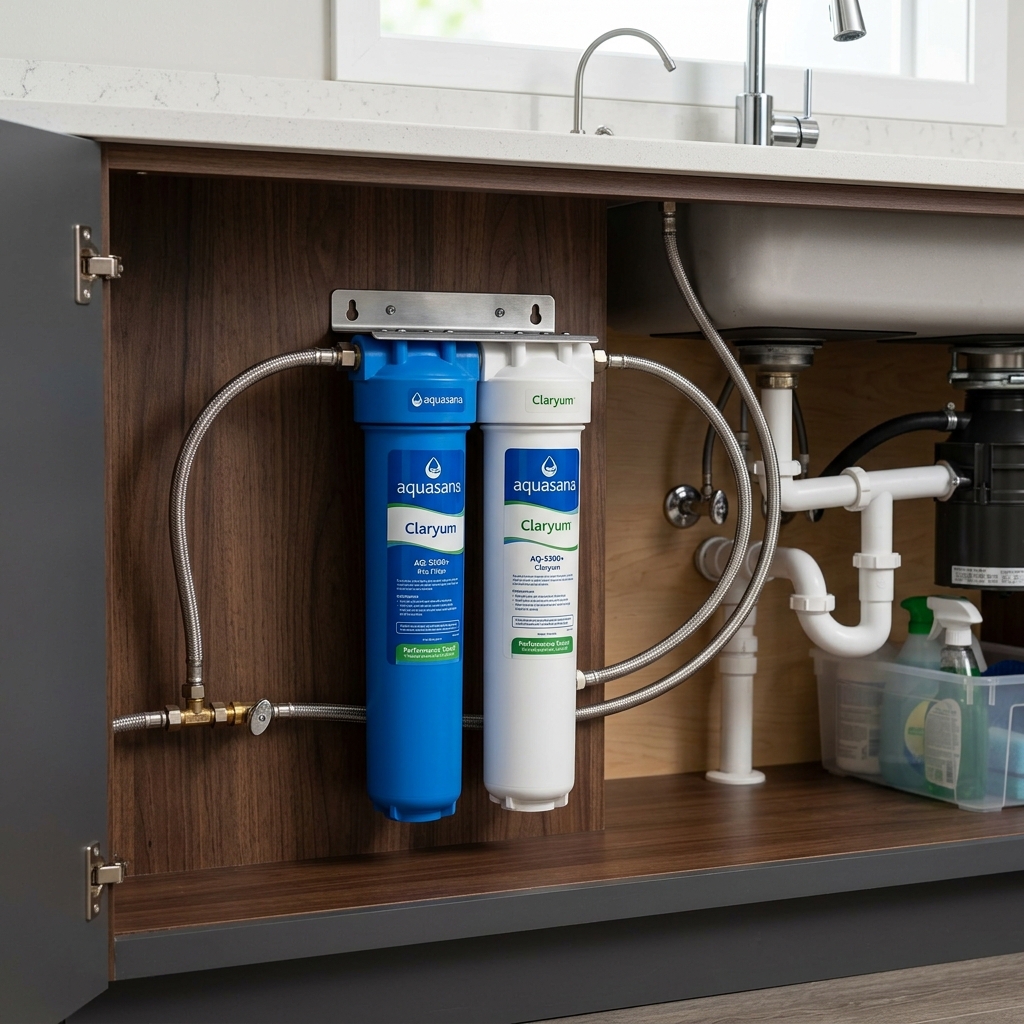
Aquasana Claryum Direct Connect AQ-MF-1
$110 to $180 typical Amazon range
- Pharmaceutical evidence
- Certified claims for all 15 NSF/ANSI 401 compounds
- Capacity
- 784 gallons
- Rated flow
- 1.5 GPM through the existing faucet
- Operating limits
- Cold water, 10 to 125 psi, municipally treated supply
Why it fits. The AQ-MF-1 performance sheet reports 94.2% to 98.9% reduction across the 15 NSF/ANSI 401 compounds, including seven named pharmaceuticals. The system also carries lead, PFOA and PFOS, VOC, cyst, chloramine, and chlorine claims. Its 1.5 GPM rating makes it the least disruptive daily-use pick.
Sale-stopping flaw. It is for treated municipal water and cannot do the dissolved-solids job of RO. A fluoride, nitrate, arsenic, or salt concern points elsewhere. The system also routes all cold faucet use through the cartridge, so dish rinsing can consume capacity unless the household changes that habit.
Capacity math. Two gallons a day for drinking and cooking would reach 784 gallons in 392 days. Four gallons a day cuts that to 196 days. Calendar instructions and changed taste or flow can force an earlier replacement.
The broader pick when RO already solves another problem
For a homeowner who also needs dissolved-contaminant treatment
Aquasana SmartFlow RO AQ-SFRO2-BN
$200 to $480 typical Amazon range
- Pharmaceutical evidence
- Certified claims for all 15 NSF/ANSI 401 compounds
- Capacity
- 365 gallons
- Production rating
- 25.7 gallons per day under test conditions
- Installation
- Tank, drain, dedicated faucet, no electrical outlet
Why it fits. The SmartFlow performance sheet reports 90.9% to 97% reduction across the NSF/ANSI 401 list. Its certified claims also include fluoride, nitrate and nitrite, pentavalent arsenic, chromium, TDS, and PFOA and PFOS. That wider boundary justifies RO when the water report names more than trace organics.
Sale-stopping flaw. The 365-gallon capacity is less than half the AQ-MF-1 rating, while the system adds a storage tank, drain saddle, separate faucet, replacement stages, and reject water. Buying it only for pharmaceuticals pays for a larger treatment job than the evidence may require.
Capacity math. Two gallons a day reaches 365 gallons in about 183 days. Four gallons a day reaches it in about 91 days. The membrane and other cartridges can have different service schedules, so a single annual reminder is not enough.
The reverse osmosis guide compares tank, tankless, and countertop tradeoffs when dissolved contaminants make RO the right mechanism.
The portable pick for a rental kitchen
For a renter who cannot alter plumbing
Clearly Filtered P-V3 10-Cup Pitcher
$90 to $120 typical Amazon range
- Pharmaceutical evidence
- Independent laboratory results published by the maker
- Certification
- NSF/ANSI 42 and 372, not NSF/ANSI 401
- Capacity
- 100 gallons
- Installation
- None; refill and refrigerator space required
Why it fits. The current P-V3 performance page publishes results for more pharmaceuticals than the NSF/ANSI 401 list, including acetaminophen, ciprofloxacin, diclofenac, erythromycin, fluoxetine, primidone, and sulfamethoxazole. The page identifies an ISO 17025 laboratory and states testing was completed in November 2025.
Sale-stopping flaw. The pharmaceutical results are not presented as NSF/ANSI 401 certification. The pitcher is certified to 42 and 372. Buyers who want a third-party certified emerging-compound claim should choose an exact 401-listed model. Gravity filtration also trades faucet speed for portability.
Capacity math. Two gallons a day reaches 100 gallons in 50 days. One gallon a day reaches it in 100 days. A family that cooks with filtered water can turn a lower purchase price into the heaviest refill and cartridge workload here.
The pitcher guide compares refill work, exact claims, and short certified capacities across portable alternatives.
The same 401 label does not mean every drug
Seven of the 15 NSF/ANSI 401 compounds are commonly described as pharmaceuticals. The remaining list also includes an estrogen, pesticides, flame retardants, a detergent breakdown product, and BPA. The standard creates repeatable challenge conditions; it does not claim that these compounds are the only drugs in water or that one result predicts an unlisted molecule.
| Compound | AQ-MF-1 certified result | SmartFlow certified result | P-V3 published lab result |
|---|---|---|---|
| Atenolol | 94.2% | 94.4% | Greater than 99.96% |
| Carbamazepine | 98.6% | 96.4% | Greater than 99.99% |
| Ibuprofen | 95.4% | 95.3% | Greater than 99.98% |
| Meprobamate | 94.7% | 95.2% | Greater than 99.98% |
| Naproxen | 96.4% | 97% | Greater than 99.93% |
| Phenytoin | 95.6% | 94.2% | Greater than 99.95% |
| Trimethoprim | 96.7% | 95.8% | Greater than 99.93% |
The percentages are not a ranking. The certified Aquasana values and the P-V3 laboratory values come from different product protocols and evidence scopes. A larger number under a different claim boundary does not become stronger certification.
What does not prove pharmaceutical reduction
Brita Standard and Brita Elite. Neither catalog record carries a pharmaceutical tag, and the Elite claim list should not be stretched from chlorine, lead, PFOA and PFOS, or selected VOCs into unlisted drug claims.
Waterdrop 17UB-UF. Its 0.01-micron membrane and chlorine claim do not prove removal of dissolved drug molecules. The ultrafiltration explainer separates particle retention from dissolved-chemical treatment.
A generic NSF/ANSI 42 badge. Standard 42 covers aesthetic effects such as chlorine taste and odor. It is not a shortcut to 401, and the words carbon block do not fill a missing compound list.
A TDS reading. A dissolved-solids meter measures conductivity and cannot identify atenolol, carbamazepine, or ibuprofen. EPA Method 542 uses liquid chromatography and tandem mass spectrometry for selected pharmaceuticals in finished drinking water.
Capacity matters more than the biggest percentage
A laboratory result applies through the rated test life under stated conditions. Running a cartridge past its capacity turns a strong original result into an unsupported household assumption. Estimate drinking, ice, coffee, tea, and cooking water together.
| Model | Rated gallons | At 2 gallons per day | At 4 gallons per day |
|---|---|---|---|
| AQ-MF-1 | 784 | 392 days | 196 days |
| SmartFlow RO | 365 | About 183 days | About 91 days |
| Clearly Filtered P-V3 | 100 | 50 days | 25 days |
The non-commissioned step reduces the source
EPA recommends drug take-back programs for unwanted household medicines and discourages flushing unless the label or FDA guidance specifically calls for it when no take-back option exists. Take-back does not erase residues from medicines people use as directed, but it avoids adding an unnecessary disposal pathway.
We earn nothing from a utility call, a qualified laboratory, or a pharmacy take-back box. Those steps answer whether the concern is measured, which compound matters, and whether a purchase is needed at all.
Pharmaceutical filter questions
What water filter removes pharmaceutical residues?
Choose an exact model with reduction data for the named drug. NSF/ANSI 401 covers up to 15 emerging compounds, including atenolol, carbamazepine, ibuprofen, meprobamate, naproxen, phenytoin, and trimethoprim. Certified carbon and reverse osmosis systems can both qualify, but the complete model and claim list matter more than the treatment label alone.
Does NSF/ANSI 401 mean a filter removes every pharmaceutical?
No. NSF says the standard verifies reduction of one or more compounds from a list of 15. It does not cover every prescription drug, metabolite, antibiotic, hormone, or mixture. Check the certifier listing and performance sheet for the exact compound and model.
Is reverse osmosis better than carbon for pharmaceuticals?
Neither mechanism deserves a blanket claim. Reverse osmosis rejects many dissolved compounds and can cover other concerns such as nitrate or fluoride, while certified carbon can reduce listed pharmaceuticals without a drain stream. Exact-model results, source water, capacity, and service discipline decide the better fit.
Can a home test kit detect pharmaceuticals in tap water?
A color strip or TDS meter cannot identify drug residues. EPA Method 542 uses laboratory liquid chromatography and tandem mass spectrometry for selected pharmaceuticals in finished drinking water. Ask a qualified laboratory which compounds it can measure and compare any result with current health guidance.
How often should a pharmaceutical water filter be replaced?
Use the shorter of the model-rated gallon capacity and the maker service interval. At two gallons of filtered drinking and cooking water each day, 100 gallons lasts about 50 days, 365 gallons about 183 days, and 784 gallons about 392 days. Actual life can be shorter when water quality or use differs from test conditions.
Match the filter to the compound and the rest of your water report
The finder compares pharmaceutical evidence with lead, PFAS, nitrate, fluoride, installation, capacity, and rental limits.