Buying guide
Microplastics vs Nanoplastics Water Filter Claims
Buy for the exact particle band on the exact system, not for the word nanoplastics. Aquasana AQ-MF-1 is the simpler choice when its 0.5-to-under-1-micron claim is the main goal. SmartFlow or AquaTru earns the extra RO work only when another measured water problem or a no-plumbing limit makes RO useful.
PureWater Filter Finder Research · Updated · 18 min read
We may earn from qualifying purchases. Price ranges are budgets, not live offers. Choose the right model before comparing deals.
The label must name a size range
A trustworthy filter claim tells you the model, replacement element, particle band, challenge, result, rated life, and certifier. The three eligible systems below have a complete-system result for particles from 0.5 to under 1 micron. None proves removal of every smaller nanoplastic.
Stop before buying if the water is under an advisory, comes from an untested well, or may contain germs. A narrow particle result cannot make unknown water safe. It also does not promise a health benefit. FDA says current evidence does not show that detected microplastic and nanoplastic levels in foods and beverages pose a human-health risk, and standard definitions and test methods are still missing.
Micro and nano do not have one fixed border
FDA says microplastics are usually described as plastic pieces under 5 millimeters, while nanoplastics are usually under 1 micron. The agency warns that these are reference descriptions, not standard definitions. EPA also describes nanoplastics as particles smaller than 1 micron, while its research program notes that size, shape, density, and composition make one measurement method impossible.
That creates a label trap. A certifier may call a 0.5-to-under-1-micron challenge “microplastics,” while the same size band fits the common under-1-micron nanoplastics description. The correct reading is narrow: the model passed that band. It says nothing about 0.49 micron, 100 nanometers, 20 nanometers, or every plastic shape.
Check six fields before a claim changes your choice
- Exact system
Match the model on the box, performance sheet, certifier record, and shopping page. A product family name is not enough.
- Replacement element
A certified housing with the wrong cartridge does not inherit the tested claim. Record every required part number.
- Particle band
Find both the lower and upper cutoff. “Submicron” and “fine particles” are not complete size ranges.
- Challenge and result
Look for the starting particle count, required reduction, reported reduction, and test conditions.
- Rated life
Use the earlier gallon or time limit. A new-cartridge result cannot promise performance after overdue service.
- Home fit
Check source water, daily volume, pressure, space, drain, power, faucet, and the work needed to change parts.
NSF tells buyers to verify the exact product and the claims covered by its certification. A general NSF/ANSI 401 badge is not a shortcut because products may carry different optional claims under the same standard.
Read the three exact-model results
| Decision field | AQ-MF-1 | SmartFlow AQ-SFRO2 | AquaTru Classic AT2000 family |
|---|---|---|---|
| Named claim | Microplastics reduction | Microplastics reduction | Microplastics reduction |
| Particle band | 0.5 to under 1 micron | 0.5 to under 1 micron | 0.5 to under 1 micron |
| Published result | 99.4% | 99.3% | 96.48% average |
| Particle challenge | At least 10,000 particles/mL | At least 10,000 particles/mL | 1,400,000 particles/mL |
| Rated-life parts | AQ-MF-1-R, 784 gallons or 6 months | S1/S3, S2, and remineralizer; 250 gallons on the current sheet | AT2001 and AT2003 or AT2004 at 600 gallons; AT2002 at 1,200 gallons |
| What the row cannot prove | Particles below 0.5 micron | Particles below 0.5 micron | Particles below 0.5 micron |
Do not rank these systems from the percentages alone. The challenge counts differ, the formats solve different installation problems, and the sheets do not provide one shared test below 0.5 micron. No public numerical product score is shown because that missing evidence is central to the question.

Aquasana Claryum Direct Connect AQ-MF-1
Typically $110–$180 · equipment only
Choose it if safe municipal water needs the stated particle reduction at the main drinking and cooking faucet, and you do not need RO for fluoride, nitrate, or dissolved salts.
What supports the choice The AQ-MF-1 sheet reports 99.4% reduction for 0.5-to-under-1-micron particles. It names AQ-MF-1-R, 784 gallons or six months, 1.5 GPM, 10 to 125 psi, and IAPMO certification for the listed claims.
What costs the sale Every cold gallon through the connected faucet uses capacity. It needs a compatible cold-water line and leak-safe cabinet installation. It does not reduce TDS, fluoride, or nitrate like RO.

Aquasana SmartFlow RO AQ-SFRO2-BN
Typically $200–$480 · equipment only
Choose it if a water report gives you another reason for RO and you have room for a tank, dedicated faucet, and drain connection.
What supports the choice The AQ-SFRO2 sheet reports 99.3% reduction for 0.5-to-under-1-micron particles. It also lists WQA certification, a 250-gallon capacity, 25.7 GPD production, and a 40 to 80 psi inlet range.
What costs the sale The narrow particle claim alone does not justify RO water use, a storage tank, drain work, several service parts, and a higher annual filter budget. Skip it when AQ-MF-1 covers the measured goal.
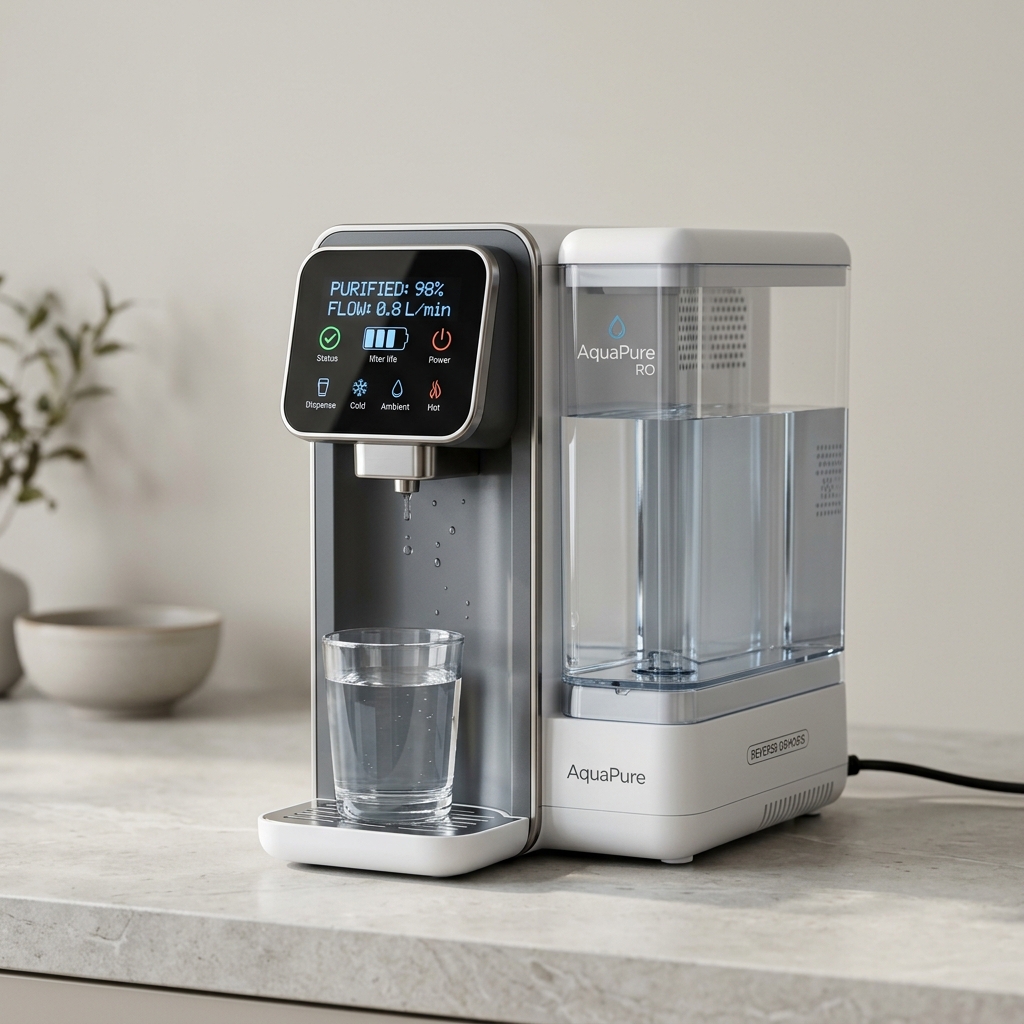
AquaTru Classic Alkaline Countertop RO
Typically $400–$550 · equipment only
Choose it if a no-plumbing countertop RO solves another measured need and you can refill the source tank, discard concentrate, and give the unit permanent counter space.
What supports the choice The current AT2000-family sheet reports a 96.48% average reduction for 0.5-to-under-1-micron particles. It names the certified model family, the exact AT2001 through AT2004 parts, 600 and 1,200 gallon limits, and a 10 gpg hardness ceiling unless feed water is softened.
What costs the sale It needs power and a 12 by 14 by 14 inch counter area. Manual tank handling repeats through the week. The alkaline Classic shopping configuration still needs the matching AT2004 finishing filter.
A pore label is a lead, not a finished-system result
A membrane can block particles through size exclusion and other surface interactions, but the finished device also has seals, housings, flow paths, aging, fouling, and parts after the membrane. A review in Current Opinion in Environmental Science & Health found that particle material, shape, size, water quality, and treatment conditions affect removal. That is why a nominal pore size cannot be converted into an all-size nanoplastics percentage.
Scott Coffin, PhD, is an environmental toxicologist who led California work on microplastics in drinking water. An EPA-hosted webinar identifies him as the California State Water Resources Control Board microplastics subject-matter expert. His presentation separates nanoplastics, sub-micron plastics, and larger microplastics into different size bands.
A TDS meter cannot count plastic
A common handheld TDS meter estimates dissolved solids from electrical conductivity. The U.S. Bureau of Reclamation explains that conductivity gives only an estimate of TDS and cannot measure non-conductive substances. Plastic particle identity and count need different laboratory methods.
- Low TDS after RO supports a change in dissolved-ion passage. It does not prove the 0.5-to-under-1-micron plastic result.
- Unchanged TDS after AQ-MF-1 is expected because the filter is not designed to remove dissolved mineral salts. It does not mean its particle claim failed.
- A high TDS number cannot tell you which ions are present, whether they are harmful, or how many plastic particles are in the glass.
The high-TDS filter guide explains what conductivity can and cannot check. Do not use that tool as a substitute for polymer-specific particle analysis.
Match the cost to the second water goal
| Planning choice | Equipment | Annual filters | Daily work and fit |
|---|---|---|---|
| AQ-MF-1 | Typically $110 to $180 | Typically $150 to $200 | No refills; direct cold-line connection and six-month service |
| SmartFlow | Typically $200 to $480 | Typically $140 to $220 | Tank, faucet, drain, several parts, and no electrical outlet |
| AquaTru Classic | Typically $400 to $550 | Typically $120 to $170 | Counter space, power, source-tank refills, and concentrate disposal |
These are planning ranges, not offers. AQ-MF-1 usually makes the most sense when the stated particle band is the only treatment goal. The RO microplastics decision guide matches the added hardware to other measured contaminants, while the renter guide compares no-install and permission-based setups.
How the claim check was done
This source-based assessment compared current exact-model performance sheets, replacement elements, certification statements, installation limits, maintenance, and planning costs. No filter was owned, installed, or laboratory-tested for this article. Manufacturer percentages were not extended beyond their stated particle bands.
Evidence for particles below 0.5 micron is the weakest part of the record. None of the three exact sheets supplies a result there. The recommendation stops at that line instead of treating membrane type, pore size, or a low TDS reading as proof.
Stop the sale when the claim outruns the test
- The exact model is missing Reject a family-level claim when the purchased model and cartridge are not named in the record.
- The lower cutoff is missing “Submicron,” “nano,” and “ultrafine” do not state how small the challenge went.
- The proof is only a pore size Ask for the finished-system challenge, result, rated life, and flow.
- The proof is a TDS reading Conductivity does not identify or count plastic particles.
- The second water problem is uncovered Follow the utility report, certified lab result, or active advisory before buying for an emerging concern.
- The service plan fails Wrong or overdue replacement parts can break the tested configuration.
The main microplastics filter comparison matches exact claims to filter formats. The whole-house versus drinking-water guide prevents an unsupported every-tap upsell. Use the water quality report finder to identify regulated concerns in public water before paying for a narrower claim.
Questions you may ask next
Does a microplastics claim also cover nanoplastics?
Only the stated test band. The exact claims compared here cover particles from 0.5 to under 1 micron. Some agencies describe that band as nanoplastics, but the result does not cover every smaller particle below 0.5 micron.
Is an NSF/ANSI 401 badge enough?
No. NSF/ANSI 401 includes several optional reduction claims. Check the exact model in the certifier directory and its performance sheet for a named microplastics row, particle band, result, capacity, and replacement element.
Does a 0.0001-micron RO membrane prove nanoplastics removal?
No. A membrane rating is one component fact. A finished system also has housings, seals, connections, flow conditions, aging, and stages after the membrane. Ask for a complete-system result in the particle band you care about.
Can a TDS meter detect plastic particles?
No. A common TDS meter estimates dissolved ions from electrical conductivity. It cannot identify or count plastic particles, so a low reading is not a nanoplastics test and a high reading is not proof that a particle filter failed.
Which filter should I buy for a documented 0.5 to under 1 micron claim?
Choose AQ-MF-1 when that claim is the main goal and direct-connect plumbing fits. Choose SmartFlow only when another measured dissolved contaminant justifies RO. Choose AquaTru Classic when you need RO without a plumbing change and can handle its tanks.
What should stop the purchase?
Stop if the exact model lacks a claim for the stated particle band, the replacement part does not match, the source water is unsafe or unknown, another measured contaminant is not covered, or the installation and replacement plan do not fit the home.
Still deciding? Start with your home and water.
The finder narrows the choices by water source, space, budget and the problem you want to fix.