Buying guide
The Best Water Filters for High TDS
The Waterdrop G3P800, typically $600 to $750 on Amazon, is the best high-TDS water filter for a busy kitchen that has under-sink power, a drain, and room for a dedicated faucet. Its exact-model record includes NSF/ANSI 58 certification, a published 98 percent TDS result, 800 GPD rated production, and a 3:1 pure-to-drain claim.
A high TDS reading is not a diagnosis, and a low reading is not proof of safe water. TDS combines many dissolved ions into one number. The U.S. EPA lists 500 mg/L as a non-enforceable secondary standard tied to aesthetic effects. Test the individual constituents before treating a number that may mostly represent harmless calcium, magnesium, or bicarbonate.
Published October 16, 2026 · 20 minute read
The short list
| Situation | Pick | TDS basis | Cost and burden |
|---|---|---|---|
| Fast plumbed kitchen | Waterdrop G3P800 | NSF/ANSI 58, published 98% result | $600 to $750, power and drain |
| Lower purchase cost | APEC ROES-50 | WQA-certified TDS reduction | $180 to $250, tank and drain |
| No plumbing changes | Culligan ZeroWater 10-Cup | Maker reports 99.6% TDS removal | $35 to $60, source-sensitive refills |
Decide whether TDS is the problem
TDS is the dry mass left after dissolved material is separated and the water is evaporated under a defined method. A pocket meter does something different. It measures electrical conductivity and applies a conversion factor. A 2023 Applied Geochemistry study led by U.S. Geological Survey scientists compared 6,391 surface-water samples and found that common TDS methods differed from a full speciated-ion sum by a median 19 to 24 percent. The meter remains useful for trends, but its displayed precision can exceed what the method knows.
Start with a certified laboratory report or the current utility report. Identify sodium, chloride, sulfate, nitrate, arsenic, fluoride, hardness, alkalinity, and any locally relevant contaminant. A salty sodium-chloride supply, a hard calcium-bicarbonate supply, and a nitrate-affected well can all show similar TDS while requiring different decisions. The laboratory panel is the first non-commissioned purchase in this guide.
Select a product only after that chemistry check. We required an exact-model TDS claim, an inlet range that covers the source, a workable flow or batch rate, and service instructions that a household can follow. Water use, installation, electricity, tank space, cartridge cost, and the need for finished-water testing broke ties.
Who should skip these filters
Skip TDS treatment when the water meets applicable health standards, the dissolved constituents are acceptable, and the only reason to buy is a fear-driven meter color chart. Water below or above 500 mg/L is not automatically safe or unsafe. The chemistry behind the number matters.
Choose whole-home softening instead when the actual complaint is scale and laboratory results show hardness. The hard-water guide explains why cation exchange changes hardness without reliably lowering total dissolved solids. Choose professional source treatment when salinity affects every fixture, damages crops or appliances, or sits beyond a residential unit's feed-water limit.
Do not use these products to make microbiologically unsafe water potable. The pitcher is for potable source water, and an RO membrane does not replace source repair, disinfection, or public-health instructions after a positive coliform or E. coli result. The bacteria guide separates emergency response from long-term treatment.
How we assessed the choices
First decide why you want to lower dissolved minerals. Compare the system’s claims, filling speed, space and upkeep; check any health concern with the right water test.
A 59-household Nevada field study in Science of the Total Environment found that treated arsenic still exceeded 10 ppb in 18 homes. TDS or conductivity reduction did not consistently track arsenic reduction. The authors were affiliated with the University of Nevada, and the paper is listed as U.S. government-supported research. The PubMed record does not display a conflict-of-interest statement. Its lesson is narrow but decisive: a pleasing TDS result cannot certify a separate health-contaminant result.
Best for a fast plumbed kitchen
Affiliate disclosure: We may earn from qualifying purchases. Price ranges are planning budgets, not live offers.
For high use and small cabinets
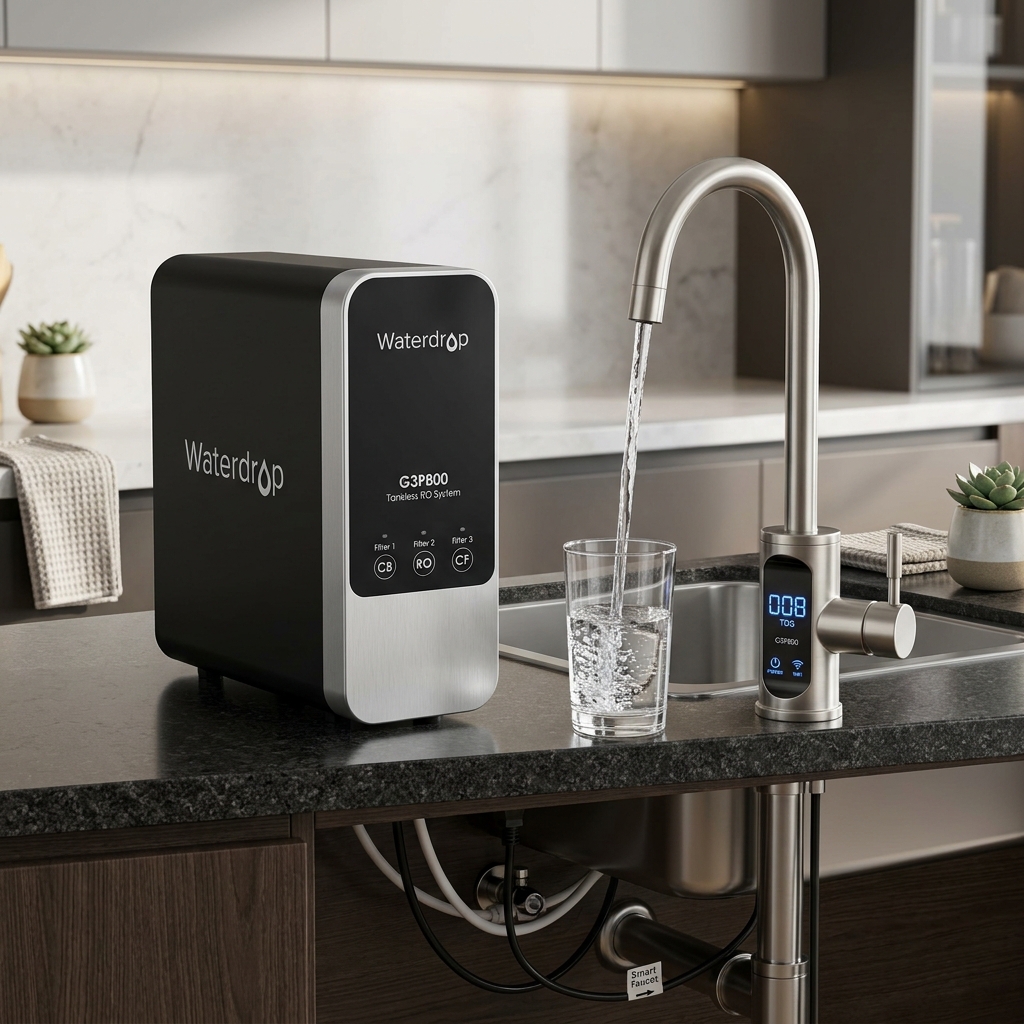
Waterdrop G3P800 Tankless Reverse Osmosis
$600 to $750 typical Amazon range
- TDS result
- 98% in the model performance sheet
- Rated production
- 800 GPD
- Water claim
- 3:1 pure to drain
- Installation
- Power, drain, feed valve, faucet
Why it fits. The Waterdrop G3P800 performance sheet publishes a 98 percent TDS reduction result, while the current product record names NSF/ANSI 58 certification. The smart faucet reports TDS and filter status, and the 5.67-inch-wide tankless cabinet avoids a storage tank.
Sale-stopping flaw. The unit needs an electrical outlet, cold-water connection, drain saddle, and dedicated faucet. It does not include remineralization in this configuration. A countertop hole or landlord restriction can end the purchase before performance matters.
Water math. At a claimed 3:1 pure-to-drain ratio, producing two gallons per day sends about 0.67 gallon to the drain, or roughly 243 gallons per year, if the installed unit sustains the claim. The same two daily gallons at a one-to-one ratio would drain 730 gallons per year.
Service. Waterdrop lists the CF cartridge at six months or 550 gallons, the CB cartridge at 12 months or 1,100 gallons, and the RO cartridge at 24 months or 2,900 gallons, whichever limit arrives first. At two gallons per day, the calendar limits arrive first for all three.
Best lower-cost reverse osmosis system
For value and standard housings
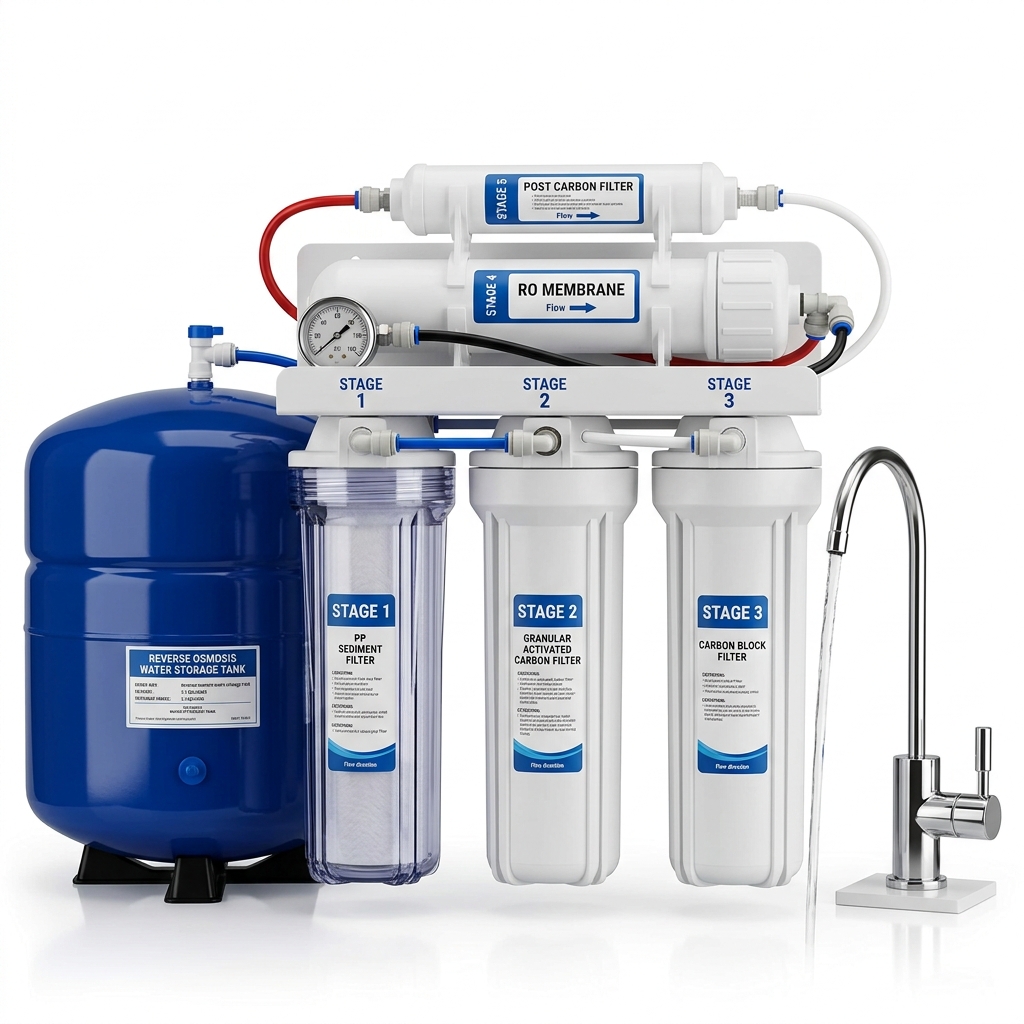
APEC Essence ROES-50
$180 to $250 typical Amazon range
- Certified claim
- NSF/ANSI 58 TDS reduction through WQA
- Rated production
- 50 GPD at 60 psi
- Feed limit
- 2,000 ppm TDS maximum
- Installation
- Tank, drain, feed valve, faucet
Why it fits. The current APEC page says the ROES-50 is WQA-certified and tested for TDS reduction. Its manual prints the NSF/ANSI 58 test conditions: 750 plus or minus 40 mg/L influent, 187 mg/L maximum permissible product water, and a 75 percent minimum reduction requirement. It also says normal product water should read about 3 to 10 percent of tap TDS after proper flushing.
Sale-stopping flaw. The four-gallon nominal tank takes cabinet space, and the test table reports a 25.4 percent recovery rating. That is much less water-efficient than Waterdrop's stated 3:1 ratio. Production also falls with low pressure or cold water.
Water math. Apply the 25.4 percent certified recovery only as a planning example. Two gallons of product water would require about 7.9 gallons of feed and send about 5.9 gallons to drain. Across a year, that is roughly 2,143 drain gallons. Real household results change with pressure, temperature, tank cycling, and feed chemistry.
Service. APEC calls for stage 1 to 3 prefilters every six to 12 months. It lists the membrane and final carbon filter at two to four years on city water, with a two-year membrane interval for private wells. Its operating table requires 40 to 85 psi and no more than 2,000 ppm TDS.
Best no-install option
For renters with modest daily volume
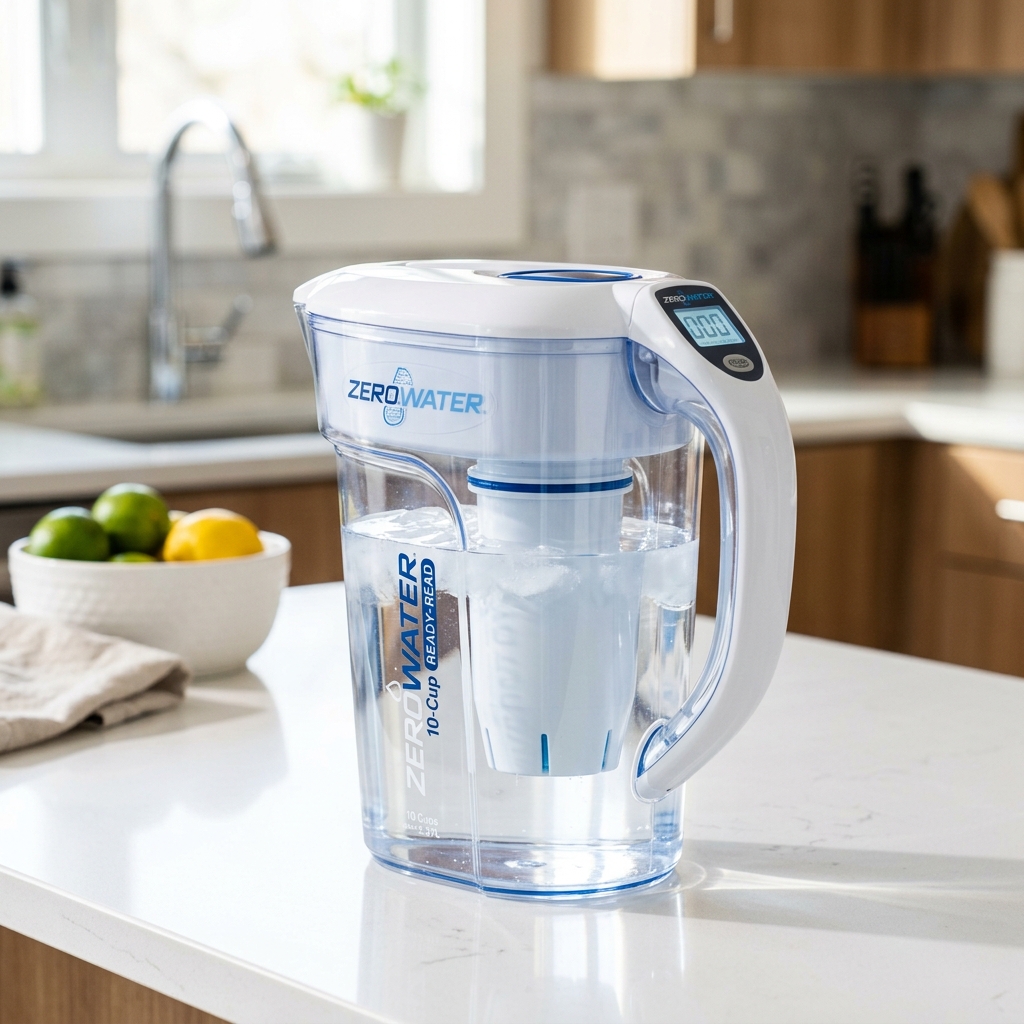
Culligan ZeroWater 10-Cup Pitcher
$35 to $60 typical Amazon range
- TDS basis
- Maker reports 99.6% removal
- Flow
- 6.5 ounces per minute
- Change signal
- 006 ppm or higher
- Installation
- None
Why it fits. The exact ZP-010 product page reports 99.6 percent TDS removal and includes a removable meter. Mixed-bed ion exchange can pull dissolved cations and anions without a drain, powered pump, faucet hole, or permanent plumbing change.
Sale-stopping flaw. Source-water TDS controls cartridge life. The maker says water above 300 ppm requires more frequent meter checks and tells users to replace the filter at 006 ppm or higher. High-TDS households can turn a cheap pitcher into the costliest refill path. The 99.6 percent TDS figure is a manufacturer-published result, not presented here as one of the model's IAPMO health-contaminant claims.
Time threshold. At the maker's 6.5-ounce-per-minute flow, one gallon takes about 19.7 minutes to pass through the cartridge and two gallons take about 39.4 minutes. Gravity does the work, but a household that routinely needs several gallons at once may find the reservoir cycle too slow.
Safety boundary. The manufacturer says the current system is for municipally treated potable water and does not remove microbiological contaminants. Its own FAQ also says the meter does not measure lead or PFOA/PFOS and cannot detect uncharged organics, undissolved particles, or bacteria.
Two popular filters do not lower the number
Brita Elite is useful for its listed chlorine, lead, and specified PFOA/PFOS claims, but it is not a deionization or reverse osmosis system. The Brita Elite review separates its 120-gallon claim from contaminants it does not address. Do not reject it for holding useful minerals in the water, and do not buy it to chase a low meter reading.
Aquasana Claryum Direct Connect AQ-MF-1 is a 1.5 GPM carbon-based under-sink filter with strong exact-model claims for several organic and health contaminants. The Aquasana AQ-MF-1 review documents its 784-gallon service capacity and TDS limitation. Its ability to leave dissolved minerals in place is an advantage for many homes, but it makes the model a non-pick for lowering TDS.
Measure rejection without mistaking it for safety
Rinse two clean glasses with their respective waters, let the RO reach normal flow, and measure feed and product water near the same temperature. Calculate rejection as (feed TDS minus product TDS) divided by feed TDS, multiplied by 100. A 700 ppm feed and 35 ppm product equal 95 percent rejection. A 700 ppm feed and 140 ppm product equal 80 percent.
Trend the percentage, not only the outlet number. A change from 700 to 70 ppm and a change from 200 to 20 ppm both equal 90 percent rejection. Tankless systems can show a higher first-draw value after an idle period, while a tank blends production from multiple cycles. Follow the exact manual's flushing and sampling instructions before diagnosing a membrane.
Pair the meter with laboratory results when sodium, nitrate, arsenic, fluoride, PFAS, or another health contaminant drives the purchase. The reverse osmosis guide compares certification scope, pressure, storage, and water efficiency. A TDS percentage checks broad membrane behavior; only the target-contaminant result answers the health question.
Frequently asked questions
What water filter is best for high TDS?
Choose an exact-model reverse osmosis system certified to NSF/ANSI 58 for TDS reduction when you need steady drinking and cooking water. The Waterdrop G3P800 suits a high-use kitchen with power and a drain, while the APEC ROES-50 offers a lower-cost tank system. A Culligan ZeroWater pitcher can lower TDS without plumbing, but filter life can be short when incoming TDS is high.
Is water above 500 ppm TDS unsafe?
Not by that number alone. The U.S. EPA value of 500 milligrams per liter is a non-enforceable secondary standard aimed at taste, deposits, color, and staining rather than a primary health limit. A laboratory must identify the individual dissolved constituents before the health risk or treatment need can be judged.
Can a TDS meter show whether water is safe?
No. A handheld meter estimates dissolved ionic material from electrical conductivity. It does not identify which ions are present, and it can miss uncharged organic chemicals, particles, and microorganisms. Use it to watch a known system trend, not to replace a certified laboratory contaminant panel.
Does a water softener lower TDS?
A conventional sodium or potassium ion-exchange softener usually does not lower total dissolved solids. It exchanges hardness ions for other ions, so the water can feel soft while the TDS reading stays similar or rises slightly. Choose softening for hardness and scale control, not for a lower overall TDS number.
How much should an RO system lower TDS?
NSF/ANSI 58 requires a TDS reduction claim for certified reverse osmosis systems, but the exact model record and manual should set the working expectation. APEC says ROES-50 product water should normally read about 3 to 10 percent of feed-water TDS and calls 15 to 20 percent a membrane-replacement signal. Waterdrop publishes a 98 percent TDS result for the G3P800 under its stated test conditions.