Product buying guide
SpringWell Calcite pH Neutralizer Review
The SpringWell SCN1-6 is a qualified buy for a private well with laboratory pH from 6.0 to 6.5, enough pump flow for a 7 GPM backwash, and room for a powered tank and drain. Plan roughly $1,500 to $2,200 for the unit before installation.
Skip it when pH is below the written range, alkalinity and hardness are unknown, or the home cannot accept added calcium hardness. This is an acid-neutralizing tank. It is not a certified lead filter, disinfectant, iron filter, or cure for every cause of corrosion.
Best fit
Tested mild acidity inside the 6.0 to 6.5 inlet range
Main tradeoff
Raises calcium hardness and needs recurring media work
Stop the sale
Less than 7 GPM sustained backwash supply
Verdict: useful inside a narrow lane
The treatment method makes sense for mild acid water. Calcite is calcium carbonate. As it dissolves, pH, calcium, and alkalinity rise. That can make water less aggressive to copper and other plumbing materials. The SCN1-6 gives buyers a clear inlet pH range, service-flow label, backwash demand, tank size, pressure range, and refill procedure.
The limits matter as much as the specifications. SpringWell does not publish an exact-model finished-water table, independent pH-performance certification, pressure-drop curve, or universal hardness increase. The sales page says “no drop in water pressure,” while independent guidance says neutralizer media resistance may lower pressure. Treat the phrase as marketing, not a measured promise for your plumbing.
Our internal neutralizer rubric gives treatment evidence and hydraulic fit the most weight. The public record supports a conditional recommendation, but the missing performance and pressure data prevent a complete numerical score. Missing evidence is not an invented zero or a pass.
How this review was built
Check whether your water test supports a calcite neutralizer. Compare added hardness, refill work, pump flow, drain capacity and the installed cost.
EPA says private wells should be tested every year for total coliform bacteria, nitrate, total dissolved solids, and pH. Its updated private-well guidance also tells owners with plumbing corrosion to test pH, lead, and copper and to use a state-certified laboratory.
A peer-reviewed limestone-contactor study by Letterman, Hadad, and Driscoll found that calcite performance depends on influent chemistry, particle size, bed depth, temperature, and flow. It did not test the SCN1-6. It explains why no honest review can promise one pH or hardness increase for every well.
A separate Water Research study of calcite contactors showed that calcite adds calcium hardness and bicarbonate alkalinity and that media coating can change performance. It was not a residential SpringWell test. Its useful lesson is to verify finished water instead of trusting a universal media claim.
Affiliate disclosure: We may earn from qualifying purchases. Price ranges are planning budgets, not live offers.
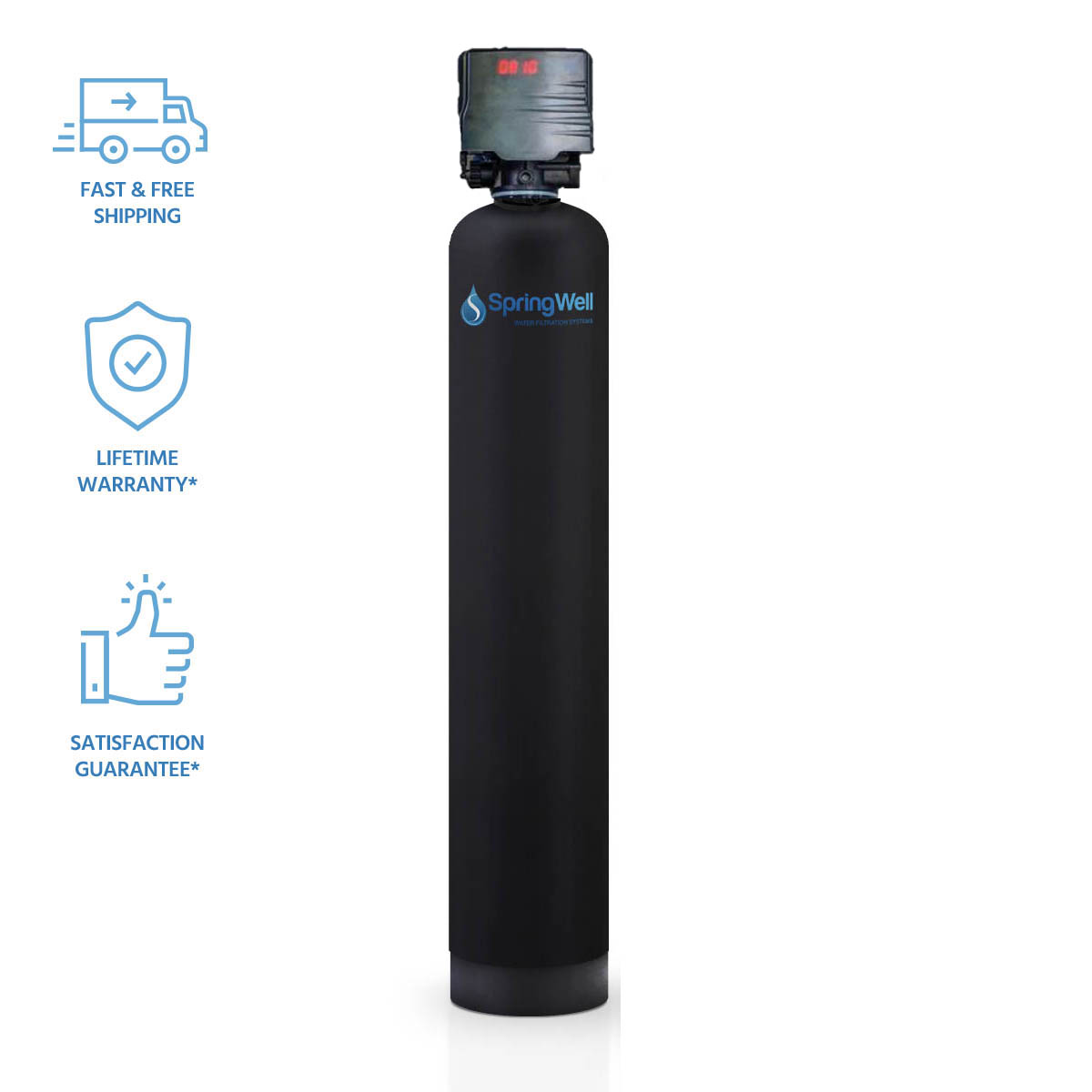
For laboratory-confirmed mild acid water
SpringWell SCN1-6 Calcite pH Neutralizer
$1,500 to $2,200 planning range before installation
- Inlet pH
- 6.0 to 6.5
- Service flow
- 12 GPM maker label
- Backwash
- 7 GPM; every seven days in the manual
- Pressure
- 25 to 80 psi
- Tank size
- 13 inches wide; 63 inches with head
- Connections and utilities
- 1 inch; power and nearby drain
Why it earns a qualified recommendation. The current SpringWell SCN1-6 page gives an unusually specific operating envelope and requires current well-test results before the order moves forward.
What could cost the sale. The page does not publish finished-water performance across its inlet range, a pressure-drop curve, or exact independent certification. It lists a 34°F minimum while the manual lists 36°F. Freeze protection matters either way, but SpringWell should resolve the document conflict in writing.
Start with chemistry, not the blue stain
A pH reading alone does not describe corrosion. Alkalinity shows how much acid the water can neutralize. Hardness, calcium, total dissolved solids, temperature, and dissolved gases also change how water behaves. Copper or lead may come from plumbing, while red-brown stains may be iron. A stain is a clue, not a treatment prescription.
Water source
Use this review for a private well. A public-water customer should start with the utility report and a plumbing-specific test.
Measured problem
Order laboratory pH, alkalinity, hardness, calcium, iron, manganese, copper, and any locally relevant corrosion or health tests.
Household demand
List fixtures that run together and measure pump delivery. Service demand and backwash supply are separate checks.
Installation limits
Confirm pressure, one-inch plumbing, a dry outlet, legal drain and air gap, freeze protection, floor space, and service clearance.
Upkeep and budget
Plan for plumbing, possible electrical or drain work, calcite refills, testing, service calls, and any downstream softener.
Desired outcome
Buy for acidity correction and corrosion control, not for certified removal of a contaminant already in the water.
The University of Georgia's corrosive-water guide calculates saturation tendency from pH, hardness, alkalinity, total dissolved solids, and temperature. It recommends calcite or a calcite-magnesium oxide blend and points to the blend when pH is below 6.0. That supports treating the SCN1-6 range as a real boundary, not a sales suggestion.
Added hardness is part of the treatment
Calcite cannot raise pH without dissolving. The same reaction that adds buffering also adds calcium. That is why “Will it make my water harder?” has no honest yes-or-no number. The direction is yes; the amount depends on the water.
| Before purchase | Why it matters | After startup |
|---|---|---|
| pH and alkalinity | Define the acid load and buffering | Verify correction at the tap |
| Hardness and calcium | Show the scale risk before calcite | Measure the mineral increase |
| Copper and lead when relevant | Show what plumbing may be releasing | Use the laboratory's sampling plan to track change |
| Iron, manganese, sulfur, bacteria | Can require another treatment job | Do not assume neutralization removed them |
Test soon after commissioning, again after the water has stabilized, and on the laboratory schedule. If post-treatment hardness creates scale or soap problems, size a downstream softener from the new hardness result. Do not buy the softener in advance from a guessed increase.
The pump must clean the bed
The SCN1-6 has two different flow numbers. The 12 GPM service label describes household use through the tank. The 7 GPM backwash number describes the sustained flow needed to lift and clean the media. Neither number proves the well, pressure tank, piping, drain, or other treatment equipment can deliver it.
Ask a well contractor to measure sustained flow at the pressure tank while pressure stays inside the 25 to 80 psi operating range. Check recovery after the test. If another filter or softener regenerates, stagger the cycles. The manual sets SCN1-6 backwash to every seven days, usually at 2 a.m., and says the 45-minute cycle prevents household water use.
Penn State Extension's corrosive-water treatment guidance says neutralizing media can reduce pressure and needs frequent maintenance. Until SpringWell supplies a pressure-drop curve, size with margin and verify pressure at a far fixture under the household's real peak demand.
Installation order and space
The SCN1-6 installation and refill manual places a spin-down screen before the neutralizer and carbon tanks or softeners after it. That drawing is useful, but it is not a universal treatment train. A laboratory result and equipment manuals decide the final order.
- Leave room above and around the tank. The tank is 13 inches wide and 63 inches high with the control head. The side fill port, jacket, bypass, plumbing, and head all need service access.
- Provide continuous power. The electronic head needs an outlet that is not controlled by a wall switch. The 9-volt battery is not a substitute for the power supply.
- Build a legal drain route. The line must pass 7 GPM without a kink, unsafe cross-connection, or flood risk. Follow local plumbing rules for the air gap and termination.
- Plan the bypass. A shutoff and working bypass let the owner inspect or refill the bed without guessing how to isolate the tank.
- Protect from freezing. The product page and manual disagree by 2°F on the minimum operating temperature. Neither permits a freezing location.
Media work is not optional
The manual includes three 50-pound calcite bags and tells the installer to load 2.5 bags, keeping the remaining half bag dry. That is a 125-pound initial load, so moving and filling the tank are real installation jobs.
For service, the manual says to shine a light through the tank. At about 10 inches of media, isolate the tank, release pressure, open the side port, and refill to about 25 inches. The refill target is about 75 pounds from the 10-inch mark. It does not promise a calendar interval because water chemistry and use control how quickly calcite dissolves.
Track after installation
Log raw and treated pH, alkalinity and hardness, media level, backwash dates, pressure at a far fixture, drain behavior, and plumbing-metal results where relevant.
Ask before purchase
Request a written chemistry approval, expected finished-water range, pressure-drop data, current media specification, warranty exclusions, and service-part availability.
Budget beyond the tank
Use the $1,500 to $2,200 equipment band only for planning. Add a certified laboratory panel, plumber labor, possible electrical and drain work, permits, calcite, follow-up tests, and service access changes. A difficult main-line location or an inadequate drain can cost more than the media.
The current SpringWell page advertises a six-month performance promise, but installed systems are not generally returnable unless SpringWell finds a defect. Its warranty also excludes use outside written water conditions and does not cover installation-related costs. Read the current terms before paying a plumber, because removal and reinstallation can be the larger risk.
Who should buy and who should skip
Buy when all are true
- A certified lab places pH inside 6.0 to 6.5 and the full chemistry supports calcite.
- The goal is whole-home acidity correction and corrosion control.
- The well sustains at least 7 GPM for backwash with safe pressure and recovery.
- The home has power, a legal drain, service room, freeze protection, and a refill plan.
- The buyer accepts a maker-evidence product and will verify finished water.
Skip when one is true
- pH is below 6.0, varies widely, or the water's acidity source is unresolved.
- Current hardness is already high enough that added calcium would create an unwanted scale problem.
- The goal is bacteria, lead removal, iron, manganese, sulfur odor, arsenic, nitrate, or another separate contaminant.
- The pump or drain cannot support 7 GPM, or the owner cannot manage heavy media and testing.
- Exact independent performance certification is a firm buying requirement.
When calcite is not enough
- Below the written pH range. A calcite-magnesium oxide blend or a professionally sized chemical-feed system may be considered. Faster media can overshoot and chemical feed adds a pump, solution tank, dosing checks, and safety work.
- Variable acidity or high flow. Soda ash injection can be adjusted to the water, but the dose, mixing, contact time, and verification plan must be designed. Do not confuse soda ash feed with chlorine injection.
- Source or plumbing failure. A damaged well, mixed-metal plumbing, a failing water heater, or a local contamination source may need repair rather than another tank.
- Multiple test findings. The acidic-well-water treatment guide compares calcite, blended media, chemical feed, and source correction. The well-water buying guide builds a treatment train from the full panel.
Frequently asked questions
What well-water pH fits the SpringWell SCN1-6?
SpringWell lists an inlet pH range of 6.0 to 6.5. That number is only a starting gate. A certified laboratory should also measure alkalinity, hardness, iron, manganese, copper, lead where plumbing risk calls for it, and other local well concerns before treatment is chosen.
Will the SCN1-6 make my water harder?
Yes, it can. Calcite dissolves into acidic water and adds calcium and alkalinity while raising pH. The amount is not a fixed number because it changes with inlet chemistry, temperature, contact time, and water use. Test hardness again after treatment before deciding whether a softener is needed.
How much well-pump flow does the SCN1-6 need?
The current product page and manual list 7 GPM for backwash. Have a well contractor measure sustained delivery at the pressure tank while the system can hold its required pressure. A 12 GPM service-flow label does not prove the well can backwash the media bed.
How often does the SpringWell calcite tank need service?
The manual sets automatic backwash to every seven days and says the 45-minute cycle blocks household water use. Media use varies. It tells owners to inspect the level with a flashlight and add calcite when the bed reaches about 10 inches, refilling it to about 25 inches.
Does this neutralizer remove lead, copper, bacteria, iron, or sulfur?
Do not treat it as a certified contaminant-removal system. Raising pH can reduce corrosive conditions that cause plumbing metals to enter water, but it does not remove metal already present with a documented reduction claim. Bacteria, iron, manganese, sulfur, nitrate, arsenic, and other findings need their own test-led response.
What should stop me from buying the SCN1-6?
Stop if the lab pH is outside 6.0 to 6.5, the cause of corrosion is unknown, the well cannot sustain 7 GPM for backwash, a code-compliant drain or unswitched outlet is unavailable, existing hardness is already costly, or SpringWell will not approve the complete water analysis and treatment order in writing.