Private-well treatment guide
How to Fix Acidic Well Water
Start with a certified laboratory panel, then use a calcite neutralizer for mild, steady acidity or a professionally sized chemical-feed system when the chemistry falls outside a media tank's range.
Do not buy from a pH strip or a blue-green stain alone. A pH neutralizer does not disinfect a well, repair damaged pipe, or prove that lead and copper at the tap are safe.
Best first move
Lab pH, alkalinity, hardness, metals, bacteria, and nitrate
Likely mild-acid option
Backwashing calcite tank sized to the well pump
Stop the sale
No test, no written target, or too little backwash water
Test the water before buying a tank
A pH reading tells you how acidic the sample is at that moment. It does not show the water's acid-buffering capacity or the full corrosion risk. Order pH, alkalinity, calcium hardness, total hardness, total dissolved solids or conductivity, iron, manganese, copper, and lead. Add coliform bacteria and nitrate to the normal private-well safety panel. Ask the laboratory whether it can report a corrosion or saturation index from the full chemistry.
The EPA private-well testing page calls for annual pH, total dissolved solids, nitrate, and total-coliform checks. It also points owners with corroding plumbing toward pH, lead, and corrosion testing. The University of Georgia treatment bulletin adds alkalinity and hardness to a useful mineral panel and separates neutralizing filters from soda ash feed.
Collect tap metals with the bottle and timing instructions from the lab. A first-draw sample can show what water picks up while it sits in household plumbing. A flushed source sample answers a different question about the well. The copper filter guide explains why those two samples should not be treated as the same result.
Use the result to choose a treatment
| Option | Best fit | What changes | Main limit |
|---|---|---|---|
| Calcite contact tank | Mild, steady acidity with enough pump flow | Raises pH, alkalinity, and calcium hardness | Needs backwash, media refills, and chemistry inside the model range |
| Calcite and magnesium oxide blend | Lower pH when a treatment professional supports the blend | Raises pH faster than calcite alone | Can overshoot and can add more hardness; it is not a guess-at-home mix |
| Soda ash chemical feed | Very low, changing, or hard-to-buffer water | Raises pH and adds sodium rather than calcium hardness | Needs dosing, solution refills, mixing or contact time, and calibration |
| Source or plumbing correction | Failed well parts or damaged lead and copper plumbing | Removes a physical source that treatment cannot repair | May cost more now but can be the only sound fix |
Calcite works because calcium carbonate dissolves into acidic water. That reaction raises pH and alkalinity while adding calcium. A peer-reviewed Journal of Environmental Engineering study by Raymond Letterman, Marwan Hadad, and Charles Driscoll found that contactor design depends on inlet chemistry, media size and shape, bed depth, temperature, and water velocity. A pH number cannot size the vessel by itself.
Check six limits before the quote
Water source
Confirm this is private-well water. A public-water customer should call the utility before changing whole-house corrosion chemistry.
Measured problem
Use pH with alkalinity, hardness, calcium, iron, manganese, copper, lead, TDS, bacteria, nitrate, and any local concerns.
Household demand
List fixtures that run together and measure the well pump drawdown or sustained supply. Service flow and backwash flow are separate checks.
Installation limits
Confirm pressure, one-inch or other pipe size, tank clearance, a nonswitched outlet, a code-compliant drain, and a safe discharge route.
Upkeep and budget
Budget the tank, lab work, plumbing, electrical and drain work, later media, pH checks, and a finished-water laboratory test.
Desired outcome
Set a written finished-water target that controls corrosion without creating excessive hardness or scale. Retest instead of trusting taste or stain color.
How this guide was built
Choose treatment from your water test, not pH alone. Compare the effect on hardness, the space and drain needed, and how often the system needs refilling or service.
The weakest evidence is the lack of a model-specific independent pH-performance report for the retail system below. Its page and manual publish operating limits, but neither states the inlet alkalinity, test flow, finished pH, or pressure loss behind the broad performance language. Treat the written lab review and finished-water test as required parts of the purchase.
Affiliate disclosure: We may earn from qualifying purchases. Price ranges are planning budgets, not live offers.
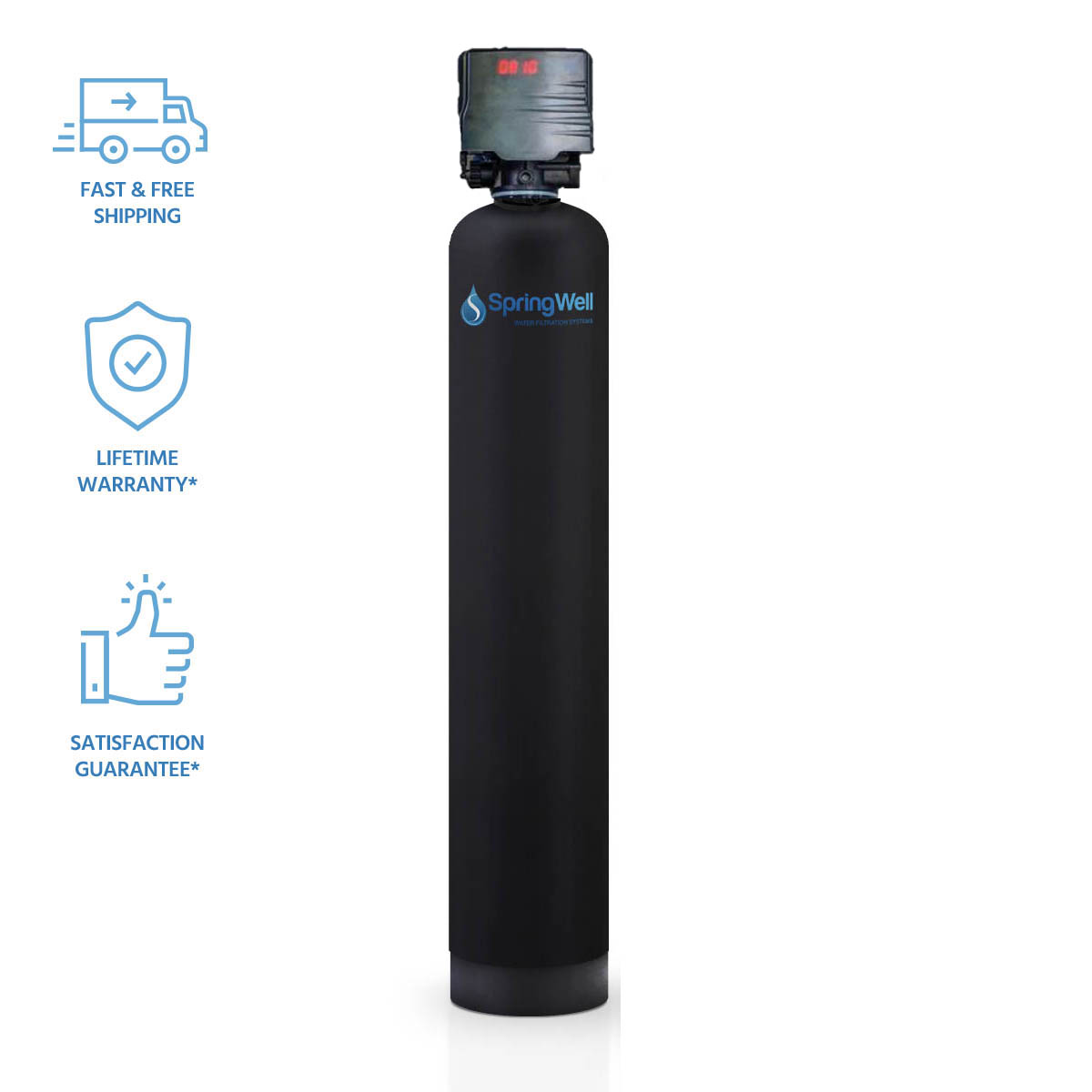
For tested pH 6.0 to 6.5
SpringWell SCN1-6 Calcite pH Neutralizer
Plan $1,500 to $2,200 for the equipment before testing and installation
- Published inlet pH
- 6.0 to 6.5
- Service flow
- 12 GPM maker label
- Backwash supply
- 7 GPM
- Pressure
- 25 to 80 psi
- Tank size
- 13 inches wide; 63 inches high with head
- Utilities
- Nonswitched power and a backwash drain
Why it can fit. The current SpringWell SCN1-6 page gives a narrow pH range plus service, pressure, connection, tank, and backwash labels. Its order process also requires current well-test results.
What could cost the sale. The maker does not publish an exact independent performance certification, inlet alkalinity limit, finished-pH table, pressure-loss curve, or media-use rate. The 7 GPM backwash demand alone rules out a weak well pump.
The SCN1-6 installation and refill instructions call for power, a drain, 2.5 initial 50-pound bags, a seven-day backwash setting, and inspection of the media level. The manual says the 45-minute regeneration blocks household water use.
Size backwash before service flow
A 12 GPM service label does not prove the well can clean the media bed. The SCN1-6 calls for 7 GPM during backwash. Ask a well contractor to measure sustained delivery at the pressure tank, not just read the pump label. Leave margin for pressure changes and other treatment tanks that may regenerate on the same night.
The manual sets backwash every seven days and says the cycle takes 45 minutes. That is about 16,400 gallons per year if the drain held 7 GPM for all 45 minutes, but the document does not publish a stage-by-stage drain curve. Use that figure only as a conservative plumbing and septic planning ceiling, then request the valve's actual cycle volumes in writing.
Plan for harder finished water
Calcite adds calcium as it dissolves. The amount depends on inlet pH, alkalinity, carbon dioxide, temperature, contact time, and flow. Do not accept a universal grains-per-gallon increase. Test hardness and pH after the tank under normal household flow.
A 2019 Water Research study by Hamed Pourahmad and colleagues found that a manganese coating reduced hardness release from a calcite contactor during a 600-hour high-manganese experiment. The work did not test the SpringWell unit or a home well. It does show why iron and manganese cannot be ignored when a seller predicts calcite performance.
If the finished water becomes hard enough to cause scale, a true ion-exchange softener may belong after the neutralizer. The hard-water guide separates hardness removal from scale conditioning. Do not add a softener until post-treatment hardness and household goals justify its salt, drain water, and service burden.
Know which products do not fix acidity
- SpringWell WS1 or WS4. These units target iron, sulfur odor, and manganese. Their own limits require enough pH for oxidation. The SpringWell WS well-filter specifications do not turn that product into an acid neutralizer.
- SpringWell SS1, SS4, or SS+. A softener removes hardness minerals. It does not raise low pH, and acidic water may harm the resin or plumbing ahead of it. The SpringWell SS softener review calls for low-pH pretreatment on a well.
- Point-of-use lead or copper filters. A certified tap filter can reduce exposure at that outlet, but it does not stop corrosive water from moving through the rest of the home. The lead-filter guide explains the tap-sampling and plumbing limits.
Budget the whole job
Use four lines in the quote: testing and design, equipment, installation, and ongoing service. For the SCN1-6, plan roughly $1,500 to $2,200 for the unit before a plumber, electrical work, drain changes, or treatment of iron, manganese, sulfur, or bacteria. The exact checkout figure can change.
Ask each installer for the same written scope. It should name the model, inlet test values, finished pH and hardness target, service and backwash flow, pressure loss, drain route, media quantity, inspection method, refill labor, startup sampling, and the first follow-up test. A low equipment quote can become the costly option if it omits the drain or misses a second water problem.
Who should buy and who should skip
The right buyer has a measured, narrow problem and a house that can support the treatment. Everyone else should pause for more testing or a different design.
Buy a calcite system when
- A certified lab confirms mild, steady acidity and the full chemistry fits the model.
- The well can sustain service and backwash flow at usable pressure.
- The home has power, a legal drain, enough floor and service space, and a plan to refill media.
- Post-treatment hardness and pH will be tested before any softener decision.
Skip or pause the purchase when
- The diagnosis rests on stain color, taste, or one home pH strip.
- pH falls below the model range or changes enough that passive media cannot hold the target.
- Iron, manganese, sulfur, oil, bacteria, lead, or copper needs a separate written response.
- The pump, drain, septic system, electrical supply, or installation space cannot support the design.
Questions people ask before treatment
What pH is too low for well water?
A pH below 7 is acidic, but pH alone does not predict how fast water will corrode plumbing. EPA uses 6.5 to 8.5 as a secondary drinking-water range. A treatment decision should also use alkalinity, hardness, dissolved minerals, plumbing metals, and actual corrosion results.
Will a calcite neutralizer fix every acidic well?
No. A calcite tank fits mildly acidic water when the tested chemistry and pump supply match the unit. Very low or changing pH, low alkalinity, iron, manganese, sulfur, bacteria, or limited backwash flow may call for another design or pretreatment.
Does a calcite neutralizer make water harder?
Yes. Calcite dissolves calcium carbonate into the water, which raises calcium hardness and alkalinity as it raises pH. Test the finished water before deciding whether a softener is needed after the neutralizer.
When is soda ash injection a better choice?
A properly designed soda ash feed can fit water that is too acidic or too variable for a simple calcite tank. It needs a chemical tank, metering pump, mixing or contact time, refill work, and regular testing. The dose must come from the water chemistry and actual pump rate.
Can a pH neutralizer remove lead, copper, or bacteria?
Do not treat it as a certified contaminant filter or disinfectant. Higher pH may reduce corrosive conditions that release plumbing metals, but damaged plumbing can remain a source. Lead, copper, and bacteria each need their own sampling plan and treatment response.
What should stop the purchase?
Stop if there is no certified laboratory report, pH and alkalinity are not measured, the well cannot supply the required backwash flow, there is no legal drain or power, or the seller will not put the proposed finished-water target and feed-water limits in writing.