Product comparison
SpringWell WS vs iSpring WGB32BM
Choose the iSpring WGB32BM, usually $450 to $650 before installation, for light, tested iron or manganese; choose the SpringWell WS, usually $2,000 to $3,000, only when the report and pump justify a backwashing oxidation system.
Rust stains and rotten-egg odor do not identify the full problem. Iron bacteria, organic iron, tannins, low pH, or an unsafe well can defeat both choices. Skip both until a laboratory report and an on-site flow check support the treatment plan.
Lower-cost fit
WGB32BM below its 3 ppm iron and 1 ppm manganese limits
Heavier-duty fit
WS for compatible iron, sulfur, or manganese with enough backwash flow
Stop the sale
No current water test, bacteria risk, or unsupported pump and drain
Start with six buying checks
The EPA says private wells should be tested each year for coliform bacteria, nitrate, total dissolved solids, and pH, with added tests for local risks and visible changes. An iron-system decision needs more detail.
Water source
These are point-of-entry choices for a private well. A disinfected city supply with chlorine needs a different comparison.
Measured problem
Record total iron, manganese, pH, hardness, turbidity, bacteria, and on-site hydrogen sulfide. Note clear-water iron, red particles, and slime.
Household demand
List fixtures that run together. Peak service flow and the pump flow needed for backwash are different numbers.
Installation limits
The WS needs power and a drain. The WGB32BM needs wall support, shutoffs, a bypass, and clearance below three large housings.
Upkeep and budget
Compare a $450 to $650 cartridge system with a $2,000 to $3,000 backwashing system before installation. Add filters, testing, plumbing, and repairs.
Desired outcome
Pick stain and odor control, particle control, or a treatment train. Neither product softens water, treats every chemical, or disinfects the well.
A low-producing well, a rental, or a home without service space should skip this pair. The well-water treatment guide maps a complete lab report to the right treatment train, while the iron-filter guide separates cartridge, backwashing, and source-repair jobs.
How this comparison was built
Choose from measured iron and manganese, any sulfur problem and the flow your home needs. Compare backwashing with cartridge changes, plus pump, drain and service costs.
Darren Lytle and EPA colleagues reported in Environmental Science: Water Research & Technology that an aeration and granular-media pilot reduced iron and manganese by 98 to 99 percent after start-up. EPA funded the work, and every listed author had an EPA affiliation. The pilot used biological treatment and named AdEdge media, not either household product here. It shows why oxygen, media, chemistry, and start-up conditions matter. It does not prove a WS result.
Affiliate disclosure: We may earn from qualifying purchases. Price ranges are planning budgets, not live offers.
The quick decision table
The two systems can overlap on low iron and manganese. The better fit depends on contaminant load, sulfur, pump capacity, and how much service work you will accept.
| Decision | SpringWell WS | iSpring WGB32BM |
|---|---|---|
| Best fit | Compatible iron, measured sulfur, or heavy load | Light iron or manganese and lower upfront budget |
| Maker inlet limits | 7 ppm iron, 8 ppm hydrogen sulfide, 1 ppm manganese | 3 ppm iron, 1 ppm manganese; no numeric sulfur limit |
| Published flow | Current technical table says 12 or 20 GPM; linked manual says 12 or 18 GPM | 15 GPM peak, not a tested clean-water delivery promise |
| Service | Automatic backwash, control valve, and media service | Three 20-inch cartridges changed by condition and capacity |
| Utilities | Outlet plus a safe backwash drain | No power or treatment drain |
| Planning price | $2,000 to $3,000 before installation | $450 to $650 before installation |
| Certification boundary | No exact-system certification linked for the reduction claims | Maker says two cartridges meet NSF/ANSI testing; no exact-system claim is linked |
| Sale stopper | Weak pump, no drain, or unapproved water report | Iron above 3 ppm, heavy sulfur, bacteria, or rapid cartridge loading |
SpringWell WS fits a heavier oxidation job
This is the premium choice when a measured load is too much for the cartridge case and the property can support automatic backwash.
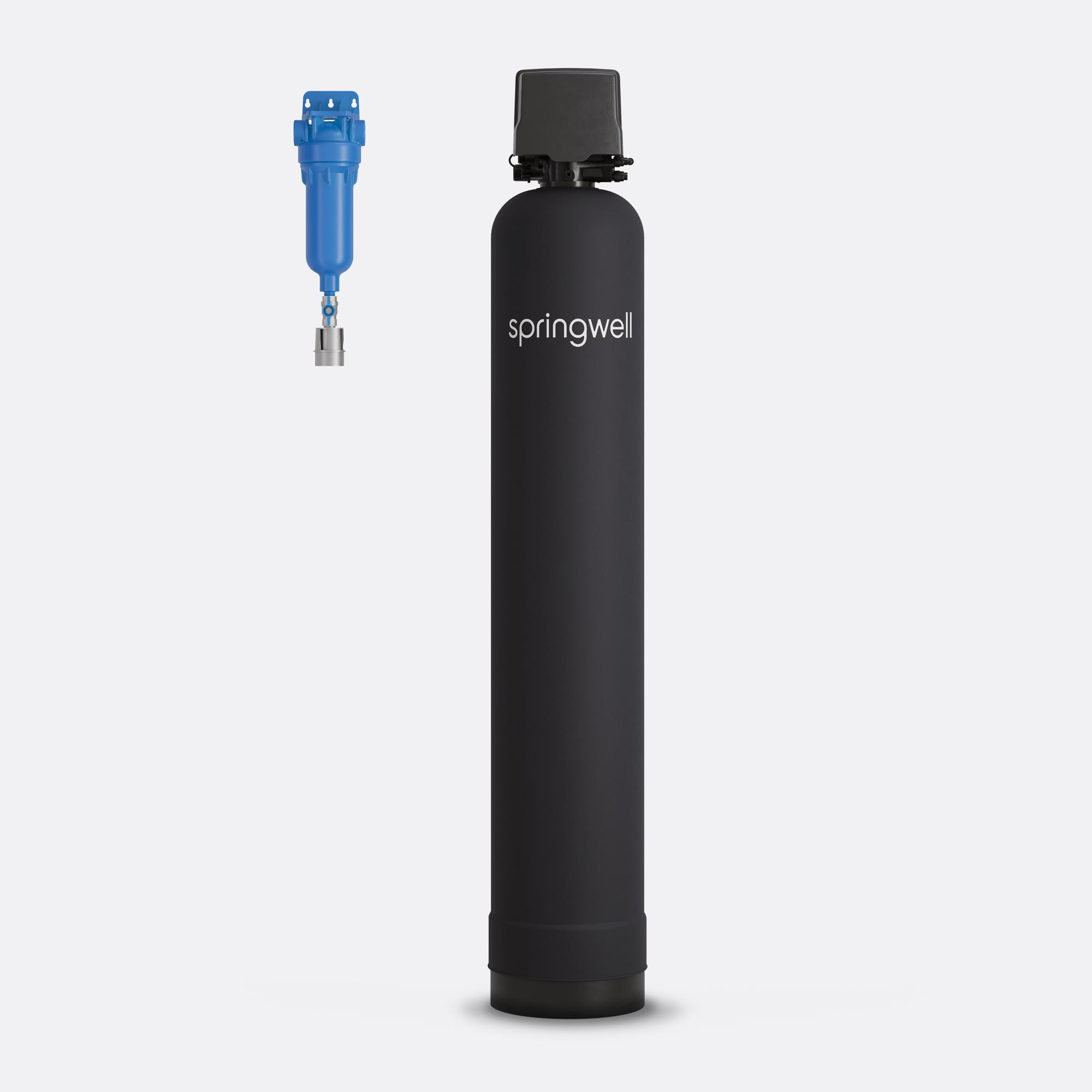
For a tested well with sulfur or a larger iron load
SpringWell WS Whole House Well Water Filter
$2,000 to $3,000 planning range before installation
- Process
- Air injection, oxidation, media filtration, backwash
- Iron limit
- Up to 7 ppm by maker claim
- Manganese limit
- Up to 1 ppm by maker claim
- Sulfur limit
- Up to 8 ppm hydrogen sulfide by maker claim
- Published flow
- 12 or 20 GPM in the current technical table
- Service burden
- Automatic backwash; old manual lists 5 or 7 GPM
Why it wins this slot. The current SpringWell WS page requires a water test and lists air injection with automatic backwash. It covers a higher iron ceiling than the WGB32BM and gives hydrogen sulfide a numeric inlet limit.
What costs the sale. This system depends on pump flow and a safe drain. The current page and linked WS1 and WS4 manual disagree on WS4 service flow, connection size, and minimum pH. Get the model, head, flow, pH floor, backwash rate, and approved test limits in writing.
iSpring WGB32BM fits lighter water and tighter budgets
This is the value choice when the report falls inside its narrower limits and cartridge work will not become a recurring burden.
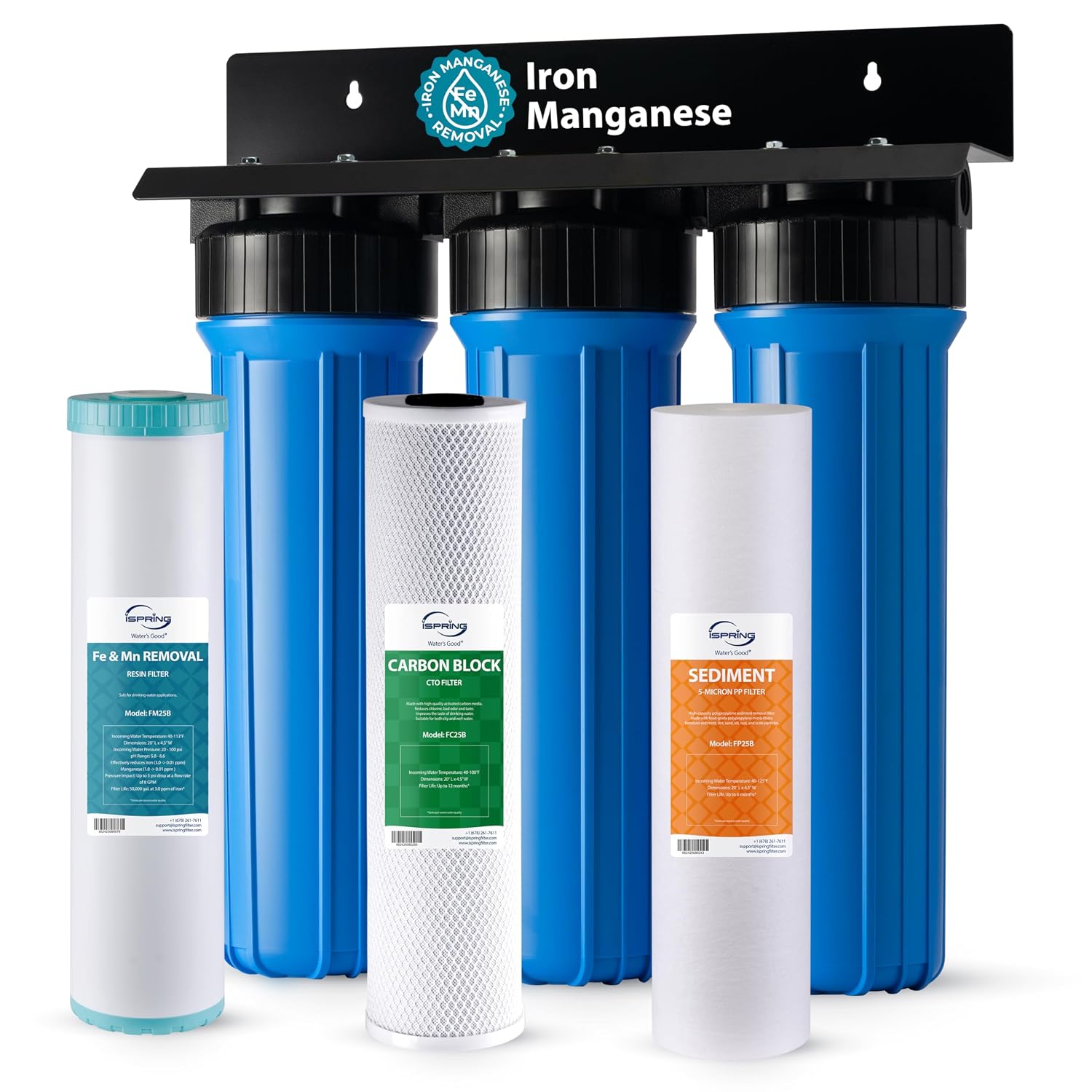
For light iron and a homeowner ready to change cartridges
iSpring WGB32BM
$450 to $650 planning range before installation
- Process
- Sediment, carbon block, catalytic iron and manganese cartridges
- Iron limit
- Up to 3 ppm by maker claim
- Manganese limit
- Up to 1 ppm by maker claim
- Sulfur limit
- No numeric inlet limit published
- Published flow
- 15 GPM peak maker label
- Service burden
- Six to 12 months or earlier at stated capacities
Why it wins this slot. The current WGB32BM page lists a 5-micron sediment stage, carbon block, and FM25B specialty cartridge. It needs no outlet or backwash drain, and the complete replacement pack usually falls in a $140 to $240 planning range.
What costs the sale. Iron above 3 ppm is outside the maker limit. At 500 gallons per day, a 50,000-gallon iron rating equals about 100 days, while a 100,000-gallon carbon rating equals about 200 days. Both calculations assume the listed capacity is reached and ignore earlier pressure loss. Heavy sediment, ferric particles, or slime can force faster changes.
Cartridge workload can erase the price advantage
The WGB32BM saves about $1,350 to $2,550 at the equipment stage, before installation. Its payback changes when iron or sediment consumes cartridges early.
| Household example | WGB32BM capacity math | Buying meaning |
|---|---|---|
| 300 gallons per day | 50,000 gallons equals about 167 days | Plan around two iron cartridges per year if the full rating holds |
| 500 gallons per day | 50,000 gallons equals about 100 days | Plan around three to four iron cartridges per year at the rated load |
| 700 gallons per day | 50,000 gallons equals about 71 days | Frequent service can outweigh the lower purchase price |
Each example divides iSpring's 50,000-gallon FM25B rating at 3 ppm iron by the stated daily household use. Lower iron may extend capacity. Ferric particles, sediment, bacteria, pressure loss, and water chemistry may shorten it. The figures are planning scenarios, not replacement promises.
Pump and plumbing limits decide the WS sale
The WS trades cartridge labor for automatic backwash. That trade only works when the well and drain can carry it. The old manual lists a 5 GPM backwash rate for WS1 and 7 GPM for WS4, plus a 14-minute backwash step. Those two figures imply 70 or 98 gallons during that step alone.
Ask the installer to measure sustained pump delivery at the treatment location, pressure before and during flow, and pressure-tank drawdown. Confirm drain size, air gap, freeze protection, septic effect, and local discharge rules. A bathroom-count selector cannot answer those questions.
Neither maker claim is a blank check
The NSF consumer guide says a certified system's data should name the model, validated contaminants, rated flow, capacity, and service requirements. The maker pages here do not link that complete exact-system record for the compared metal and sulfur claims.
- SpringWell WS has useful inlet ceilings, but no linked challenge concentration, finished-water result, test flow, or useful-life endpoint for those reduction claims.
- iSpring WGB32BM says its sediment and carbon filters were independently tested to meet NSF/ANSI standards. That wording does not establish finished-system certification or validate the FM25B iron and manganese claim.
- Both systems need paired raw and finished-water tests. An inlet ceiling tells you where the maker says the system may be used, not what concentration will leave the tap.
Water type can defeat both products
The Minnesota Department of Health separates clear-water, red-water, and organic iron. It warns that organic iron and tannins can slow or prevent oxidation, while sediment and carbon filters can clog fast on heavier ferric iron.
Iron bacteria or slime
Treat the well and source problem with a qualified professional. Neither product disinfects or repairs a fouled well.
Organic iron or tannins
Do not assume air injection will work. Get treatability guidance and a written equipment limit.
Hardness
Add a correctly sized softener only when the water report and desired outcome call for true hardness removal.
Low pH
Do not buy at the edge of a listed range. Manganese oxidation can be harder than iron oxidation.
Nitrate, arsenic, PFAS, or uranium
Choose separate treatment with an exact claim. Neither product earns a recommendation for these jobs.
Bacteria or untested safety
Stop the sale. Use health-department guidance, correct the well where possible, and design disinfection separately.
Products that do not solve this job
The base iSpring WGB32B sediment and carbon specifications do not include the FM25B iron and manganese cartridge. A name that looks similar does not make it a substitute for WGB32BM.
A softener may handle low clear-water iron under its own written limits, but it is not a sulfur filter and can foul on the wrong iron form. A spin-down sediment filter can protect later equipment from larger particles. It cannot remove a measured dissolved iron or manganese load by itself.
A local treatment professional remains the uncommissioned choice when the report shows mixed iron forms, bacteria, tannins, a result above either maker limit, or a pump that cannot support backwash. Ask for written inlet limits, service flow, backwash demand, replacement triggers, and a finished-water target before accepting a quote.
Follow this three-step decision
- 1. Stop for safety or unclear water. If bacteria are present or untested, iron form is unclear, tannins or slime appear, or a health contaminant is above its limit, fix the source and treatment plan before shopping.
- 2. Choose WGB32BM for the narrow cartridge case. Keep iron at or below 3 ppm, manganese below 1 ppm, sulfur out of the main job, and accept the replacement math.
- 3. Choose WS for a supported oxidation case. Require SpringWell's written approval, enough pump flow, a compliant drain, and matching current documents for the unit that will arrive.
Questions buyers ask
Is the SpringWell WS better than the iSpring WGB32BM?
The SpringWell WS is the stronger fit for a compatible well with iron above 3 ppm, a measured hydrogen sulfide problem, or a heavy particle load that would make cartridge changes costly. The WGB32BM is the lower-cost fit when iron is at or below 3 ppm, manganese is below 1 ppm, sulfur is not the main problem, and the household accepts cartridge replacement.
Can the iSpring WGB32BM remove sulfur odor?
iSpring says the WGB32BM can address some hydrogen sulfide, but it does not publish a numeric inlet limit or exact-system performance sheet for that claim. A measured sulfur problem is a poor place to guess. The SpringWell WS has an 8 ppm maker limit, though that claim also lacks a linked exact-model performance sheet.
How often do WGB32BM filters need replacement?
iSpring lists six to 12 months for the cartridges, up to 100,000 gallons for sediment and carbon, and 50,000 gallons for the iron cartridge at 3 ppm iron. Water use, iron form, sediment, and pressure loss can require earlier changes.
Does either system soften hard water?
No. Both systems leave calcium and magnesium hardness in the water. A separate ion-exchange softener is needed when the goal is truly soft water.
Does either system make a private well microbiologically safe?
No. Neither comparison product is a disinfection system. A positive or missing bacteria result should stop the purchase until the well and treatment plan are reviewed with the local health department or a qualified well professional.
What test results matter before choosing?
At minimum, use a certified laboratory for total coliform and E. coli, iron, manganese, pH, hardness, turbidity, nitrate, and local risks. Measure hydrogen sulfide at the site. Also check pump delivery, pressure, peak household flow, and the form of visible iron or slime.