Buying guide
The Best Ultrafiltration Water Filters
Buy the Waterdrop 17UB-UF if you want the strongest documented value in this two-model catalog, or the iSpring CU-A4 if you prefer four replaceable stages and accept weaker finished-system evidence.
The dangerous shortcut is treating a 0.01-micron label as a universal safety certificate. A membrane pore claim does not prove the complete appliance reduces lead, PFAS, chemicals, bacteria, or viruses, and the current documents for these exact models do not support that leap.
CDC says an absolute pore rating sets a maximum pore size while a nominal or mean rating allows larger openings. CDC also tells buyers to match the exact label to the germ or chemical of concern. Neither maker identifies the 0.01-micron number as an absolute rating on the current pages reviewed for this guide.
Who should skip both picks
Skip both for untreated surface water, an unsafe or untested well, a boil-water notice, or a household member who needs validated microbial protection. Skip them for fluoride, nitrate, sodium, hardness, arsenic, or lower TDS. A dissolved-contaminant problem calls for an exact certified claim, often from reverse osmosis or ion exchange rather than UF alone.
Four checks come before a product name
Use the utility report or a certified laboratory result. Taste and TDS cannot identify most health contaminants.
Ask whether the rating is absolute, then confirm the exact complete system and named reduction claim.
Both picks need a dedicated faucet opening. Neither is a simple direct connection to the main kitchen faucet.
Calendar time can end a cartridge decades before a large gallon ceiling at normal drinking-water demand.
The decision table
| Model | Best fit | Independent evidence | Published service | Main limit |
|---|---|---|---|---|
| Waterdrop 17UB-UF | Compact, low-work taste and particle filtration | NSF/ANSI 42 chlorine taste and odor plus 372 | 36 months or 24,000 gallons | One composite cartridge and narrow certified claim |
| iSpring CU-A4 | Owners who want separate stages | No finished-system certification located | Full replacement set listed for up to one year | More service work and weaker claim support |
What to check before choosing
Check whether the filter covers your water concerns, then compare faucet fit, flow, replacement parts and upkeep. A small membrane-size label alone does not tell you everything a complete system treats.
A field study by Zhang and colleagues in Science of the Total Environment found coliforms in effluent from operating small-scale UF systems and recommended routine microbial monitoring. The study covered village water systems, not either under-sink pick. It still demonstrates that membrane hardware, source quality, downstream sanitation, and monitoring work as one system.
Two picks with different evidence burdens
Affiliate disclosure: We may earn from qualifying purchases through retailer links. The comparison method and evidence limits explain how the products were assessed. Price bands are planning ranges, not live offers.
For a compact system with a documented chlorine claim
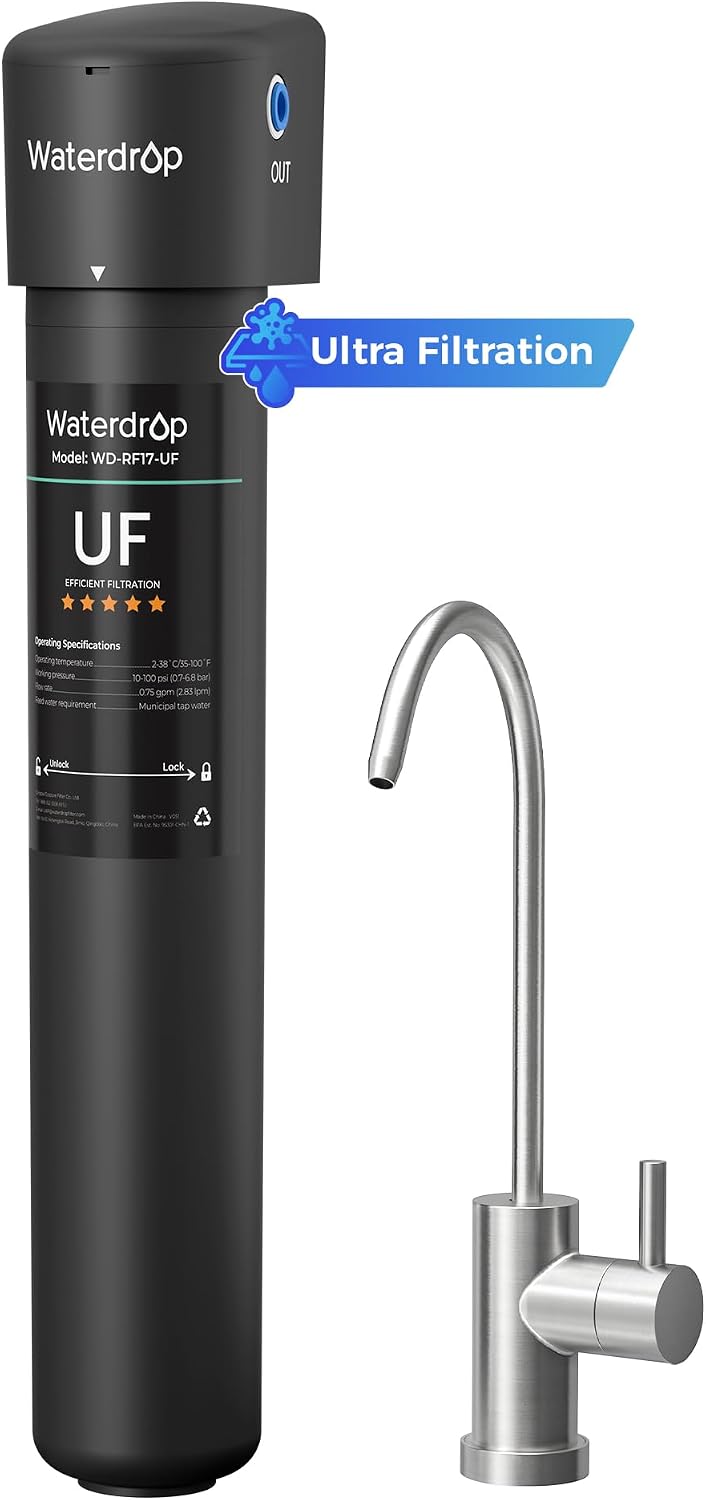
Waterdrop 17UB-UF
$60 to $100 typical range
Choose the 17UB-UF for treated municipal water when you want chlorine taste reduction, fine-particle filtration, no drain stream, and one cartridge to replace. Its current model page identifies the UF variant, flow, pressure range, and exact cartridge schedule in one place.
- Membrane
- Maker-listed 0.01-micron UF membrane in one composite cartridge
- Evidence
- NSF/ANSI 42 chlorine taste and odor claim plus NSF/ANSI 372 materials compliance; no NSF/ANSI 53, 244, or P231 claim located for this model
- Flow
- 0.75 GPM at the maker stated condition
- Service schedule
- 36 months or 24,000 gallons for WD-RF17-UF, whichever arrives first
- Installation
- 3.6 by 3.85 by 19.1 inches; cold line, dedicated faucet opening, and 10 to 125 psi feed range
Sale-stopping flaw. The long gallon rating can distract from the three-year calendar limit. The current certification language does not establish lead, PFAS, cyst, bacteria, or virus reduction for this exact model, so the membrane label cannot carry a health claim by itself.
The Waterdrop 17UB-UF model, flow, pressure, capacity, and certification details define the published configuration and limits.
For separate serviceable stages
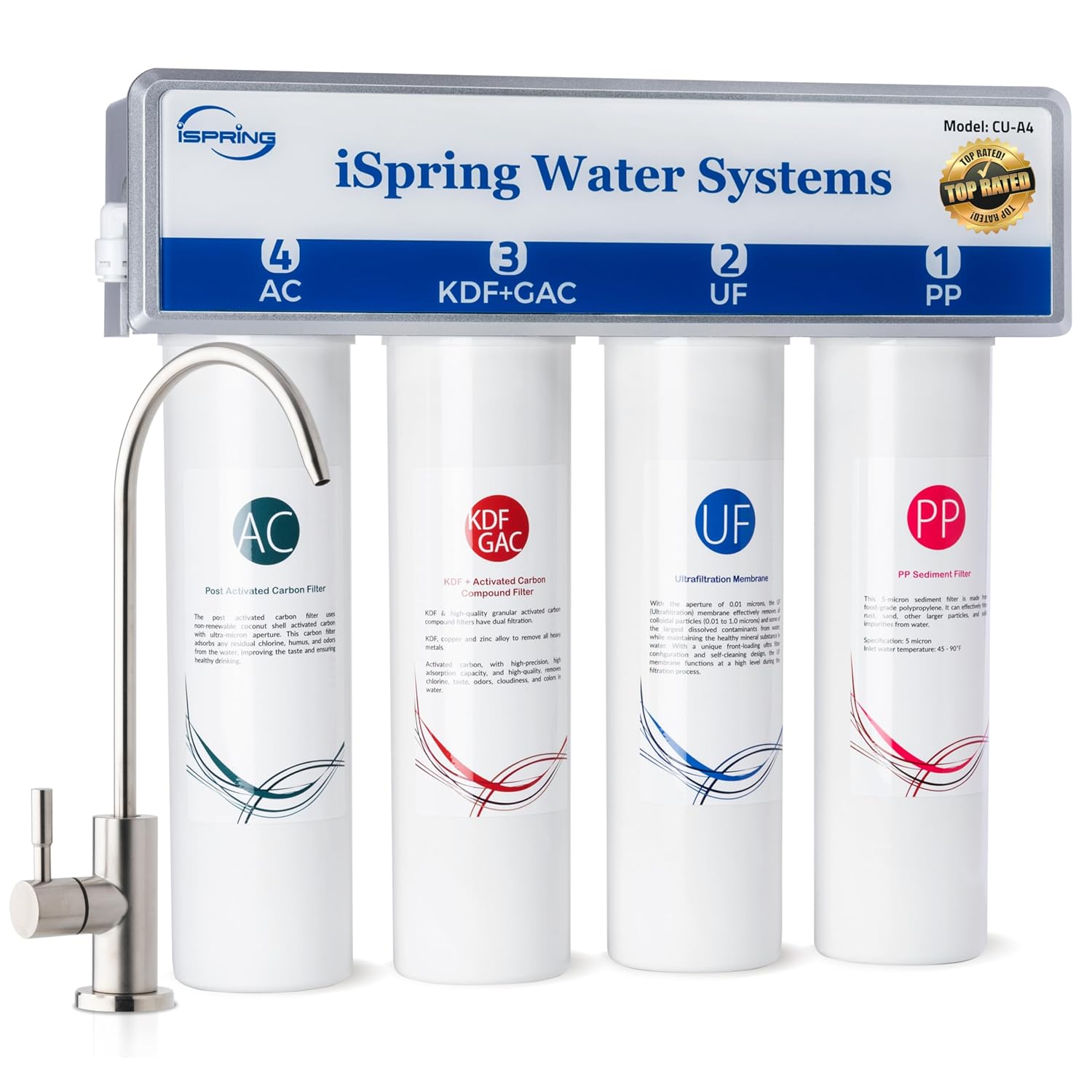
iSpring CU-A4
$140 to $310 typical range, depending on bundle
Choose the CU-A4 only when separate cartridges are worth the extra cabinet width and service work. A sediment stage can be changed without discarding the UF membrane, and the four-inch depth is easy to place against a cabinet wall.
- Membrane
- Maker-listed 0.01-micron UF membrane with separate sediment, carbon, KDF/carbon, and finishing stages
- Evidence
- No current finished-system NSF certification located; maker reduction language is not treated as an independent certified claim
- Flow
- No current model-specific flow rating located on the manufacturer page
- Service schedule
- Current bundle language supplies a full replacement set for up to one year; individual stages are sold separately
- Installation
- 15 by 4 by 13.5 inches; cold line and dedicated faucet required; no drain or electrical outlet
Sale-stopping flaw. The current page uses sweeping reduction language but does not provide a finished-system certification or a model performance sheet that supports a health-contaminant ranking. The annual full-set schedule also creates more recurring work than the Waterdrop cartridge.
The iSpring CU-A4 configuration, dimensions, cartridge list, and current service bundle define the published configuration and limits.
A 0.01-micron label answers only one question
UF is a pressure-driven size barrier. Suspended material larger than the effective pores stays behind while water and most dissolved ions pass. That explains why these systems retain the calcium and magnesium that contribute to TDS, but it does not establish the removal of a dissolved chemical.
NSF separates aesthetic claims under Standard 42 from health-effect claims under Standard 53 and incidental-compound claims under Standard 401. Certification follows named claims for an exact system. The standard number is not a score, and the membrane size is not a substitute for the claim list.
Both picks combine UF with adsorption media. Their carbon stages can improve chlorine taste and odor, while the membrane handles fine suspended particles. That combination does not allow a reader to assign every chemical claim from carbon and every germ claim from UF without model-level data.
The calendar limit defeats the headline capacity
Assume a household filters two gallons each day for drinking and cooking. Waterdrop's 24,000-gallon ceiling would take about 32.9 years to reach, but the 36-month limit arrives after roughly 2,190 gallons. That household uses about 9% of the gallon rating before the calendar controls replacement.
The same cartridge would need about 21.9 gallons every day for three years to reach 24,000 gallons. Waterdrop's own page says the family can serve 22 gallons daily, which explains how the two limits align. A large family, office, or refrigerator connection can approach that demand. A typical dedicated drinking faucet will not.
iSpring packages a complete replacement set for up to one year. Plan roughly $90 to $120 for a full set at current manufacturer ranges, then adjust if source water causes early sediment loading or one cartridge lasts longer. The separate stages give you service flexibility, but they also create four schedules to track.
Flow and cabinet shape matter more than stage count
Waterdrop publishes 0.75 GPM. That equals 45 gallons per hour as a flow ceiling, far above normal drinking demand. It does not mean the cartridge can deliver 24,000 gallons at the same chlorine performance under every source-water condition. Pressure, temperature, fouling, and water chemistry can reduce real flow.
The 17UB-UF is tall and narrow at 19.1 inches high. Leave clearance to release and replace the cartridge. The CU-A4 is shorter at 13.5 inches but uses a 15-inch-wide multi-stage frame. Measure the cabinet around the disposal, shutoff valve, drain, and shelf rather than comparing cubic volume alone.
Both systems avoid a storage tank, pump, electrical outlet, and drain saddle. Both require a cold-water connection and a dedicated faucet. Renters need written permission before drilling a sink or countertop. The renter filter guide compares no-drill alternatives when that permission is unavailable.
The purchase we recommend without earning a commission
Order a certified laboratory test before buying UF for a private well, unexplained illness, visible sediment changes, or a health contaminant missing from the utility report. We earn nothing from that test. The result can point to disinfection, pretreatment, a certified carbon claim, reverse osmosis for an appropriate dissolved contaminant, or no treatment at all.
Four claims should stop the sale
Waterdrop 17UB and 17UB-UF are the same filter
They are different cartridges. The current 17UB page describes 0.5-micron filtration, while the 17UB-UF page describes a 0.01-micron UF membrane. Confirm the UF suffix and matching WD-RF17-UF replacement before buying.
The CU-A4 removes 99.99% of contaminants
That headline does not name a contaminant, challenge concentration, finished-water result, capacity, or certifier. It cannot support a health decision. The full CU-A4 review and specifications keep the missing certification visible.
The 17UB-UF is a certified lead filter
NSF/ANSI 372 concerns lead content in wetted materials. It does not certify lead reduction. Look for an exact NSF/ANSI 53 lead claim when lead is the target. The lead filter guide compares models with named lead evidence.
A UF faucet replaces well disinfection
Neither pick has the complete-system microbial certification needed for that job. Source testing, pretreatment, validated disinfection, correct flow, and finished-water monitoring belong in a professional well-water plan.
Questions about ultrafiltration water filters
Does a 0.01-micron ultrafiltration filter make tap water microbiologically safe?
Not by label alone. Confirm whether the pore rating is absolute, then look for an exact-model cyst, bacteria, or virus claim under an applicable certification such as NSF/ANSI 53, 244, or P231. Neither catalog pick has that finished-system claim documented here.
Does ultrafiltration remove lead from drinking water?
A UF membrane can catch particles larger than its effective pores, but dissolved lead ions are much smaller. A carbon or ion-exchange stage may reduce lead only when the exact model has supporting performance data. Use an NSF/ANSI 53 lead claim for the complete system.
Can ultrafiltration remove PFAS?
Pore size alone does not establish PFAS reduction because PFAS molecules are dissolved. Activated carbon or another media stage may reduce named PFAS, but the exact complete system needs a model-specific claim. Neither pick is recommended here for PFAS treatment.
Will ultrafiltration lower TDS or soften hard water?
No. Household UF leaves most dissolved salts, calcium, magnesium, fluoride, nitrate, and sodium in the water. Choose reverse osmosis for an appropriate dissolved-contaminant claim or ion exchange for measured hardness.
Can either pick treat private well water?
Not as a stand-alone safety system. Test the well through a certified laboratory, address sediment and chemistry, and use a treatment plan that includes validated disinfection when microbes are present or the source is uncertain.
Match the treatment to the measured problem
The under-sink guide compares UF-adjacent carbon filtration with tank and tankless RO. Use the filter finder when your source, installation limits, and contaminant target are already clear.