Contaminant buying guide
The Best Water Filters for Barium
Choose the $600 to $750 Waterdrop G3P800 for a fast, plumbed kitchen system, or the $400 to $550 AquaTru Classic when a no-plumbing countertop format matters more. Both exact models publish a certified barium claim, but neither replaces an untreated-water test and a finished-water confirmation.
Do not buy a basic carbon filter for confirmed barium. Barium in water is a dissolved inorganic ion. A chlorine, taste, lead, or sediment claim says nothing about barium, and a generic NSF/ANSI 58 badge still requires a check of the model's optional contaminant claims.
EPA sets both the enforceable maximum contaminant level and the health goal at 2 mg/L. EPA lists increased blood pressure as the long-term health concern above the limit and identifies natural deposits, drilling waste, and refinery discharge as sources. Milligrams per liter and parts per million are numerically equivalent in water.
What earns a recommendation
The certifier or performance sheet must connect the claim to the product family and replacement membrane. A brand-level statement or an NSF/ANSI 58 logo without the contaminant list is insufficient.
NSF/ANSI 58 barium testing uses about 10 mg/L influent and a 2 mg/L maximum permissible product-water concentration. Reduction percentages need that challenge and endpoint for context.
A tankless under-sink system needs power, a drain, a feed connection, and a dedicated faucet. A countertop system needs power, clear counter space, tank refills, cleaning, and concentrate disposal.
Cartridge cost, gallon limits, calendar limits, source-water chemistry, and laboratory checks determine protection after installation. A TDS display cannot identify barium.
The three defensible treatment paths
Point-of-use RO treats the water used for drinking, ice, and cooking. Cation exchange can treat a larger household demand when the water chemistry and system design support it. Distillation can also reduce dissolved inorganic contaminants, but its slow production and energy demand make it a narrow household option.
| Path | Best fit | Barium evidence | Routine work | Reason to reject it |
|---|---|---|---|---|
| Waterdrop G3P800 | A high-use kitchen with cabinet power and permission to alter plumbing | IAPMO listing names barium; sheet reports 97.79% at a 10 mg/L challenge | Three cartridges, drain connection, faucet, flushing, leak checks, lab confirmation | Rental restrictions, no outlet or drain access, or source water outside the manual limits |
| AquaTru Classic | A renter or household that needs one no-plumbing drinking-water station | IAPMO-certified sheet reports 88.0% minimum and 96.4% average at a 10 mg/L challenge | Fill and empty tanks, clean the appliance, replace three cartridge types, retest | Hard feed water, limited counter space, or demand beyond practical batch refilling |
| Professionally designed cation exchange | A private well that needs whole-home treatment for barium and hardness | Exact NSF/ANSI 44 claim or written performance design tied to the water analysis | Salt, regeneration, hardness checks, sample taps, periodic laboratory testing | Unverified retail bundle, high sodium concern, poor drain capacity, or missing waste plan |
How we assessed the choices
Use your water test to choose a filter with a matching barium claim. Check its water limits, installation needs and replacement costs before buying.
Cwiertny coauthored a 2022 AWWA Water Science survey of 94 private wells across 10 Iowa counties. Barium was most often below 1 mg/L, though some untreated well samples fell between 1 and 2 mg/L. The study found higher barium in several aquifer groups and reported that some inorganic contaminants persisted after in-home treatment. Its authors reported no conflict of interest. The work maps occurrence and treatment limits, not product performance.
Best for a plumbed high-use kitchen
Affiliate disclosure: We may earn from qualifying purchases. Price ranges are planning budgets, not live offers.
For fast tankless delivery
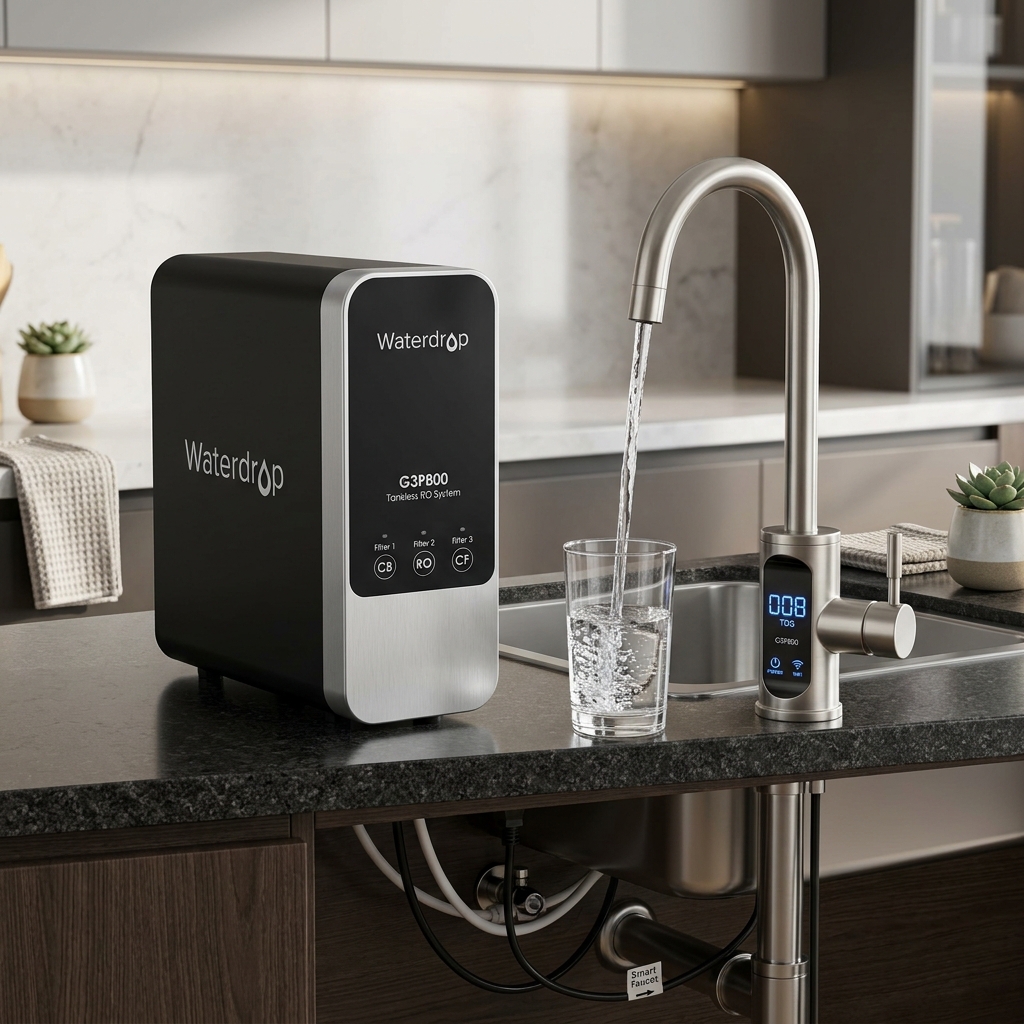
Waterdrop G3P800 Tankless Reverse Osmosis
$600 to $750 typical Amazon range
- Barium challenge
- 10 mg/L, plus or minus 20 percent
- Published result
- 97.79%, with a 2 mg/L maximum permissible output
- Rated delivery
- 800 GPD and 0.63 GPM catalog flow
- Water use
- 3:1 pure-to-drain manufacturer rating
Why it fits. The manufacturer-hosted WD-G3P800 sheet states IAPMO certification and names barium among its NSF/ANSI 58 reduction claims. It reports a 97.79 percent result against a 10 mg/L challenge. The model also has a 5.67-inch-wide cabinet footprint and a smart faucet that reports TDS and filter status.
Sale-stopping flaw. The system needs an outlet, a cold-water feed connection, a drain saddle, and a dedicated faucet. The 800 GPD label is a production rating, not the amount a household should plan to consume each day. Water temperature, feed pressure, dissolved solids, and membrane condition change real output.
Finished-water math. If 97.79 percent reduction held at the federal limit of 2 mg/L, the estimate would be 0.044 mg/L. At 5 mg/L, it would be 0.111 mg/L. Those examples show margin only. The certified challenge was about 10 mg/L, and household chemistry can change performance.
Service workload. Waterdrop lists six months or 550 gallons for the CF cartridge, 12 months or 1,100 gallons for CB, and 24 months or 2,900 gallons for RO. At an assumed three treated gallons per day, the gallon totals equal 183, 367, and 967 days. The calendar limits arrive first for CF and RO, while CB is nearly tied.
Best when plumbing changes are off limits
For a countertop drinking-water station
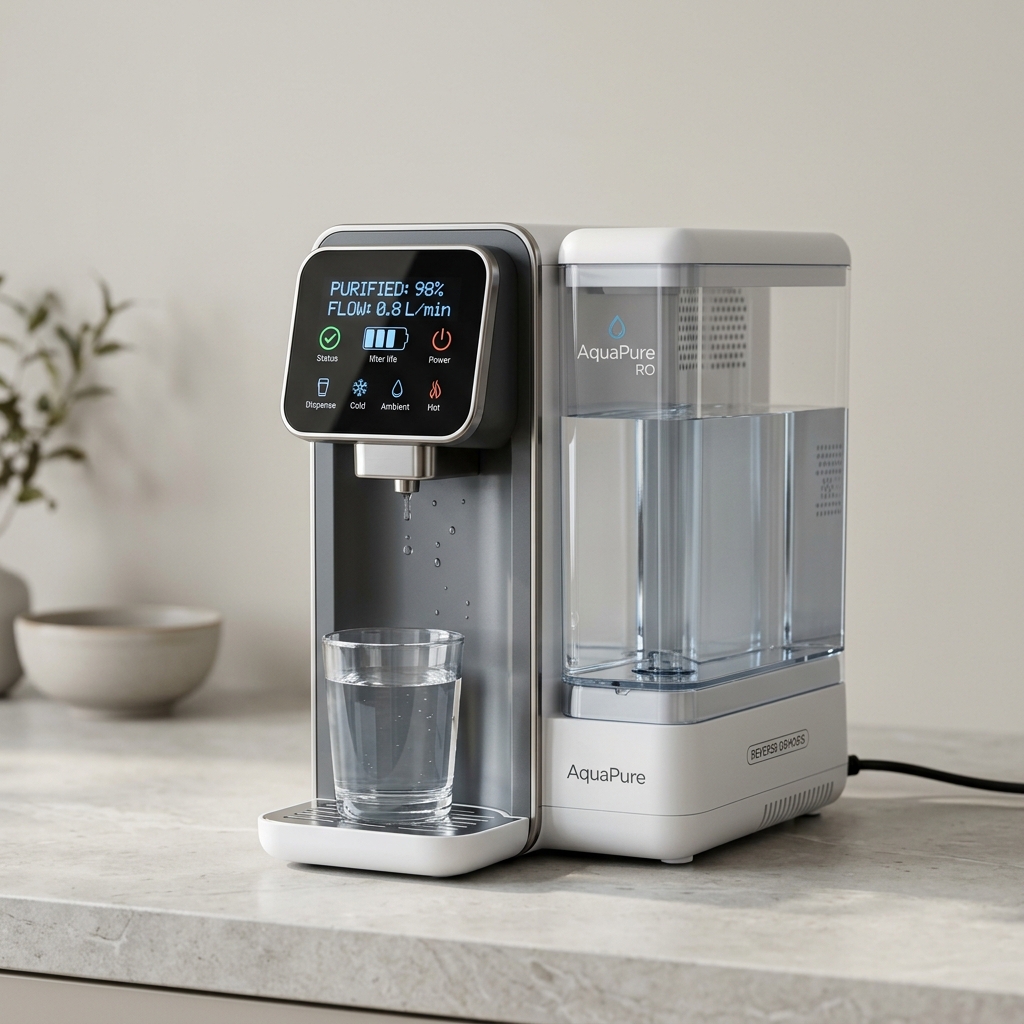
AquaTru Classic Alkaline Countertop RO
$400 to $550 typical Amazon range
- Barium challenge
- 10 mg/L, plus or minus 10 percent
- Published result
- 88.0% minimum and 96.4% average
- Installation
- No feed or drain plumbing
- Service
- 6-, 12-, and 24-month cartridge limits
Why it fits. The current AquaTru Classic performance sheet names barium under NSF/ANSI 58, reports an 88.0 percent minimum and 96.4 percent average reduction, and sets a 2 mg/L maximum permissible output. It provides a model-specific claim without requiring a landlord-approved feed valve, drain saddle, or faucet hole.
Sale-stopping flaw. Manual batches shift the work from plumbing to daily handling. The unit needs power, counter space, tank refills, concentrate disposal, and cleaning. AquaTru advises pretreatment above 10 grains per gallon hardness and lists limits for iron, manganese, sulfide, turbidity, TDS, temperature, and pH.
Conservative math. Apply the 88 percent minimum only as an illustration. A 2 mg/L feed would estimate to 0.24 mg/L; 5 mg/L would estimate to 0.60 mg/L; 10 mg/L would estimate to 1.20 mg/L. All sit below 2 mg/L on paper, but a finished-water sample must confirm the actual installation.
Capacity workload. At two treated gallons per day, a 600-gallon limit equals 300 days and a 1,200-gallon limit equals 600 days. The six-month prefilter interval arrives before 600 gallons, the 600-gallon finishing filter reaches its gallon limit before 12 months, and the membrane reaches 1,200 gallons before 24 months.
Whole-home treatment needs a water analysis
Barium and hardness ions carry positive charges, so strong-acid cation exchange can capture both. Health Canada's technical review reports 95 to 97 percent barium removal in full-scale and bench-scale cation-exchange work and recommends monitoring hardness breakthrough as the regeneration trigger. It also warns that sodium-form resin adds sodium to treated water.
This is the non-commissioned path for a private well that needs every tap treated. Request designs based on the same accredited-laboratory report. Each proposal should name the resin, vessel size, certified or warranted barium claim, continuous and peak flow, hardness capacity, salt dose, regeneration water, drain requirement, sample taps, breakthrough trigger, and follow-up sampling schedule.
The hard-water treatment guide explains grain-capacity math and regeneration tradeoffs. Barium changes the stakes: soft feel and scale control are not enough. A laboratory result from the treated tap must demonstrate barium control, and any radium finding needs separate handling and waste advice.
Two familiar RO systems miss the model check
Aquasana SmartFlow AQ-SFRO2-BN has broad certified claims, a tank, no powered booster pump, and a mineral stage. Its current performance sheet does not list barium. The Aquasana SmartFlow review documents the exact certified contaminant list and service needs. Those strengths do not supply the missing barium claim.
APEC ROES-50 is a sound value format for contaminants it documents, but its current catalog record does not publish a comparable model-specific barium result. The APEC ROES-50 review covers its 50 GPD rating, storage tank, pressure dependence, and cartridge format. A general NSF/ANSI 58 certification cannot fill a contaminant-specific evidence gap.
The reverse osmosis system guide compares tank, tankless, and countertop formats after the target claim is established. Format comes second here. The barium line in the exact model record comes first.
Carbon, sediment, UV, and boiling fail the job
Activated carbon. Carbon is useful for chlorine and named organic chemicals. It does not earn a dissolved-barium claim from an NSF/ANSI 42 taste-and-odor certification or an unrelated NSF/ANSI 53 claim.
Sediment and ultrafiltration. Fine membranes catch particles above their pore rating. Dissolved barium ions pass through particle filters unless the barium has precipitated, and particle removal alone does not establish a safe dissolved concentration.
Ultraviolet light. UV can inactivate susceptible microorganisms under defined dose and water-quality conditions. It does not remove dissolved metals.
Boiling. Barium stays behind as water evaporates. Boiling is a microbiological response, not an inorganic-contaminant treatment.
Test the source and the finished tap
Public-water customers should start with the current consumer confidence report and any utility notice. Ask whether the barium number represents source water, an entry point, a distribution sample, an average, or a maximum. A result below the public-system limit does not create a need for treatment by itself.
Private-well owners should use a state-certified or otherwise accredited laboratory. Ask for total barium and a panel that includes hardness, calcium, magnesium, iron, manganese, sodium, sulfate, alkalinity, pH, TDS, arsenic, uranium, and combined radium when local geology warrants it. Radium treatment and disposal need their own claim and verification plan; barium and radium appearing together does not make them interchangeable measurements.
Collect untreated and treated samples on the same day after the new system has been flushed and placed in normal service. Keep the chain-of-custody form, analytical method, reporting limit, units, and results. Repeat on the laboratory or treatment professional's schedule and after service changes. A faucet TDS number can help reveal a broad membrane change, but it cannot say how much barium remains.
Frequently asked questions
What water filter removes barium?
Choose a reverse osmosis system whose exact model certification names barium for drinking and cooking water. A properly selected cation-exchange softener can treat a larger household supply, but the finished system needs sizing from a complete water analysis and laboratory verification after installation. A carbon filter, sediment cartridge, ultrafiltration membrane, or UV system does not prove barium reduction.
Does boiling water remove barium?
No. Barium is a dissolved inorganic contaminant. Boiling removes water as vapor but leaves barium behind, so evaporation can increase the concentration in the remaining water. Use alternate water that meets public-health guidance until suitable treatment is operating and verified.
Is barium in drinking water regulated?
Yes. The U.S. EPA maximum contaminant level and maximum contaminant level goal are both 2 milligrams per liter, equal to 2 parts per million in water. The rule applies to public water systems. Private-well owners are responsible for testing and treatment, subject to any state or local requirements.
Does a water softener remove barium?
Strong-acid cation exchange can reduce barium because the resin favors divalent ions such as barium, calcium, and magnesium. Do not assume that any retail softener is a barium treatment system. Demand an exact certification or a professional design based on barium, hardness, iron, manganese, sodium, pH, alkalinity, sulfate, flow, and regeneration requirements.
How often should a barium filter be replaced?
Follow both the calendar and gallon limits for the exact model, then confirm the result with finished-water laboratory testing. Waterdrop lists six months or 550 gallons for the G3P800 CF cartridge, 12 months or 1,100 gallons for the CB cartridge, and 24 months or 2,900 gallons for the RO membrane. AquaTru lists six months or 600 gallons for the prefilter, 12 months or 600 gallons for the finishing filter, and 24 months or 1,200 gallons for the RO membrane.