Contaminant buying guide
The Best Water Filters for Radium
Choose the $400 to $550 AquaTru Classic Alkaline for a countertop system with an exact radium-226/228 claim and no plumbing changes. Choose the $200 to $480 Aquasana SmartFlow AQ-SFRO2-BN when you own the home, have cabinet space, and want a dedicated kitchen faucet. A private well that needs whole-house treatment calls for a professionally sized cation-exchange system, not a generic softener picked from a marketplace listing.
A filter purchase should follow a laboratory result or a public-water notice. EPA sets the health goal for combined radium-226 and radium-228 at zero and the enforceable public-water limit at 5 pCi/L. Private wells are not covered by that federal enforcement program, so the owner has to arrange the testing and response.
The category warning is identity. A gross-alpha screen can prompt more testing, but it does not tell you how much of the activity is radium-226 plus radium-228. Radon and uranium are separate measurements. A filter sold for radiation, heavy metals, or total dissolved solids without an exact radium claim leaves the central question unanswered.
Who should skip a retail filter purchase
Skip a device when the only evidence is a regional map, nearby violation, or home radiation meter. Use a state-certified drinking-water laboratory and request the radionuclide panel your state recommends. EPA maintains state contacts for certified drinking-water laboratories.
Skip self-directed treatment during a utility notice. Follow the utility or health department instructions for drinking, ice, food preparation, and infant formula until the notice is lifted.
Skip these two point-of-use systems when every fixture must be covered or when a well result exceeds the state action threshold. Whole-house cation exchange can reduce radium, but a professional must account for hardness, barium, iron, manganese, peak flow, regeneration, septic or sewer limits, sodium, and the disposal of concentrated media or brine.
Five checks make the decision
Use a combined radium-226/228 result reported in pCi/L. Do not substitute gross alpha, uranium, radon, or a TDS value.
NSF identifies radium-226/228 reduction as an optional NSF/ANSI 58 claim. The broad standard number alone proves less than many product pages imply.
Hardness, turbidity, iron, manganese, pressure, temperature, and pH can shorten membrane life or move the installation outside the tested conditions.
Size daily demand for drinking, coffee, ice, soups, food preparation, and infant formula. Rated capacity can arrive months before the calendar interval.
Test the treated outlet after installation and near the service interval. Ask the installer or state radiation and solid-waste offices how spent media should be handled because captured radionuclides can make ordinary trash disposal inappropriate.
What to check before choosing
Choose from your well test, not location or well depth alone. Compare the exact radium claim, the system’s water limits and the checks needed after installation.
A 2022 AWWA Water Science study sampled 94 private wells in ten Iowa counties. Six wells, or 6.3%, exceeded 5 pCi/L. Follow-up samples at 11 homes found the largest reductions where softening or reverse osmosis was used, while other inorganic contaminants could persist. The small treatment subset cannot rank retail products. The authors disclosed support from the Iowa Center for Health Effects of Environmental Contamination, the National Science Foundation, and the University of Iowa Graduate College.
Two picks fit two kitchens
Both picks publish exact radium results, but their percentages come from separate product records. Treat the figures as certification evidence, not a head-to-head laboratory test. Price bands are Amazon planning ranges, not live quotes.
| Option | Radium evidence | Rated service | Installation | Sale-stopping limit |
|---|---|---|---|---|
| AquaTru Classic Alkaline | IAPMO-certified NSF/ANSI 58 claim; 88% minimum and 96.4% average reduction from a 25 pCi/L challenge | 600-gallon pre/carbon and VOC filters; 1,200-gallon RO membrane | Countertop power and manual tank filling; no plumbing | Hardness above 10 gpg is outside the maker limit without pretreatment |
| Aquasana SmartFlow AQ-SFRO2-BN | WQA-certified NSF/ANSI 58 claim; 94% minimum and 98% overall reduction | 250 gallons; six-month carbon and 12-month membrane schedule | Tank, drain saddle, feed connection, dedicated faucet | Permanent plumbing work, cabinet space, and 27.4% efficiency rating |
Affiliate disclosure: We may earn from qualifying purchases through retailer links. The comparison method and evidence limits explain how the products were assessed. Where a product has more than one retailer, you can choose where to check the current offer.
The no-plumbing pick for renters
For apartments and kitchens without cabinet access
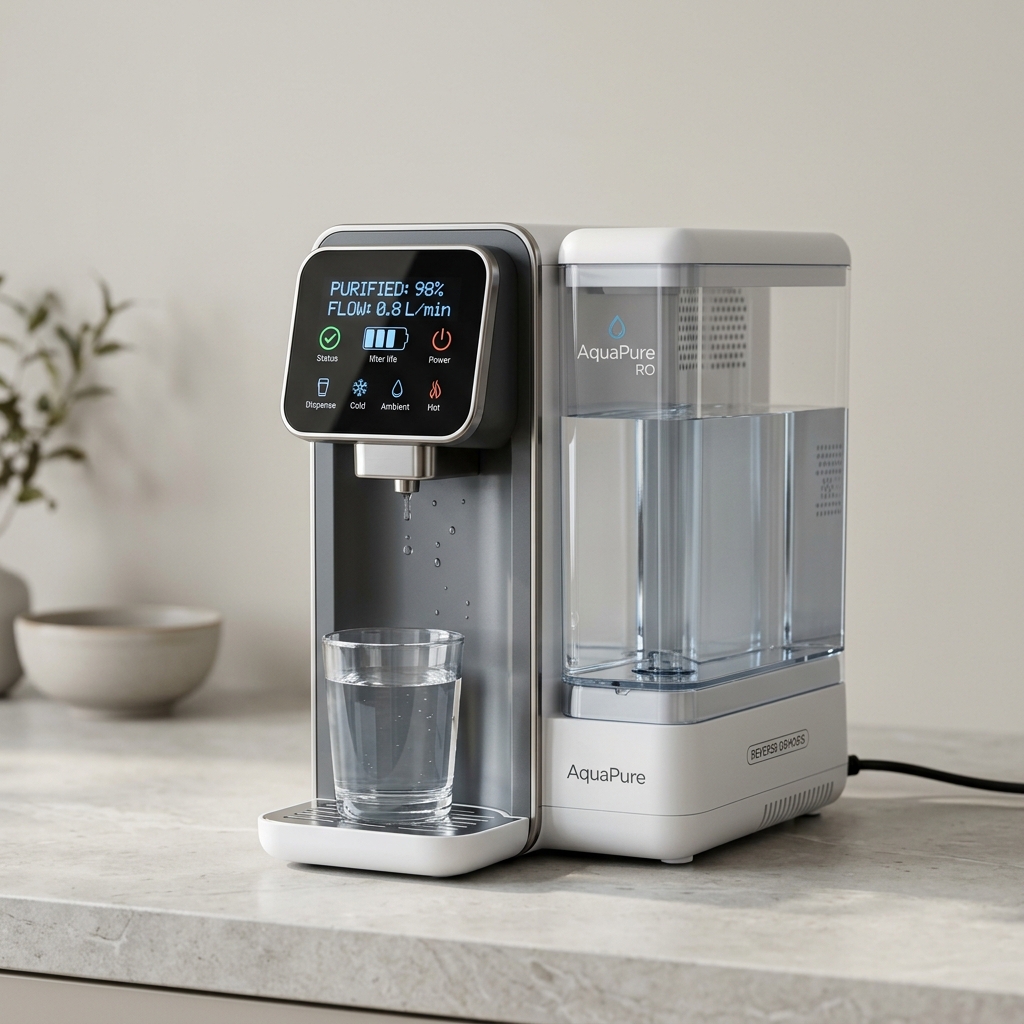
AquaTru Classic Alkaline Countertop RO
$400 to $550 typical Amazon range
- Radium evidence
- Certified NSF/ANSI 58 claim
- Published result
- 88% minimum; 96.4% average
- Rated service
- 600 gallons carbon; 1,200 gallons RO
- Installation
- Counter space and outlet; fill and empty tanks
Why it fits. The AquaTru performance sheet lists AT2000 through AT2050 models and a certified radium-226/228 claim. Its 25 pCi/L challenge is five times the federal limit. At the 96.4% average result, the calculated finished concentration is about 0.9 pCi/L. At the 88% minimum, it is 3 pCi/L. The sheet says the method used barium as a surrogate, so these estimates are certification evidence rather than a direct household radium measurement. They do not extend to an untested higher source concentration.
Sale-stopping flaw. AquaTru says hardness above 10 grains per gallon, or 171 mg/L, needs softening first. It also limits iron, manganese, and sulfide to less than 0.1 mg/L and turbidity to 5 NTU. A hard or dirty well can make this the wrong first treatment stage.
Service math. Two gallons a day reaches each 600-gallon carbon limit in about 300 days and the 1,200-gallon membrane limit in about 600 days. Both arrive before their one- and two-year calendar marks. The tanks also require repeated filling, concentrate disposal, and cleaning.
The countertop comparison covers tank handling, cleaning, clearance, and reject-water routines before you commit counter space.
The installed pick for daily cooking water
For homeowners who want a dedicated treated tap

Aquasana SmartFlow RO AQ-SFRO2-BN
$200 to $480 typical Amazon range
- Radium evidence
- WQA-certified NSF/ANSI 58 claim
- Published result
- 94% minimum; 98% overall
- Rated service
- 250 gallons; staged six- and 12-month changes
- Installation
- Feed tee, faucet, storage tank, and drain
Why it fits. The current AQ-SFRO2 performance sheet reports a 94% minimum and 98% overall radium-226/228 reduction. The exact system also publishes 40 to 80 psi operating pressure, 25.7 GPD daily production, 42.8% recovery, and a 27.4% efficiency rating.
Sale-stopping flaw. The 250-gallon contaminant capacity is short for a household that filters all cooking water. It also needs cabinet room for a storage tank, a drain saddle, a feed connection, and a dedicated faucet opening.
Service math. Two gallons a day reaches 250 gallons in about 125 days, before the six-month carbon interval. One gallon a day reaches it in about 250 days, so the six-month schedule arrives first. Use the earliest capacity or calendar limit stated for the replacement set.
The under-sink guide compares cabinet fit, plumbing work, faucet flow, and cartridge service across installed formats.
Whole-house radium treatment starts with the lab report
EPA identifies ion exchange and reverse osmosis as point-of-use methods that work well for radionuclides, but it also warns that spent media can collect enough radioactivity to require special disposal. New Jersey identifies cation exchange as the whole-house option when radium is the source of a gross-alpha result.
Do not turn that technology statement into a purchase recommendation for any softener. The resin volume and salt dose must match hardness and daily demand, while barium, iron, manganese, and other ions compete for capacity. A state or local authority may also set rules for discharging regeneration brine that contains concentrated radium.
A professional proposal should state the raw-water radium-226 and radium-228 results, design flow, resin volume, regeneration setting, expected run length, sampling ports, startup verification, follow-up schedule, and waste plan. The hard-water guide explains capacity and regeneration math, while the well-water guide covers treatment-train order and post-installation testing.
Products and claims that do not make the cut
Chlorine, taste, and organic-chemical claims do not establish radium reduction. Reject a product unless its exact model and cartridge carry a named radium-226/228 claim.
TDS reduction is required under NSF/ANSI 58, while radium reduction is optional. A standard number printed without the optional claim is insufficient.
APEC's current product page names radium, but we did not locate a model-specific numeric radium performance sheet comparable to the two picks. The full ROES-50 review and specifications cover its verified pressure, production, installation, and broader certification record without promoting an unsupported percentage here.
Cation exchange can reduce radium, but a tank size or grain number does not prove an exact-model radium claim, safe run length, or lawful brine disposal. Treat a generic bundle as equipment that still needs a professional design.
Boiling does not remove dissolved radium and can concentrate nonvolatile contaminants as water evaporates. UV inactivates microorganisms; it does not remove dissolved radionuclides.
A finished-water number matters more than a badge
A certified claim shows that a new system met a defined laboratory protocol. It does not measure your installed outlet, establish performance above the test challenge, or cover neglected cartridges. Sample after the maker's startup flush and ask the laboratory to report radium-226 and radium-228 separately plus the combined value.
Retest near the first service limit and after any repair or change in source water. A passing result is the evidence that the complete installation, water chemistry, and maintenance schedule work together.
Questions about radium filters
What type of water filter removes radium?
Reverse osmosis and cation exchange can reduce radium. For a drinking-water system, choose an exact model with a radium-226/228 reduction claim under NSF/ANSI 58. For whole-house treatment, use a water test and a professional design because resin capacity, hardness, barium, flow, regeneration, and waste disposal all affect the result.
Does every reverse osmosis system remove radium?
No. Radium-226/228 reduction is an optional claim under NSF/ANSI 58. A system can carry the standard for required TDS reduction without carrying the radium claim. Check the exact model and replacement modules in a current certifier listing or performance sheet.
Can a carbon filter remove radium?
A basic carbon filter should not be assumed to remove dissolved radium. Carbon is useful for chlorine and many organic chemicals, but radium treatment normally relies on reverse osmosis or cation exchange. Buy against a named radium-226/228 claim, not a generic multi-stage description.
Is radium the same as radon or uranium in water?
No. Radium, radon, and uranium are different radionuclides and can require different tests and treatment. Radium-226 decays into radon gas, but a radium result does not measure indoor-air radon or establish uranium removal.
How often should a private well be tested for radium?
EPA advises private-well owners to test for radionuclides every three years and to ask the local drinking-water office or radiation-control program which radionuclides matter locally. Retest sooner after treatment changes, a new well, flooding, nearby drilling, or a result close to a health benchmark.
Match the rest of the water profile
Radium rarely arrives with a complete treatment plan. Compare your hardness, iron, manganese, nitrate, arsenic, bacteria, pressure, installation limits, and daily demand before you buy.