Contaminant buying guide
The Best Water Filters for Cadmium
Choose the $200 to $480 Aquasana SmartFlow AQ-SFRO2-BN when a laboratory has confirmed cadmium and you can install a dedicated kitchen tap. Choose the $90 to $120 Clearly Filtered P-V3 only for already disinfected municipal water when a no-plumbing pitcher matters more than certified cadmium performance. Investigate galvanized plumbing or another local source before treating every faucet.
A filter purchase should follow a tap-water laboratory result or a public-water notice. EPA sets both the health goal and enforceable public-water limit for cadmium at 0.005 mg/L, or 5 micrograms per liter. EPA identifies kidney damage as the long-term health effect and names galvanized-pipe corrosion, natural deposits, metal refineries, waste batteries, and paints as potential sources.
The category warning is margin. A filter tested to finish at or below 5 micrograms per liter can have little safety margin when source water is far above its challenge level. A percentage alone cannot establish safe household output, and a generic reverse osmosis badge does not prove the optional cadmium claim.
Who should skip a filter purchase
Skip hardware when cadmium has not been measured at the tap. Ask the utility for its water-quality report, or use a state-certified drinking-water laboratory. A broad heavy-metals panel can reveal whether cadmium is the only problem.
Skip self-directed treatment during a utility violation notice. Follow the supplier or health department instructions for drinking, ice, food preparation, and infant formula until the notice is lifted.
Skip a point-of-use purchase when the result changes sharply after flushing, when several fixtures differ, or when galvanized plumbing is suspected. A qualified plumber and the water supplier can help locate the source. Removing the source can protect every tap and avoid a permanent cartridge burden.
Five checks make the decision
Use a cadmium result in micrograms per liter or parts per billion. A TDS value and a metallic taste cannot identify cadmium.
NSF lists cadmium reduction as an optional NSF/ANSI 58 claim. The standard requires TDS reduction, so the broad badge alone is not enough.
Count drinking, coffee, ice, soup, infant formula, and foods that absorb water. A small capacity can expire months before its calendar interval.
Compare first-draw and flushed samples only under a laboratory or utility sampling plan. That pattern can help separate source-water contamination from building plumbing.
Sample the treated outlet after installation and again near the service limit. Certification supports a product claim; it does not replace the result from your faucet.
What to check before choosing
Match the filter’s cadmium claim to your water test. Check the water conditions it can handle, the space it needs and the cost of replacement filters.
A 2026 Cureus field study in Kanchipuram, India, compared 52 participant-linked drinking-water samples from December 2024 to October 2025. Cadmium and several other analytes were significantly lower in RO-treated water than in natural drinking water. The study was exploratory, did not test these products, and cannot assign the change to one model or a service interval. The biochemistry and urology authors at two Chennai medical colleges reported no financial support, relevant financial relationships, or other conflicts.
Two picks fit different evidence needs
Aquasana supplies the stronger evidence because the exact system carries a certified cadmium claim. Clearly Filtered publishes a direct laboratory result but not a certified cadmium claim. Price bands are Amazon planning ranges, not live quotes.
| Option | Cadmium evidence | Rated service | Installation | Sale-stopping limit |
|---|---|---|---|---|
| Aquasana SmartFlow AQ-SFRO2-BN | WQA-certified NSF/ANSI 58 claim; 84.2% minimum and 95.6% overall reduction | 250 gallons; staged six- and 12-month changes | Tank, drain saddle, feed connection, dedicated faucet | Permanent plumbing work and a calculated 4.74 µg/L output from a 30 µg/L source using the minimum result |
| Clearly Filtered P-V3 pitcher | Independent ISO 17025 laboratory result; 33 µg/L reduced to 1 µg/L, or 96.97% | 100-gallon maker rating | No plumbing; manual filling | Cadmium is not an NSF-certified claim, and use is limited to municipally treated water |
Affiliate disclosure: We may earn from qualifying purchases through retailer links. The comparison method and evidence limits explain how the products were assessed. Where a product has more than one retailer, you can choose where to check the current offer.
The certified pick for a dedicated kitchen tap
For homeowners who need the strongest exact-model record

Aquasana SmartFlow RO AQ-SFRO2-BN
$200 to $480 typical Amazon range
- Cadmium evidence
- WQA-certified NSF/ANSI 58 claim
- Published result
- 84.2% minimum; 95.6% overall
- Rated service
- 250 gallons; six- and 12-month intervals
- Installation
- Feed tee, faucet, storage tank, and drain
Why it fits. The current AQ-SFRO2 performance sheet reports a passing cadmium claim with 84.2% minimum and 95.6% overall reduction. It also names the exact replacement modules, a 250-gallon capacity, 40 to 80 psi operating pressure, 25.7 GPD production, 42.8% recovery, and 27.4% efficiency.
Sale-stopping flaw. The minimum result leaves little margin at a high source concentration. At 30 micrograms per liter, 84.2% reduction calculates to 4.74 micrograms per liter. At 40 micrograms per liter, it calculates to 6.32, above the federal limit. Those estimates demand a treated-water test rather than trust in the average result.
Service math. Two gallons a day reaches 250 gallons in about 125 days, before the six-month carbon interval. One gallon a day reaches it in about 250 days, so the six-month schedule arrives first. Use the earliest capacity or calendar limit stated for the replacement set.
The reverse osmosis comparison covers cabinet fit, pressure, faucet flow, and reject-water demands before installation.
The no-plumbing pick for treated tap water
For renters who accept weaker evidence
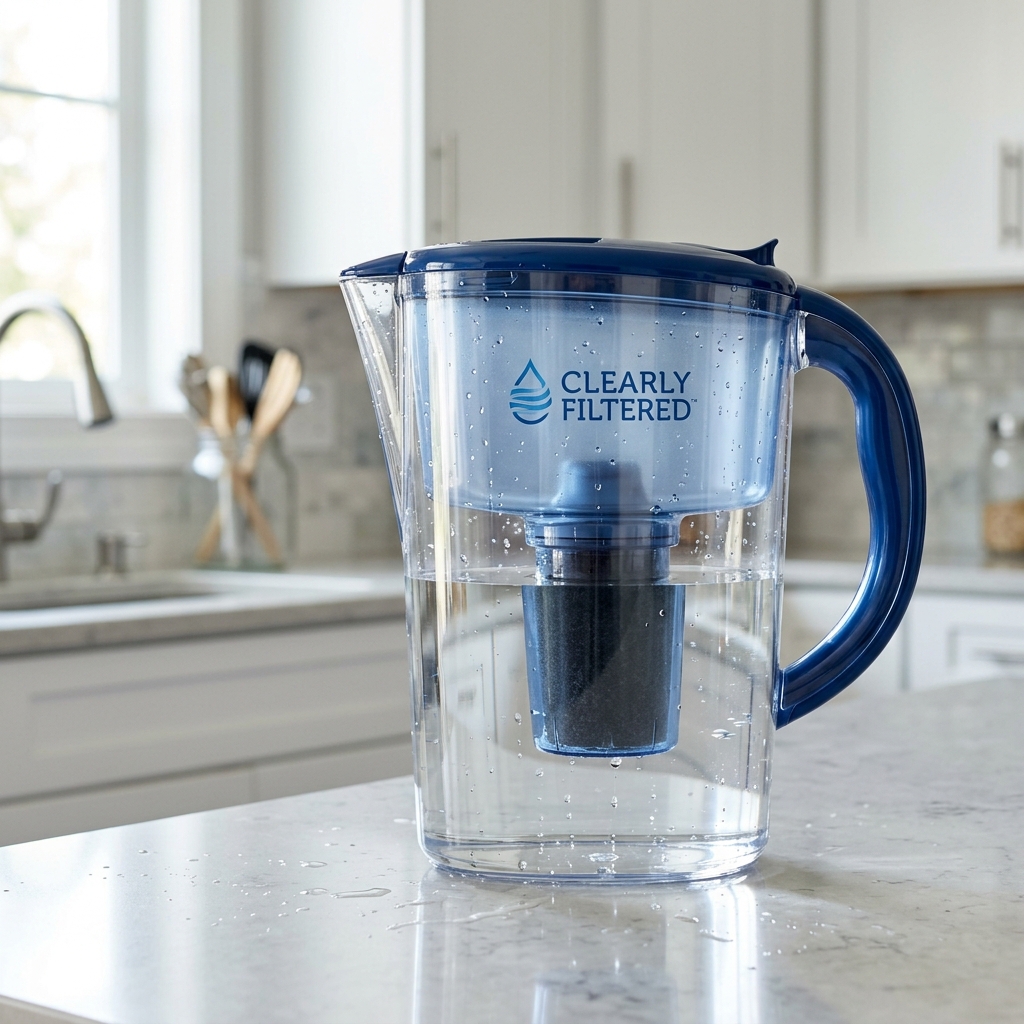
Clearly Filtered P-V3 10-Cup Pitcher
$90 to $120 typical Amazon range
- Cadmium evidence
- Independent laboratory result, not certified
- Published result
- 33 µg/L reduced to 1 µg/L
- Rated service
- 100-gallon maker rating
- Installation
- None; manual filling and refrigerator storage
Why it fits. The current P-V3 performance page reports 96.97% cadmium reduction from a 33 micrograms-per-liter challenge to 1 microgram per liter. It says the November 2025 testing came from QFT, now IAPMO New Jersey, an ISO 17025 laboratory capable of testing to NSF/ANSI protocols.
Sale-stopping flaw. The system is certified only to NSF/ANSI 42 and 372. Cadmium is an additional laboratory result, not a certified reduction claim, and the page reports the maximum removal percentage. The maker restricts use to municipally treated water and excludes water that is microbiologically unsafe or of unknown quality.
Service math. Two gallons a day reaches the 100-gallon rating in 50 days. One gallon a day reaches it in 100 days. That cartridge workload can make the higher-priced installed system less expensive over time for a household that filters cooking water.
The pitcher guide compares refill work, service capacity, and certification boundaries across portable options.
The source result changes the answer
Multiply the source concentration by the fraction left after reduction. The table applies the published percentages as planning assumptions. It does not predict output from a particular home.
| Source result | At 84.2% reduction | At 95.6% reduction | At 96.97% reduction |
|---|---|---|---|
| 5 µg/L | 0.79 µg/L | 0.22 µg/L | 0.15 µg/L |
| 30 µg/L | 4.74 µg/L | 1.32 µg/L | 0.91 µg/L |
| 40 µg/L | 6.32 µg/L | 1.76 µg/L | 1.21 µg/L |
The federal limit is 5 micrograms per liter. The minimum Aquasana result crosses that line between 30 and 40 micrograms per liter in this arithmetic. A source result above the product challenge, a large margin need, or multiple contaminated taps calls for professional design and direct finished-water measurement.
Popular systems that lack the needed proof
AquaTru Classic. Its current performance sheet lists many exact NSF/ANSI 58 claims but no cadmium row. The AquaTru Classic review documents its verified claims and water-quality limits, but this model does not make the cadmium shortlist.
Waterdrop G3P800. The maker currently promotes membrane fineness, production, and broad treatment, yet its product page does not publish a cadmium result. The Waterdrop G3P800 specifications show where its model-level evidence is strong. An NSF/ANSI 58 badge alone cannot fill the missing optional claim.
APEC ROES-50. APEC names cadmium among contaminants the system removes, but the current product page does not provide an exact cadmium challenge, endpoint, or percentage. The APEC ROES-50 review covers its certified scope, pressure limits, and tank requirements. A broad list is weaker than the SmartFlow record for this job.
Plain carbon and sediment filters. Sediment control can protect downstream treatment, and carbon can address chlorine or organic chemicals. Neither function proves dissolved cadmium reduction without a named model claim.
The non-commissioned work comes first
Buy a state-certified laboratory test before hardware when the utility report does not answer the question. If samples implicate galvanized plumbing, pay for source investigation before committing to years of replacement filters. We earn nothing from laboratory work, utility coordination, or plumbing repair.
Private-well users should pair cadmium treatment with the well-water guide's microbial testing, pretreatment, peak-flow, and post-installation checks. A pitcher intended for municipally treated water is not a shortcut around an unknown well-water result.
The weakest evidence on this page is the use of controlled results to estimate household output. Those records do not reproduce every home's plumbing, concentration, pH, competing ions, flow pattern, or maintenance. The decision is a model-specific filter plus treated-water testing, or source removal when plumbing is responsible.
Cadmium filter questions
What type of water filter removes cadmium?
Choose an exact reverse osmosis system with a cadmium-reduction claim certified under NSF/ANSI 58. Ion exchange and other treatment can also reduce cadmium in some water, but a household product should be selected from the laboratory result, water chemistry, service flow, and a model-specific performance record.
Does every reverse osmosis system remove cadmium?
No. Total dissolved solids reduction is required under NSF/ANSI 58, while cadmium reduction is optional. A system can carry NSF/ANSI 58 without a cadmium claim. Check the exact model and replacement modules in a current performance sheet or certifier listing.
Can a water pitcher remove cadmium?
The Clearly Filtered P-V3 pitcher has current independent-laboratory data reporting 96.97% cadmium reduction from 33 micrograms per liter to 1 microgram per liter. Its cadmium result is not an NSF-certified claim, and the maker limits the pitcher to municipally treated water that is not microbiologically unsafe or of unknown quality.
Can a TDS meter detect cadmium?
No. A TDS meter estimates the combined concentration of dissolved ions from conductivity. It cannot identify cadmium at parts-per-billion concentrations or prove that treated water is below the federal 5 micrograms per liter limit.
Will boiling water remove cadmium?
Do not rely on boiling for cadmium treatment. Cadmium is a dissolved inorganic contaminant, not a microorganism. Follow the utility or health department instructions during a notice, or use an alternate safe water source until a tested treatment is in place.
Match the device to the measured water problem
The finder compares contaminant concerns with installation limits, household demand, rental constraints, water chemistry, and the rest of your water report.