Contaminant buying guide
The Best Water Filters for Manganese
Choose the $450 to $650 iSpring WGB32BM only when a laboratory report shows manganese at or below 1 ppm and iron at or below 3 ppm. Lower dissolved manganese plus hardness may suit a manganese-rated softener, while higher loads, black particles, or mixed iron and sulfur call for professionally sized oxidation and backwashing filtration.
Black staining is not enough evidence to buy a filter. Manganese can be dissolved, particulate, or associated with slime-forming bacteria, and each condition changes the treatment. The iron and manganese reference separates the common source clues and treatment roles. An infant in the home also changes the acceptable drinking-water target.
EPA lists 0.05 mg/L as a non-enforceable secondary standard for manganese. That value addresses color, taste, and staining. It should not be confused with a universal health limit or a filter sizing rule.
Who should pause before buying
Use an alternate source for infant formula and other infant drinking water when manganese exceeds 100 micrograms per liter. Minnesota guidance uses 300 micrograms per liter for households where no infant drinks the water. The Minnesota Department of Health explains those health-based values and calls for accredited laboratory testing. Ask the local health department which target applies where you live.
Pause if the well has not been tested for coliform bacteria, nitrate, pH, hardness, iron, manganese, and local geologic risks. A cartridge cannot repair a damaged well, identify manganese bacteria, or prove that another health contaminant is absent.
Six results choose the treatment
Collect the measurements before comparing equipment. A sales page that omits one of these variables has not established a fit.
A clear sample that darkens after air exposure suggests dissolved manganese. Black water at the tap may already contain particles. Ask the laboratory how the sample was filtered and preserved.
Iron adds oxidant demand and solids. Hydrogen sulfide can consume treatment capacity and needs its own quantified claim. A rotten-egg odor alone does not identify the source.
Manganese generally needs more oxidation time than iron. Low pH can make a media or oxidant ineffective unless neutralization comes first.
Hardness can justify ion exchange, but oxidized manganese can foul a softener. The order of aeration, filtration, and softening matters.
Count simultaneous fixtures rather than bedrooms alone. Whole-home treatment must supply the real peak without unacceptable pressure loss.
A media tank needs enough pump and drain capacity to lift and clean its bed. Service flow and backwash flow are separate specifications.
The three honest treatment paths
The concentration bands below are screening boundaries from the cited guidance and exact product claim. They do not replace a written design for the complete water chemistry.
| Path | Measured fit | Treatment method | Service work | Reason to reject it |
|---|---|---|---|---|
| iSpring WGB32BM | Manganese at or below 1 ppm and iron at or below 3 ppm | Sediment, carbon, then FM25B catalytic media | Replace three large cartridges, log pressure, retest finished water | No complete-system manganese certification located; no hardness or bacteria treatment |
| Manganese-rated cation exchange | Lower dissolved manganese when hardness also needs removal | Exchange manganese, calcium, and magnesium for sodium or potassium | Salt, regeneration, drain flow, resin cleaning, finished-water testing | Oxidized particles can foul resin; the exact model must state a manganese limit |
| Oxidation plus backwashing filtration | Higher load, particulate manganese, or mixed iron and sulfur | Convert dissolved manganese to particles, capture them, flush the bed | Oxidant or air system, drain, valve service, adequate backwash flow | A generic tank is unsafe to size without pH, contact time, media, and pump data |
How we assessed the choices
Choose from measured manganese levels and the form present in your water. Check the system’s limits, service needs and how you will confirm that treatment is working.
Their iron and manganese guidance places softening below about 0.5 mg/L dissolved manganese, oxidizing filtration near a combined 1 mg/L load, and aeration plus filtration around 5 to 10 mg/L combined iron and manganese. Those are method ranges, not product promises. The source also notes that water chemistry, contaminant form, bacteria, and required flow decide the equipment.
The catalog pick inside a 1 ppm limit
Affiliate disclosure: We may earn from qualifying purchases through retailer links. The comparison method and evidence limits explain how the option was assessed. The price band is a planning range, not a live offer.
For moderate manganese within every published limit
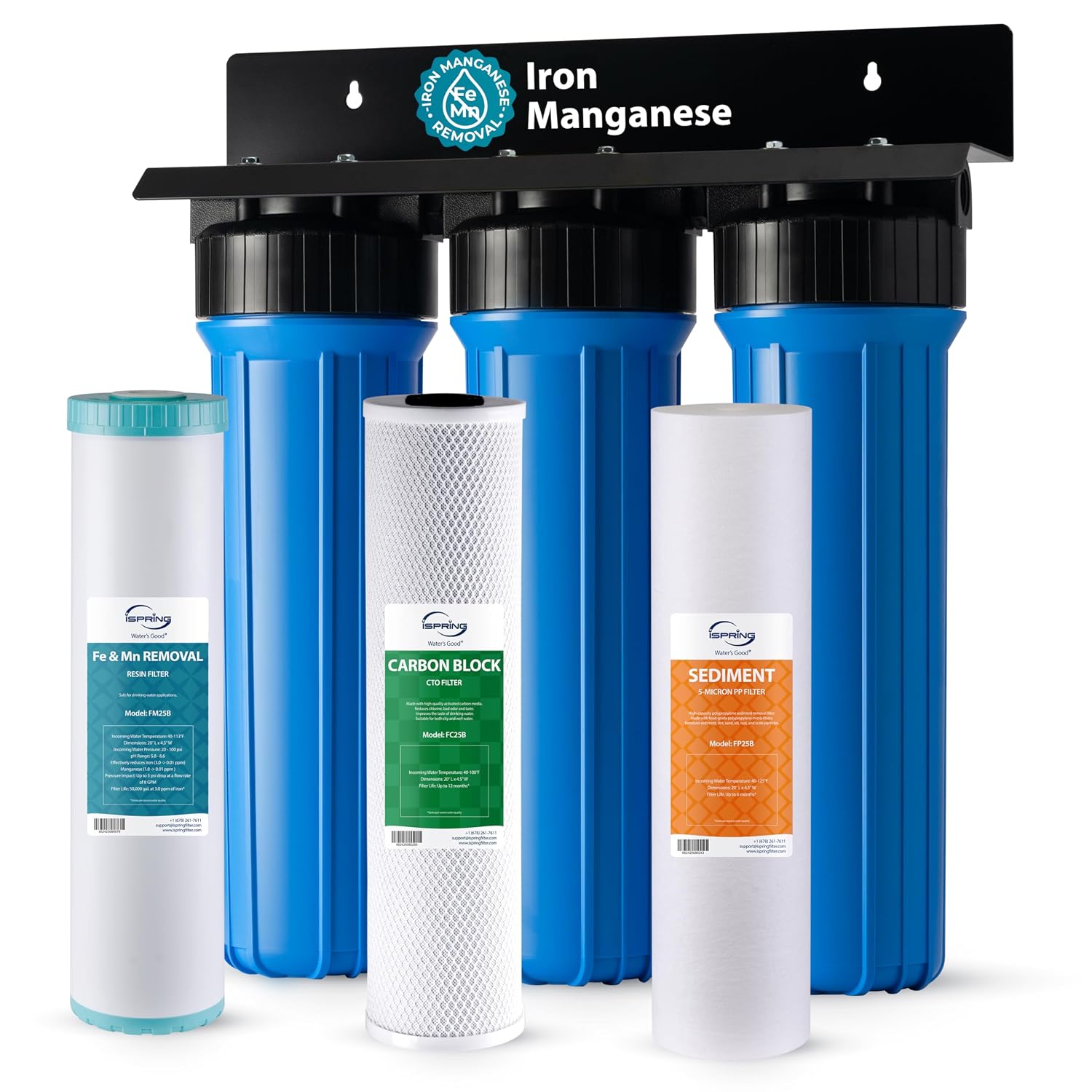
iSpring WGB32BM
$450 to $650 typical Amazon range
- Manganese limit
- Up to 1 ppm, manufacturer claim
- Iron limit
- Up to 3 ppm, manufacturer claim
- Flow and pressure
- 15 GPM peak; 25 to 80 psi
- Service
- Three 20 by 4.5-inch cartridges; six to 12 months listed
Why it fits. iSpring names the WGB32BM, the FM25B metal cartridge, a 1 ppm manganese maximum, a 3 ppm iron maximum, and a 15 GPM peak flow. That model-specific boundary is stronger buying evidence than a generic “iron and manganese” label.
Sale-stopping flaw. No live certifier listing for a complete-system manganese claim was located. NSF says Standard 42 can cover a named manganese reduction claim, but a standard mentioned for components or general testing does not prove the exact system carries that certified claim.
Capacity math. iSpring rates the FM25B cartridge for 50,000 gallons at 3 ppm iron, not as a universal manganese capacity. At an assumed 240 gallons per day for four people, 50,000 gallons equals about 208 days. The six-to-12-month schedule, pressure loss, and finished-water manganese result can all end the run sooner.
Installation work. The current WGB32B-series manual lists one-inch ports, 25 to 80 psi, 40 to 100 degrees Fahrenheit, and 3 to 15 GPM. Add a supported wall bracket, shutoffs, bypass, gauges, and enough clearance to lower wet 20-inch cartridges.
A softener works only when its own claim fits
Cation exchange can serve two jobs when dissolved manganese is low and the water is also hard. Nebraska Extension describes effective treatment below about 0.5 mg/L dissolved manganese, while warning that efficiency changes with hardness, pH, contaminant concentration, and the exact equipment. Oxygen or chlorine can oxidize manganese before it reaches the resin, turning a dissolved-ion job into a particle-fouling problem.
The catalog's DuraWater 48,000-grain Fleck 5600SXT review documents a hardness softener without a published manganese limit. It is not the pick here. Ask a supplier to put the exact resin, manganese maximum, iron maximum, salt dose, programmed capacity, service flow, and regeneration flow in writing.
A softener also needs a drain, overflow route, nearby power, space for resin and brine tanks, regular salt, and enough well flow for regeneration. Retest at the drinking tap before relying on it for a health-based target.
Higher loads need oxidation and backwashing
Manganese takes more time and oxygen to oxidize than iron. A professional design may use air, chlorine, ozone, potassium permanganate, or another validated oxidant before a media bed captures the resulting particles. The choice depends on pH, alkalinity, manganese form, iron, sulfur, organic matter, bacteria, contact time, and the media's backwash demand.
The iron-filter comparison explains how dissolved metal, oxidized particles, and bacterial slime create different first steps. Manganese needs its own finished-water target even when the same equipment treats both metals.
This is the non-commissioned recommendation when the cartridge or softener boundary is exceeded. Request two written proposals based on the same laboratory report. Each proposal should name the oxidant, contact volume, media, tank diameter, service flow, backwash rate, drain load, residual-control step, maintenance schedule, and finished-water manganese target.
A peer-reviewed field study in the Journal of Environmental Science and Health, Part A found consistently high manganese removal by residential reverse osmosis and ion exchange, but four poorly operating point-of-entry greensand filters increased measured manganese by 29 to 199 percent. The authors were affiliated with Polytechnique Montréal's NSERC Industrial Chair in Drinking Water. The result does not condemn greensand. It shows that maintenance and verification decide whether installed media is treatment or a new source.
What does not solve a manganese result
iSpring WGB32B. The base model contains one sediment cartridge and two carbon blocks. It lacks the WGB32BM's FM25B metal cartridge. The base WGB32B review separates that municipal-water configuration from the manganese model.
A sediment cartridge. It can catch black manganese particles after oxidation. Clear dissolved manganese can pass through. A finer micron rating does not create the missing chemical conversion.
The sediment guide compares particle stages by micron rating, flow, and pressure loss, which becomes useful only after dissolved manganese has been converted to a filterable solid.
An ordinary carbon block. A separate peer-reviewed household-device study found activated carbon blocks inappropriate for dissolved manganese removal. Pour-through adsorptive filters performed better in the test but declined after rated capacity, while small cation-exchange devices had shorter lives and could release manganese after exhaustion.
A TDS meter or stain check. Total dissolved solids do not isolate manganese. Clear fixtures also do not prove that drinking water meets a health-based value. Only an appropriate manganese analysis answers that question.
The measured number that controls service
Record raw manganese, finished manganese, meter gallons, inlet pressure, and outlet pressure when treatment is new. Repeat the finished-water test on the schedule set with the laboratory or local health authority, after service, and whenever staining or pressure changes. A cartridge's gallon ceiling cannot reveal early breakthrough.
Suppose raw water contains 0.8 mg/L manganese and the household uses 240 gallons daily. That equals about 908 liters and 726 milligrams of manganese passing into the system each day. At 0.2 mg/L, the daily mass is about 182 milligrams. The fourfold difference explains why identical households can see very different media life even when both results sit below a product's maximum concentration.
We earn nothing from accredited laboratory work, an alternate safe water supply, well rehabilitation, or a properly sized backwashing system. Those purchases come before a retail cartridge when health guidance or equipment limits are exceeded. The well-water guide maps manganese beside bacteria, nitrate, arsenic, hardness, sediment, and sulfur when the laboratory report finds more than one problem.
Manganese filter questions
What is the best filter for manganese in well water?
The best treatment depends on a laboratory result, manganese form, iron, hardness, pH, bacteria, household peak flow, and available backwash flow. The iSpring WGB32BM is a practical cartridge option when manganese is at or below its published 1 ppm limit and iron is at or below 3 ppm. A manganese-rated softener may fit lower dissolved concentrations when hardness also needs treatment. Higher or mixed loads usually need professionally sized oxidation followed by backwashing filtration.
Is 0.3 ppm manganese in water safe?
EPA has a non-enforceable secondary standard of 0.05 mg/L, or ppm, for aesthetic effects. Minnesota health guidance uses 0.1 mg/L for water consumed by infants and 0.3 mg/L for households without an infant drinking the water. State guidance can differ, so use an accredited laboratory, consult the local health department, and provide an alternate water source when the result exceeds the guidance for the person drinking it.
Will a water softener remove manganese?
Some cation-exchange softeners can reduce dissolved manganese, especially at lower concentrations, but performance depends on the exact resin, manganese concentration, hardness, pH, iron, oxygen exposure, regeneration, and maintenance. Do not apply a generic treatment range to a softener whose manufacturer does not publish a manganese claim.
Can a sediment filter remove manganese?
A sediment filter can capture manganese that has already oxidized into particles. It cannot reliably remove clear, dissolved manganese before oxidation. If a clear sample darkens or forms black particles after standing, the treatment may need an oxidation step before filtration.
How often should a manganese filter be changed?
Follow the exact model limit and test the finished water. iSpring lists a 6-to-12-month replacement cycle for the WGB32BM set and rates the FM25B cartridge for 50,000 gallons at 3 ppm iron, but it does not publish a separate gallon capacity at every manganese concentration. Source load, water use, sediment, pressure loss, and breakthrough can require earlier service.
Match treatment to the laboratory result
Use the finder to separate manganese from iron, hardness, bacteria, sulfur, sediment, and other well-water needs.