Contaminant buying guide
The Best Water Filters for Sediment and Turbidity
Start with a reusable 50-micron spin-down filter for visible sand, then add a 20-inch depth cartridge only when finer silt still reaches the house. Choose the $400 to $600 iSpring WGB32B when treated municipal water also needs chlorine reduction, the $450 to $650 WGB32BM when a well test finds iron or manganese within its limits, or the $60 to $100 Waterdrop 17UB-UF only for a dedicated drinking tap after the whole-home sediment problem is controlled.
Sediment is a description, not one contaminant. Sand, clay, pipe scale, ferric iron, manganese particles, and disturbed-main rust differ in size and origin. The sediment and turbidity reference explains the source clues and treatment boundaries.
The category warning is over-filtration. A 1- or 5-micron cartridge placed first on a sandy well may load rapidly, cut shower flow, and hide a damaged screen, poor well development, failing casing, or seasonal source change. Filtration should protect the plumbing while the source problem is investigated.
Who should skip a filter purchase
Skip a shopping decision when cloudy water appeared after flooding, a well repair, a pressure loss, or a sudden color change. Use alternate safe water until the well, casing, pump, and laboratory results are assessed.
Skip sediment-only treatment when the sample stays clear but later turns orange or black. That pattern can point to dissolved iron or manganese, which passes through an ordinary particle screen before oxidizing. The iron-filter guide separates dissolved metals, visible particles, and iron bacteria.
Skip every product here as a substitute for disinfection. CDC says private wells are not regulated or monitored by officials and recommends yearly testing for coliform bacteria, nitrate, total dissolved solids, and pH. Local conditions can require more tests.
Five checks make the decision
Let a clear sample settle. Sand drops quickly. Fine clay can remain suspended. Orange or black particles justify iron and manganese testing. Laboratory turbidity adds a repeatable number but does not identify every particle.
Add the fixtures likely to run together, then compare that demand with the filter, housing, pipe, and pump limits. A nominal micron rating says nothing about usable household flow after the media loads.
A flushable screen catches the large load without consuming cartridges. A finer depth cartridge can follow when the first stage leaves silt. Each step should have a pressure reading on both sides.
NSF places particulate reduction under NSF/ANSI 42 aesthetic claims. Certification applies to the listed claim and exact product. It does not turn a sediment device into a microbiological purifier.
Plan a bypass, isolation valves, drainage, a pressure-relief method, and vertical clearance for the screen or sump. A filter that cannot be flushed or opened without flooding the room will not receive dependable maintenance.
What to check before choosing
Match the filter to the particles in your water and the flow your home needs. Compare screen or cartridge size, pressure loss, cleaning and replacement work.
A 2018 Science of the Total Environment study tested how several turbidity-causing materials affected bacterial attachment and UV inactivation. Ferric iron particles at 0.2 NTU produced the weakest E. coli inactivation in that experiment, while material type and UV transmittance mattered as much as a single turbidity number. UK Water Industry Research funded the work, and the paper says the funder did not influence its content. The study did not test household filters or these exact systems. It supports pretreatment before UV, not a universal household turbidity cutoff.
The useful comparison starts with the plumbing job
The first two options are unmonetized reference configurations because they isolate the sediment task. The catalog products add carbon, iron media, or point-of-use polishing. Price bands are Amazon planning ranges for catalog products, not live quotes.
| Option | Particle stage | Published flow | Service method | Sale-stopping limit |
|---|---|---|---|---|
| Rusco 1-inch Spin-Down | Selectable reusable screen; 50 microns is the practical coarse starting point used here | 1 to 25 GPM | Flush and clean the screen | Fine silt passes; solvent-weld 1-inch ports require planned plumbing |
| Pentek DGD-5005-20 in a 20-inch Big Blue housing | 5-micron nominal dual-gradient polypropylene | Initial loss under 1 psi at 20 GPM in maker testing | Replace the cartridge when loading causes pressure loss | A fine cartridge can plug quickly without coarse pretreatment |
| iSpring WGB32B | 5-micron FP25B followed by two carbon blocks | Up to 15 GPM | Replace three 20 by 4.5-inch cartridges | Carbon is unnecessary expense for sediment alone; no disinfection or softening |
| iSpring WGB32BM | 5-micron FP25B, carbon block, iron and manganese media | Up to 15 GPM | Replace three 20 by 4.5-inch cartridges | Iron above 3 ppm or manganese above 1 ppm exceeds the maker limit |
| Waterdrop 17UB-UF | 0.01-micron UF membrane at one dedicated faucet | 0.75 GPM | Replace the single cartridge | Not a whole-home sediment fix; well use requires upstream whole-house filtration |
Affiliate disclosure: We may earn from qualifying purchases through retailer links. The comparison method and evidence limits explain how the options were assessed. Where a product has more than one retailer, you can choose where to check the current offer.
The coarse first stage for visible sand
For a reusable first stage before fine media
Rusco 1-inch Spin-Down with a 50-micron screen
- Particle stage
- 50-micron reusable polyester screen
- Published flow
- 1 to 25 gallons per minute
- Pressure limit
- 150 psi maximum
- Installation
- 1-inch slip ports and a flushable sump
Why it fits. Rusco lists reusable polyester screens from 15 to 700 microns for the 1-inch model. A 50-micron screen is coarse enough to avoid pretending it will polish clay while still catching visible sand and rust flakes. The clear body and flush valve make loading observable.
Sale-stopping flaw. The 1-inch version uses slip ports, so copper, PEX, or threaded main lines need the correct adapters and a bypass. A spin-down screen also cannot capture dissolved iron or disinfect water. Fine silt can pass straight through.
Service math. A home that peaks at 12 GPM uses less than half the published 25 GPM ceiling when the screen is clean. That is not a guarantee of pressure after loading. Install gauges and flush based on the actual pressure difference, not a calendar guess.
A threaded spin-down option: iSpring WSP
iSpring WSP with a 50-micron screen
Choose the WSP when visible sand or rust calls for a reusable first stage and threaded connections suit your plumbing. Its flush valve helps clear trapped particles. Plan roughly $50 to $100 and select the 50-micron version on the store page.
Skip it for fine clay or dissolved contaminants. A coarse screen is pretreatment. Heavy sediment can clog the 50-micron screen quickly, so ask about a coarser size before buying. Leave room to flush and clean it.
The iSpring WSP specifications explain screen choice and maintenance.
The fine stage for silt that remains
For fine particles after coarse pretreatment
Pentek DGD-5005-20 in a 20-inch Big Blue housing
- Particle stage
- 5-micron nominal depth cartridge
- Published flow
- Under 1 psi initial loss at 20 GPM
- Cartridge size
- 4.5 inches by 20 inches
- Installation
- Compatible 20-inch heavy-duty housing, valves, bypass, and gauges
Why it fits. The Pentair sheet gives the DGD-5005-20 a 5-micron nominal rating and under 1 psi initial pressure drop at 20 GPM. The dual-gradient depth design spreads particle loading through the cartridge instead of relying on a thin surface screen.
Sale-stopping flaw. Nominal is not absolute. The maker also warns against microbiologically unsafe or unknown water without adequate disinfection. A heavily loaded 5-micron cartridge can become the household flow bottleneck, so it belongs after a coarse stage when sand is present.
Service math. Compare pressure before and after the housing at a repeatable flow. A clean under-1-psi result is only the starting condition in manufacturer testing. Replacement timing should respond to the increase from that baseline and the household's minimum acceptable fixture pressure.
The combined municipal sediment and chlorine pick
For treated city water with rust or main-work debris

iSpring WGB32B 3-Stage Whole-House Filter
$400 to $600 typical Amazon range
- Particle stage
- 5-micron FP25B polypropylene
- Published flow
- Up to 15 gallons per minute
- Rated service
- Up to 100,000 gallons or 12 months
- Installation
- Three 20 by 4.5-inch housings with 1-inch ports
Why it fits. iSpring identifies the base WGB32B as a 5-micron sediment stage followed by two carbon blocks. That combination fits disinfected municipal water when rust particles and chlorine taste are both real problems. It is more equipment than a sediment-only housing.
Sale-stopping flaw. The base WGB32B does not soften hard water, disinfect a private well, or include the WGB32BM iron and manganese cartridge. Two carbon stages add replacement cost when particles are the only target.
Service math. At 300 gallons of household use per day, 100,000 gallons equals about 333 days. At 500 gallons daily, it equals 200 days. Sediment pressure loss can force earlier service, so the gallon number and calendar limit are both ceilings.
The whole-house comparison separates carbon filtration, softening, and UV by job.
The cartridge pick for tested iron and manganese
For well water within the exact model limits
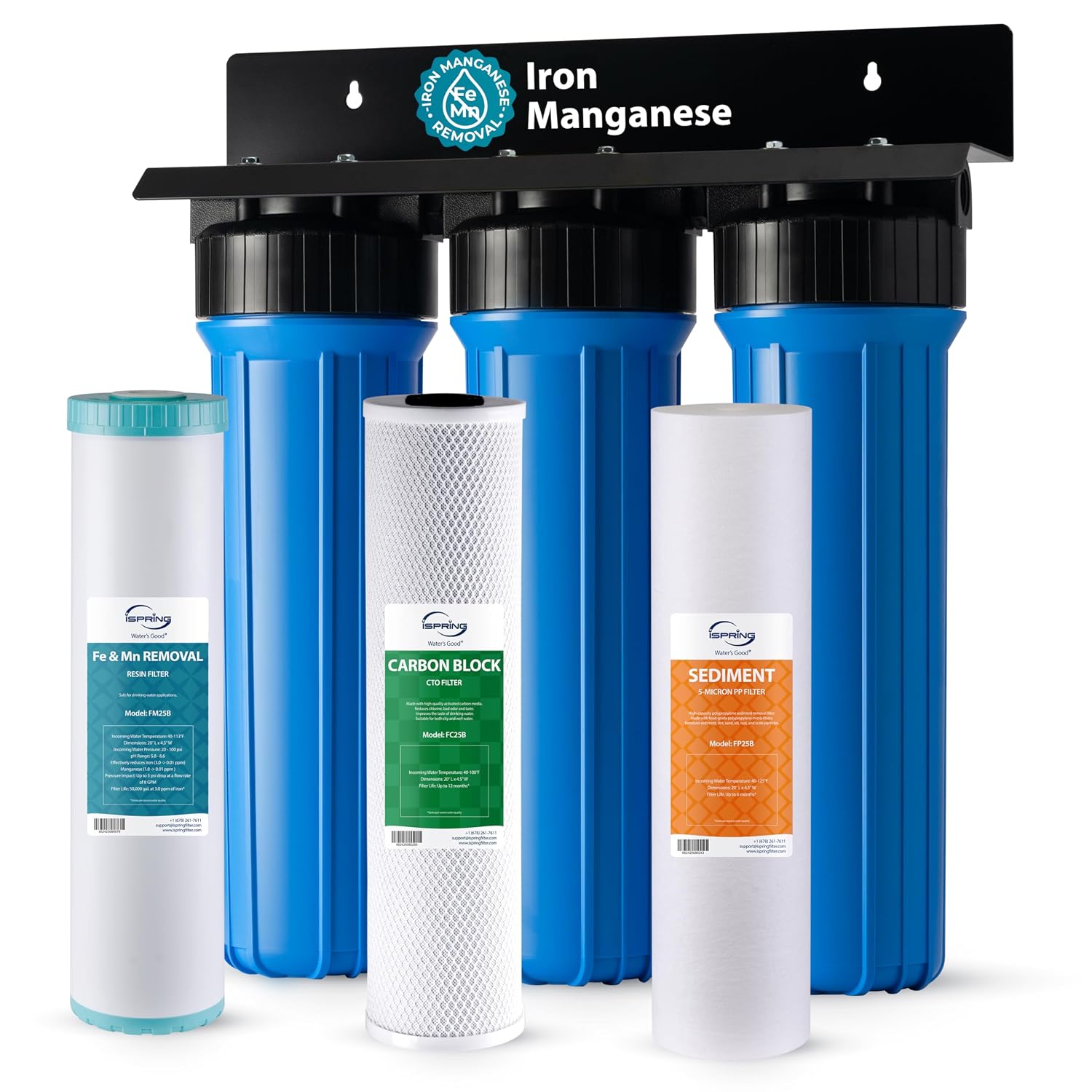
iSpring WGB32BM Iron and Manganese Filter
$450 to $650 typical Amazon range
- Particle stage
- 5-micron FP25B polypropylene
- Published flow
- Up to 15 gallons per minute
- Metal limits
- Iron up to 3 ppm; manganese up to 1 ppm
- Installation
- Three 20 by 4.5-inch housings with 1-inch ports
Why it fits. The current WGB32BM record lists a 5-micron sediment cartridge, carbon block, and FM25B metal stage. The maker publishes a 50,000-gallon rating at 3 ppm iron, plus 25 to 80 psi and pH 6 to 11 operating limits.
Sale-stopping flaw. The model limit rules out stronger iron or manganese problems, and cartridge media may be a poor workload match for continuous heavy loading. It does not fix a damaged well, iron bacteria, hardness, or unsafe microbial results.
Service math. At 300 gallons daily, 50,000 gallons lasts about 167 days at the maker's 3 ppm iron condition. At half that daily use, the arithmetic reaches about 333 days. Pressure loss, color breakthrough, or a laboratory check can require earlier service.
The one-tap polishing pick
For residual particles at one treated-water faucet
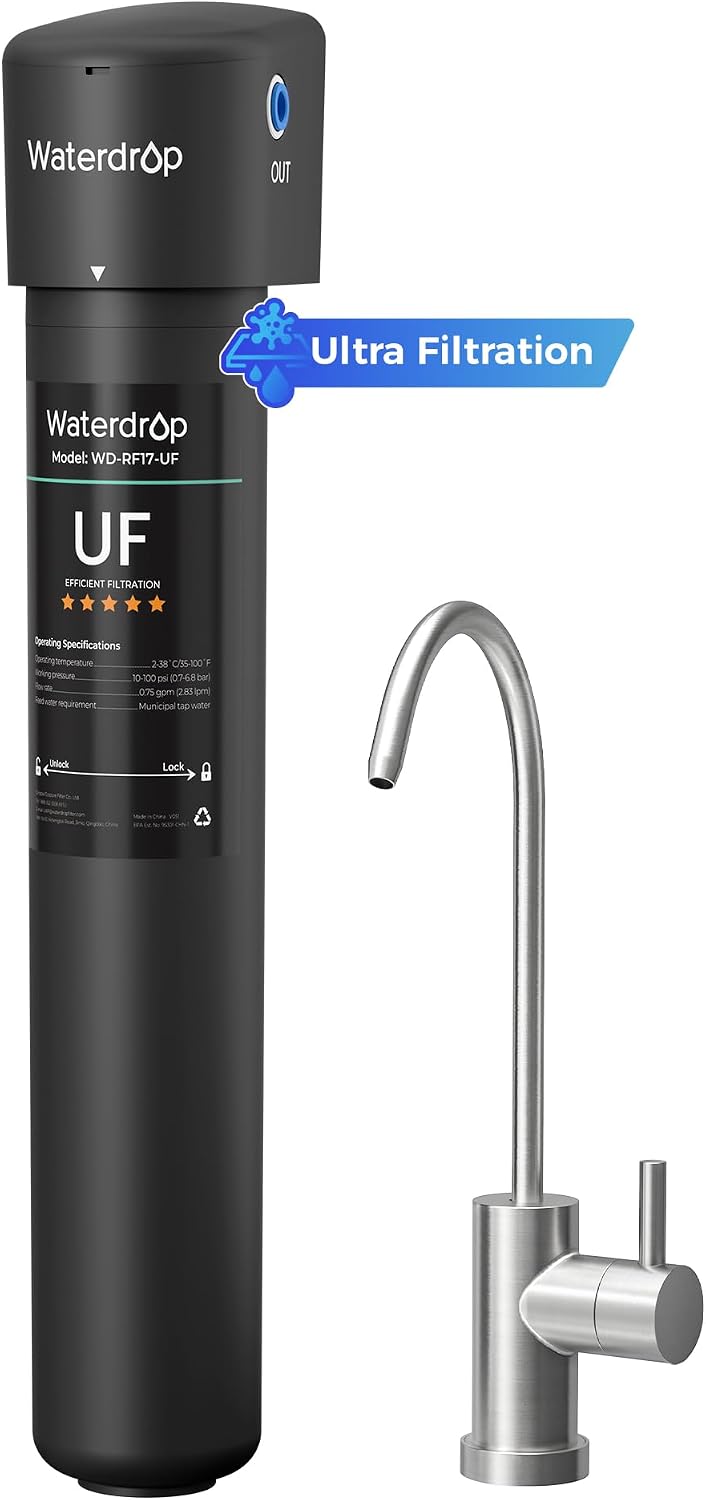
Waterdrop 17UB-UF Under-Sink Ultrafiltration System
$60 to $100 typical Amazon range
- Particle stage
- 0.01-micron maker-rated UF membrane
- Published flow
- 0.75 gallon per minute
- Rated service
- 24,000 gallons or three years
- Installation
- Cold-water feed and dedicated faucet
Why it fits. Waterdrop lists a 0.01-micron membrane and sediment reduction for the UB-UF family. The dedicated faucet avoids filtering toilet, laundry, and shower flow through a small point-of-use device.
Sale-stopping flaw. The maker says well use needs an existing whole-house prefilter. The 0.75 GPM rating cannot protect plumbing or appliances, and the pore-size statement is not a finished-system health-contaminant claim.
Service math. At 2 gallons daily, 24,000 gallons would take nearly 33 years, so the three-year calendar limit arrives first. That large mismatch shows why a capacity claim cannot predict service by itself. Fouling and the maker's time limit still matter.
What does not work for the underlying problem
The wrong product can make clear water without solving why particles reached the tap. These named limits matter more than extra stages.
AquaBliss SF100 belongs in a shower
A shower filter cannot protect the pressure tank, water heater, laundry valves, or the rest of the plumbing from incoming sediment. It is not a point-of-entry filter.
iSpring ED2000 does not remove particles
The clamp-on electronic conditioner has no screen, cartridge, or drain path for solids. It does not reduce sediment concentration or replace a filter housing.
WGB32B carbon stages do not disinfect
The base three-stage system can reduce particles and chlorine on suitable water. It does not inactivate bacteria. The bacteria guide explains boiling, source repair, and validated UV treatment.
A finer micron number is not automatically better
A 1-micron cartridge can be useful after pretreatment. As the first barrier on a sandy source, it may exchange a visible-particle problem for rapid clogging and pressure loss.
A pressure log is more useful than a calendar
Record inlet pressure, outlet pressure, and a repeatable flow when the media is new. Repeat the measurement after storms, well work, seasonal drawdown, and any visible-water change. A rising pressure difference shows that the filter is loading. A sudden sediment increase with little filter change points back toward the well or plumbing.
Pay a state-certified laboratory and a qualified well or water-treatment professional when turbidity persists, a health result is positive, or filters clog unusually fast. We earn nothing from laboratory analysis, well rehabilitation, casing repair, or a properly sized backwashing sediment system. Those can be the better purchase.
Questions readers ask before installation
What micron filter is best for well-water sediment?
Start with the largest pore size that captures the visible material without causing frequent pressure loss. A 50-micron flushable screen is a practical first stage for sand and coarse grit. Fine silt may need a 25- or 5-micron cartridge after that coarse stage. The right answer depends on particle size, sediment load, peak household flow, and what equipment follows the filter.
Does a sediment filter make well water safe to drink?
No. A sediment filter removes particles within its rated range. It does not prove removal or inactivation of bacteria, viruses, nitrate, arsenic, dissolved metals, pesticides, or other health contaminants. Test private-well water through a state-certified laboratory and add treatment for each confirmed problem.
Should a sediment filter go before or after a pressure tank?
Follow the well professional and equipment instructions for the exact installation. A whole-home filter normally needs stable pressure, isolation valves, a bypass, drainage for service, and enough clearance to remove the screen or housing. Do not place a restrictive fine cartridge where clogging could interfere with pump controls or leave the home without required flow.
Will a sediment filter remove orange iron stains?
It can capture ferric iron particles that are already oxidized, but clear dissolved ferrous iron passes through ordinary sediment media. A laboratory result and a sample observed before and after aeration help distinguish the forms. Dissolved iron often needs oxidation, catalytic media, ion exchange, or another professionally sized process.
How often should a whole-house sediment filter be changed?
Use pressure loss and visible loading as the operating signals, while staying within the maker's maximum service interval. Record clean inlet and outlet pressure at a known flow, then service the filter when the pressure difference or household flow becomes unacceptable. Heavy or seasonal sediment can shorten a nominal six- or twelve-month interval to weeks.
Match the filter to the measured problem
Use the finder after you know whether the source carries coarse grit, fine silt, dissolved metals, or a separate health contaminant.