Contaminant buying guide
The Best Water Filters for Mercury
Choose the $35 to $60 Brita Elite pitcher for most municipal-water households because its exact OB06 filter combines a 120-gallon rating with certified mercury reduction. Choose the $200 to $480 Aquasana SmartFlow AQ-SFRO2 when you want an installed kitchen system for drinking and cooking water. The $35 to $60 Culligan ZeroWater 10-Cup is the short-term, no-install option when near-zero TDS also matters, but its certified mercury capacity is only 15 gallons.
A filter purchase should follow a laboratory result or a public-water notice. EPA sets both the health goal and enforceable limit for inorganic mercury at 0.002 mg/L, or 2 parts per billion. A database estimate, metallic taste, or TDS reading cannot tell you whether your tap exceeds that limit.
The category warning is chemical form. Household filter claims address mercury in drinking water under specific test conditions. They do not fix the dominant methylmercury exposure route from food, and they do not establish safe handling after a thermometer, lamp, or other mercury-containing product breaks.
Who should skip a filter purchase
Skip a device when mercury has not been measured at the tap. Ask the utility for its water-quality report, or use a state-certified laboratory for a private well. The lab result provides the concentration needed to judge a filter and retest its output.
Skip these picks as a response to a spill. Do not vacuum, sweep, or pour elemental mercury down a drain. Follow state or local spill guidance because the main hazard can be invisible vapor, not drinking water.
Skip a filter-only plan when the public supplier issues a violation notice or a private well remains above the limit after treatment. Use the alternate water source and follow-up testing specified by the responsible health authority.
Five checks make the decision
Use a result reported as mercury in µg/L or ppb. A TDS meter cannot separate mercury from harmless dissolved minerals.
NSF's current product listings treat mercury reduction as a named NSF/ANSI 53 function. The brand, technology, and broad standard number are not substitutes for that claim.
A kitchen device should supply drinking water plus water used for coffee, ice, soup, infant formula, and other foods that absorb water.
The mercury claim ends with the tested cartridge life. Daily use can make a low-capacity pitcher far more expensive than its purchase band suggests.
A percentage is not a household result. Sample the installed outlet after the prescribed flush, then repeat on a schedule set with the laboratory or treatment professional.
What to check before choosing
Match the exact mercury claim to your water test. Compare the water conditions, installation and replacement schedule before choosing.
A Water Research study of activated carbon and organoclay found that mercury form, ionic strength, and natural organic matter changed removal behavior. The study did not test these household products. Its useful lesson is narrower: exact-model certification and a finished-water test deserve more weight than a generic carbon claim.
Three picks fit three service levels
The same decision fields apply to every pick. Price bands are Amazon planning ranges, not live quotes. Percentages come from different product records and should not be treated as a laboratory shootout.
| Option | Mercury evidence | Rated service | Installation | Sale-stopping limit |
|---|---|---|---|---|
| Brita Elite OB06 | Certified NSF/ANSI 53 claim; 95.5% at pH 6.5 and 95.9% at pH 8.5 | 120 gallons or about six months; no more than two gallons daily | No plumbing; manual pitcher filling | Does not make unsafe source water microbiologically safe |
| Aquasana SmartFlow AQ-SFRO2 | WQA-certified NSF/ANSI 53 claim; 97% at pH 6.5 and 95% at pH 8.5 | 250 gallons for carbon stages; six- and 12-month cartridge intervals | Tank, drain saddle, feed connection, dedicated faucet | Permanent plumbing work, cabinet space, and reject water |
| Culligan ZeroWater 10-Cup | IAPMO-certified NSF/ANSI 53 claim; maker reports 96% after 15 gallons | 15-gallon certified contaminant capacity | No plumbing; manual filling and TDS checks | Very short life when daily demand or source TDS is high |
Affiliate disclosure: We may earn from qualifying purchases through retailer links. The comparison method and evidence limits explain how the products were assessed. Where a product has more than one retailer, you can choose where to check the current offer.
The practical pick for most kitchens
For municipal water and one to four drinkers
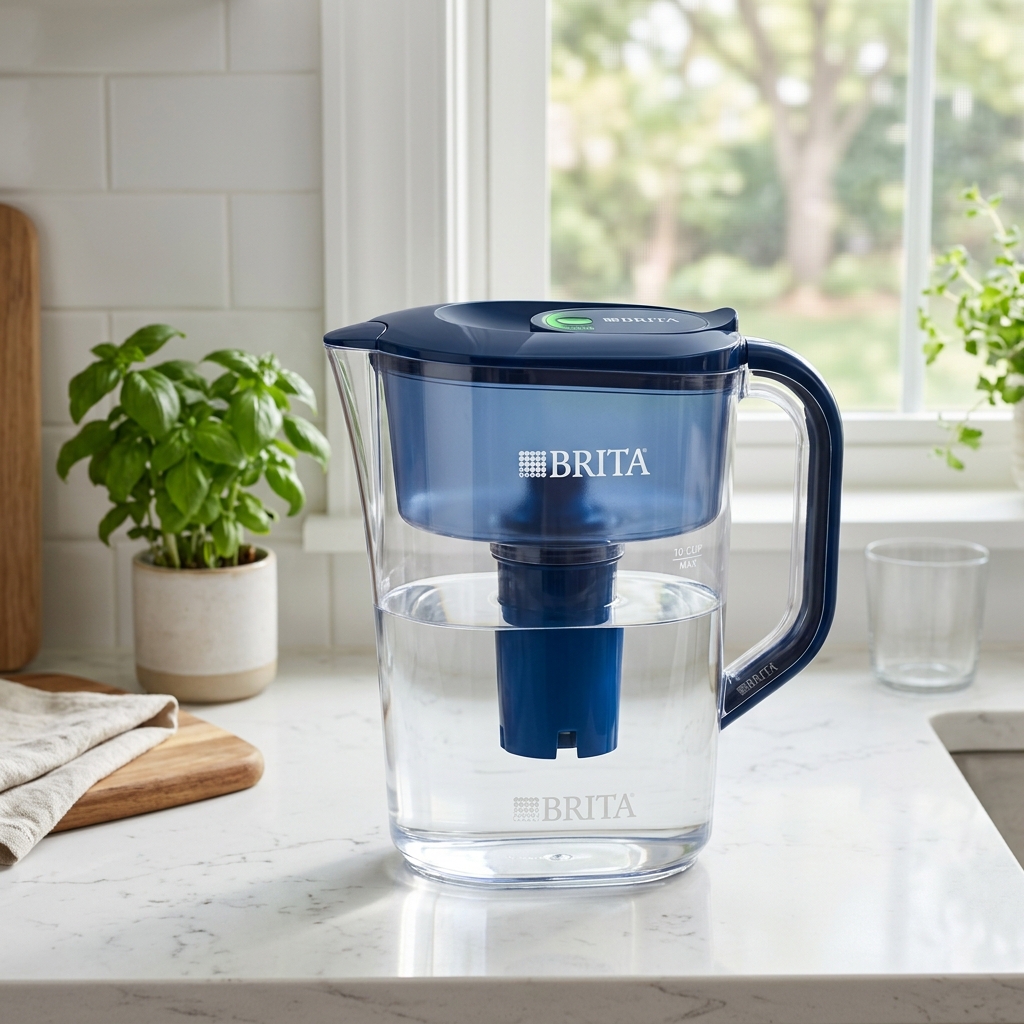
Brita 10-Cup Pitcher with Elite OB06
$35 to $60 typical Amazon range
- Mercury evidence
- Certified NSF/ANSI 53 claim
- Published result
- 95.5% at pH 6.5; 95.9% at pH 8.5
- Rated service
- 120 gallons or about six months
- Installation
- None; cold-water pitcher filling
Why it fits. The Brita performance sheet names model OB06 and reports mercury results at two pH conditions. Brita now sells that cartridge as Elite. The longer rated life reduces filter-change work compared with ZeroWater for the same daily volume.
Sale-stopping flaw. The two-gallon daily processing limit can be too low for a large household that filters all cooking water. It is not a purifier and should not be used on microbiologically unsafe water without adequate disinfection.
Service math. Two gallons a day reaches 120 gallons in 60 days, so capacity arrives well before the six-month calendar estimate. One gallon a day reaches capacity in about 120 days.
The pitcher comparison adds refill speed, cartridge workload, and other contaminant claims to the decision.
The installed pick for cooking volume
For homeowners who want a dedicated treated tap

Aquasana SmartFlow RO AQ-SFRO2-BN
$200 to $480 typical Amazon range
- Mercury evidence
- WQA-certified NSF/ANSI 53 claim
- Published result
- 97% at pH 6.5; 95% at pH 8.5
- Rated service
- 250 gallons; staged six- and 12-month service
- Installation
- Under-sink tank, drain, feed tee, faucet
Why it fits. The current SmartFlow sheet names AQ-SFRO2, a 250-gallon capacity, and passing mercury results at both test pH levels. The system also carries exact claims for several other dissolved contaminants, which can justify the plumbing work when the lab report names more than mercury.
Sale-stopping flaw. It needs a storage tank, drain saddle, feed connection, and dedicated faucet. The 27.4% efficiency rating in the performance sheet means reject water remains part of ownership, even though the system uses no electric pump.
Service math. Two gallons a day reaches 250 gallons in about 125 days, before the six-month carbon interval. One gallon a day reaches it in about 250 days, so the six-month calendar interval arrives first.
The reverse osmosis guide compares tanks, pressure, faucet flow, and reject-water demands across the format.
The short-term pick for near-zero TDS
For one person or a temporary bridge
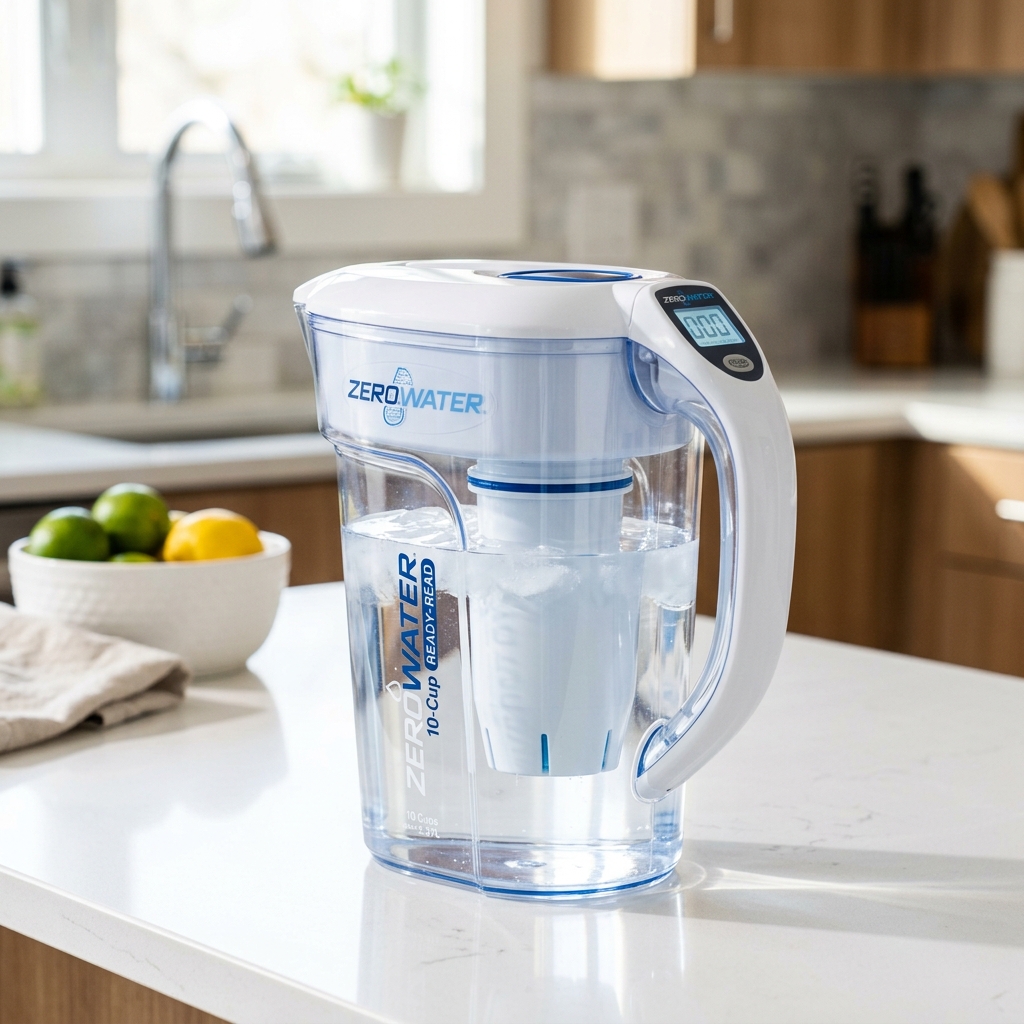
Culligan ZeroWater 10-Cup ZP-010
$35 to $60 typical Amazon range
- Mercury evidence
- IAPMO-certified NSF/ANSI 53 claim
- Published result
- Maker reports 96% after 15 gallons
- Rated service
- 15 gallons for certified claims
- Installation
- None; manual filling and meter checks
Why it fits. The maker reports 96% average mercury reduction after 15 gallons at pH 6.5 and 8.5 test conditions. Its certification FAQ identifies the compatible pitcher systems, NSF/ANSI 53, mercury, and the same 15-gallon capacity.
Sale-stopping flaw. Fifteen gallons is a small contaminant-claim capacity. The included meter helps identify overall ion-exchange exhaustion, but it cannot identify mercury or replace a finished-water laboratory result.
Service math. Two gallons a day reaches 15 gallons in 7.5 days. One gallon a day reaches it in 15 days. Source-water TDS can shorten practical life, so this is not the economical high-volume pick.
The number that decides the purchase
Multiply the source concentration by the fraction that remains after the published reduction. A 95% reduction leaves 5%. A 4 ppb source estimate becomes 0.20 ppb, while a 40 ppb source becomes 2 ppb. The second example only reaches the federal limit under that assumed performance.
| Source result | At 94% reduction | At 95% reduction | At 97% reduction |
|---|---|---|---|
| 2 ppb | 0.12 ppb | 0.10 ppb | 0.06 ppb |
| 4 ppb | 0.24 ppb | 0.20 ppb | 0.12 ppb |
| 40 ppb | 2.4 ppb | 2.0 ppb | 1.2 ppb |
These values are arithmetic, not promised output. A result well above 2 ppb deserves professional treatment design and follow-up sampling rather than faith in a catalog percentage.
Tap water and fish require different actions
EPA identifies fish and shellfish with elevated methylmercury as the main route of mercury exposure for most people. A kitchen filter cannot remove mercury already accumulated in food. The right response is current federal, state, or tribal fish-consumption guidance.
A confirmed tap result is still actionable. Treat all water swallowed or absorbed into food at the kitchen tap. Bathing usually contributes much less ingestion than drinking and cooking, so a point-of-use device can be the proportionate first step unless a health authority recommends broader control.
Private-well users can pair the treatment plan with the well-water guide's source testing, pretreatment, and post-installation verification steps.
What does not prove mercury reduction
An NSF/ANSI 42 badge. That standard covers aesthetic claims. Look for mercury beside the exact system under NSF/ANSI 53.
A reverse-osmosis label. Membranes can reject dissolved ions, but the named household system still needs an exact mercury record.
A plain carbon cartridge. Carbon formulation and water chemistry matter. The research record does not support transferring one product's claim to another carbon block.
A zero TDS reading. Conductivity cannot identify one contaminant at parts-per-billion concentrations. Use it only as the product's service cue.
Boiling. Boiling does not create a certified mercury treatment step. Use the alternate water and treatment instructions supplied by the responsible authority.
The non-commissioned purchase comes first
Buy a state-certified laboratory test before hardware when the utility report does not answer the question. One source-water result and one treated-water result can prevent the wrong filter purchase and reveal whether the installed device reaches the target. We earn nothing from laboratory testing.
The weakest evidence on this page is the use of controlled certification results to plan household performance. Those tests do not reproduce every home's pH, organic matter, competing ions, flow pattern, or maintenance behavior. That is why the final recommendation is a filter plus a finished-water test, not a filter alone.
Mercury filter questions
What kind of water filter removes mercury?
Choose an exact system certified for mercury reduction under NSF/ANSI 53. Reverse osmosis can be part of that system, but an NSF/ANSI 58 badge or an RO membrane by itself does not prove a mercury claim. Match the model and replacement cartridge to a current performance sheet or certifier listing.
Does a Brita filter remove mercury?
Brita Elite model OB06 carries a certified mercury-reduction claim when used in the system combinations named in its performance sheet. Do not apply that claim to every Brita cartridge. The Elite sheet rates the filter for 120 gallons and no more than two gallons of processing per day.
Does reverse osmosis remove mercury?
The Aquasana SmartFlow AQ-SFRO2 is certified for mercury reduction under NSF/ANSI 53 and uses reverse osmosis as one stage. A generic RO system may lack that optional claim, so check the exact model record rather than relying on the technology name.
Can a TDS meter detect mercury?
No. A TDS meter estimates the combined concentration of dissolved ions from conductivity. It cannot identify mercury or show that treated water is below the federal 2 ppb limit. Use a laboratory test that names mercury.
Will a drinking-water filter reduce mercury from fish?
No. A tap-water filter treats water, not methylmercury already present in fish tissue. EPA says eating fish and shellfish with elevated methylmercury is the main mercury exposure route for most people. Follow current fish-consumption advice for that exposure.
Match the device to the measured water problem
The finder compares contaminant concerns with installation limits, household demand, rental constraints, water chemistry, and the rest of your water report.