Contaminant buying guide
The Best Water Filters for Pesticides
Choose the $110 to $180 Aquasana Claryum Direct AQ-MF-1 for broad certified pesticide coverage at a treated municipal tap. Choose the $35 to $60 Brita Elite when a compatible pitcher and its narrower atrazine, simazine, endrin, linuron, or metolachlor record match the problem. Choose the $400 to $550 AquaTru Classic when no-plumbing reverse osmosis and broader water treatment justify more counter space and daily tank work.
A pesticide result needs a chemical name, not a category label. EPA sets different public-water limits for alachlor, atrazine, carbofuran, 2,4-D, glyphosate, lindane, and simazine. The limits range from 0.0002 mg/L for lindane to 0.7 mg/L for glyphosate, and each compound can behave differently in treatment media.
The category warning is claim mismatch. A filter certified for one herbicide, or for an NSF standard that contains optional claims, does not establish removal of every pesticide. The three exact records in this guide do not list glyphosate. Treat a generic pesticide, carbon, or reverse osmosis promise as incomplete until the detected compound appears in the model's current performance sheet.
Who should skip a filter purchase
Skip hardware when no pesticide has been identified. A utility consumer confidence report can answer some public-water questions. A private-well owner needs a laboratory panel selected around local crops, application history, spills, storage areas, golf courses, or other plausible sources.
Skip self-directed treatment during a public-water violation or spill advisory. Follow the water supplier or health department instructions for drinking, ice, infant formula, cooking, and pets until the notice is lifted.
Skip these three products for an untreated or microbiologically unsafe source. Their performance records require adequately disinfected water. A private well can need source repair, disinfection, sediment control, or other treatment before an organic-chemical filter.
Five checks make the decision
Match atrazine to atrazine, not to a broad pesticide statement. Ask the laboratory which parent compounds and breakdown products its panel includes.
NSF explains that standards 53 and 401 contain specific contaminant claims that vary by product. A standard number alone is not a compound list.
Count drinking, ice, coffee, infant formula, soup, and foods that absorb water. A point-of-use device works only when every swallowed-water task uses that outlet.
Check disinfection, hardness, turbidity, temperature, pressure, and flow. An exact chemical claim does not override the product's inlet-water restrictions.
Test the treated outlet after installation and near the service limit when the source result presents a health concern. A certification record supports a claim under stated conditions, not the condition of a cartridge in a particular home.
What to check before choosing
Look for the specific pesticide named in your water report or test. Compare that exact claim, filter life, installation and replacement costs.
A 2024 Environmental Pollution study compared nine residential treatment processes against 13 pesticides added to tap water at environmental concentrations. Activated carbon and reverse osmosis achieved complete removal in that experiment, while four unspecified membrane filters performed poorly. The paper did not test these exact products, does not supply a household service life, and cannot replace compound-specific model evidence. The authors reported no competing interests, although one author also listed an affiliation with F.S. Farm Limited.
Three picks solve different installation problems
Aquasana and AquaTru publish broad NSF/ANSI 53 organic-chemical tables that include pesticide compounds through the standard's chloroform surrogate test. Brita publishes direct results for a smaller set and adds trace-level linuron and metolachlor claims under NSF/ANSI 401. Price bands are Amazon planning ranges, not live quotes.
| Option | Named pesticide evidence | Rated service | Installation | Sale-stopping limit |
|---|---|---|---|---|
| Aquasana AQ-MF-1 | Alachlor, atrazine, carbofuran, 2,4-D, DBCP, dinoseb, endrin, heptachlor, lindane, methoxychlor, simazine, and more through certified VOC surrogate testing; linuron and metolachlor under 401 | 784 gallons | Direct connection to the existing cold-water faucet | Municipal or adequately disinfected water only; no glyphosate result |
| Brita Elite OB06 | 99.3% atrazine, 98.4% simazine, 98.7% endrin; over 93% linuron and over 94% metolachlor | 120 gallons or about six months; no more than 2 gallons daily | Compatible pitcher; manual filling | The certified claim set applies only to listed pitcher models; no glyphosate result |
| AquaTru Classic | Broad certified organic-chemical table using surrogate testing, including alachlor, atrazine, carbofuran, 2,4-D, endrin, lindane, and simazine | 600-gallon prefilter and VOC filter; 1,200-gallon RO membrane | Countertop power and manual feed and reject-tank handling | Hardness above 10 gpg needs softening; no glyphosate result |
Affiliate disclosure: We may earn from qualifying purchases through retailer links. The comparison method and evidence limits explain how the products were assessed. Where a product has more than one retailer, you can choose where to check the current offer.
The best balance for an existing kitchen faucet
For treated tap water and broad named coverage
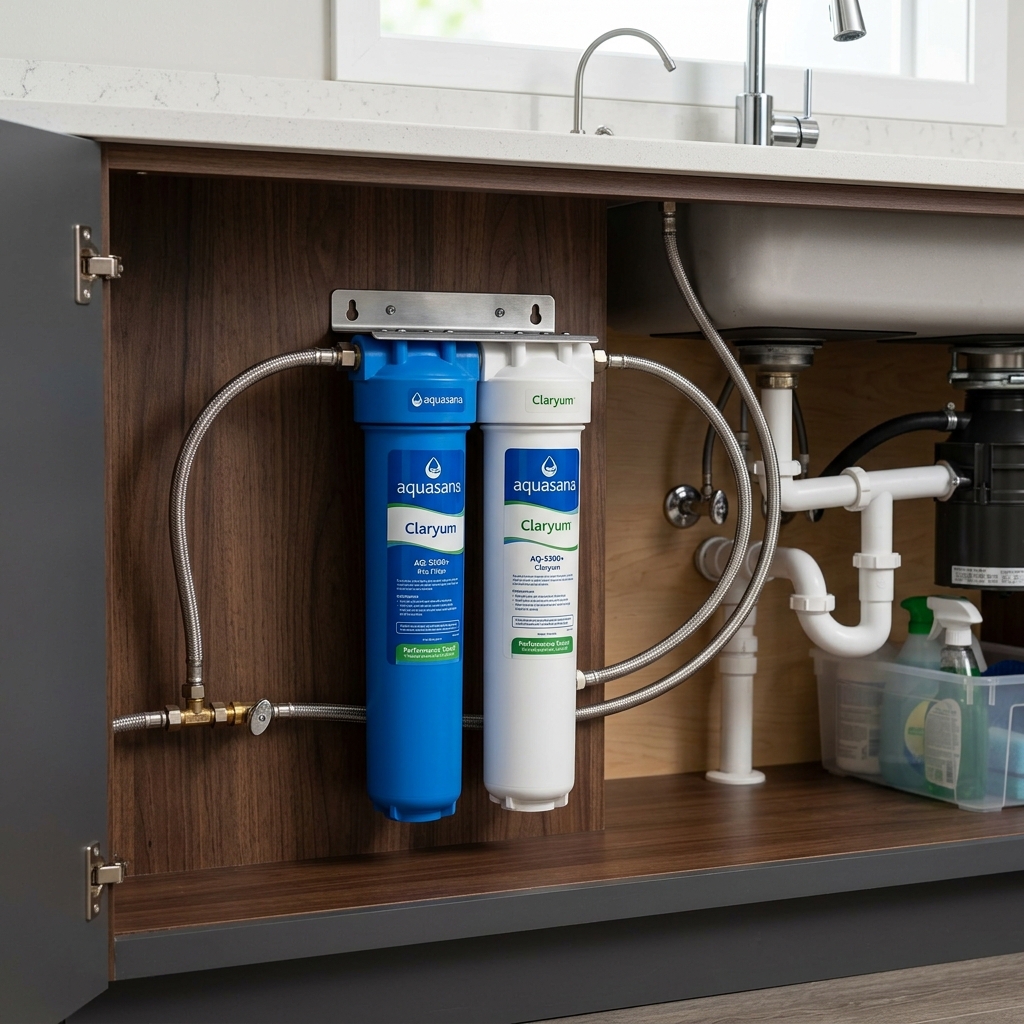
Aquasana Claryum Direct AQ-MF-1
$110 to $180 typical Amazon range
- Pesticide evidence
- Certified 53 surrogate and 401 claims
- Rated flow
- 1.5 gallons per minute
- Rated service
- 784 gallons
- Installation
- Cold-water line to existing faucet
Why it fits. The current AQ-MF-1 sheet reports a passing 99.4% VOC surrogate test and lists compound endpoints, including atrazine at 0.003 mg/L, simazine at 0.004 mg/L, lindane at 0.00001 mg/L, and 2,4-D at 0.0017 mg/L. It also reports 96.6% linuron and 98.6% metolachlor reduction under NSF/ANSI 401. The 1.5 GPM rating makes the device less restrictive than a gravity pitcher.
Sale-stopping flaw. The long organic-chemical table comes from the NSF VOC surrogate method using chloroform, not a separate full-life challenge with each listed pesticide. The system is not a microbiological purifier and publishes no glyphosate result. It also sends every cold-water task at that faucet through the cartridge, which can consume capacity faster than a dedicated drinking tap.
Service math. A household that filters 2 gallons daily reaches 784 gallons in about 392 days. Four gallons daily reaches it in about 196 days. The capacity limit can therefore arrive well before a calendar reminder in a home that uses the same faucet for cooking.
The under-sink comparison explains direct-connect flow, cabinet access, and cartridge workload.
The budget pick for two measured herbicides
For a compatible pitcher and modest daily volume
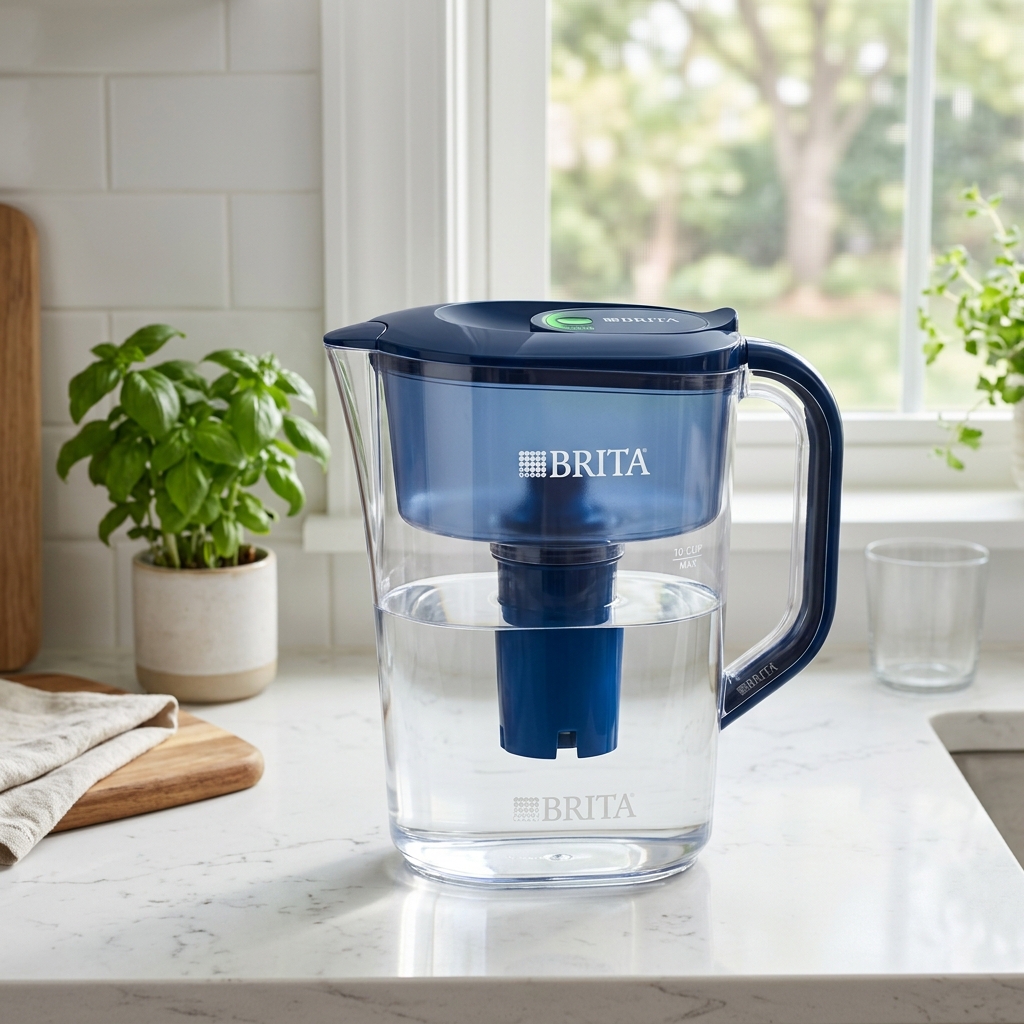
Brita 10-Cup Pitcher with Elite Filter
$35 to $60 typical Amazon range
- Pesticide evidence
- Direct 53 and 401 results
- Daily limit
- No more than 2 gallons
- Rated service
- 120 gallons or about six months
- Installation
- None; manual filling
Why it fits. The current OB06 performance sheet reports 99.3% atrazine and 98.4% simazine reduction. It also lists 98.7% endrin plus trace-level 401 results for linuron and metolachlor. The catalog's Everyday 10-cup configuration is model OB60, one of the systems covered by those claims.
Sale-stopping flaw. The pesticide list is much narrower than the Aquasana and AquaTru organic-chemical tables. Claim scope also depends on the pitcher model, not the OB06 cartridge in any improvised container. The filter is not intended to purify microbiologically unsafe or unknown water.
Service math. Two gallons daily reaches 120 gallons in 60 days, far sooner than six months. One gallon daily reaches it in 120 days. The maker's six-month wording describes an average family, but the gallon limit controls a high-use household.
The pitcher guide compares refill work and capacity across portable filters.
The no-plumbing reverse osmosis pick
For renters who need broader treatment at one counter
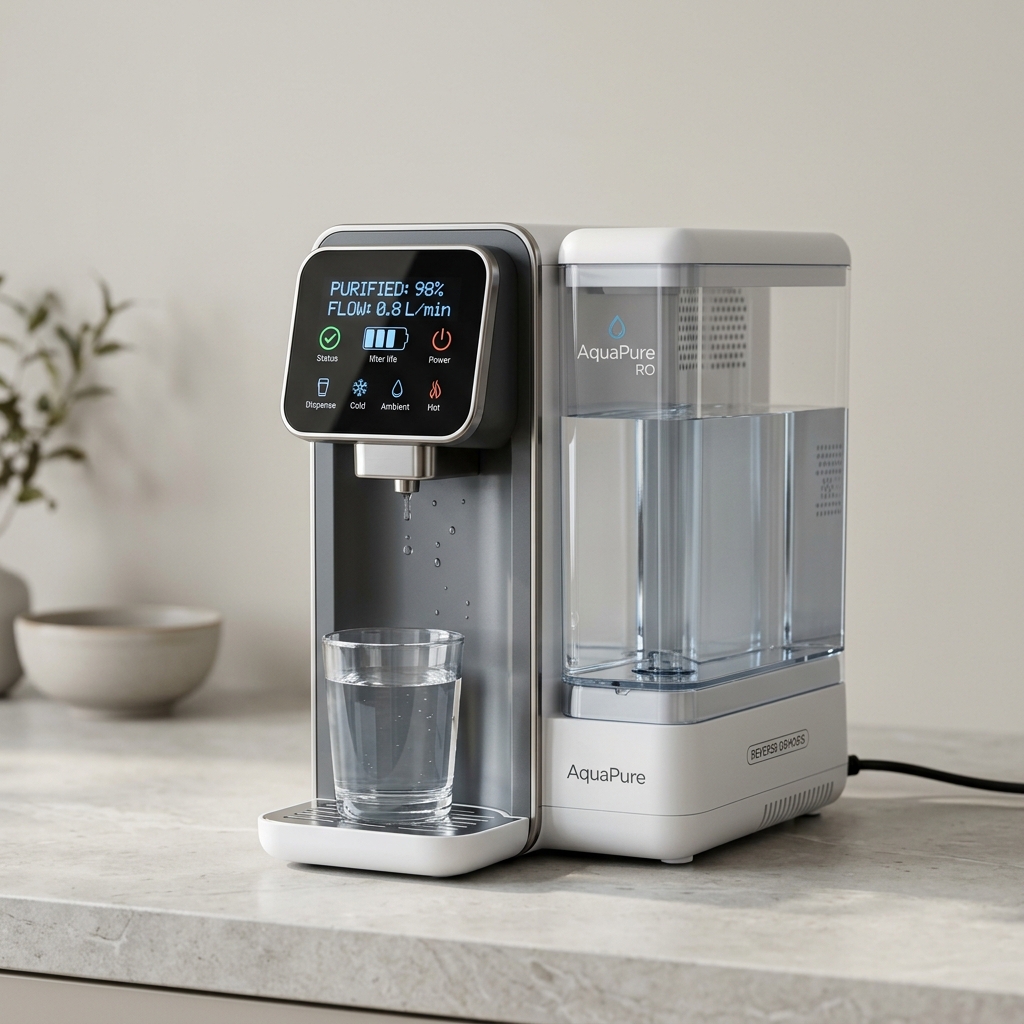
AquaTru Classic Alkaline Countertop RO
$400 to $550 typical Amazon range
- Pesticide evidence
- Certified 53 surrogate claims
- Rated output
- 54 gallons per day
- Rated service
- 600 and 1,200 gallon stages
- Installation
- Power only; manual tanks
Why it fits. The current Classic sheet lists certified pesticide-related endpoints and the exact AT2000 through AT2050 model family. It includes alachlor below 0.001 mg/L, atrazine at 0.003 mg/L, carbofuran at 0.001 mg/L, 2,4-D at 0.0017 mg/L, lindane at 0.00001 mg/L, and simazine at 0.004 mg/L under the certified surrogate method.
Sale-stopping flaw. Counter space, power, feed-tank filling, and reject-water disposal are daily costs that a percentage table cannot show. Hardness above 10 grains per gallon requires upstream softening, and iron, manganese, turbidity, chlorine, pH, and TDS each have stated inlet limits. The sheet does not list glyphosate.
Service math. Two treated gallons daily reaches the 600-gallon prefilter and VOC-filter rating in about 300 days. Four gallons daily reaches it in about 150 days. The 1,200-gallon membrane can still outlast those two stages, so replacement work is staggered.
The countertop guide quantifies tank handling, reject water, cleaning, and counter-space tradeoffs.
The chemical name changes the shortlist
The table below compares only claims printed in the current exact-model records. A blank is not proof that a product fails. It means the record does not support a recommendation for that compound.
| Compound | EPA public-water limit | Brita Elite | Aquasana AQ-MF-1 | AquaTru Classic |
|---|---|---|---|---|
| Atrazine | 0.003 mg/L | 99.3% direct result | 0.003 mg/L endpoint by surrogate method | 0.003 mg/L endpoint by surrogate method |
| Simazine | 0.004 mg/L | 98.4% direct result | 0.004 mg/L endpoint by surrogate method | 0.004 mg/L endpoint by surrogate method |
| 2,4-D | 0.07 mg/L | No listed claim | 0.0017 mg/L endpoint by surrogate method | 0.0017 mg/L endpoint by surrogate method |
| Lindane | 0.0002 mg/L | No listed claim | 0.00001 mg/L endpoint by surrogate method | 0.00001 mg/L endpoint by surrogate method |
| Glyphosate | 0.7 mg/L | No listed claim | No listed claim | No listed claim |
The useful result is not that one product wins every row. Brita can be the cheapest defensible answer for atrazine or simazine in treated water. Aquasana covers more named organic chemicals without the water and counter demands of RO. AquaTru earns its cost when the household also needs its other exact claims and cannot alter plumbing.
Popular options that lack the needed proof
Waterdrop G3P800. Its current marketing describes broad contaminant reduction, but the catalog record does not carry an exact pesticide performance table comparable to the three picks. The Waterdrop G3P800 review documents its certified scope, pressure needs, and installation limits. A reverse osmosis label cannot supply a missing glyphosate or atrazine claim.
Clearly Filtered P-V3. The maker publishes wide pesticide results from an independent laboratory, but its product certification is limited to NSF/ANSI 42 and 372. The Clearly Filtered P-V3 review separates certified claims from manufacturer-published test data. Buyers who value broader test coverage may still consider it, but the three picks above provide clearer certified pesticide claim paths.
Sediment, ultrafiltration, and UV. A fine pore rating can capture particles and microbes while dissolved pesticide molecules pass. UV dose targets microorganisms, not a general organic-chemical mixture. Those technologies can protect a carbon or RO stage, but they do not substitute for a named pesticide claim.
The source result matters more than the device list
EPA advises private-well owners near intensive agriculture to consider pesticide testing and to use a state-certified drinking-water laboratory. The lab should help select analytes that fit local land use. Older regulated pesticides, current-use compounds, and transformation products do not always appear in the same panel.
Public-water customers should start with the utility's consumer confidence report and any current notice. Private-well owners can also inspect the wellhead, drainage, chemical storage, and recent flood or spill history with the local health or environmental agency. We earn nothing from laboratory analysis, utility consultation, source protection, or well repair.
The weakest evidence on this page is the jump from standardized model records to a mixed pesticide profile in one home. The surrogate method is useful certification evidence, but it does not recreate every compound, degradate, natural organic matter level, flow pattern, or exhausted cartridge. A named source result, a matching model claim, and finished-water confirmation close that gap.
Pesticide filter questions
What type of water filter removes pesticides?
Activated carbon and reverse osmosis can reduce some pesticides, but the word pesticides covers many chemicals with different behavior. Choose an exact model whose current performance sheet names the compound found in your water, and verify treated water when a laboratory result or public notice identifies a health concern.
Does a Brita filter remove pesticides?
The Brita Elite OB06 performance sheet reports certified reduction of atrazine, simazine, endrin, linuron, and metolachlor in specified compatible pitcher models. That evidence does not establish removal of every pesticide, and it does not include glyphosate.
Does reverse osmosis remove glyphosate?
Do not assume that a general reverse osmosis claim proves glyphosate reduction. EPA regulates glyphosate at 0.7 mg/L, but the exact Brita Elite, Aquasana AQ-MF-1, and AquaTru Classic performance records compared here do not list a glyphosate result. Ask the treatment supplier for a model-specific claim that matches the detected chemical.
Can a TDS meter detect pesticides?
No. A TDS meter estimates the combined concentration of dissolved ions from conductivity. It cannot identify atrazine, simazine, glyphosate, or another pesticide at the low concentrations used for drinking-water decisions.
Should private well water be tested for pesticides?
EPA recommends pesticide testing when a private well is near intensive agriculture or another plausible source. Use a state-certified drinking-water laboratory and ask which pesticide panel fits local land use, because one broad screen may not include every current-use compound or degradate.
Match the device to the measured water problem
The finder compares contaminant concerns with installation limits, household demand, rental constraints, water chemistry, and the rest of your water report.