Contaminants guide
The Best Water Filters for Arsenic
AquaTru Classic is the best-documented catalog choice for confirmed pentavalent arsenic. Waterdrop G3P800 needs arsenic-form clarification, while APEC ROES-50 needs stronger model-level proof and paired water tests.
The market trap is treating every reverse-osmosis system or carbon filter as an arsenic filter. NSF/ANSI 58 requires TDS reduction, but arsenic reduction is optional. A product also can perform well on As(V) while leaving much more As(III) behind.
Who should stop shopping for now
Use a safe alternate source for drinking, cooking, ice, and infant formula when a result exceeds 10 micrograms per liter until a finished-water laboratory test confirms treatment. Call the local health department and a qualified water-treatment professional. A product purchase does not identify the arsenic form or account for iron, manganese, pH, silica, phosphate, and other conditions that can shorten media life or weaken removal.
Four checks decide the shortlist
Arsenic has no useful taste, color, or odor warning. Make these checks before comparing price or flow.
Start with a certified laboratory
Confirm total arsenic in micrograms per liter and ask whether the treatment designer needs As(III) and As(V) speciation.
Match the exact claim
Require the system model, replacement element, arsenic form, challenge concentration, and finished-water endpoint to line up.
Check the full water chemistry
Iron, manganese, pH, hardness, silica, phosphate, and competing ions can change pretreatment and media life.
Prove the treated tap
A TDS display cannot identify arsenic. Use a certified laboratory after installation and during service.
What matters when choosing arsenic filters
Start with a lab test that identifies the arsenic level and form. Then compare the exact filter claim, water limits, installation and replacement schedule.
Zheng and colleagues studied 250 private-well households in Maine and New Jersey in Science of the Total Environment. Their field data found treatment failure rates of 19% in Maine and 16% in New Jersey. Higher untreated arsenic and a larger As(III) share increased failure, while vendor-installed and maintained systems failed less often than homeowner-managed systems. The study does not rank these three consumer models.
The arsenic form can reverse the answer
| Laboratory result | What it tells you | Buying consequence |
|---|---|---|
| Total arsenic only | The combined amount, not the As(III) and As(V) split | Ask whether speciation or a treatment pilot is needed |
| Pentavalent arsenic, As(V) | Charged arsenate, the form named in many RO claims | Match an exact model claim and verify the treated tap |
| Trivalent arsenic, As(III) | Arsenite, which standard RO removes less reliably | Get professional pretreatment or adsorptive-media design |
EPA regional guidance reports typical RO removal of about 60% to 65% for As(III) and greater than 98% for As(V). That gap is large enough to make an untyped result a treatment-design problem, not a shopping shortcut.
Three catalog systems with unequal proof
Affiliate disclosure: We may earn from qualifying purchases through retailer links. The comparison method and its limits explain why these options do not receive equal confidence. Price ranges allow for normal Amazon offer changes.
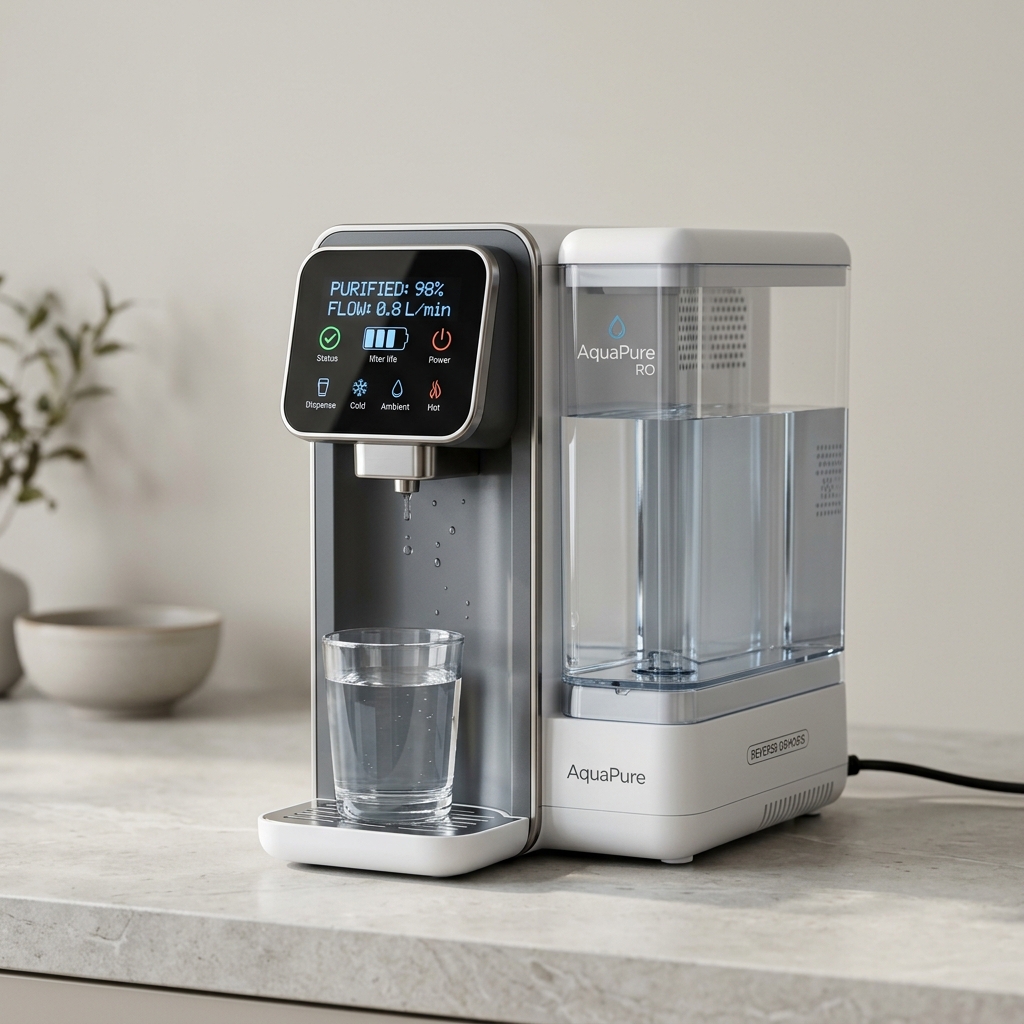
For a documented pentavalent arsenic claim
AquaTru Classic Alkaline Countertop RO
$400 to $550 price range
AquaTru Classic is the strongest catalog choice when a laboratory has confirmed arsenate, also called As(V). Its performance sheet reports 95.8% minimum and 98.0% average reduction from a 50 microgram-per-liter pentavalent arsenic challenge.
- Treatment
- Countertop reverse osmosis with no feed or drain plumbing
- Arsenic evidence
- IAPMO-certified NSF/ANSI 58 pentavalent arsenic claim
- Service basis
- Pre/carbon at 6 months or 600 gallons; VOC at 12 months or 600 gallons; RO at 24 months or 1,200 gallons
- Setup
- 120-volt outlet, manual tank filling, and concentrate disposal
Finished-water rule. Use the 95.8% minimum only as screening math. A 25 microgram-per-liter As(V) source would estimate to 1.05 micrograms per liter after treatment. A paired laboratory sample must confirm the real result.
Sale-stopping flaw. It is not designed to convert arsenite, also called As(III), to arsenate. AquaTru also advises against feed water above 10 grains per gallon, about 171 mg/L hardness, unless it is softened first.
The evidence level and limits come from the AquaTru Classic Alkaline Countertop RO technical record.
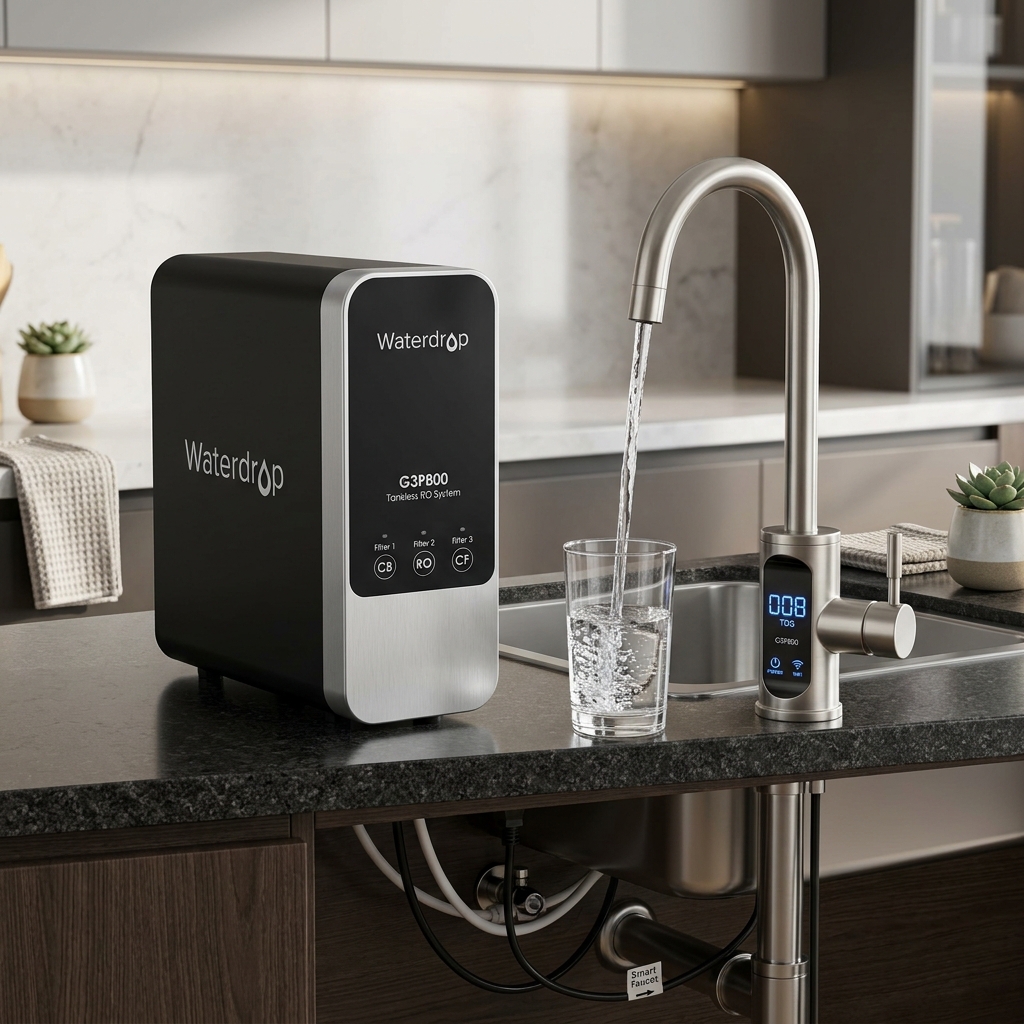
For faster draws with a speciation plan
Waterdrop G3P800 Tankless Reverse Osmosis
$600 to $750 price range
Choose the G3P800 when repeated fast draws matter and you can verify both the source chemistry and finished water. Its sheet reports less than 5 micrograms per liter in product water after an arsenic challenge of 115.1 micrograms per liter.
- Treatment
- Powered tankless reverse osmosis with a smart faucet
- Arsenic evidence
- Model sheet reports more than 99% arsenic reduction from 115.1 micrograms per liter
- Service basis
- CF at 6 months or 550 gallons; CB at 12 months or 1,100 gallons; RO at 24 months or 2,900 gallons
- Setup
- Cold-water feed, drain saddle, dedicated faucet, and power outlet
Finished-water rule. The table labels the challenge only as arsenic. It does not state the As(III) and As(V) split, so the reported percentage cannot answer an arsenite-heavy well result.
Sale-stopping flaw. The smart faucet reports TDS and filter life, not arsenic. The form omission makes this a weaker arsenic record than AquaTru's explicit pentavalent claim.
The evidence level and limits come from the Waterdrop G3P800 Tankless Reverse Osmosis technical record.
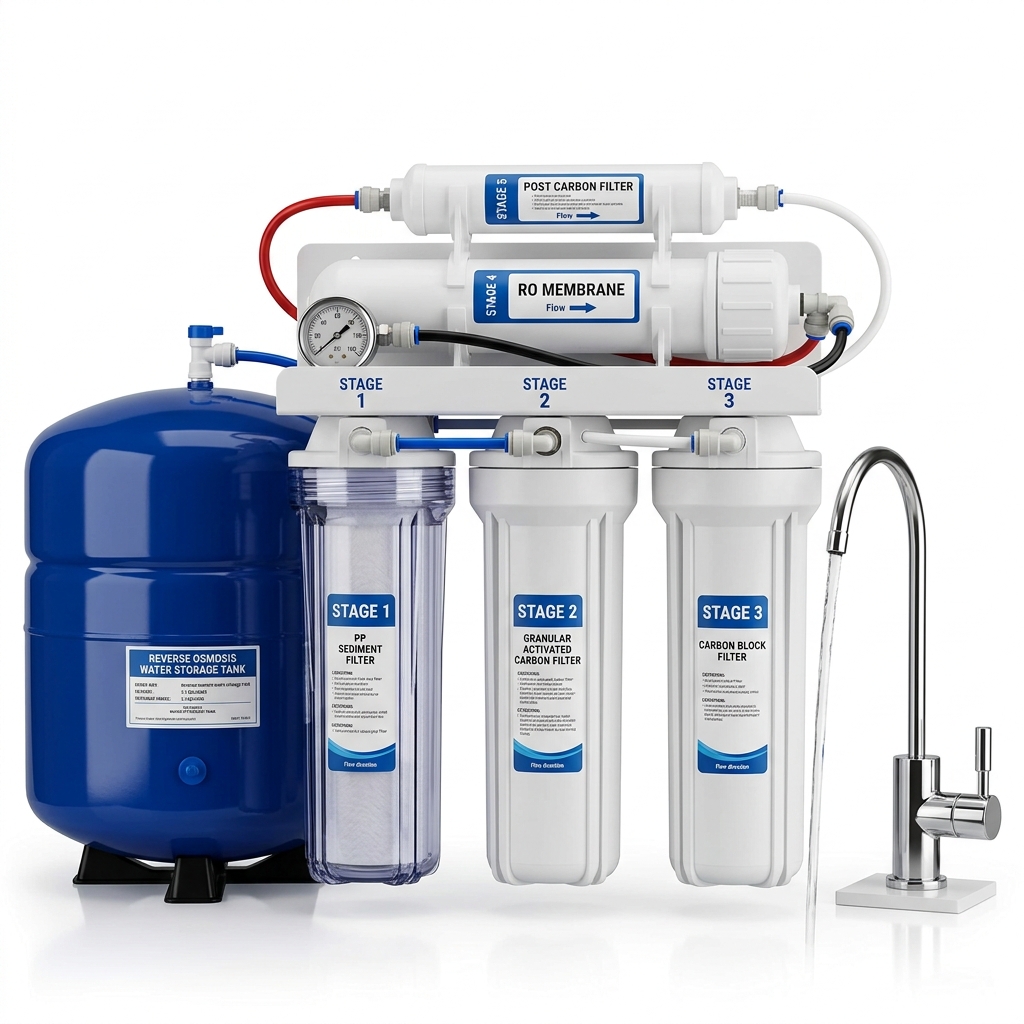
For a lower purchase band after professional review
APEC Essence ROES-50
$180 to $250 price range
The ROES-50 is a lower-cost conditional option when a water-treatment professional accepts the source chemistry and you will run paired laboratory tests. APEC rates it at 50 GPD at 60 psi and 30 GPD at 50 psi and 77 degrees F.
- Treatment
- Non-electric tank-style reverse osmosis
- Arsenic evidence
- Manufacturer names As(III) and As(V); certification copy names TDS reduction
- Service basis
- Prefilters at 6 to 12 months; membrane every 2 years on private wells; post-carbon with the membrane
- Setup
- Cold-water feed, drain saddle, storage tank, and dedicated faucet
Finished-water rule. APEC names both arsenic forms but does not publish a model-specific arsenic challenge concentration, finished concentration, or reduction percentage on the current product page.
Sale-stopping flaw. Its WQA certification statement identifies TDS reduction, not an arsenic claim. Do not substitute a broad contaminant list for an exact arsenic record.
The evidence level and limits come from the APEC Essence ROES-50 technical record.
Finished-water math needs a lab result
AquaTru publishes a 95.8% minimum reduction for pentavalent arsenic at a 50 microgram-per-liter challenge. Multiply a confirmed As(V) source result by 0.042 for a screening estimate, then test the actual treated water. Do not extend the claim to As(III) or source concentrations above the tested range.
| Confirmed source As(V) | Planning reduction | Arithmetic estimate |
|---|---|---|
| 10 micrograms per liter | 95.8% | 0.42 micrograms per liter |
| 25 micrograms per liter | 95.8% | 1.05 micrograms per liter |
| 50 micrograms per liter | 95.8% | 2.10 micrograms per liter |
These values are arithmetic, not household performance predictions. Pressure, temperature, membrane age, hardness, and the rest of the water chemistry can move the measured result.
Pick the next move by result
| Situation | Best next move | Reason |
|---|---|---|
| More than 10 micrograms per liter, form unknown | Alternate safe water and professional design | Exposure stops before the equipment decision |
| Confirmed As(V), no plumbing changes | AquaTru Classic plus lab verification | Explicit pentavalent claim and countertop setup |
| Confirmed treatment plan, fast repeated draws | Waterdrop G3P800 plus lab verification | High nominal output, but the sheet omits arsenic form |
| As(III) or mixed arsenic on a private well | Professional oxidation or iron-media design | Standard RO may leave too much As(III) |
| Several drinking taps need protection | Professionally sized point-of-entry system | Media selection and breakthrough monitoring depend on full chemistry |
What else can work
Activated alumina and iron-based adsorptive media can remove arsenic when the media, pH, arsenic form, and competing ions match. Anion exchange and coagulation-filtration can work in larger systems. Distillation can treat a limited drinking-water volume but uses energy and works slowly. EPA identifies point-of-use reverse osmosis and activated alumina as small-system compliance technologies.
A whole-house system may make sense when multiple drinking taps matter or the source level and chemistry defeat a kitchen unit. The 250-household field study found fewer failures among professionally installed and maintained systems. That is the strongest non-affiliate recommendation here.
The water filter matchmaker connects source and installation limits to a treatment type. Compare the separate nitrate model-claim checks and fluoride finished-water calculations when the same laboratory report lists more than one contaminant.
What does not solve arsenic
Brita 10-Cup with Elite, Aquasana AQ-MF-1, and Waterdrop 17UB-UF are named non-picks for this job. Their catalog records support other contaminant claims, but none supplies the exact arsenic evidence required here. A lead reduction claim or PFAS reduction claim cannot be stretched to cover arsenic.
Boiling can concentrate arsenic as water leaves as vapor. UV disinfects microbes but does not remove dissolved arsenic. A standard softener is not an arsenic system. An alkaline cartridge does not oxidize As(III) merely because it raises pH. More stages and lower micron labels do not answer the chemistry question.
EPA sets the public-water arsenic limit at 10 parts per billion. Private wells are not federally regulated, and a county risk map cannot replace a sample from your well.
Limits that change the verdict
Cold water and low pressure reduce RO production. Hardness can scale a membrane. Iron and manganese can foul media or require pretreatment. Silica and phosphate can compete for adsorption sites. A spent or damaged treatment element can lose arsenic removal without changing taste or a faucet TDS display.
USGS says a laboratory test is the only way to know what is in an individual well. Sample source water before design, sample the treated tap before relying on it, and keep a written schedule for follow-up tests and replacements.
Arsenic filter questions
What water filter removes arsenic?
A model with an exact pentavalent arsenic reduction claim can treat confirmed As(V). Reverse osmosis, activated alumina, iron-based adsorptive media, anion exchange, and distillation may work under the right water chemistry. Test total arsenic and, for a private well, ask whether speciation is needed before selecting treatment.
Does reverse osmosis remove arsenic 3?
Standard household reverse osmosis is much less reliable for trivalent arsenic, also called As(III), than for pentavalent arsenic. A qualified treatment professional may specify pre-oxidation or iron-based media after reviewing arsenic speciation, iron, manganese, pH, silica, and competing ions.
Does a Brita filter remove arsenic?
Do not rely on an ordinary carbon pitcher for arsenic unless the exact model has a current arsenic reduction claim. Chlorine taste, lead, or PFAS claims do not prove arsenic removal.
Is 10 ppb arsenic safe?
EPA sets 10 parts per billion, equal to 10 micrograms per liter, as the enforceable limit for public water systems. The health goal is zero. Private wells are not federally regulated, so use the public standard as a comparison point and follow state or local health guidance.
Can a TDS meter show arsenic removal?
No. A TDS meter estimates the combined conductive dissolved load. It cannot identify arsenic, separate As(III) from As(V), or prove that finished water is below 10 micrograms per liter.
How often should treated water be tested for arsenic?
Test after installation before relying on the treated tap, then follow the schedule set by the certified laboratory, health department, or treatment professional. Source concentration, arsenic form, media exhaustion, membrane condition, and maintenance can change performance.