Contaminant buying guide
The Best Water Filters for Giardia and Cryptosporidium
Choose the $200 to $480 Aquasana SmartFlow AQ-SFRO2 for an installed kitchen system on disinfected water because its current sheet names live Cryptosporidium and Giardia and reports 99.997% cyst reduction. Choose the $400 to $550 AquaTru Classic Alkaline when you rent or cannot alter plumbing. Use neither as a substitute for boiling during an active advisory.
A cyst claim has a narrow job. CDC says a parasite filter should be certified to NSF/ANSI 53 or 58 for cyst reduction or removal, use an absolute pore size of 1 micron or smaller, or use a suitable membrane process. The words “NSF certified,” “reverse osmosis,” or “1 micron” without the exact claim and the word “absolute” leave room for the wrong product.
The dangerous shortcut is treating a cyst claim as full microbiological protection. Both picks below say they may be used on disinfected water that may contain filterable cysts. Both also warn against use on microbiologically unsafe or unknown water without adequate disinfection before or after the system.
Who should skip a filter purchase
Skip normal filter shopping during a boil-water advisory. Use bottled water or bring water to a rolling boil for the time specified by the health authority. The advisory may cover bacteria and viruses that a cyst claim does not address.
Skip these point-of-use systems for an untreated private well with a positive microbial result. Fix the contamination source and have a qualified treatment professional design disinfection, pretreatment, and post-treatment sampling. The well-water treatment guide separates source repair, whole-home disinfection, and drinking-water polishing.
People with weakened immune systems should ask a clinician and water-treatment specialist about added precautions. CDC also advises them not to change cartridges themselves because captured germs can be released during service.
Five checks make the decision
A routine risk decision, a positive well test, and a boil-water advisory require different responses. Follow the health authority during an incident.
Find “cyst reduction” or “cyst removal” beside the precise system and replacement elements. A generic standard number can cover unrelated claims.
Use treated water for drinking, ice, coffee, infant formula, toothbrushing, and foods that absorb water.
Cyst filtration is not proof against bacteria or viruses. Unknown water needs a broader microbial barrier and source correction.
Capacity, pressure, hardness, turbidity, flushing, and cartridge dates matter. A missed replacement can undo the reason you bought the system.
What to check before choosing
Compare the exact cyst-reduction claim and the water conditions the filter needs. Check flow, replacement limits and whether your water requires other treatment too.
Rose, Debra Huffman, and Angela Gennaccaro reported in FEMS Microbiology Reviews that watershed conditions, precipitation, infrastructure, and treatment reliability all affect waterborne Cryptosporidium risk. The paper did not test either household product. It supports the narrower conclusion that a device cannot replace source control and reliable treatment.
Two picks fit two homes
Both products publish exact cyst results, but neither is an emergency purifier for unknown water. Price bands are Amazon planning ranges, not live quotes. Their percentages come from separate certification records and do not form a head-to-head laboratory test.
| Option | Cyst evidence | Rated service | Installation | Sale-stopping limit |
|---|---|---|---|---|
| Aquasana SmartFlow AQ-SFRO2 | WQA-certified NSF/ANSI 53; 99.997% live Cryptosporidium and Giardia reduction | 250-gallon system capacity; staged six- and 12-month service | Feed tee, drain, tank, and dedicated faucet | Not for unsafe or unknown water without adequate disinfection |
| AquaTru Classic Alkaline | IAPMO-certified NSF/ANSI 58; 99.99% minimum and average cyst reduction | 600-gallon prefilter and VOC stages; 1,200-gallon RO membrane | Countertop power and manual tank handling | Not recommended above 10 gpg hardness without softening |
Affiliate disclosure: We may earn from qualifying purchases through retailer links. The comparison method and evidence limits explain how the products were assessed. Where a product has more than one retailer, you can choose where to check the current offer.
The installed pick for a dedicated kitchen tap
For homeowners on disinfected municipal water

Aquasana SmartFlow RO AQ-SFRO2-BN
$200 to $480 typical Amazon range
- Cyst evidence
- WQA-certified NSF/ANSI 53 claim
- Published result
- 99.997% live Crypto and Giardia reduction
- Rated service
- 250 gallons; six- and 12-month stages
- Operating limits
- Cold water; 40 to 80 psi
Why it fits. The current AQ-SFRO2 sheet reports 99.997% reduction of live Cryptosporidium and Giardia against a 99.95% requirement. It also names a 250-gallon capacity, 25.7-gallon daily production rating, and 40 to 80 psi operating range.
Sale-stopping flaw. The sheet limits cyst use to disinfected water that may contain filterable cysts. Installation also needs a feed connection, drain saddle, storage tank, and dedicated faucet. Those constraints rule it out for an untreated positive well and many rentals.
Service math. Two gallons of drinking and cooking water per day reaches 250 gallons in about 125 days, before six months. One gallon per day reaches the rating in about 250 days, so the six-month carbon and remineralizer schedule comes first.
The reverse osmosis comparison explains tanks, pressure, daily production, and reject-water demands.
The no-plumbing pick for renters
For disinfected tap water and available counter space
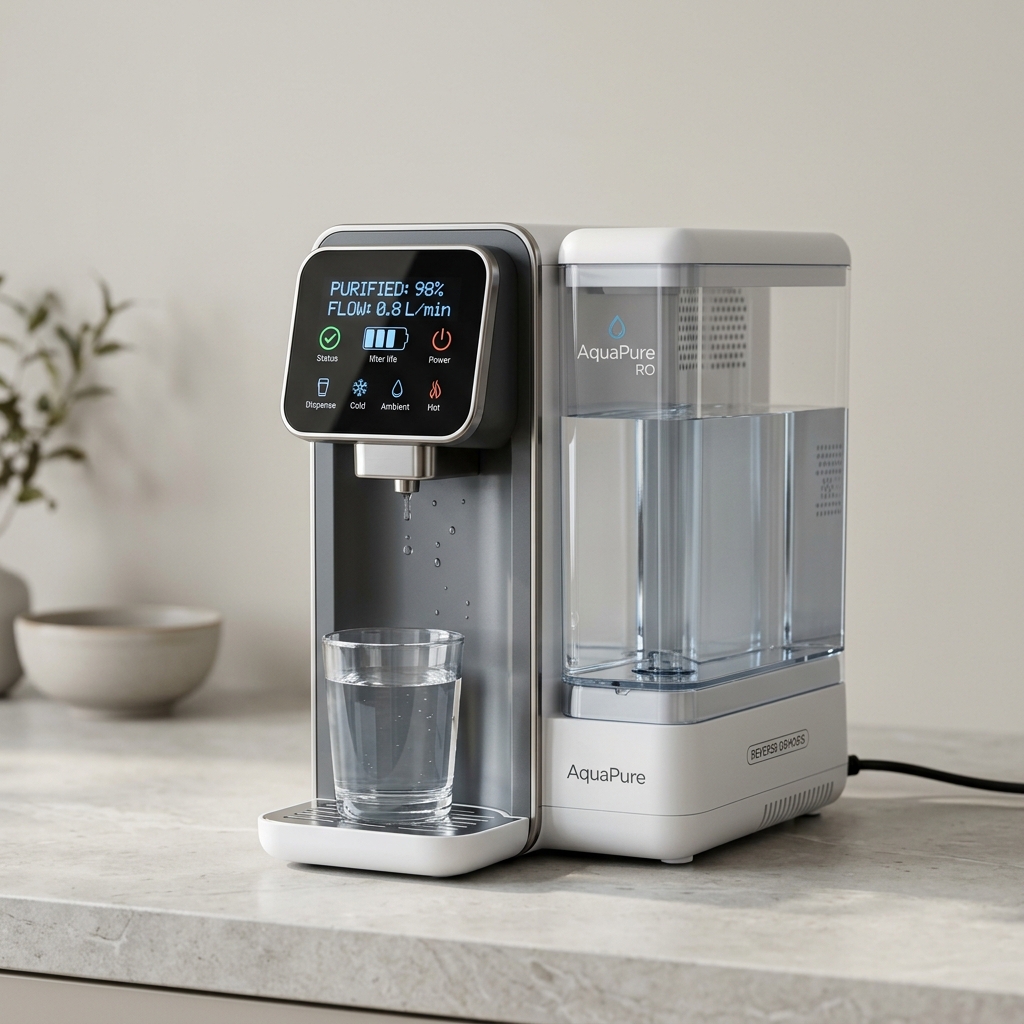
AquaTru Classic Alkaline Countertop RO
$400 to $550 typical Amazon range
- Cyst evidence
- IAPMO-certified NSF/ANSI 58 claim
- Published result
- 99.99% minimum and average cyst reduction
- Rated service
- 600-gallon carbon stages; 1,200-gallon membrane
- Operating limits
- Cold water; 5 NTU maximum turbidity
Why it fits. The AquaTru sheet lists the AT2000 through AT2050 family and reports 99.99% minimum and average cyst reduction. The unit needs power but no feed, drain, or faucet alteration. Its removable tanks make the format practical when a lease blocks plumbing changes.
Sale-stopping flaw. You must fill the source tank, discard concentrate, wash the tanks, and protect substantial counter space. The maker does not recommend use above 10 grains per gallon of hardness without softening, and the sheet still requires adequate disinfection for unsafe or unknown water.
Service math. Two gallons a day reaches 600 gallons in about 300 days. The six-month prefilter interval arrives first, while the 12-month mineral VOC stage reaches its calendar limit shortly after the same daily volume reaches 600 gallons.
Physical removal works only while the barrier holds
Giardia cysts and Cryptosporidium oocysts are filterable particles. A membrane or certified mechanical barrier retains them while treated water passes. The word “absolute” matters for pore ratings because it limits the largest opening. A nominal 1-micron filter describes an average and can include larger openings.
That physical advantage has a boundary. Smaller bacteria and viruses need tighter barriers or disinfection. Cracks, poor seals, exhausted stages, excessive pressure, or contaminated plumbing downstream can defeat a good cartridge. The bacteria guide shows why cyst reduction and microbial purification are different claims.
Public water already has a treatment barrier
EPA’s surface-water rules require 99.9% Giardia treatment and 99% Cryptosporidium removal, with added Crypto treatment for higher-risk sources. A household system is an added point-of-use barrier, not a replacement for the utility’s filtration, disinfection, monitoring, and distribution controls.
Review your utility’s annual report and notices before buying. A routine preference for added protection differs from a confirmed incident. The official notice controls during an incident.
What does not solve the problem
Brita Elite OB06. The exact performance sheet lists chemical, asbestos, and particulate claims but no cyst reduction. Do not transfer one NSF/ANSI 53 claim to every other optional claim in that standard. The full Brita Elite review and specifications show the jobs its OB06 cartridge is documented to do.
A carbon pitcher with no cyst claim. Taste, odor, lead, or chemical claims do not transfer to parasites. Most pitchers are not designed for germ removal.
A nominal 1-micron cartridge. Average pore size does not cap the largest opening. CDC calls for an absolute 1-micron rating when pore size is the basis for parasite removal.
An NSF/ANSI 42 badge. Standard 42 covers aesthetic claims such as chlorine taste and odor. It does not prove cyst reduction.
A filter during an active advisory. CDC says to boil tap water even when it has passed through a home filter or pitcher. Filtered water may still carry other disease-causing organisms.
The non-commissioned response comes first
Use properly boiled or bottled water during an advisory, and follow the issuing authority’s instructions for ice, food, toothbrushing, appliances, and post-advisory flushing. We earn nothing from that recommendation.
For a private well, pay first for a state-certified laboratory test and a sanitary inspection. A positive result calls for source repair, disinfection, and follow-up sampling. A kitchen RO system may become a final barrier after that work, but it should not carry the whole safety plan.
The weakest evidence on this page is the use of controlled certification results to plan household performance. Those tests cannot reproduce every home’s water quality, component condition, pressure, installation, and service habits. Product certification plus correct operation and source-water control is the safer decision frame.
Giardia and Cryptosporidium filter questions
What water filter removes Giardia and Cryptosporidium?
Look for the exact model to be certified under NSF/ANSI 53 or 58 for cyst reduction or removal. CDC also identifies filters with an absolute pore size of 1 micron or smaller, microfiltration, ultrafiltration, nanofiltration, and reverse osmosis as technologies that can remove parasites. A broad standard badge without a named cyst claim is not enough.
Can I use a home filter during a boil-water advisory?
Follow the advisory, even if your home has a filter. CDC says to use bottled or properly boiled water during a boil-water advisory and to boil tap water even when it has passed through a home filter or pitcher. A cyst-reduction claim does not prove removal of every bacterium or virus that may be involved.
Does reverse osmosis remove Giardia and Cryptosporidium?
Reverse osmosis can remove parasites, but the safest buying check is an exact product record that names cyst reduction. Aquasana SmartFlow AQ-SFRO2 and the listed AquaTru Classic models publish exact cyst results. Both manufacturers limit that use to disinfected water that may contain filterable cysts.
Does a Brita pitcher remove Giardia or Cryptosporidium?
Do not assume that it does. Most pitcher filters are designed for taste, odor, or selected chemical claims. Check the exact pitcher and cartridge combination for a current cyst-reduction listing. The Brita Elite catalog product on this site does not carry a cyst claim in its cited performance sheet.
Does a cyst filter also remove bacteria and viruses?
Not necessarily. Parasites are larger than bacteria, and bacteria are larger than viruses. A cyst-reduction claim addresses filterable protozoan cysts or oocysts. It does not by itself establish bacteria or virus removal, so unknown or microbiologically unsafe water needs a treatment plan designed for the full test result.
Match the device to the measured water problem
The finder compares contaminant concerns with installation limits, household demand, rental constraints, water chemistry, and the rest of your water report.