Head-to-head buying guide
SpringWell CF vs Aquasana Rhino
Choose the SpringWell CF, usually $1,100 to $2,200 before installation, for most city-water homes that need more than 7 GPM or want fewer cartridge changes. Choose the Aquasana Rhino EQ-1000, usually $1,000 to $1,400 before installation, when a published exact-model free-chlorine test matters more than higher stated service flow.
Neither system softens hard water, disinfects unsafe water, or proves every broad chemical claim on a sales page. A whole-house carbon filter also removes disinfectant before water crosses the home's plumbing, so poor maintenance can raise microbial-growth risk downstream.
SpringWell wins
Flow choices and lighter cartridge work
Aquasana wins
Exact EQ-1000 chlorine test record
No sale
Wrong source, wrong claim, or too little peak flow
Check six facts before either product
Start with the utility's current Consumer Confidence Report and disinfectant record. A chlorine result does not prove chloramine treatment, and a taste problem does not prove a health contaminant. The chlorine filter guide explains the exact-model claim check.
Water source
These two base systems are for treated municipal water. A private well needs a laboratory report and a separate treatment plan.
Measured problem
Confirm free chlorine, chloramine, sediment, or a named chemical. Buy only against an exact claim for that model.
Peak demand
Add the fixtures that can run together. Bathroom count is only a shortcut, not a flow measurement.
Installation limits
Check pipe size, pressure, protected floor space, bypass access, grounding, and room to open filter housings.
Upkeep
Decide whether a six-to-nine-month sediment cartridge or Aquasana's shorter prefilter schedule fits the household.
Desired outcome
Both target city-water taste and chemical concerns. Neither makes hard water soft or unsafe water microbiologically safe.
The short comparison
| Decision point | SpringWell CF | Aquasana Rhino EQ-1000 |
|---|---|---|
| Source | Treated city water | Municipally treated water |
| Published flow | 9, 12, or 20 GPM by size | 7 GPM rated, 14.6 GPM peak |
| Main capacity | 1,000,000 gallons or 10 years on the current product page | 1,000,000 gallons or 10 years |
| Strongest evidence | Manufacturer specifications and performance guarantee | Exact-model test to NSF/ANSI 42 for free chlorine |
| Cartridge schedule | Sediment prefilter every 6 to 9 months | Standard prefilter about every 2 months; Pro Kit post-filter about every 6 months |
| Utilities | No power or treatment drain | No power or treatment drain |
Flow labels are not interchangeable. SpringWell publishes service flow by size. Aquasana separates 7 GPM rated flow from 14.6 GPM peak flow. Size to sustained household demand and acceptable pressure loss, not the largest number on either page.
What matters when choosing
Compare these systems by the water concerns each one covers, the flow your home needs, installation and upkeep. Include replacement parts and service costs before deciding.
Do not skip upkeep. The CDC explains that removing chlorine throughout the home can allow more germs to grow in plumbing. Follow the filter’s cleaning and replacement instructions, and choose a system you can keep serviced.
Affiliate disclosure: We may earn from qualifying purchases. Price ranges are planning budgets, not live offers.
SpringWell fits higher flow and lighter upkeep
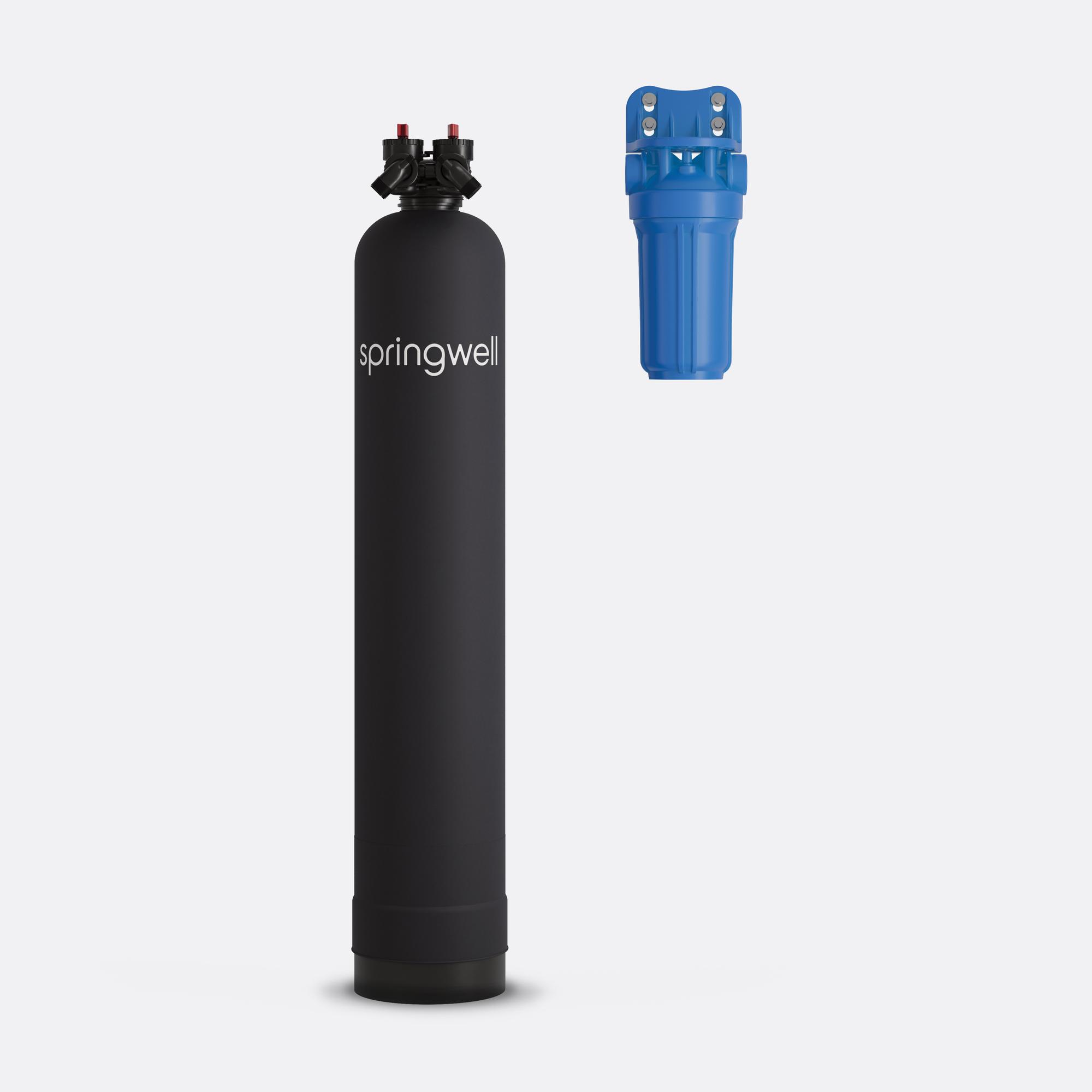
Best for variable household demand
SpringWell CF Whole House Water Filter
$1,100 to $2,200 planning range before installation
- Sizes
- CF1, CF4, and CF+
- Service flow
- 9, 12, and 20 GPM
- Pressure
- 25 to 80 psi
- Service
- Prefilter every 6 to 9 months
Why it fits. SpringWell publishes 9, 12, and 20 GPM service-flow sizes with a 1,000,000-gallon or 10-year main-media rating. The range gives a household more room to match simultaneous showers and appliances. Its catalytic carbon and KDF claims cover chlorine and chloramine, while one sediment cartridge carries the routine replacement work.
Evidence limit. The current SpringWell record is a manufacturer page and performance guarantee. It does not provide an exact finished-system certifier listing for chlorine, chloramine, PFAS, or VOC reduction. A broad sales-page list cannot replace a model-specific test endpoint.
Document conflict. The current product page lists CF4 at 12 GPM and the main media at 10 years or 1,000,000 gallons. The linked CF1 and CF4 manual lists CF4 at 11 GPM and the media at six years or 1,000,000 gallons. Get the applicable revision and warranty terms in writing before sizing or pricing a decade of ownership.
Sale-stopping flaw. Skip it when an exact third-party reduction claim is required, when pressure is outside 25 to 80 psi, or when the document conflict affects the size or ownership plan. A chloramine claim without an inlet concentration, rated flow, endpoint, and test duration leaves a large planning gap.
Installation. The manual calls for a 48-hour carbon soak, a main-line installation, support for a 9- to 13-inch tank, and a serviceable bypass. CF+ uses 1.5-inch connections. The 52- or 58-inch installed height also needs overhead room.
Aquasana fits buyers who want a chlorine test record

Best for documented free-chlorine performance
Aquasana Rhino EQ-1000
$1,000 to $1,400 typical Amazon range before installation
- Rated flow
- 7 GPM
- Test result
- Greater than 97.4% overall free-chlorine reduction
- Pressure drop
- 10.5 psi in the stated test
- Service
- Prefilter about every 2 months
Why it fits. The EQ-1000 performance sheet reports a 2.02 mg/L free-chlorine challenge, greater than 97.4 percent overall reduction, 7 GPM rated flow, and 10.5 psi pressure drop. The final 1,000,000-gallon sample reported 92.82 percent reduction. That full test curve is more useful than one headline percentage.
Certification boundary. Aquasana states that the Rhino is independently tested to NSF/ANSI 42 for free-chlorine reduction. Its WQA certification to NSF/ANSI/CAN 61 covers materials safety and structural integrity. That is not the same as certifying the 97 percent reduction claim.
Sale-stopping flaw. The 7 GPM rated flow and 10.5 psi test pressure drop can be too restrictive for a busy home. The standard Rhino does not publish a chloramine result. Choose the separate Rhino Chloramines model only after confirming chloramine and reading that exact performance sheet.
Installation. Aquasana calls for at least 50 inches of height and 30 inches of floor space, cold water from 40 to 90 degrees Fahrenheit, indoor protection from sun and freezing, and proper grounding across metallic plumbing. The standard 20-inch prefilter is listed for replacement about every two months.
Ten-year workload changes the value
SpringWell's six-to-nine-month prefilter schedule means about 14 to 20 planned changes over ten years. Aquasana's standard two-month prefilter schedule means about 60 changes. A Pro Kit post-filter at six months adds about 20 more. Sediment can shorten either schedule, so these are calendar estimates, not promises.
SpringWell sells the compatible CF1 and CF4 sediment filters in two- and four-packs. Plan about $30 to $60 per year at the stated schedule. Aquasana sells a six-month bundle with three prefilters and one post-filter, which supports a $140 to $220 yearly planning band. That puts ten years of equipment and routine cartridges near $1,400 to $2,800 for SpringWell and $2,400 to $3,600 for Aquasana, before labor, plumbing parts, tax, damage, or a main-tank replacement. The arithmetic is a planning tool, not a promised price.
A cheap installation can erase that difference after one leak. Ask for a written quote that names the bypass, unions, pressure gauge, grounding parts, drain plan for housing service, wall support, freeze protection, and labor warranty.
Chloramine changes the answer
CDC notes that utilities may switch between chlorine and chloramine. The standard Aquasana Rhino test covers free chlorine, not chloramine. Aquasana directs chloramine customers to its separate Rhino Chloramines system. SpringWell uses catalytic carbon and makes a chloramine claim for the CF series, but the current page does not publish a comparable exact-system test curve.
The chloramine guide explains why contact time and exact claim scope matter. A home served by chloramine should not buy the standard Rhino from a chlorine percentage alone. A buyer who needs a documented chloramine endpoint should also pause before the SpringWell CF until the maker supplies a current test report for the chosen size and flow.
Who should skip both
- Private-well homes. The well-water treatment guide starts with bacteria, iron, manganese, sulfur, nitrate, arsenic, hardness, and pH. A city-water carbon tank cannot replace that work.
- Homes with measured lead, PFAS, nitrate, or arsenic. Require an exact model claim for the target and a finished-water check. A broad carbon-media claim is not enough. The SpringWell PFAS system review documents the separate 7 GPM PFAS product and its evidence limits.
- Households that need soft water. Carbon does not remove calcium and magnesium. The hard-water guide compares true softening with scale conditioning.
- Renters and tight mechanical rooms. Both systems require main-line plumbing, a supported tank, housing service space, and a plan for water released during maintenance.
- Immunocompromised households without a plumbing-hygiene plan. Removing the disinfectant residual from every pipe raises a risk that needs professional advice and careful service.
Two near-misses deserve a look
iSpring WGB32B. Its replaceable cartridge housings cost less at purchase and make media changes obvious, but the base model has no exact chlorine performance curve comparable to the Rhino sheet. The iSpring WGB32B review covers the 15 GPM maker rating and cartridge burden.
A certified point-of-use filter. If the concern is a drinking-water contaminant rather than shower taste or odor, a certified under-sink or countertop unit can supply stronger exact claims at far lower flow and cost. That path does not treat baths, laundry, or every tap.
The no-commission step comes first
Read the utility report, ask which disinfectant is used now, and measure peak flow at the main before requesting quotes. A state-accredited laboratory is worth the cost when a health contaminant is suspected. PureWater Filter Finder earns nothing from the utility report, laboratory, plumber, pressure gauge, or finished-water test.
Request source and finished-water samples when the purchase depends on a reduction claim. Record free chlorine and total chlorine separately when chloramine may be present. Check pressure before and after the system at normal and peak demand. Those numbers settle the choice better than bathroom count or a single headline percentage.
Frequently asked questions
Is the SpringWell CF certified to reduce chlorine or chloramine?
SpringWell makes chlorine and chloramine reduction claims for the CF series, but no current finished-system certification supports those claims. Treat them as manufacturer claims and verify finished water if the result matters to your decision.
Is the Aquasana Rhino EQ-1000 NSF certified?
The exact Rhino tank is independently tested to NSF/ANSI 42 for free-chlorine reduction and WQA certified to NSF/ANSI/CAN 61 for materials safety and structural integrity. Aquasana does not describe the standard Rhino chlorine result as an exact-system NSF certification.
Which filter is better for chloramine?
The standard SpringWell CF uses catalytic carbon and carries a manufacturer chloramine claim. The standard Aquasana Rhino chlorine model does not publish a chloramine result. Aquasana sells a separate Rhino Chloramines model. Confirm the disinfectant in the utility report before choosing either path.
Will either system soften hard water?
No. Both leave calcium and magnesium hardness in the water. A household that wants lower hardness needs a true ion-exchange softener or another treatment selected for that measured problem.
Can either filter treat untreated well water?
Neither is a safe default for untreated well water. Test the well for bacteria, nitrate, arsenic, iron, manganese, hardness, pH, turbidity, and local risks, then size a treatment train from those results.
What result would stop the sale?
Stop if the water report names a contaminant without an exact claim, if peak demand exceeds the selected model flow, if pressure falls outside the manual limits, or if the installation lacks protected floor space, a bypass, and service access.