Contaminants guide
The Best Water Filters for Chlorine
Choose Brita Elite for the lowest-cost drinking-water fix, Aquasana AQ-MF-1 for normal kitchen-faucet service, or Aquasana Rhino EQ-1000 only when whole-home coverage justifies the plumbing work and loss of disinfectant residual.
The first warning is easy to miss. Chlorine is the disinfectant residual that protects public water as it moves through pipes. CDC says whole-home removal can allow more germs to grow in household plumbing, and most pitcher or carbon filters are not designed to remove germs.
A filter purchase should solve a named problem, usually taste and odor at one tap or a deliberate whole-home treatment goal. EPA sets a 4.0 mg/L maximum residual disinfectant level for chlorine. A chlorine smell does not by itself prove a safety violation, and an active advisory calls for agency instructions rather than ordinary carbon filtration.
Who should skip a chlorine filter
Skip the purchase when public water meets its standards and the taste is acceptable. Use a filter with germ-reduction evidence or medical guidance when an occupant has a weakened immune system. Private wells do not normally need chlorine removal unless continuous disinfection is already part of a professionally designed treatment train.
Four checks come before product names
Free chlorine is usually easy for activated carbon to reduce. The buying decision still depends on the disinfectant, coverage, evidence, and service burden.
Confirm free chlorine
Use the utility report or call the supplier. A chlorine claim cannot be carried across to chloramine, and some utilities switch disinfectants during the year.
Name the treatment boundary
A pitcher or under-sink system covers drinking and cooking. A point-of-entry system also changes shower, laundry, appliance, and premise-plumbing water.
Match the exact claim
Find the model and replacement element beside a free-chlorine result. A carbon label or general Standard 42 badge is not the same as a model-level claim.
Plan flow and service
Compare gallons, time limit, rated flow, pressure, cartridge work, and bypass needs. Whole-home systems require a peak-demand calculation.
How the chlorine filters were compared
Compare the exact chlorine claim, water flow and replacement schedule. Choose the setup that covers the taps you need without adding work or cost you do not want.
A 2026 Water Research study by Gemma Clark, Evan Coey, Alexandra Loya, and Thanh Nguyen modeled Legionella risk with new and aged activated-carbon point-of-use filters. The study found that filter condition, chlorine residual, organism concentration, aerosol exposure, and exposure time changed modeled risk. It did not test the products in this guide, but it supports strict replacement schedules and rejects the idea that dechlorination is automatically a microbial-safety upgrade. The authors declared no known competing financial interests or personal relationships.
A free option can solve a taste-only problem
EPA advises placing tap water in an uncovered pitcher in the refrigerator overnight when free-chlorine taste is objectionable. Use a clean food-safe pitcher, cover it after the overnight rest, and keep it refrigerated. This costs nothing and avoids a cartridge when drinking-water taste is the only goal.
The method is not a substitute for an advisory response, a contaminant-specific filter, or aquarium treatment. It is also a poor answer for chloramine, which is more persistent. Households served with chloramine should use the separate model-level chloramine filter comparison.
Three products for three treatment boundaries
Affiliate disclosure: We may earn from qualifying purchases through retailer links. The comparison method and its limits explain why an exact claim receives more weight than media descriptions. Price ranges allow for normal Amazon offer changes.
For low-cost chlorine taste reduction
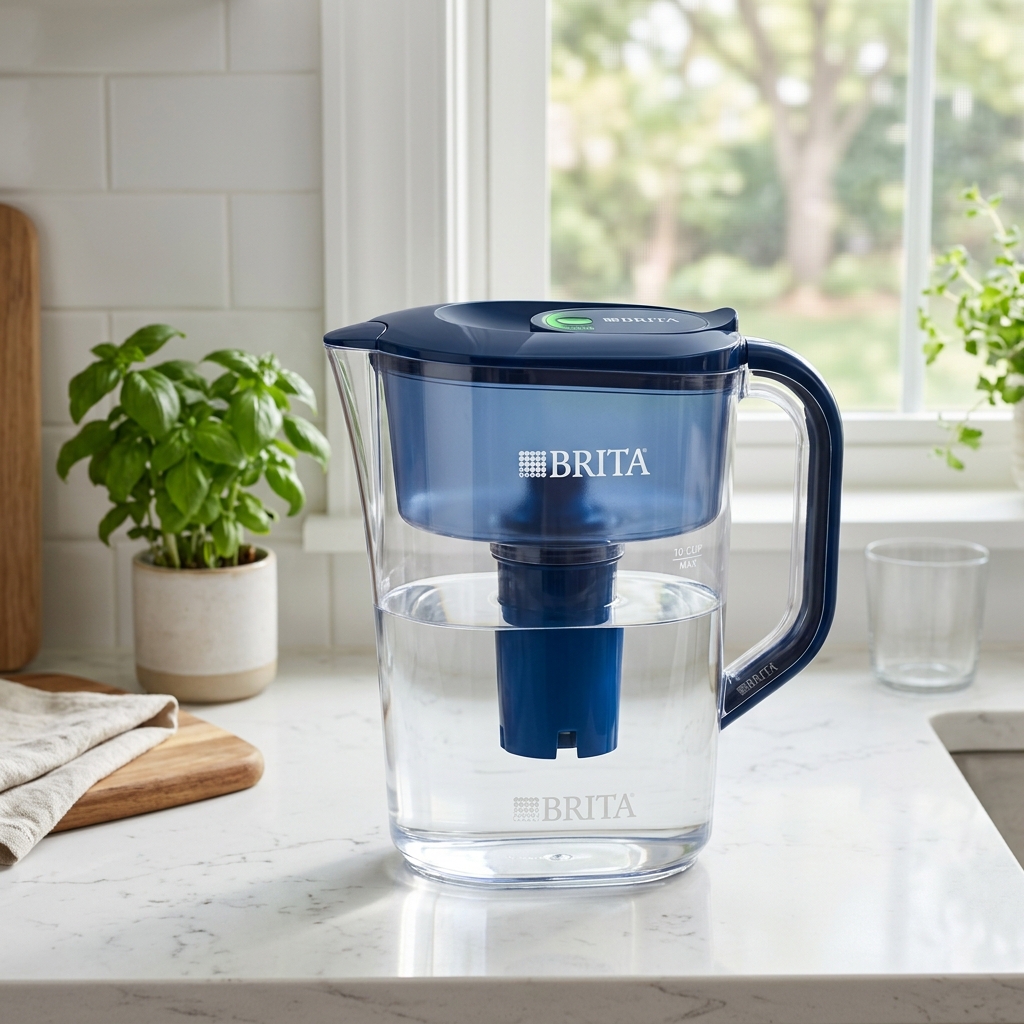
Brita 10-Cup Pitcher with Elite Filter
$35 to $60 price range
Brita Elite is the sensible first purchase when free-chlorine taste at the drinking glass is the whole problem. The exact Elite sheet reports a 2.0 ppm challenge and 97.4% reduction, while the pitcher avoids permanent plumbing work.
- Treatment
- Gravity-fed activated carbon and ion-exchange media
- Chlorine evidence
- 97.4% chlorine reduction from a 2.0 ppm challenge in the Elite performance sheet
- Service basis
- 120 gallons or about 6 months, whichever comes first
- Setup
- No plumbing; fill the upper reservoir and wait for gravity filtration
Capacity example. At 1 gallon per day, the 120-gallon rating equals about 4 months. At 2 gallons per day, it falls to about 2 months, so volume can control long before the 6-month calendar limit.
Sale-stopping flaw. The Elite sheet does not list chloramine reduction. A household that buys this without checking the utility disinfectant can end up treating the wrong compound.
The claim boundary comes from the Brita 10-Cup Pitcher with Elite Filter performance record.
For filtered water from the main kitchen faucet
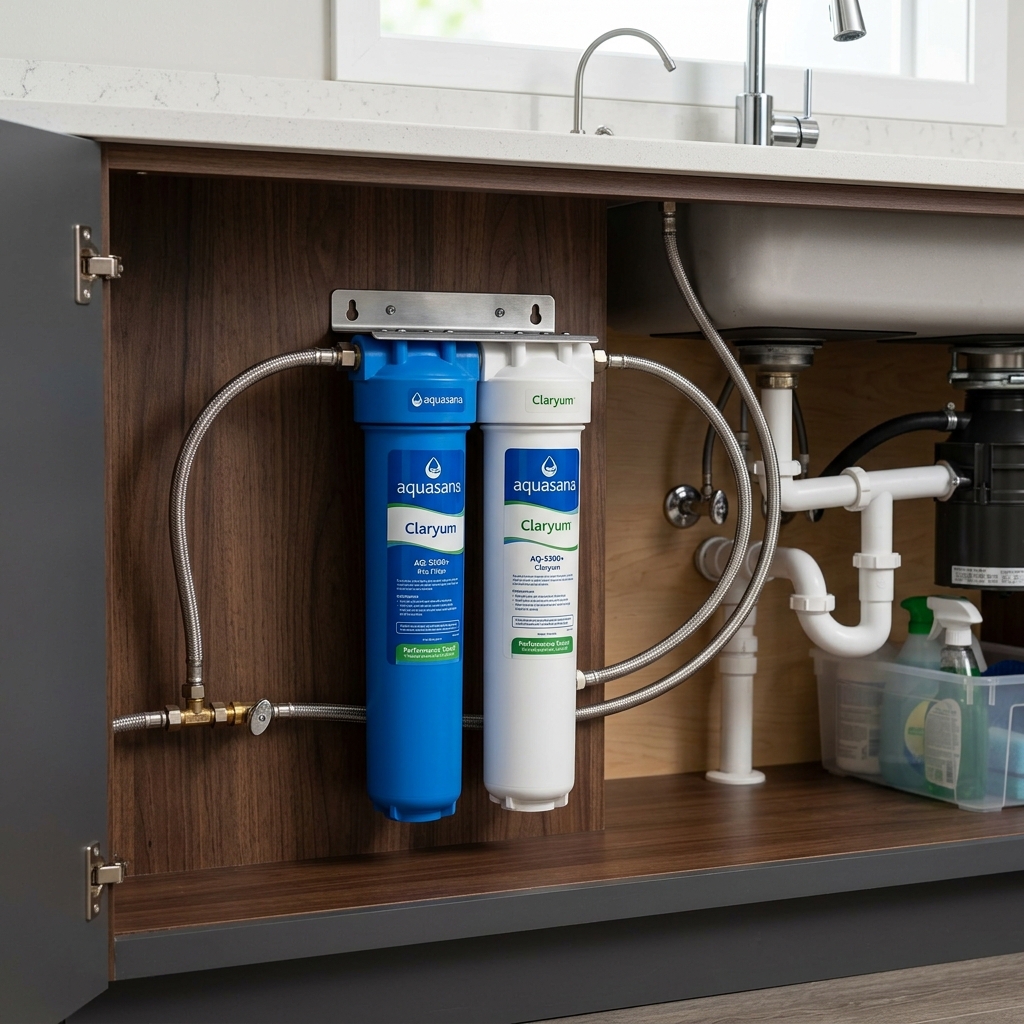
Aquasana Claryum Direct Connect AQ-MF-1
$110 to $180 price range
Aquasana AQ-MF-1 is the strongest one-tap catalog choice for a household that wants normal faucet flow and broader certified chemical claims. Its exact performance sheet records 96.06% overall free-chlorine reduction and ties the result to a 1.5 GPM system.
- Treatment
- Direct-connect carbon-based filtration on the cold-water line
- Chlorine evidence
- IAPMO-certified NSF/ANSI 42 free-chlorine result with 96.06% overall reduction
- Service basis
- 784 gallons or 6 months, whichever comes first
- Setup
- 1.5 GPM rated flow, existing faucet, cold-water line, no drain and no power
Capacity example. At 2 gallons per day for drinking and cooking, 784 gallons equals about 392 days. The 6-month limit arrives first, so plan on two replacement cartridges per year.
Sale-stopping flaw. Every cold-water gallon through the kitchen faucet uses capacity, even when chlorine reduction is unnecessary. The unit also leaves showers and other taps untreated.
The claim boundary comes from the Aquasana Claryum Direct Connect AQ-MF-1 performance record.

For professionally planned whole-home coverage
Aquasana Rhino EQ-1000 Whole-House Filter
$1,000 to $1,400 price range
Aquasana Rhino EQ-1000 is the catalog choice when the actual goal is free-chlorine reduction at showers, laundry, and every tap. The performance table reports 92.82% reduction at the 1,000,000-gallon sample point, which is more informative than a headline percentage without an endpoint.
- Treatment
- Point-of-entry carbon and KDF treatment with prefiltration and postfiltration
- Chlorine evidence
- Independent NSF/ANSI 42 test table ending at 92.82% free-chlorine reduction after 1,000,000 gallons
- Service basis
- Main tank rated for 1,000,000 gallons or 10 years; prefilters and postfilters need separate service
- Setup
- 7 GPM rated flow, one-inch plumbing, bypass valves, drain-down space, and professional installation
Capacity example. At 300 gallons per day, 1,000,000 gallons equals about 9.1 years. That estimate assumes every gallon crosses the treatment train and does not override the 10-year limit or the shorter prefilter and postfilter schedules.
Sale-stopping flaw. The 7 GPM rated flow can be undersized for a large home with several fixtures running together. Whole-home disinfectant removal can also support more germ growth in downstream plumbing, so maintenance and household risk matter.
The claim boundary comes from the Aquasana Rhino EQ-1000 Whole-House Filter performance record.
The cost and workload do not scale together
A larger system can have a long media-tank claim and still need frequent prefilter service. A small pitcher can be cheap to buy and consume several cartridges per year. The examples below use stated model limits, not a promise of household performance.
| Option | Planning range | First likely limit | Work the headline misses |
|---|---|---|---|
| Refrigerated pitcher overnight | No filter purchase | Only practical for free-chlorine taste | Clean, refill, chill, then cover the pitcher |
| Brita Elite | $35 to $60 system range | 120 gallons at moderate to high use | Batch refills and cartridge tracking |
| Aquasana AQ-MF-1 | $110 to $180 system range | 6 months at 2 gallons daily | Cold-line installation and twice-yearly cartridge work |
| Aquasana Rhino EQ-1000 | $1,000 to $1,400 system range | About 9.1 years at 300 gallons daily | Plumbing labor, a 2-month or 6-month prefilter by configuration, and a 6-month postfilter |
Whole-home flow needs a fixture calculation
The Rhino's 7 GPM rated flow is not the same as its higher peak-flow number. Three WaterSense showerheads at 2.0 GPM plus a 1.5 GPM kitchen faucet total 7.5 GPM. EPA says WaterSense showerheads use no more than 2.0 GPM, while standard showerheads can use 2.5 GPM.
Count fixtures that can run together, measure service-line pressure, and size to the continuous rated flow. A large house that regularly exceeds 7 GPM needs another design or a documented parallel arrangement, not faith in a peak number.
The label must name the actual claim
NSF lists chlorine, taste and odor, chloramine, and particulates among the optional NSF/ANSI 42 claims. Certification applies to claims named for the exact system, not every claim that the standard can contain.
| Wording on the record | What it supports | What it does not prove |
|---|---|---|
| Certified for free-chlorine reduction | The exact system met the chlorine test conditions through rated service | Chloramine, disinfection byproducts, germs, or use beyond the listed capacity |
| Certified to NSF/ANSI 42 | Only the Standard 42 claims named in the listing | Every aesthetic claim offered by the standard |
| Independent NSF/ANSI 42 test | Performance under the reported method, flow, challenge, and endpoint | Ongoing product certification or factory-surveillance scope unless separately stated |
| Activated carbon media | A treatment mechanism that commonly reduces free chlorine | Finished-system performance at the advertised flow and service life |
A chlorine result is not a byproduct result
Residual chlorine can be measured as the disinfectant still present in water. Disinfection byproducts form when disinfectants react with organic or inorganic material. A system can reduce free chlorine without proving reduction of trihalomethanes, haloacetic acids, or the hundreds of other compounds researchers study.
The AQ-MF-1 performance sheet separately lists a 99.4% VOC surrogate result under NSF/ANSI 53. That evidence is useful because the claim is separate. The VOC filter guide explains surrogate testing and whole-home exposure limits. Do not treat a Standard 42 chlorine percentage as a substitute.
Products that miss this job
Several catalog products can reduce chlorine in some circumstances, but they are poor chlorine-only recommendations or lack the exact evidence needed for a top pick.
The base iSpring WGB32B lacks a finished-system chlorine percentage
The model uses one sediment cartridge and two carbon blocks, and iSpring lists a 15 GPM peak flow plus 100,000-gallon service claim. The current exact-model record does not provide a finished-system chlorine certification or endpoint table comparable with the Rhino. The iSpring WGB32B review and exact model limits show why media identity alone did not earn a recommendation.
Reverse osmosis is excessive for chlorine taste alone
RO systems add a drain stream, more stages, tighter pressure requirements, and higher service cost. Their carbon prefilters protect the membrane and may reduce chlorine, but an RO badge is not automatically a free-chlorine claim. Use the reverse osmosis comparison only when dissolved contaminants justify the added treatment.
A shower filter does not cover drinking water
A shower cartridge treats one shower at hot-water flow and temperature. It cannot replace a kitchen-tap filter or whole-home system. The shower filter chlorine guide compares exact NSF/ANSI 177 and manufacturer test boundaries for that narrower job.
A chlorine strip cannot prove broad contaminant removal
A strip can help compare free or total chlorine before and after a filter when used correctly. It says nothing about lead, PFAS, nitrate, microbes, or byproducts. Each target needs its own method and exact-model evidence.
The shortest decision path
Three questions narrow the purchase without pretending that the most expensive system is best.
- 1. Does the utility use free chlorine?If no or unknown, stop. Confirm the disinfectant. Use the chloramine guide when the report names chloramine.
- 2. Is taste at the drinking glass the only complaint?Try the refrigerated-pitcher method first. Choose Brita Elite when a filter is more convenient or other exact Elite claims also matter.
- 3. Do you need one tap or every tap?Choose AQ-MF-1 for the main kitchen faucet. Price and size a whole-home carbon system only when shower, laundry, appliance, or building-wide treatment justifies the plumbing and microbial-management burden.
Questions about chlorine water filters
What is the best water filter for chlorine?
For chlorine taste in drinking water, start with a pitcher or exact-model NSF/ANSI 42 chlorine claim. Brita Elite is the low-cost choice here, while Aquasana AQ-MF-1 provides 1.5 GPM service from the kitchen faucet. Whole-home carbon only makes sense when showers, laundry, or downstream equipment also need treatment.
Does NSF/ANSI 42 certification mean a filter removes chlorine?
Only when the exact model and replacement element list a chlorine-reduction claim. NSF/ANSI 42 covers several optional aesthetic claims, so the standard number alone does not prove every claim within the standard.
Will a chlorine filter remove chloramine too?
Not necessarily. Free chlorine and chloramine are separate performance claims. Check the utility report and require the exact word chloramine in the product listing or performance sheet when chloramine is the disinfectant.
Can I remove chlorine by leaving water in the refrigerator?
Free chlorine can dissipate from a clean uncovered pitcher left in the refrigerator overnight. This no-purchase method is for taste and odor, not an active advisory, and it does not work the same way for persistent chloramine.
Is a whole-house chlorine filter safe?
It can be appropriate, but removing disinfectant before water enters household plumbing removes residual protection too. CDC warns that more germs may grow in plumbing after whole-home disinfectant removal. Maintain the system, avoid oversizing claims, and seek professional advice for medically vulnerable occupants.
Does chlorine reduction prove that a filter removes disinfection byproducts?
No. A chlorine taste-and-odor claim under NSF/ANSI 42 does not establish trihalomethane, haloacetic acid, or broad VOC reduction. Those need their own exact-model evidence, such as a named NSF/ANSI 53 VOC surrogate claim.
Match the treatment boundary to the complaint
The filter finder can narrow the format after you confirm free chlorine. Compare pitcher capacity and refill work, under-sink installation choices, or whole-home flow and maintenance limits before paying for broader coverage.