Product buying guide
SpringWell CF Whole House Filter Review
Buy the SpringWell CF, usually $1,100 to $2,200 before installation, when treated city water has a chlorine or chloramine problem, your measured peak flow fits one of its three sizes, and you accept manufacturer evidence instead of an exact finished-system certification.
Skip it for untreated well water, hard-water softening, germs, or any health contaminant that needs a certified model claim. The sales page names PFAS and other chemicals, but a list of targets does not prove the result for your inlet level, flow, and service life.
Best fit
Treated city water with disinfectant taste or odor
Main strength
9, 12, and 20 GPM size choices with light routine service
Stop the sale
No exact evidence for the measured problem
Check the water and the house first
Open the utility's current Consumer Confidence Report through the EPA. Confirm the disinfectant and any detected contaminant before paying for a tank. A chlorine complaint, a chloramine result, and a PFAS result call for different proof.
Water source
The base CF line is built for treated city water. A private well needs a laboratory report and a treatment train selected from it.
Measured problem
Name chlorine, chloramine, sediment, or the exact chemical. A taste complaint alone cannot establish a health claim.
Household demand
Add the fixtures and appliances that can run together. Use their labels or a measured flow, not bathroom count alone.
Installation limits
Confirm 25 to 80 psi, pipe size, protected floor space, tank height, bypass access, and room below the housing.
Upkeep and budget
Plan a prefilter every six to nine months, finished-water checks, and labor for any leak or media replacement.
Desired outcome
Choose whole-home carbon for a whole-home chemical or disinfectant job, not for hardness or microbial safety.
A renter, a home with no safe main-line service area, or a household concerned only about drinking water should skip a point-of-entry tank. The under-sink filter guide keeps treatment at one faucet, which often costs less and leaves the disinfectant in the rest of the plumbing.
How this review was built
Check which CF size fits your home’s water use and the job you need it to do. Include installation, replacement parts and service work in the budget.
Knappe coauthored a 2026 AWWA Water Science study on PFAS removal by granular activated carbon. It found that dissolved organic matter changed carbon use rates and service life. The work did not test the SpringWell CF or a residential tank, so it cannot supply a CF reduction percentage. It does show why one gallon rating cannot prove PFAS life across unlike water. The Water Research Foundation and North Carolina Policy Collaboratory funded the study, and the authors declared no conflicts.
Affiliate disclosure: We may earn from qualifying purchases. Price ranges are planning budgets, not live offers.
The verdict fits one clear job
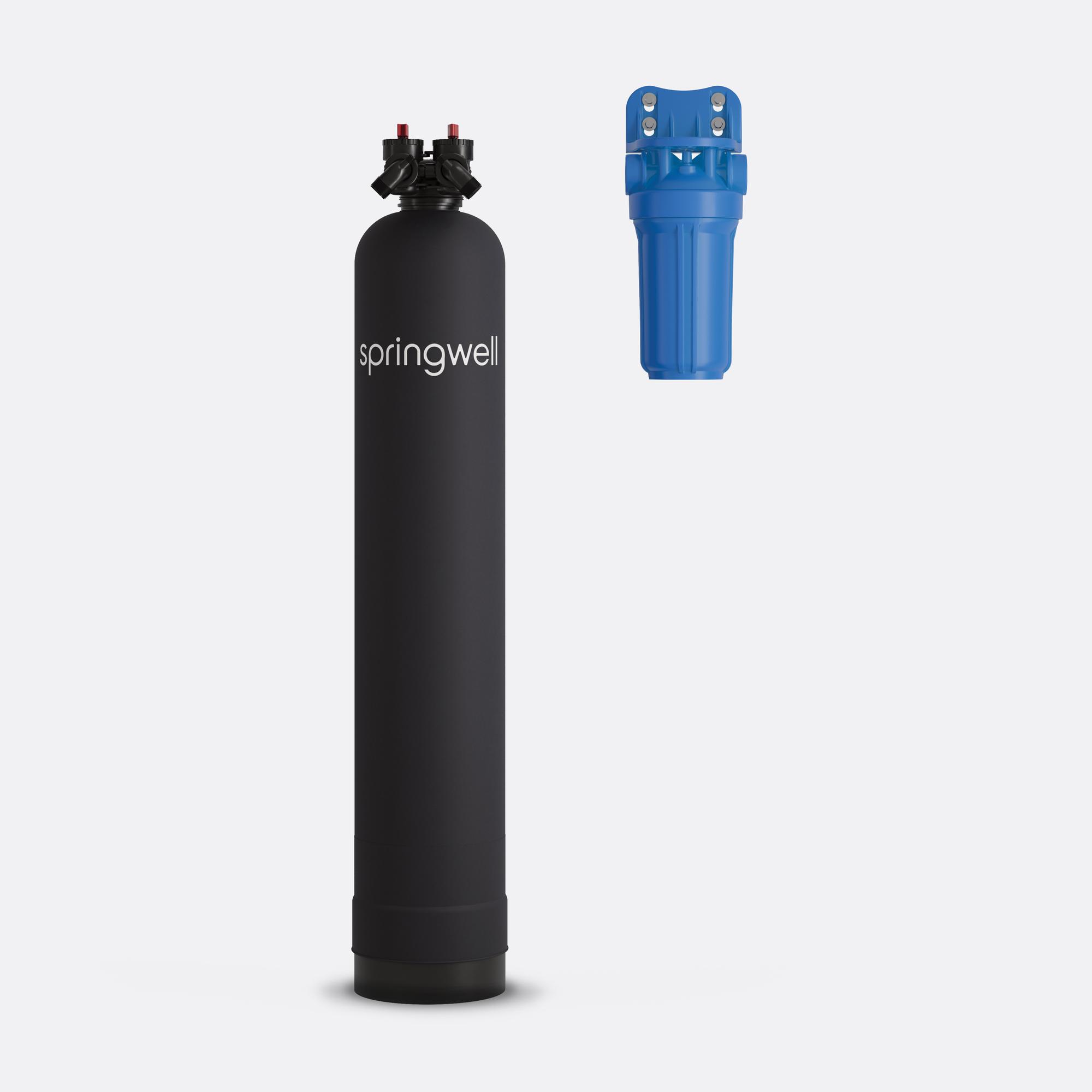
For city-water homes that value flow and low routine service
SpringWell CF Whole House Water Filter
$1,100 to $2,200 planning range before installation
- Media
- Catalytic carbon and KDF listed by maker
- Sizes
- CF1, CF4, and CF+
- Service flow
- 9, 12, or 20 GPM on product page
- Pressure
- 25 to 80 psi
- Utilities
- No power or treatment drain
- Routine service
- 5-micron filter every 6 to 9 months
Why it earns a qualified recommendation. The current SpringWell CF product record lists three service-flow sizes, catalytic carbon, KDF, no power, and a 1,000,000-gallon capacity. That combination can fit a city-water home that wants treatment at every tap without frequent large-cartridge changes.
What keeps it from an open recommendation. The same page names chlorine, chloramine, PFAS, PFOA, and PFOS but gives no model-specific challenge level, finished-water result, test flow, or certifier listing for those claims. The live NSF drinking-water directory lets buyers match an exact model to an exact certified claim. No such listing number appears in SpringWell's current CF page or manual.
Sale-stopping flaw. Do not buy it for a health claim unless SpringWell supplies current exact-model evidence that covers your contaminant, inlet level, flow, and useful life. Finished-water testing is the uncommissioned way to check the result after installation.
The claim ledger shows the evidence gap
A media type tells you how treatment may work. It does not tell you the finished concentration at your flow. Keep each claim inside the boundary of its evidence.
| Claim | Current support | Buying meaning |
|---|---|---|
| Chlorine and chloramine | Maker performance guarantee for six years or 1,000,000 gallons | Useful promise, but no public challenge level, endpoint, or test flow |
| PFAS, PFOA, and PFOS | Names appear on the product page | No exact reduction percentage or service-life curve for the CF series |
| No pressure drop | Maker statement beside 9 to 20 GPM sizing | No pressure-loss curve is published, so measure before and after installation |
| Sediment | Supplied 5-micron filter sits after the tank in the manual | Heavy incoming sediment may need a separate upstream plan |
| Microbial safety | Product page says not to use on microbiologically unsafe water | The CF is not a disinfection system |
The chlorine guide separates free-chlorine evidence from broad carbon claims. The chloramine guide explains why catalytic carbon still needs enough contact time. A confirmed PFAS result needs the tighter model-level check in the PFAS filter guide.
The six-year and ten-year records conflict
The product page gives every CF size a 10-year or 1,000,000-gallon media limit. The linked CF1, CF4, and CF+ installation manual says six years or 1,000,000 gallons. The SpringWell performance guarantee also says six years or 1,000,000 gallons for chlorine and chloramine.
The gallon math can end the service period first
200 gallons a day
1,000,000 gallons lasts about 13.7 years. A six- or ten-year time limit arrives first.
300 gallons a day
1,000,000 gallons lasts about 9.1 years. The gallon limit beats a ten-year claim.
400 gallons a day
1,000,000 gallons lasts about 6.8 years. The six-year document conflict now changes the plan.
Each example divides 1,000,000 gallons by the stated daily use and 365 days. It assumes steady use and says nothing about contaminant breakthrough.
Get the controlling revision in writing. Treat the earlier applicable limit as the budget date until SpringWell resolves the conflict for your serial number and purchase terms.
Choose the size from peak use
SpringWell puts CF1 at 9 GPM for one to three bathrooms, CF4 at 12 GPM for four to six, and CF+ at 20 GPM for seven or more. The manual still lists CF4 at 11 GPM, so a buyer near that boundary needs a written answer.
| Model | Product-page flow | Tank and connection | Best fit |
|---|---|---|---|
| CF1 | 9 GPM | 9 inches wide, 52 inches with head, 1-inch connection | Measured peak stays below 9 GPM with pressure margin |
| CF4 | 12 GPM | 10 inches wide, 58 inches with head, 1-inch connection | Busier home that needs more than CF1 and resolves the 11 versus 12 GPM conflict |
| CF+ | 20 GPM | 13 inches wide, 58 inches with head, 1.5-inch connection | Large demand with plumbing sized to use the added flow |
Two WaterSense showerheads can each use up to 2.0 GPM. Add a 1.5 GPM bathroom faucet and the example reaches 5.5 GPM before a washer, dishwasher, hose, or third shower starts. Replace every example number with the labels and measured flow in your home.
Do not place a 20 GPM tank on a narrow 1-inch service and expect the label to rewrite the plumbing. Ask the installer for static pressure, pressure while fixtures run, peak flow, pipe size, and expected loss across the complete layout.
The installation needs more than open floor
The current manual calls for a 48-hour carbon soak before the final install, then a flush in both directions until the water runs clear. It shows the carbon tank first and the 5-micron housing after it. It also recommends a three-valve bypass when the optional tank bypass is not used.
Space
Allow for 52 to 58 inches of installed tank height, overhead work room, and clearance below the filter housing.
Pressure
The stated operating range is 25 to 80 psi. Record pressure while the household draws water, not only when every fixture is closed.
Plumbing
CF1 and CF4 use 1-inch connections. CF+ uses 1.5-inch connections. Unions and a serviceable bypass reduce future labor.
Protection
Keep the system away from freezing, direct sun, impact, and any floor where a leak cannot drain safely.
Ask the quote to name the bypass, unions, shutoff, pressure gauges, pipe support, grounding parts for metal plumbing, leak plan, flush time, and labor warranty. A low equipment price cannot pay for water damage.
Maintenance stays light only when it happens
At the stated six-to-nine-month schedule, ten years means about 14 to 20 sediment-filter changes. A $30 to $60 yearly cartridge plan adds about $300 to $600 over ten years before labor and tax. Dirty water or a pressure drop can shorten the interval.
CDC warns that removing disinfectant at the point of entry can let more germs grow in household plumbing. Replace the filter on time, wear gloves during service, wash hands afterward, and do not treat the CF as a cure for unsafe source water.
A pressure gauge before and after the system gives the household a useful service signal. A paired source and finished-water test gives the contaminant result. Neither is sold through this page.
These problems need another answer
The CF can be a good carbon tank and still be the wrong purchase. Match the tool to the measured job.
- Hardness. The CF leaves calcium and magnesium in the water. The hard-water guide separates true softening from scale control.
- Untreated well water. Iron, manganese, sulfur, bacteria, pH, and sediment need a test-led plan. The well-water guide starts with the laboratory report.
- A buyer who needs an exact chlorine test. The SpringWell CF and Aquasana Rhino comparison shows the trade between SpringWell's flow range and Aquasana's published EQ-1000 chlorine record.
- Microbial risk. A carbon tank is not a boil-water response and does not replace validated disinfection selected for the source and peak flow.
Questions buyers ask
Which SpringWell CF size fits a three-bathroom home?
The maker places the 9 GPM CF1 in the one-to-three-bathroom group, but bathroom count is only a shortcut. Add the flow of fixtures and appliances that can run together. Move up only when measured peak demand, pipe size, pressure, and the installer plan support it.
Why does the SpringWell CF manual show the sediment filter after the carbon tank?
The current manual sends water through the carbon tank first, then through the 5-micron sediment housing. The maker says that housing catches particles after the tank. A home with unusual incoming sediment should ask SpringWell and the installer whether separate upstream pretreatment is needed.
Does the SpringWell CF need electricity or a drain?
No power or treatment drain is listed for the base CF system. It still needs a main-line plumbing cut, a supported bypass, room to service the housing, a 48-hour carbon soak, and flushing before use.
How often does the SpringWell CF prefilter need replacement?
SpringWell lists six to nine months. Sediment load and pressure loss can force an earlier change, so calendar time should not be the only signal. Keep a pressure record before and after the system.
Can the SpringWell CF make hard water soft?
No. Carbon filtration does not remove the calcium and magnesium that make water hard. A measured hardness problem needs a separate treatment choice, usually ion exchange when the goal is soft water.
What should a buyer get in writing before ordering?
Ask for the document revision that controls CF4 service flow, the main-media time limit, the exact contaminant evidence for the selected model, the warranty terms, and an installed quote that names the bypass, unions, gauges, support, and labor coverage.