Product buying guide
SpringWell WS Well Water Filter Review
Buy the SpringWell WS, usually $2,000 to $3,000 before installation, only when a current well test shows iron, hydrogen sulfide, or manganese within the maker's limits and the pump can support the backwash demand.
Skip it for untested water, bacteria, hardness, nitrate, arsenic, PFAS, or any result outside the approved chemistry. The current sales page and linked manual also disagree on flow, connection size, and minimum pH, so a written model sheet should be a condition of the sale.
Best fit
A tested private well with a matching iron, sulfur, or manganese problem
Main strength
Automatic air injection and backwash with no oxidant refill
Stop the sale
No written approval or not enough pump flow for backwash
Test the water and the pump first
Private wells are not monitored like public systems. The CDC calls for yearly tests for total coliforms, nitrate, total dissolved solids, and pH, plus local contaminants and any problem suggested by a change in taste, color, or smell. A WS decision also needs iron, manganese, hardness, turbidity, and an on-site hydrogen sulfide result.
Water source
Use a state-certified laboratory for the private well. A stain or odor can guide testing, but it cannot measure the load or prove the water is safe.
Measured problem
Record iron and manganese in mg/L, pH, hardness, turbidity, bacteria, and sulfur odor. Ask how dissolved and visible particles were sampled.
Household demand
Add the fixtures and appliances that can run together. Service flow and backwash flow are separate checks.
Installation limits
Confirm 25 to 80 psi, protected floor space, an outlet, a safe drain, bypass access, and a pump that can sustain backwash.
Upkeep and budget
Budget the test, installation, electricity, backwash water, drain work, annual retesting, and repairs to the valve or media bed.
Desired outcome
Name the job as stain control, sulfur-odor control, lower manganese, or a treatment train. The WS is not a universal well-water filter.
A renter, a home with a weak well pump, or a household with only a drinking-water concern should skip this large point-of-entry system. The well-water treatment guide matches equipment to the full laboratory report. The iron-filter guide compares backwashing tanks with cartridge limits.
How this review was built
Use a well-water test to check whether the WS fits your iron, manganese and sulfur needs. Confirm pump flow, backwash drain capacity and service work before ordering.
Lytle and colleagues reported a pilot treatment train in Environmental Science: Water Research & Technology. Aeration followed by granular filtration reduced iron and manganese by 98 to 99 percent in one Iowa groundwater system after the process settled in. EPA funded the work, and all authors listed an EPA affiliation. The pilot used an EPA-patented process and named AdEdge media, which is relevant institutional and commercial context. The study used biological treatment and a public-water pilot, not a SpringWell WS. It shows that oxygen, water chemistry, filter loading, and start-up behavior matter. It does not prove a WS percentage.
Affiliate disclosure: We may earn from qualifying purchases. Price ranges are planning budgets, not live offers.
The verdict is conditional
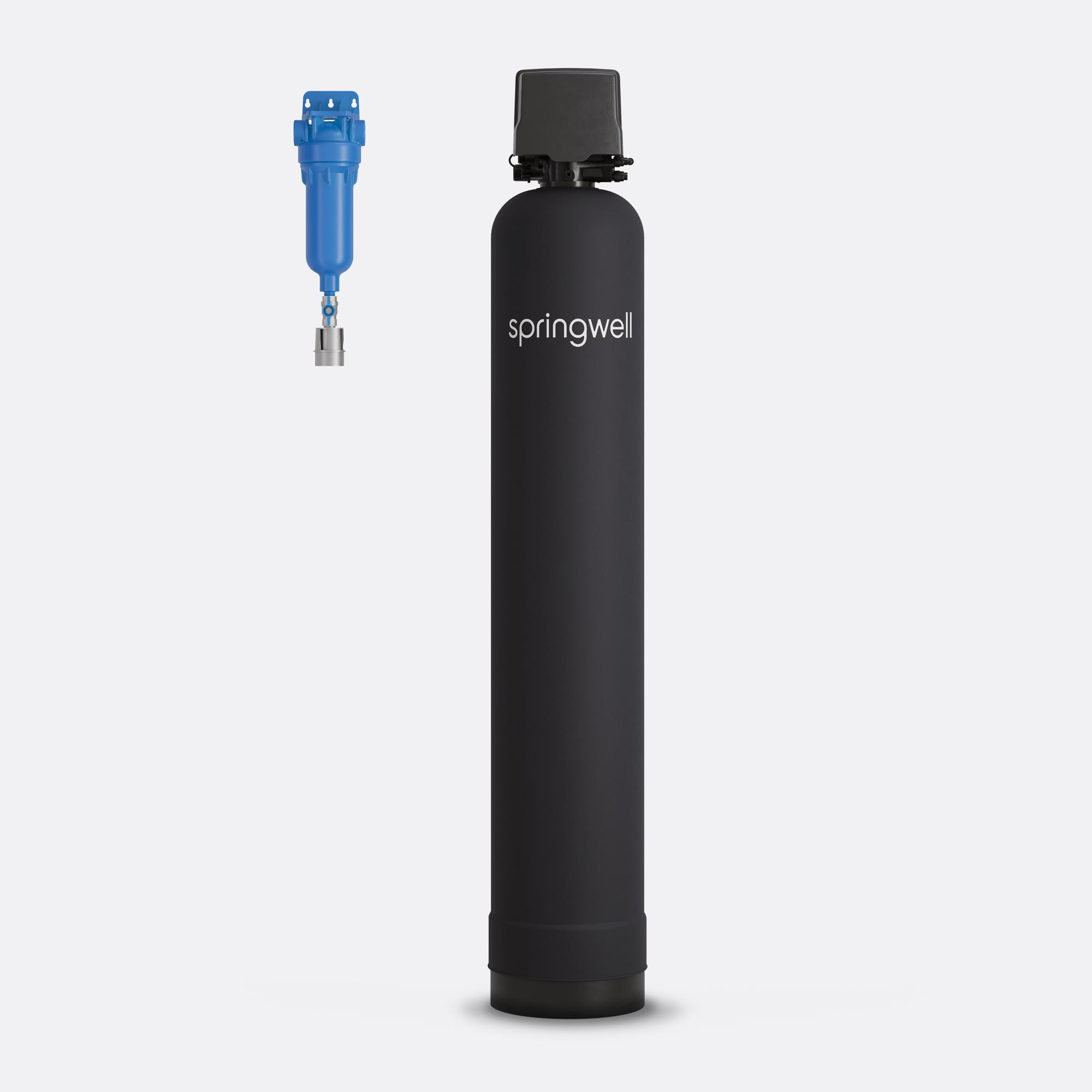
For a tested and compatible private well
SpringWell WS Whole House Well Water Filter
$2,000 to $3,000 planning range before installation
- Process
- Air injection, oxidation, media filtration, and backwash
- Maker limits
- 7 ppm iron, 8 ppm hydrogen sulfide, 1 ppm manganese
- Models
- WS1 and WS4 on current technical table
- Service flow
- 12 or 20 GPM on current technical table
- Utilities
- Power and anchored Schedule 40 PVC drain
- Backwash
- 5 or 7 GPM in linked manual
Why it earns a qualified recommendation. The current SpringWell WS product page requires a water test and describes air injection, greensand fusion media, and automatic backwash. That design avoids disposable iron cartridges and chemical refills for a compatible well.
What keeps it from an open recommendation. The reduction ceilings are maker claims without a linked challenge concentration, finished-water result, test flow, useful-life endpoint, or exact certifier listing. The current WQA directory explains that listed products have passed testing and ongoing factory review. SpringWell's WS page does not name such a listing.
Sale-stopping flaw. The sales page and manual conflict on several numbers that control sizing. Do not order until SpringWell identifies the exact model, head, connection, pH floor, service flow, backwash rate, warranty terms, and approved test results in writing.
The evidence has a firm boundary
Air oxidation can turn dissolved metals and sulfur into particles that a media bed can catch. Actual removal still changes with pH, dissolved oxygen, metal form, organic matter, flow, and bed condition.
| Claim | Current support | Buying meaning |
|---|---|---|
| Iron up to 7 ppm | SpringWell product-page claim | Do not apply it above 7 ppm or without finished-water testing |
| Hydrogen sulfide up to 8 ppm | SpringWell product-page claim | Measure at the site because the dissolved gas can escape during shipping |
| Manganese up to 1 ppm | SpringWell product-page claim | The inlet ceiling is not a promised finished concentration |
| 10-plus-year media life | SpringWell product-page claim | No public gallon load, breakthrough curve, or replacement trigger is linked |
| Bacteria and other contaminants | No WS treatment claim | Use separate treatment selected from the complete well report |
EPA's secondary guidelines list 0.3 mg/L iron and 0.05 mg/L manganese for taste, color, and staining concerns. Manganese can also be a health concern. The Minnesota Department of Health advises 100 micrograms per liter or less when an infant drinks the water or formula made with it. The manganese treatment guide separates the health target from the stain target.
The current documents disagree
The current page and its linked WS1 and WS4 installation manual do not describe the same hardware. The page also shows a generic three-size guide even though its technical table and selector show two WS models.
| Item | Current product page | Linked manual |
|---|---|---|
| WS1 service flow | 12 GPM in technical table | 12 GPM |
| WS4 service flow | 20 GPM | 18 GPM |
| Connection size | 1 inch | 3/4 inch |
| pH range | 6.5 to 10 | 6.8 to 10 |
| Backwash rate | Not in the public technical table | 5 GPM WS1 and 7 GPM WS4 |
| Control | Bluetooth control advertised | Older button setup with no Bluetooth instructions |
A newer head or plumbing kit could explain part of the mismatch. That is an inference, not proof. Ask SpringWell to send the manual and performance terms that match the exact unit in the cart. Make the installed quote use the same model and revision.
Backwash sets the real pump requirement
Service flow tells how much treated water can leave the tank. Backwash flow tells how much raw water the pump must deliver to lift and clean the media. A 20 GPM service label does not prove the well can feed a 7 GPM backwash at usable pressure.
The old manual implies a large nightly water event
WS1 example
5 GPM for the 14-minute backwash step equals 70 gallons. This excludes the listed 40-minute air-draw step and one-minute rapid rinse.
WS4 example
7 GPM for the 14-minute backwash step equals 98 gallons. This also excludes the other cycle steps.
Each example multiplies the linked manual's backwash rate by its 14-minute backwash setting. It is not a total regeneration-water claim. The current product page says backwash occurs each night, so confirm the delivered programming and total discharge before sizing a drain or septic plan.
Ask the installer for a sustained pump-flow test at the treatment location, pressure before and during flow, pressure-tank drawdown, drain route, and local discharge rules. A marginal pump can leave the bed dirty, send stains downstream, and shorten useful life.
Water chemistry can stop the system
The University of Georgia explains that oxidizing filters turn dissolved iron, manganese, and hydrogen sulfide into solids and remove them by filtration. Its oxidizing-filter guide says pH, oxygen, media choice, and backwash demand control performance. It also warns that iron-bacteria slime can clog the filter and calls for raw and treated water tests once or twice each year.
Low pH
Stop below the written approved floor. Neutralization may need to come first, and it changes flow, space, and upkeep.
Iron or sulfur bacteria
Slime can foul the well and treatment bed. Source cleaning or disinfection may be needed before ordinary oxidation filtration.
Positive coliform or E. coli
Use a safe alternate source and follow health-department advice. The WS is not disinfection.
Hardness
The WS does not remove calcium and magnesium. Add true softening only when the test and desired result justify it.
Turbidity and particles
Visible solids can load the bed. The manual places sediment or neutralizing treatment before the WS.
Other health contaminants
Nitrate, arsenic, PFAS, lead, radon, and pesticides need their own exact evidence and treatment plan.
A positive microbial test belongs in the bacteria treatment decision path. A high hardness result needs its own softening decision. Do not turn one WS tank into evidence for either job.
The install order needs a complete plan
The manual places the WS after sediment filters or acid neutralizers and before softeners or chlorinators. That order can fit ordinary particulate control and low-pH pretreatment. It may not fit a well that needs chemical oxidation or source disinfection ahead of filtration. A treatment professional should draw the whole train from the test results.
- Leave height and service room. Both tanks are listed at 54 inches plus a 10-inch head, for 64 inches total before overhead work space.
- Anchor the drain. The manual calls for Schedule 40 PVC because air is released during regeneration.
- Stagger other cycles. The manual says to separate this backwash from another system's backwash by at least two hours.
- Protect the equipment. Keep the tank above freezing, near a grounded outlet, and where a leak or drain failure will not damage the home.
- Add sample points. Raw and treated taps make paired tests possible without guessing what the system changed.
Heavy grit or cloudy water needs the separate particle-size and source checks in the sediment filter guide.
Plan ownership around tests and discharge
The WS has no routine cartridge stack or salt refill. That does not make it maintenance-free. The control valve needs power and correct time settings. The media bed needs full backwash flow. The drain needs to stay open. Raw and treated water need repeat tests.
| Ownership item | Planning assumption | Failure signal |
|---|---|---|
| Water testing | Full test before purchase, annual safety panel, paired target tests after install | Finished iron, manganese, or odor returns |
| Backwash | Delivered schedule and rates confirmed in writing | Weak drain flow, persistent stains, or media carryover |
| Power and controls | Protected outlet and correct clock after outages | Missed cycle or backwash during household use |
| Media and valve | No fixed annual number can be supported from the public records | Breakthrough, pressure loss, leaks, or noisy valve operation |
| Drain and septic | Installer checks local rules and daily hydraulic load | Overflow, backup, erosion, or septic stress |
A useful quote separates equipment, freight, plumbing, power, drain work, pretreatment, startup tests, annual service, and future media or valve work. The advertised media-life statement cannot replace a written breakthrough trigger.
Some named alternatives fail this job
The iSpring WGB32BM cartridge specifications cap iron at 3 ppm and do not establish an 8 ppm hydrogen sulfide job. It can be a lower-cost fit for lighter, compatible water, but cartridge pressure loss and replacement work grow with the particle load.
The SpringWell CF city-water filter specifications cover a different product and source. A carbon tank built for treated city water is not a substitute for oxidation and backwash on an iron-bearing well.
A water softener can handle limited dissolved iron under some maker conditions, but iron particles and bacterial slime can foul resin. Do not buy a softener as the default iron tank, and do not buy the WS to make hard water soft.
Who should buy and who should skip
Buy after written approval
- Iron, hydrogen sulfide, or manganese falls inside every approved limit.
- The pump sustains the exact backwash rate with pressure margin.
- Power, drain capacity, floor space, and service access are ready.
- The treatment plan matches your test results, and you will retest treated water.
Skip or redesign
- The water report is missing, old, or does not include bacteria and pH.
- Any target exceeds the maker ceiling or pH misses the approved range.
- The well cannot support the backwash rate or the drain cannot accept the load.
- Your real problem is hardness, nitrate, arsenic, PFAS, radon, or germs.
The uncommissioned recommendation is a state-certified laboratory report and an independent installer who can test pump delivery, draw the treatment order, and provide performance targets in writing. That work can prevent a poor $2,000 to $3,000 purchase.
Questions to put in the quote
- Which exact WS model and control head are approved for the attached raw-water report?
- Which service flow, connection size, pH floor, backwash rate, and manual revision control this order?
- What finished iron, manganese, and hydrogen sulfide results are guaranteed, and at what flow?
- What raw-water conditions void that guarantee or require pretreatment?
- Can the well and pressure tank sustain the full cycle without starving the home?
- What total water reaches the drain per cycle, and how often will the delivered controller run it?
- Who pays for diagnosis, labor, freight, media, and valve work if paired tests miss the target?
Frequently asked questions
Will the SpringWell WS remove iron, sulfur, and manganese?
SpringWell claims treatment up to 7 ppm iron, 8 ppm hydrogen sulfide, and 1 ppm manganese. Those are manufacturer limits, not a public exact-model certification result. Buy only after a current water test, written model approval, and a plan to retest the treated water.
Does the SpringWell WS kill bacteria?
No. Air injection and backwashing media are not a substitute for disinfection. A positive coliform or E. coli result needs health-department guidance, source repair where possible, and a separate disinfection plan.
How much well-pump flow does the SpringWell WS need?
The linked manual lists a 5 GPM backwash rate for WS1 and 7 GPM for WS4. The well and pressure tank must sustain the required rate at the treatment location. Ask the installer to measure delivery flow and pressure instead of relying on the service-flow label.
What pH does the SpringWell WS require?
The current product page lists pH 6.5 to 10, while the linked manual lists 6.8 to 10. Treat 6.8 as the safer planning floor unless SpringWell approves the exact water report and model in writing. Manganese removal can need more favorable chemistry than iron removal.
Does the SpringWell WS soften hard water?
No. It targets the maker-listed iron, sulfur odor, and manganese problems. Calcium and magnesium hardness need a separate softener when true soft water is the goal.
What should stop the SpringWell WS purchase?
Stop if there is no current laboratory report, bacteria are present or untested, any target exceeds the maker limit, pH is below the approved range, the pump cannot supply backwash, or the site lacks power, a safe drain, pressure, and service space.