Treatment order guide
Water Filter Before or After a Softener?
Put a whole-house filter before the softener when it removes sediment, chlorine, iron, or manganese that could foul or age the softener. Put a drinking-water filter at one sink after the softener.
That rule has limits. A softener removes hardness. It does not make unsafe water safe, and an ordinary carbon or sediment filter does not prove bacteria removal. Start with the water source, a current test, and the manuals for the exact equipment.
Most city-water homes
Carbon or sediment filter, then softener
Tested iron or manganese
Oxidation and filtration, then softener
Drinking-water filter
After whole-house treatment at the chosen tap
Use the measured problem to set the order
The EPA WaterSense softener guide says a whole-house filter for chemicals or sediment generally belongs before the softener. It also says the softener belongs before the water heater and after any branch for water that does not need softening, such as irrigation.
The order should make each stage do one job while protecting the next stage. It should also keep peak flow, pressure loss, drains, outlets, bypass valves, and service space within the written limits.
| Measured problem | Usual first stage | Why it comes first | Stop or change the plan when |
|---|---|---|---|
| Sand, silt, or rust particles | Sediment control | Keeps particles out of the softener valve and resin | A small cartridge clogs fast or cuts pressure |
| City chlorine or chloramine | Exact-claim carbon filter | Treats the disinfectant before hardness exchange | The model lacks the needed claim or peak flow |
| Oxidized iron or manganese | Oxidation and filtration | Prevents captured solids from fouling softener resin | Pump or drain cannot support backwash |
| Hardness | Softener after needed pretreatment | Removes calcium and magnesium before the water heater | Hardness does not justify the salt, water, or drain work |
| Lead, PFAS, nitrate, or another drinking concern | Exact-claim filter at the tap when appropriate | Keeps the health claim tied to drinking and cooking water | Whole-home exposure or the source needs a different plan |
| Bacteria | Source repair and validated treatment plan | Pretreatment order must support disinfection | A positive result has not been cleared by the proper authority |
City water usually puts filtration first
A city-water plan often follows this path.
Step 1
Meter and main shutoff
Step 2
Outdoor branch
Step 3
Carbon or sediment filter
Step 4
Water softener
Step 5
Water heater and home
The carbon stage must match the actual disinfectant. A broad carbon claim is not proof of chloramine or every chemical on a utility report. The chlorine filter guide compares exact evidence and flow, while the softener answers a separate hardness question.
SpringWell's current city-water combo manual shows its carbon tank before its salt softener. The CSS installation sequence is model-specific evidence, not a universal diagram for every brand. A plumber still needs to plan the outside-water branch, bypasses, unions, pressure checks, and service clearances.
Well water needs a test-led treatment train
Private-well water can have hardness, dissolved iron, oxidized iron, manganese, sulfur odor, sediment, low pH, bacteria, nitrate, or several problems at once. Odor and stain color do not set the order. The EPA tells well owners to test yearly for total coliform bacteria, nitrate, total dissolved solids, and pH, then add local and symptom-led tests.
Penn State water specialist Bryan Swistock has spent more than 30 years on water-resource research and education. His university biography lists his environmental-health and pollution-control training. Penn State's iron and manganese guidance warns that oxidized particles can foul softener resin and that using the resin bed as a mechanical filter is generally not advised.
A common tested-well path is pressure tank, suitable sediment control, iron or sulfur treatment when needed, softener, then any validated final treatment required by its own manual. The well-water buying guide starts with the laboratory panel. The iron-filter guide matches concentration, form, pH, and backwash supply to the equipment type.
SpringWell follows that logic in its WSSS package. The WSSS manual puts air-injection oxidation and filtration before ion-exchange softening. That order does not prove the bundle fits every well. The test, pump, pressure tank, drain, peak demand, pH, and treatment limits still control the sale.
Point-of-use filters usually come after softening
A pitcher, faucet filter, under-sink carbon filter, or reverse osmosis system treats water where people drink and cook. It usually receives water after whole-house treatment. That keeps the small filter focused on a named drinking-water goal instead of using its capacity on showers, toilets, and laundry.
A softener does not remove most health contaminants. The CDC says to test the water and choose a filter for the harmful germ or chemical of concern. A point-of-use model needs an exact reduction claim for that target. It also needs feed pressure, temperature, and hardness within its own limits.
A softener can lower scale load on an RO membrane, but it adds sodium in place of calcium and magnesium. RO placement still depends on the exact manual, and an active boil-water or do-not-drink notice takes priority over shopping.
Bacteria changes the whole plan
A positive bacteria result is not a filter-order puzzle. Stop the equipment sale and follow the health department or well professional's response. Source repair, shock disinfection, repeat testing, or a validated point-of-entry treatment may be needed.
Carbon can remove a disinfectant residual, and a softener is not a disinfectant. The bacteria treatment guide explains UV dose, pretreatment, flow, power, and monitoring. If UV is chosen, it normally sits after the stages needed to meet the UV unit's iron, manganese, hardness, turbidity, and transmittance limits.
How this guide judged buyer fit
The guide weighs water source, measured problem, treatment evidence, peak demand, pressure loss, pump and drain needs, installation, upkeep, budget, and the condition that stops the sale. PureWater Filter Finder did not install or laboratory-test these treatment trains.
Purdue professor Andrew Whelton leads the Center for Plumbing Safety. A peer-reviewed Environmental Science & Technology study by his team found that residential softener resins changed chlorine decay and released material during startup. The study did not compare filter order or test SpringWell. It supports flushing new equipment and treating plumbing water quality as more than a hardness number.
No numerical score is published. Exact pressure loss, treatment capacity, regeneration water, salt efficiency, and finished-water evidence are incomplete across the possible equipment pairs. Missing evidence cannot be turned into a trustworthy score.
Match an existing product to one job
The products below are examples for three different plans. They are not a universal package. A certified laboratory test and a plumber's site plan are the non-commissioned first choice when the order is still unclear.
Affiliate disclosure: We may earn from qualifying purchases. The comparison method and evidence limits explain how products qualified. These planning ranges are not live offers.
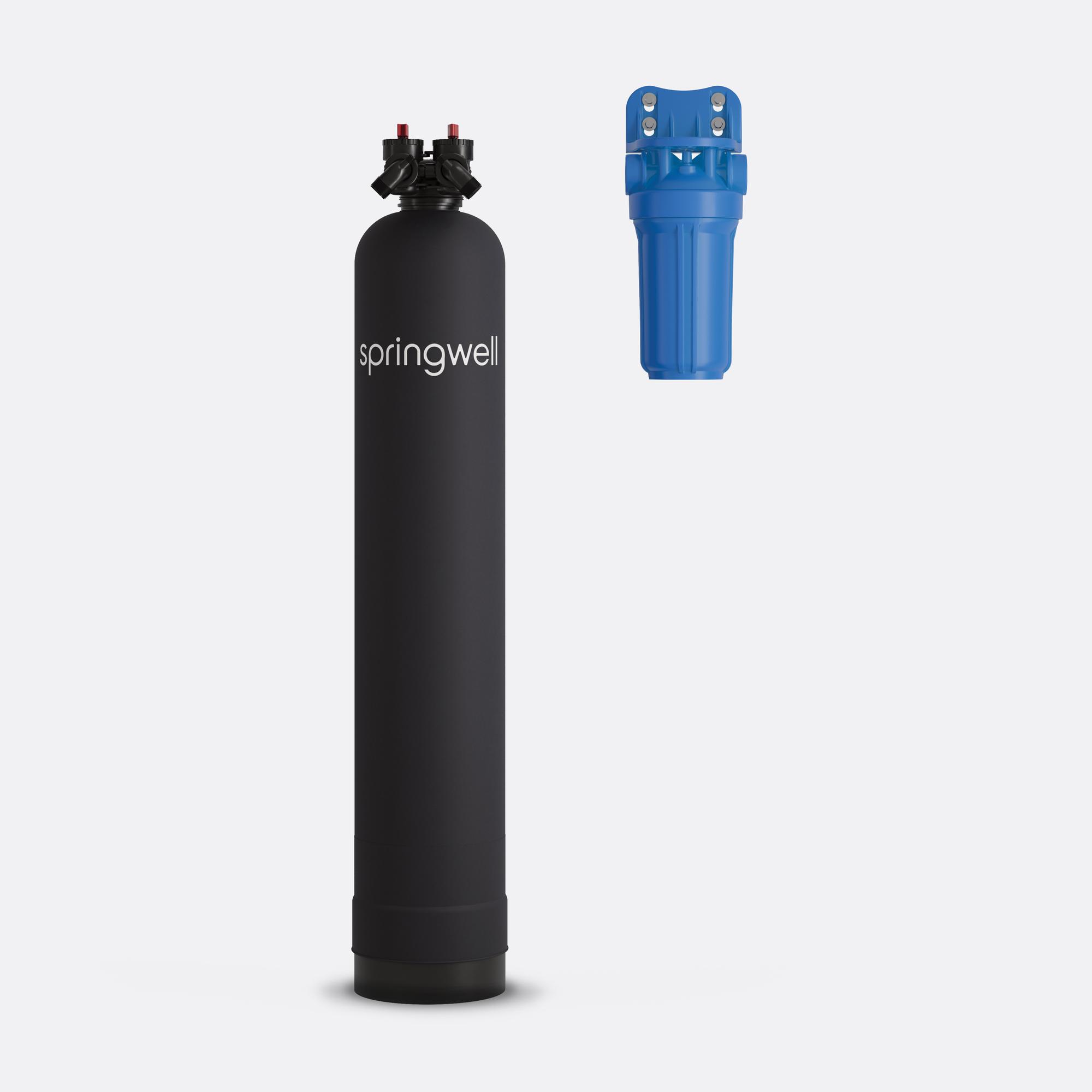
City-water filtration stage
SpringWell CF
$1,100 to $2,200 planning range
Use before a softener only when treated city water, the named chemical goal, peak flow, and current manual fit. It does not soften water or disinfect it.
Stop the sale. Do not use the CF as an iron filter for untreated well water or as proof for an exact health claim it does not document.
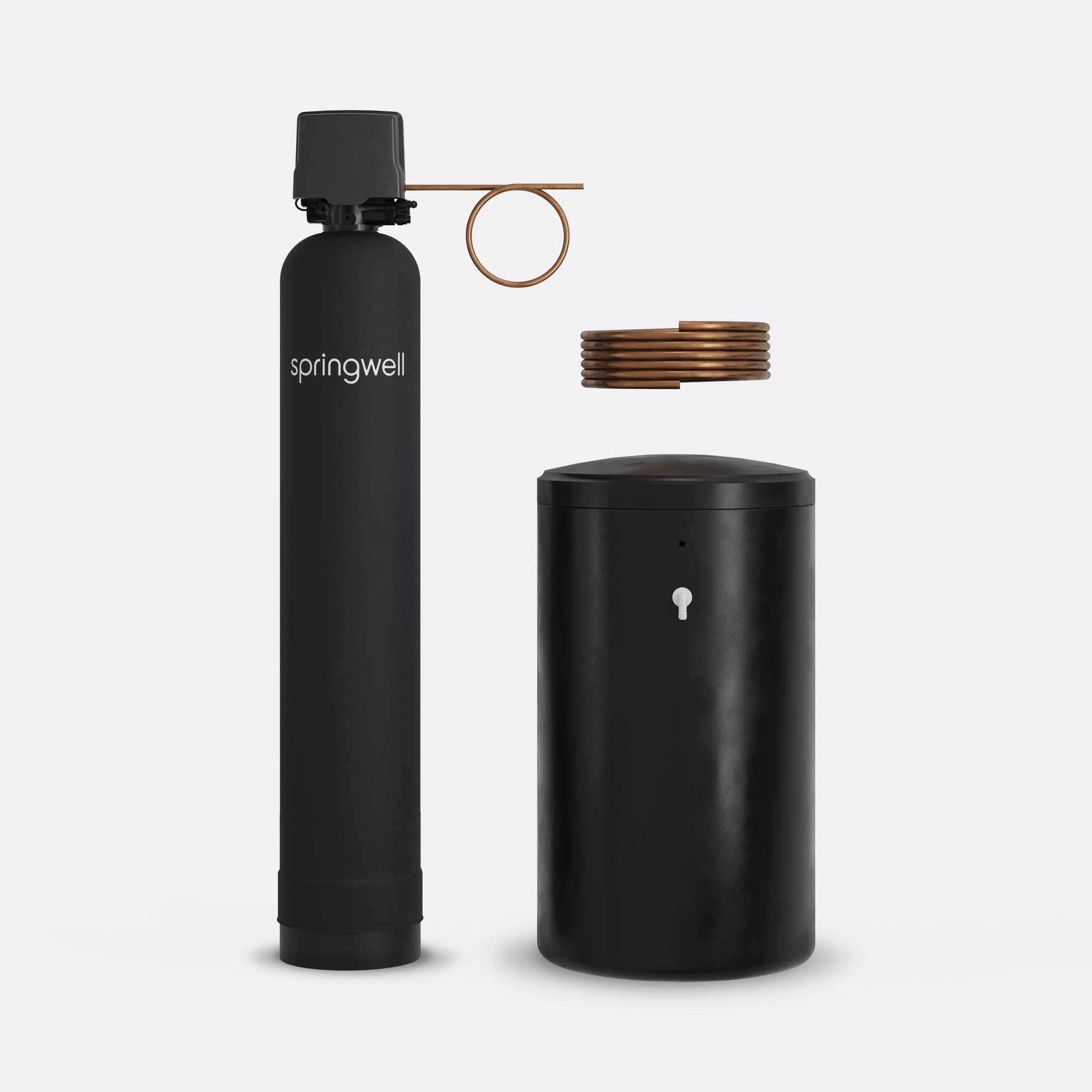
Hardness stage
SpringWell SS
$1,500 to $2,500 planning range
Use after needed pretreatment when measured hardness justifies true ion exchange and the home can support salt, power, regeneration, and a drain.
Stop the sale. The product page does not publish model-level salt efficiency or regeneration-water use, and the current records disagree on connection size.
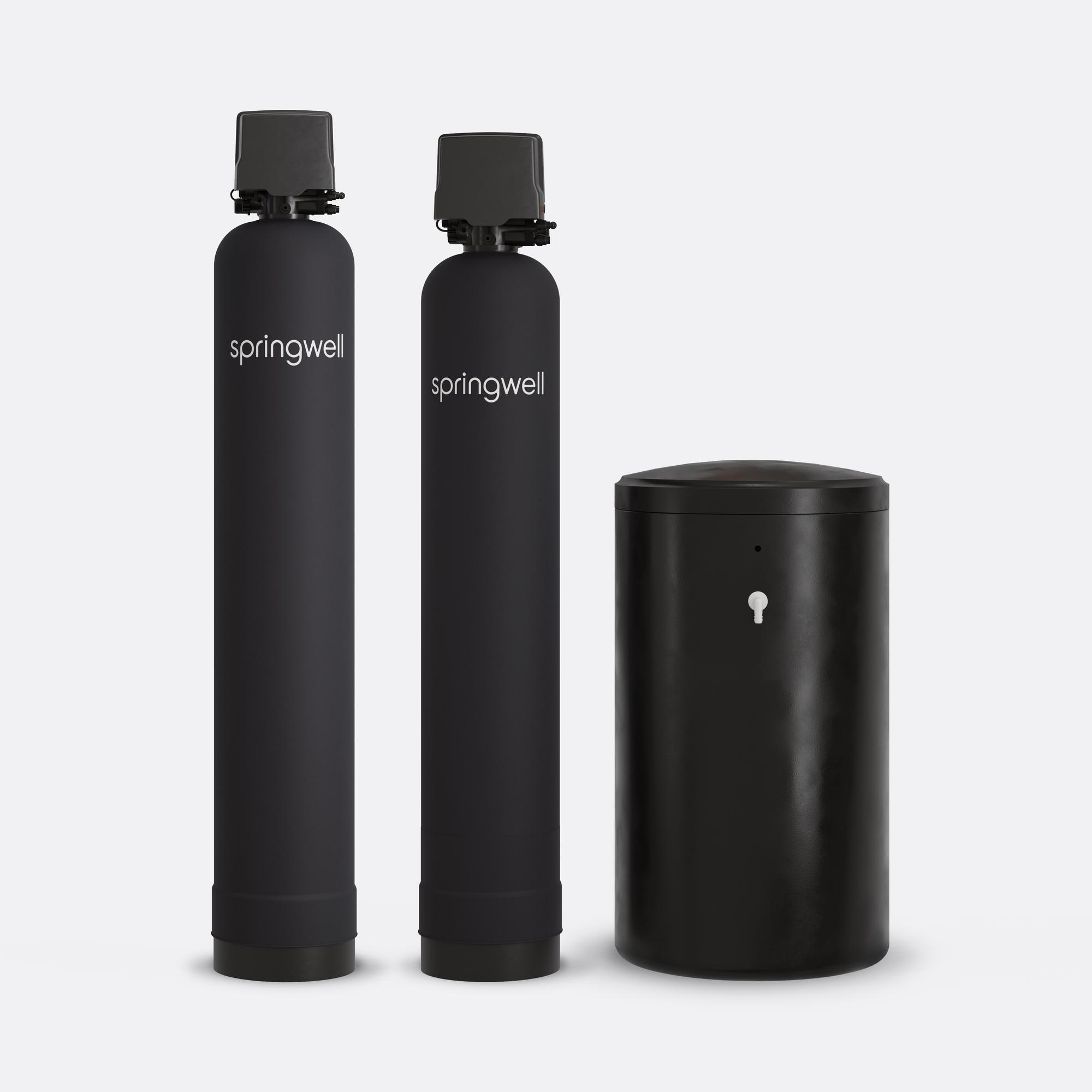
Tested well-water train
SpringWell WSSS
$3,100 to $5,000 planning range
Use only when the test supports both the WS oxidation stage and the SS softener. The lower stage flow, well pump, drain, and three-vessel footprint must fit.
Stop the sale. Skip the bundle when either tank lacks a measured job, bacteria is unresolved, or the well cannot sustain backwash.
Do not buy these products for the wrong job
A sediment cartridge for dissolved hardness
A particle filter does not remove calcium and magnesium. The hard-water guide separates true softening from scale control.
A softener for oxidized iron solids
Resin is not a substitute for the right oxidation and filtration stage. The result can be fouling, pressure loss, and more service work.
A city carbon tank for unsafe well water
A CF-style carbon system does not prove bacteria, nitrate, arsenic, or private-well iron treatment. Test the well and build a treatment train from the results.
A softener as a drinking-water purifier
Hardness removal does not establish lead, PFAS, nitrate, pesticide, or germ reduction. Match a separate exact-model claim to the measured concern.
Check the room before ordering equipment
Water source
City report or current certified well test, plus the exact contaminant and concentration.
Household demand
Add fixtures and appliances that can run together, then compare the lowest stage flow.
Pump supply
A well must sustain the backwash rate without losing safe pressure or draining the pressure tank.
Drain and air gap
Plan each backwash, regeneration, brine overflow, and legal discharge route.
Space and service
Leave room for bypasses, unions, heads, filter changes, salt bags, and tank replacement.
Finished-water check
Add sampling points and verify that each stage does its intended job after startup.
Questions buyers ask
Should a whole-house water filter go before or after a softener?
A whole-house filter that removes sediment, chlorine, iron, or manganese usually goes before the softener so it protects the resin. A drinking-water filter at one sink usually goes after the softener. The exact order must follow the water test and both product manuals.
Does a sediment filter go before a water softener?
A correctly sized sediment stage normally goes before a softener when particles could foul the valve or resin. Heavy sediment may need a spin-down screen, settling, source repair, or a backwashing filter instead of a small cartridge that clogs quickly.
Does an iron filter go before or after a water softener?
An oxidation and filtration system for iron or manganese normally goes before the softener. Oxidized particles can foul softener resin. A softener may handle limited dissolved iron only when its maker allows the measured level and water chemistry.
Should a carbon filter go before a water softener?
A whole-house carbon filter for city-water chlorine or chloramine usually goes before a softener. That order can protect resin and keeps the carbon treatment job separate from hardness removal. Confirm the exact manuals, flow, and replacement plan.
Does reverse osmosis go before or after a water softener?
A point-of-use reverse osmosis system normally receives water after whole-house softening. The softener can reduce hardness load on the membrane, but the RO manual still controls inlet limits, pressure, drain setup, and prefilter needs.
Where does UV treatment go with a water softener?
UV is commonly placed after the pretreatment needed to meet its limits, which may include iron, sediment, hardness, or turbidity treatment. The exact UV manual and a microbial treatment plan control the order. A softener does not disinfect water.
What should stop a filter and softener purchase?
Stop when there is no current water test, the problem is not defined, bacteria or another health concern remains untreated, peak flow or backwash supply is too low, the drain is unsuitable, the manuals conflict, or there is no room for bypasses and service.
Match the order to your water
Write down the source, test result, peak flow, pump supply, drain limits, and treatment goal before choosing tanks. The filter finder can narrow the format after those facts are clear.