Private-well treatment comparison
Calcite Neutralizer vs Soda Ash Injection
Choose calcite for mild, steady acidity that fits the tank's written range and choose professionally dosed soda ash when pH is lower or changes enough that a fixed media bed cannot hold the target.
Do not buy either system from a pH strip or stain color. Neither choice disinfects a well, removes every dissolved contaminant, repairs damaged plumbing, or proves that lead and copper at the tap are safe.
Choose calcite when
Acidity is mild, chemistry is steady, and 7 GPM backwash is available
Choose soda ash when
pH is lower or variable and added calcium hardness is a poor fit
Stop both sales when
There is no lab panel, written target, or post-treatment test plan
Start with six buying facts
The EPA private-well testing guidance calls for annual checks of pH, total dissolved solids, nitrate, and total coliform bacteria. A neutralizer design needs more detail. Order pH, alkalinity, calcium hardness, total hardness, conductivity or TDS, iron, manganese, copper, and lead. Add the routine bacteria and nitrate panel plus local risks.
Water source
This comparison is for a private well. Public-water customers should contact the utility before changing whole-house corrosion chemistry.
Measured problem
Use pH with alkalinity, hardness, calcium, metals, dissolved solids, and a corrosion or saturation index when the lab can report one.
Household demand
List fixtures that run together and measure the well pump's sustained delivery. Calcite service flow and backwash flow are separate gates.
Installation limits
Confirm pipe size, pressure, power, drain route, tank clearance, chemical storage, sample ports, and safe service access.
Upkeep and budget
Compare media checks and backwash with solution mixing, pump parts, calibration, and the cost of follow-up laboratory work.
Desired outcome
Set a finished pH, alkalinity, hardness, and corrosion goal. A neutral reading on a strip is not a complete treatment target.
The University of Georgia's 2026 private-water bulletin treats neutralizing media and soda-ash feed as separate whole-house choices. It favors a neutralizing filter when acidity is the only problem, while noting that chemical feed may fit when iron, manganese, or disinfection also shapes the treatment train.
Compare the two systems side by side
| Decision point | Calcite neutralizer | Soda ash injection |
|---|---|---|
| Best fit | Mild, fairly steady acidity inside the exact model range | Lower or changing pH that needs an adjustable chemical dose |
| Chemistry change | Adds calcium, alkalinity, and hardness as media dissolves | Adds carbonate alkalinity and sodium without adding calcium hardness |
| Hydraulic limit | Needs enough service flow and, for a backwashing tank, enough cleaning flow | Feed pump must match well-pump operation, line pressure, water flow, and dose range |
| Space and utilities | Media tank, control head, power, bypass, and drain | Solution tank, metering pump, power, injection point, mixing or contact space, and sample taps |
| Owner work | Inspect and refill media, protect the drain, and confirm backwash | Mix and refill solution, service pump parts, prevent clogs, recalibrate, and test output |
| Main sale stopper | Inlet chemistry outside the model range or too little pump flow for backwash | No reliable dosing control, mixing, safe chemical storage, or service discipline |
Pick calcite for a narrow, stable problem
Calcite is calcium carbonate. Acidic water dissolves part of the bed, which raises pH and alkalinity and also raises calcium hardness. The process responds to water chemistry and contact time, so it is not a fixed one-point pH correction.
A peer-reviewed Journal of Environmental Engineering study by Raymond Letterman, Marwan Hadad, and Charles Driscoll tied limestone-contactor design to inlet chemistry, media size and shape, bed depth, water temperature, and flow velocity. That is why pH alone cannot size a tank or predict its finished water.
How this comparison was built
Choose between calcite and soda ash using your water-test results and the work you are willing to do. Compare changes to hardness, space, drains, refill needs and total cost.
The weakest evidence is the lack of one matched residential field trial comparing the SpringWell tank with a soda-ash design on the same well. The retail calcite record lacks an exact independent finished-pH table and pressure-loss curve. Soda ash is a site-specific treatment design, not one comparable model. Those gaps make a public numerical score misleading.
Affiliate disclosure: We may earn from qualifying purchases. Price ranges are planning budgets, not live offers.
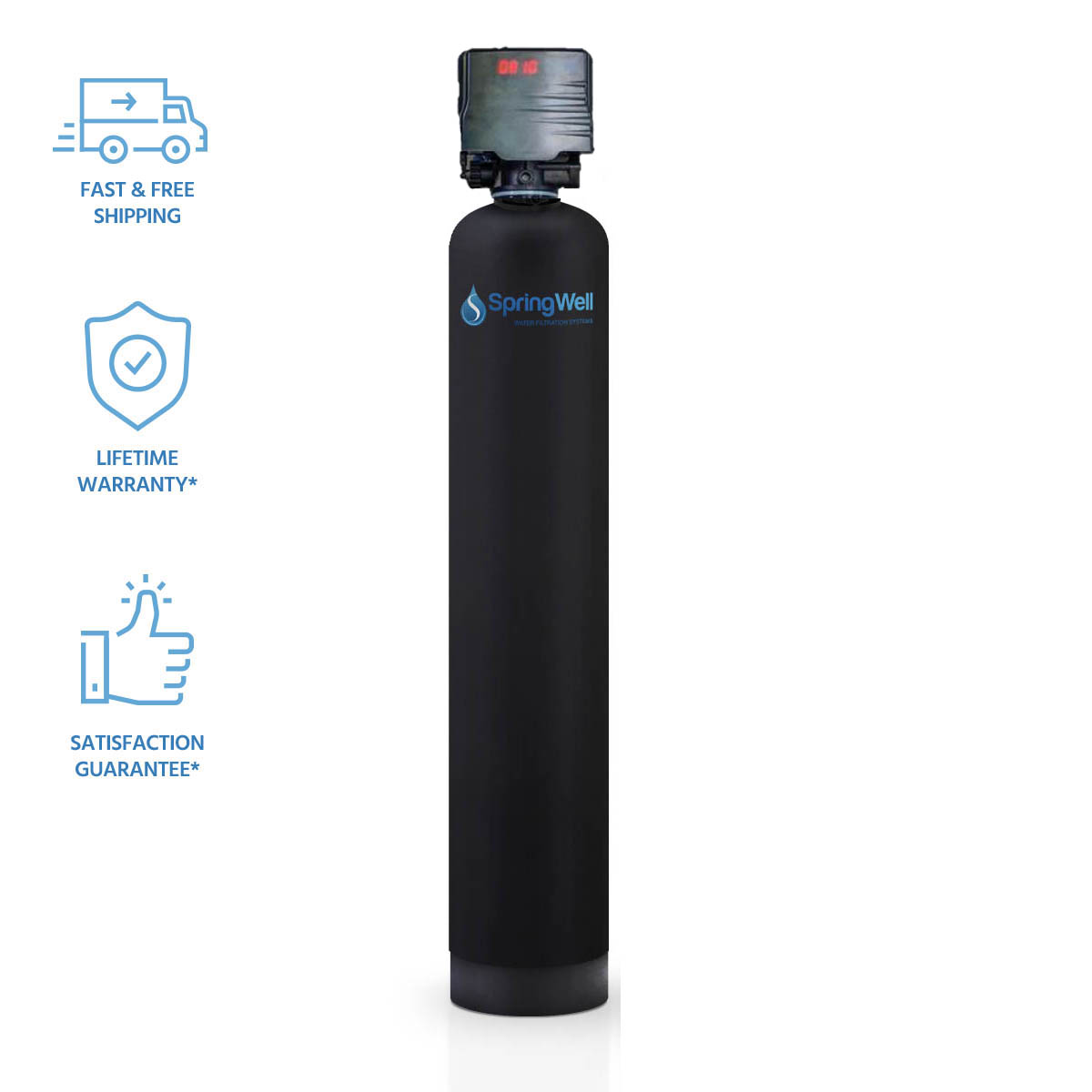
Qualified calcite choice for pH 6.0 to 6.5
SpringWell SCN1-6 Calcite pH Neutralizer
Plan $1,500 to $2,200 for the equipment before testing and installation
- Published inlet pH
- 6.0 to 6.5
- Service flow
- 12 GPM maker label
- Backwash supply
- 7 GPM
- Pressure
- 25 to 80 psi
- Tank clearance
- 13 inches wide and 63 inches high with head
- Main tradeoff
- Adds hardness and needs backwash water
Why it can fit. The current SCN1-6 product page gives a narrow inlet range plus service, pressure, tank, connection, and backwash labels. Its ordering process calls for current well-test results.
What could cost the sale. SpringWell does not publish an exact independent finished-pH table, inlet-alkalinity limit, pressure-loss curve, or media-use rate. The 7 GPM backwash demand rules out a weak well pump even when the 12 GPM service label looks adequate.
The SCN1-6 manual calls for 2.5 initial 50-pound bags, a seven-day backwash setting, and a 45-minute cycle that blocks household water use. It also gives a direct media-level inspection and refill method.
Pick soda ash for adjustable correction
Soda ash is sodium carbonate dissolved in a solution tank and delivered by a metering pump. It raises pH and alkalinity without adding calcium hardness. A dose that is too low misses the target, while a dose that is too high can push chemistry past it. The design needs the well pump rate, line pressure, water chemistry, injection control, mixing, and a sampling point.
Penn State's corrosive-water treatment guidance places a soda-ash feed ahead of the pressure tank, says it avoids the pressure drop and added hardness of a neutralizing filter, and warns that the solution tank and feed pump need significant maintenance. It also describes soda ash as safer to handle than sodium hydroxide, not as maintenance free.
Current complete-equipment listings provide a useful floor, not an installed quote. A 45-gallon solution-tank package is listed near $1,000, while a pump, solution tank, and mixing or retention package is listed near $1,600. Plan for roughly $1,000 to $1,800 in core hardware before design, electrical control, plumbing, sample ports, a larger contact tank, labor, and startup testing.
The non-commissioned recommendation is a local water-treatment professional who will size and calibrate the complete feed system from laboratory chemistry and measured pump flow. A generic pump-and-tank kit is not a finished treatment design.
Match the system to the house
The better system is the one the household can support after the installer leaves. Chemistry fit comes first, then pump capacity, room, service work, and budget.
Calcite earns the job when
- The certified lab shows mild, fairly steady acidity inside the exact model's feed range.
- Added calcium hardness will not create an unacceptable scale problem.
- The well can sustain service and backwash flow at usable pressure.
- The home has a code-compliant drain, nonswitched power, and space to refill media.
Soda ash earns the job when
- pH is below the available calcite unit's range or changes enough to need adjustable dosing.
- Current hardness makes more calcium a poor trade.
- The well-pump control and measured flow can drive a matched feed pump.
- An owner or service company will refill, clean, calibrate, and test the system.
Do not confuse treatment jobs
- Soda ash is not chlorine. Soda ash corrects acid chemistry. Chlorine is used for oxidation or disinfection under a different dose, contact-time, residual, and filtration plan. A shared feed design needs professional control.
- SpringWell WS1 and WS4 do not correct acidity. They target iron, manganese, and sulfur odor with oxidation and backwash. The SpringWell WS well-filter specifications do not turn those models into neutralizers.
- SpringWell SS1, SS4, and SS+ are not neutralizers. Ion exchange removes calcium and magnesium hardness. It does not correct low pH. The SpringWell SS softener review calls for low-pH pretreatment, while the hard-water treatment guide separates true softening from acidity correction.
- A metal filter does not repair plumbing. Point-of-use products may lower exposure at one tap, but whole-house corrosion still needs source and plumbing work. The copper guide explains first-draw and flushed sampling, and the lead guide covers certified point-of-use reduction.
Compare ten-year ownership without guessing
A calcite tank concentrates cost in the vessel, plumbing, drain, backwash water, and replacement media. A soda-ash system concentrates cost in the feed pump, solution tank, possible mixing or contact tank, pump tubes or check valves, chemical, and service visits. Either can be the lower-cost choice when it matches the water. Either can become expensive when it is bought for the wrong chemistry.
Ask both bidders to price the same ten lines: laboratory panel, design, equipment, installation, electrical work, drain or contact tank, startup calibration, first finished-water test, annual service, and five-year replacement parts. Leave chemicals and calcite as variable lines tied to water use and measured dose rather than accepting a universal yearly figure.
Use this decision path
- 1. Confirm the problem. If pH, alkalinity, hardness, metals, bacteria, and household flow are unknown, buy testing rather than equipment. The acidic-well-water treatment guide explains the full test panel and source checks.
- 2. Check the calcite envelope. If the chemistry fits an exact model and added hardness is acceptable, confirm pump, pressure, drain, power, and space. The SpringWell calcite review audits those gates for the SCN1-6.
- 3. Move to adjustable feed when needed. If pH is lower or variable, hardness is already high, or the well cannot backwash a media tank, get a soda-ash design with written dose range, control method, mixing, sample ports, and service steps.
- 4. Test the finished water. Check pH, alkalinity, hardness, sodium when relevant, and first-draw lead or copper when corrosion prompted the work. Repair damaged plumbing separately.
Who should skip both
Skip both when a one-time pH strip is the only evidence, the water is from a public utility, or the real problem is bacteria, nitrate, arsenic, fuel, saltwater intrusion, a failed well component, or damaged plumbing. The well-water buying guide builds treatment from the complete laboratory result instead of asking one neutralizer to solve unrelated risks.
Stop the sale if a bidder cannot state which test values chose the equipment, what finished chemistry is expected, what happens during peak flow, how the system is serviced, and when the water will be sampled again.
Questions buyers ask
Is calcite or soda ash better for very low well-water pH?
A professionally designed soda-ash feed is usually the stronger candidate when pH is well below a calcite unit's written inlet range or changes over time. The dose still must come from pH, alkalinity, pump rate, and a finished-water target. Do not choose from pH alone.
Does soda ash injection make well water hard?
Soda ash raises pH and alkalinity without adding calcium hardness the way calcite does. It adds sodium, and the amount depends on the dose. Test pH, alkalinity, hardness, and sodium after startup if sodium intake or appliance feed water matters.
Does a calcite neutralizer need a drain?
A backwashing calcite unit does. The SpringWell SCN1-6 calls for a drain and 7 GPM of backwash supply. Some non-backwashing contact tanks exist, but their sediment handling, pressure loss, media condition, and model limits need a separate review.
Can soda ash and chlorine use the same injection system?
Some university guidance describes combined chemical feed when acidity and disinfection both need treatment. That does not make soda ash a disinfectant or turn a general feed pump into a safe universal recipe. A water-treatment professional must set chemical compatibility, dose, contact time, residual checks, and downstream filtration.
How often should treated well water be retested?
Test after startup and every material adjustment, then follow the laboratory, installer, and local health authority schedule. EPA also recommends annual private-well checks for pH, total dissolved solids, nitrate, and total coliform bacteria.
What result should stop either purchase?
Stop if the laboratory panel is missing pH, alkalinity, and hardness, or if the seller will not state the finished-water target and service plan. Stop a calcite sale when pump flow or drain capacity cannot support backwash. Stop a soda-ash sale when there is no safe power, injection, mixing, sampling, or refill plan.